Sabitlenmiş Tweet
Broc Buckles
6.7K posts

Broc Buckles
@Broc_Buckles
Co-Founder | BC Brokerage | Insurance for Fee-Only Financial Planners | Fee-only advocate | Scuba Diver | Krav Maga | Podcaster | Making insurance suck less.
Indianapolis Indiana Katılım Aralık 2021
1.7K Takip Edilen1.6K Takipçiler
Broc Buckles retweetledi

#158 - From Planning Firm Employee to Solo RIA Founder: Matt Ryan's Story
A lot of advisors want to launch their own fee-only RIA, but the gap between "I'm ready" and "I have clients" can feel enormous. We're talking with Matt Ryan, CFA, CFP®, founder of Focused Mission Financial in San Diego, about how he made the leap in 2022 after nearly a decade inside planning-focused firms, and what it actually looked like to build momentum from the ground up.
We get specific about how his growth really happened: boots-on-the-ground marketing through coffees, lunches, and golf, backed by consistent touchpoints like a newsletter and short-form video. Matt also shares the truth about shiny objects, including paid lead programs like SmartAsset, and why some tactics fall flat for a solo RIA without the time and speed to follow up like a larger team.
On the client service side, Matt walks us through how his process evolved into a formal six-step onboarding system, plus what changed when he hired an operations specialist to tighten workflows. We also dig into his work with self-employed clients, including solo 401(k) planning and tax planning, and how those needs show up differently than traditional retiree households.
Finally, we talk about scaling with intention, integrating clients from a retiring advisor's book, and setting a boundary around lifestyle so growth never crowds out family time.
If you're building an advisory firm, refining your financial planning process, or trying to find marketing that fits your personality, you'll take away practical ideas you can use right away. Subscribe for more conversations like this, share the show with another advisor, and leave a review with your biggest takeaway.
Apple Podcasts:
podcasts.apple.com/us/podcast/onl…
Spotify:
open.spotify.com/episode/6idH4O…
English

#157 - From Furlough to Founder of a Fee-Only RIA - Ryan Johnson
A "backup plan" PowerPoint deck can become a real firm faster than you'd think, but the messy middle is where most people quit. Ryan Johnson, founder of Hundred Financial Planning, joins us to talk through what it actually takes to build a fee-only firm from the ground up.
Ryan shares how he found the fee-only RIA community through cold outreach, why he wanted ownership of a book of business, and what the first two years really felt like. We get into client experience, including the early mistake of overwhelming plan presentations and how he's shaping an ongoing service model that stays structured without feeling rigid.
We also dig into growth: why LinkedIn finally started generating leads, why silent followers often turn into your best prospects, his niche focus on high-earning young families, and the values-first discovery meeting that helps clients feel heard before any numbers come out. We close with AI in financial advice, where it helps, where it breaks, and why the risk of a wrong answer makes a human advisor worth the cost.
Subscribe, share with an advisor friend, and leave a review with your biggest growth question!
Apple Podcasts:
podcasts.apple.com/us/podcast/onl…
Spotify:
open.spotify.com/episode/5kpWDA…
English

One of the coolest parts of what I get to do is watching advisors grow.
Yesterday I had a conversation with an advisor whose RIA is up and running. Fired up, ready to go, figuring it out in real time. There’s something special about that energy, when someone is standing at the very beginning of something they’ve been dreaming about.
It reminded me of conversations I had years ago with advisors who are now thriving. Running real practices. Serving clients well. Hiring teams. Living the version of their career they were just hoping for back then.
It also took me back to when we were first building.
Those early days when you’re just trying to figure it out. Wondering if anyone will pick up the phone. Wondering if the idea is even going to work. Wondering if you’re crazy for trying.
Then time passes. The problems you used to lose sleep over get solved, or you grow past them. New ones take their place. Different problems. Better problems. The kind of problems you only get to have because you kept going.
I think a lot about how lucky I am to be on this side of those early days. To have people who believed in us when there wasn’t much to believe in yet. To get to watch advisors I’ve known for years step into the version of themselves they were working toward.
If you’re in the early part right now, hang in there. The problems get better. And one day you’ll get to be the person reminding someone else of that.
English

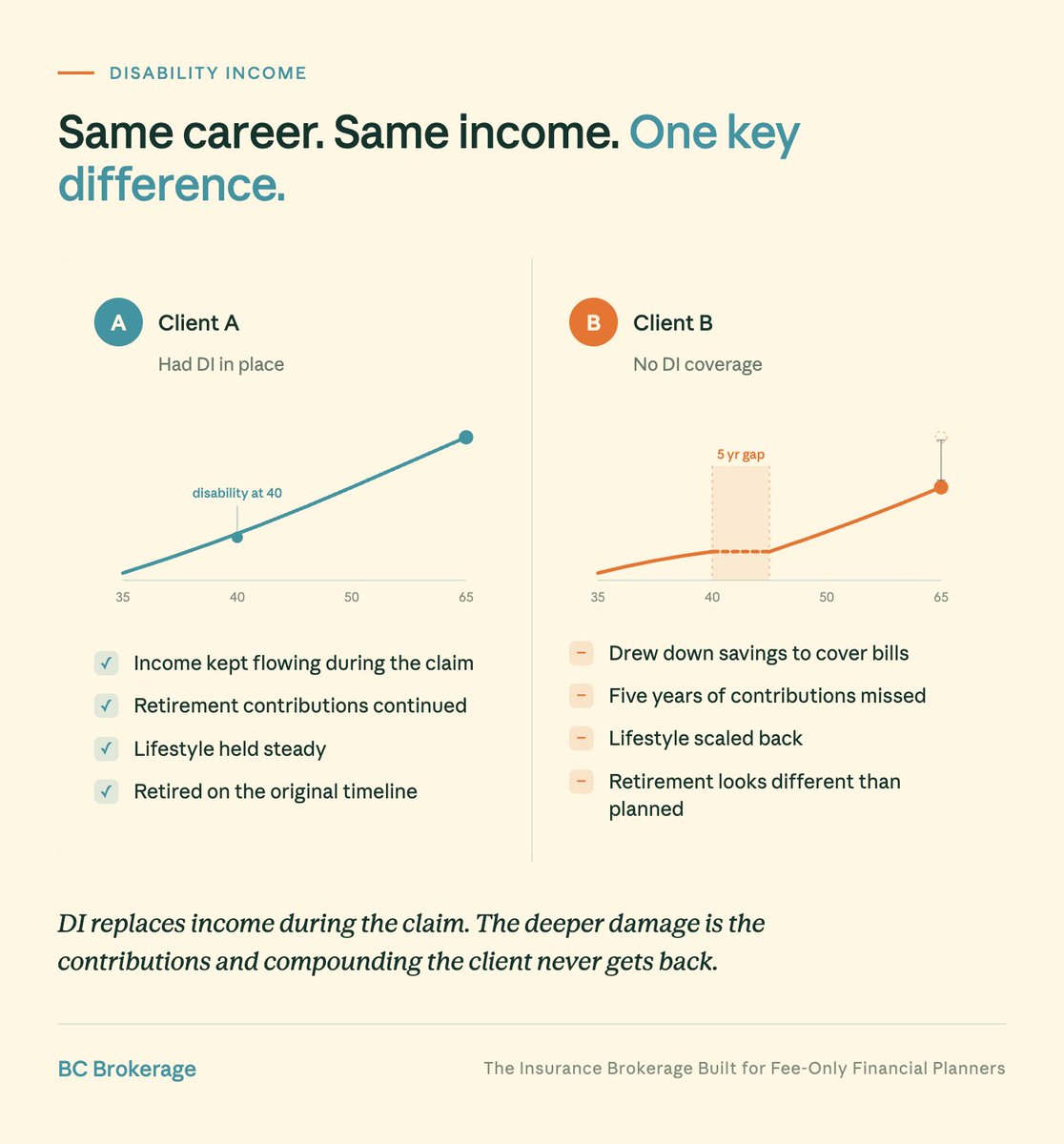
Same career. Same income. Same disability at age 40. One had disability income coverage in place.
The other didn't. Client A's paychecks kept flowing through the claim. Retirement contributions continued. Lifestyle held steady. Recovery happened on the same timeline retirement was already planned for.
Client B drew down savings to cover the bills. Five years of contributions never made it into the retirement account. The lifestyle scaled back. The retirement that eventually arrived looked different than the one originally planned for.
The income replacement during the claim is what most people focus on. The deeper impact is everything that compounds, or doesn't, in the years after.
DI is not a product conversation. It is a planning conversation about what happens to a client's trajectory when the paycheck stops.

English

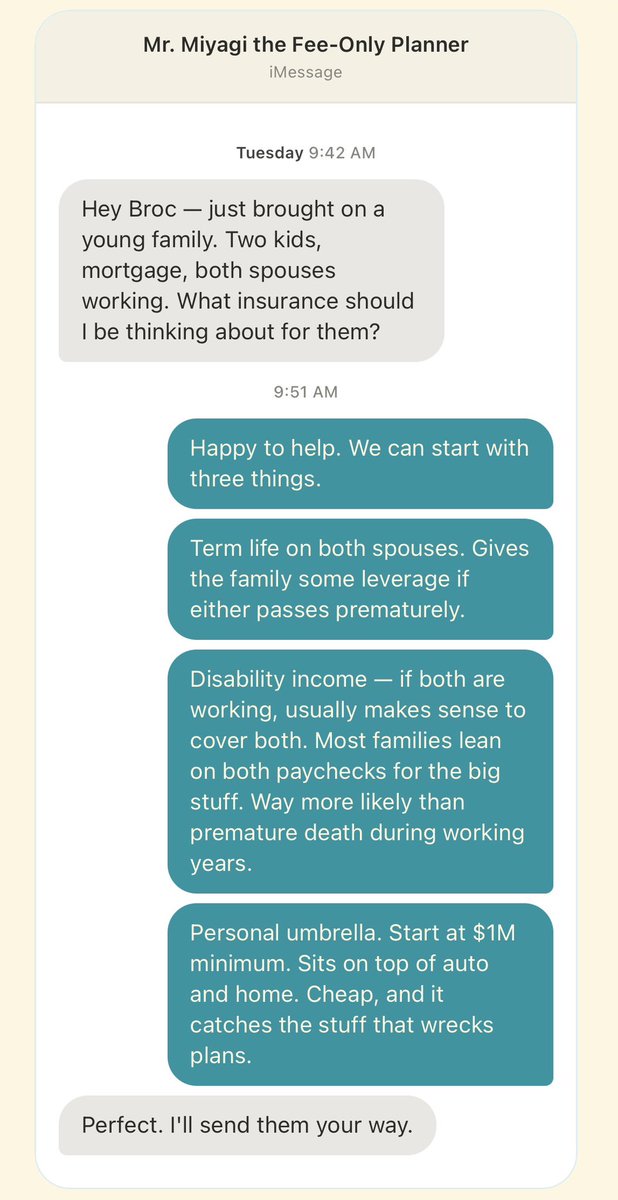
This is a text I get all the time from planners I work with.
Young family, mortgage, dual income. What should they be looking at?
Usually starts with three: term life, disability income, and a personal umbrella. Curious how other advisors are framing this conversation with younger clients.
P.S. Had to make the planner Mr. Miyagi. My grandma is from Okinawa and we love watching the Karate Kid movies together. Felt right.

English

#166 - Career Pivots And Clear Thinking with Jacob Tally
You can feel stuck in a successful career and still know it's not the life you want.
In this episode, we talk with Jacob Talley of Prospero Wealth about what it actually looks like to pivot later, especially after years in high-intensity environments like startups, corporate finance rotations, and big-name financial services.
Jacob shares the practical side of making the move: deciding between going solo or joining an independent RIA, why fee-only planning mattered to him, and how he evaluated firm fit before jumping.
We also get into planning for tech and startup employees, where equity compensation, job changes, and sudden life transitions create complexity that generic advice can't solve.
The most useful part is the decision framework. We dig into risk management beyond investing: pressure testing your situation, spotting blind spots, and using fear setting to turn vague anxiety into clear options. Jacob also challenges the obsession with goals, reframing growth around principles that keep you moving when life doesn't follow a neat timeline.
If you're considering a career change, building a financial plan, or trying to make a brave decision without guessing, this conversation gives you language and structure you can use right away.
Apple Podcasts:
podcasts.apple.com/us/podcast/onl…
Spotify:
open.spotify.com/episode/0gDAgv…
Please subscribe, share, and leave a review. What decision are you trying to get clarity on right now?
English

One of the biggest benefits of owning a business doesn’t get talked about enough.
It’s not income. It’s freedom.
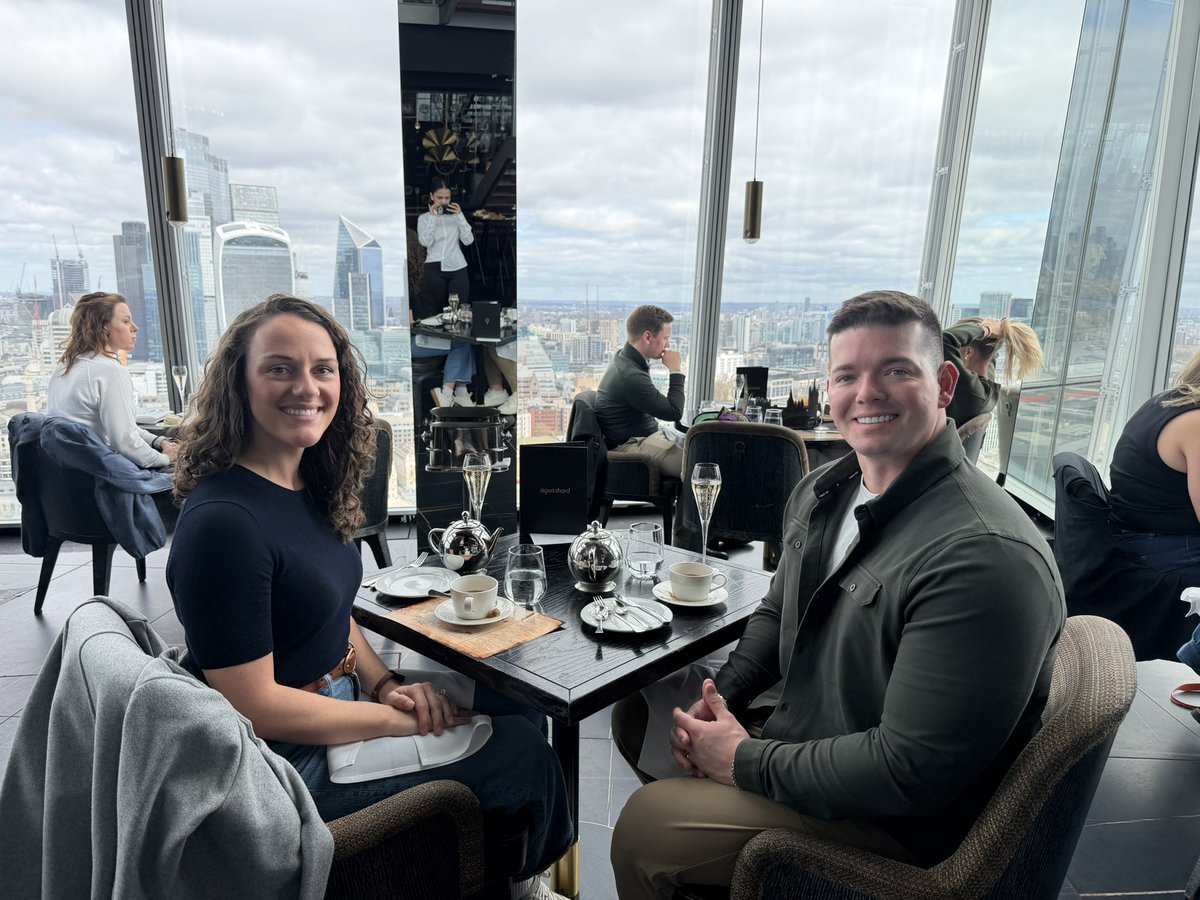
My wife and I recently had the chance to spend some time in London and Scotland recently. We did high tea at the shard, explored the city, and I still stayed on top of what mattered back home. Honestly, I wanted to. I genuinely love what I do.
That’s the part people miss. Freedom isn’t just about unplugging. It’s about building a life where the work fits around the moments, not the other way around.
Building a team you trust has been a huge part of that. Knowing things are taken care of makes it a lot easier to be present wherever you are.
There’s still risk, busy days, and real stress that comes with owning a business. Being able to say yes when an opportunity like that comes up without everything falling apart is something I don’t take for granted.
What does freedom look like in your career?

English

#155 - A Discretionary, Childfree Life with @dincplanning
Most financial advice is built around a default life plan — and it quietly breaks down when you've opted out of that script. Cory Smith is a fee-only financial life planner and founder of Discretionary inc. in Reno, Nevada, where he works exclusively with childfree individuals, couples, and business owners who want their finances to support the life they actually want — not the one they were expected to want.
In this episode, we get into his core concept of discretion: the freedom to determine your own best course of action. We talk about what changes in planning when there are no assumed heirs, why longevity and support structures deserve more attention in this space, and how he works backward from a client's vision to build a financial framework around it.
Cory also shares the path that shaped his philosophy — from commission-driven environments and door knocking to the fee-only model — and how he integrates George D. Kinder's Real Life Planning process into a modern client experience, including a concurrent planning approach that delivers early wins while the deeper work unfolds.
We also cover what's working in his business today: partnerships, community building, and using short-form and long-form content to reach people who are quietly rewriting the rules.
Apple Podcasts:
podcasts.apple.com/us/podcast/onl…
Spotify:
open.spotify.com/episode/2DgjfS…
English

How do insurance companies view tobacco and marijuana use?
In this video, I walk through how insurance carriers evaluate tobacco and marijuana use.
We’ll cover how each is viewed, what factors matter, and how things like medical marijuana prescriptions can impact the conversation. A simple breakdown to help you better understand how these are looked at behind the scenes.
Full video:
youtube.com/watch?v=hFP26L…

YouTube
English

#154 - From Side Hustle to Six-Month Waitlist: Ethan Miller’s Path to Fee-Only Planning
@ESMiller59 had a six-month waitlist… while still working a full-time job.
We sat down with the founder of Planning for Progress to talk about how he went from union organizing to building a thriving fee-only firm just outside DC—without taking a reckless leap.
He shares how he found fee-only planning, built early momentum through project work, and knew commissions weren’t the path for him. We also get into what it actually looked like to earn his CFP while working nights and weekends—and the moment he knew it was time to go all in.
We also cover how he’s designed a lifestyle practice of ~50 households, how he thinks about client fit, and why being a “people person” can matter more than a finance background when starting out.
If you’re thinking about making the jump into financial planning, this is a grounded, real-world blueprint.
Apple Podcasts:
podcasts.apple.com/us/podcast/onl…
Spotify:
open.spotify.com/episode/0NWgCg…
English

“Just self-fund it.”
That advice gets thrown around a lot.
It can definitely work……but
Self-funding only works when two things are true:
1) You can afford the loss
2) You’re willing to take the hit
Most people only think about #1.
They say:
“I have enough saved.”
They don’t ask:
“Do I actually want to be the one writing that check?”
A $10,000 loss might be annoying.
A $100,000 loss might change behavior.
A $1,000,000 loss might change everything.
Insurance isn’t about eliminating every risk.
It’s about deciding which risks you’re okay owning—and which ones you’re not.
Self-funding is a strategy.
Make sure it’s a conscious one.
English

Entrepreneurship gets a lot of attention for the upside.
Freedom. Flexibility. Ownership.
Those things are real.
What’s often underestimated is what comes with it:
- The responsibility behind every decision
- The consistency required when no one is watching
- The patience it takes to build something meaningful
That doesn’t make the upside less true.
It actually makes it more rewarding.
Because when things start to work—when clients trust you, when your team grows, when your systems click—you know it wasn’t handed to you.
You built it.
That’s a different level of satisfaction you don’t get anywhere else.
What’s been the most rewarding part of building your business so far?
English

Some people need more insurance.
Some don’t.
Almost everyone can benefit from improving what they already have.
I see it every day:
- Coverage that hasn’t kept up with life changes
- Policies solving problems that no longer exist
- Gaps in places that actually matter
Insurance isn’t a “set it and forget it” decision.
Life moves. Income changes. Families grow. Goals shift.
Your coverage should move with it.
At a minimum, it’s worth reviewing annually to make sure everything still lines up.
When’s the last time you took a fresh look at your coverage?
English

Life insurance is just a promise on a piece of paper until it pays. Then it becomes a child's education, spouse's livelihood, daughter's wedding, or all of the above.
#insurance #impact
English