Bruce Calvert

116 posts

Bruce Calvert banner
Bruce Calvert

Bruce Calvert

@BruceTTCalvert

Interested in temperature statistics and datasets

Ottawa, Canada Katılım Temmuz 2024
35 Takip Edilen10 Takipçiler
Sabitlenmiş Tweet
Bruce Calvert
Bruce Calvert@BruceTTCalvert·
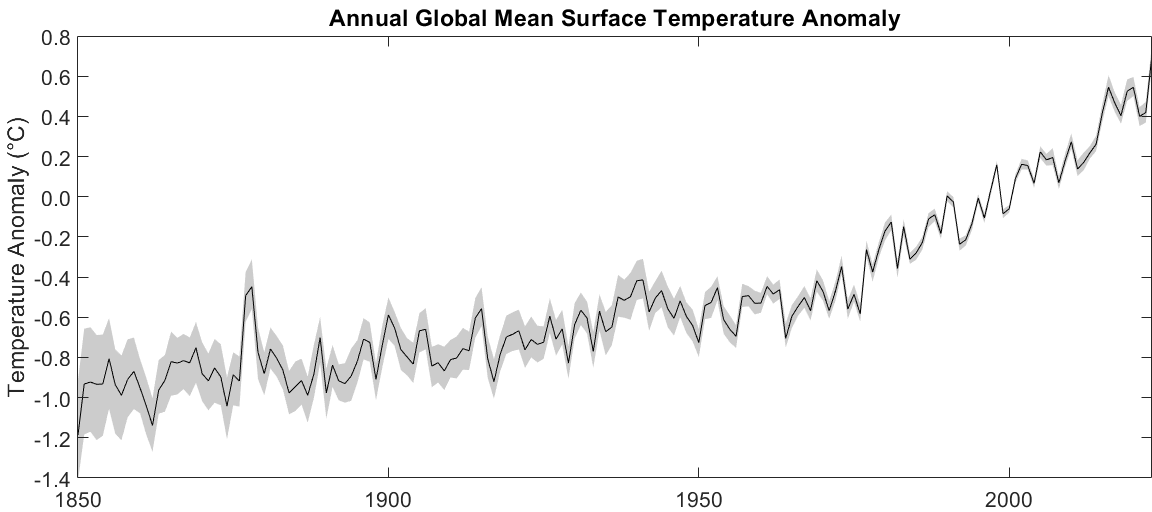
A new infilled global temperature dataset is now available: DCENT_MLE_v1. This dataset estimates more #globalwarming than other datasets: an increase of 1.59 °C from the late 19th century to 2023, with an uncertainty range of [1.48,1.72] °C. wdc-climate.de/ui/entry?acron…
Bruce Calvert tweet media
English
4
0
2
115
Bruce Calvert
Bruce Calvert@BruceTTCalvert·
@FinbarCurtin Can't you use bottom-up damage estimates instead (e.g., estimates from the GIVE or COACHH models) if the top down damage estimates are unreliable?
English
1
0
0
36
Finbar Curtin
Finbar Curtin@FinbarCurtin·
22/n) Importantly: we are *not* claiming that climate change is economically harmless. We're arguing that the magnitude of damages is deeply and irreducibly uncertain, and trillion-dollar decisions need to stop being made as if it isn't.
English
2
3
23
2.1K
Finbar Curtin
Finbar Curtin@FinbarCurtin·
20/n) There is no SCC or projection of climate damages that is “the answer.” (An “answer” which seems to change depending on who is in the White House.) Climate damages are deeply uncertain, and policy makers should truly grapple with decision making under deep uncertainty.
English
2
1
9
1.8K
Bruce Calvert
Bruce Calvert@BruceTTCalvert·
@FinbarCurtin Yes, the spatial pattern of ENSO (more warming in the tropical pacific and near the surface) is very different from the spatial pattern of long term warming (more warming in arctic land or sea ice regions, and in the upper troposphere). This causes different climate effects.
English
0
0
1
15
Finbar Curtin
Finbar Curtin@FinbarCurtin·
16/n) The methodology of Bilal and Känzig (2026) requires that 0.1°C of climate change induce the same effect as 0.1°C of warming from ENSO, solar cycles, etc. Such is the result of reducing climate (and climate change) to a single variable.
English
3
0
7
2K
Finbar Curtin
Finbar Curtin@FinbarCurtin·
15/n) We argue that Bilal and Känzig (2026) rely on an unrealistic exclusion restriction: temperature shocks affect GDP only through temperature levels. If shocks coincide with other climate phenomena (e.g., ENSO), the effect isn’t well-identified.
English
1
0
11
2.1K
Bruce Calvert
Bruce Calvert@BruceTTCalvert·
@mattkahn1966 To clarify, I was highlighting this paper regarding warming until the present rather than predictions of future warming. It can be helpful to researchers to know the current state of the literature. I have appreciated some of your past work (e.g., doi.org/10.1016/j.enec…).
English
0
0
0
5
Matthew E. Kahn
Matthew E. Kahn@mattkahn1966·
I believe this scientific work documenting the mapping of global CO2 PPM to warming. I focus on the economic consequences of passing "the target". I argue that world economy is making great progress in adapting to this challenge and that this progress will only accelerate.
Bruce Calvert@BruceTTCalvert

@mattkahn1966 Hi Dr. Kahn, Please see the latest community science assessment on how close we are to the 1.5°C warming target. While our consensus estimates have some caveats (e.g., excluding nearly 0.1°C warming prior to 1850), it can be a helpful point of reference. essd.copernicus.org/preprints/essd…

English
2
0
4
2.7K
Bruce Calvert
Bruce Calvert@BruceTTCalvert·
@mattkahn1966 Hi Dr. Kahn, Please see the latest community science assessment on how close we are to the 1.5°C warming target. While our consensus estimates have some caveats (e.g., excluding nearly 0.1°C warming prior to 1850), it can be a helpful point of reference. essd.copernicus.org/preprints/essd…
English
0
0
0
2.8K
Matthew E. Kahn
Matthew E. Kahn@mattkahn1966·
This is an interesting paper but the core assumption is that this goal is a binding constraint; "Limiting global warming to 1.5 degrees". What do we know about the Kuhn-Tucker multiplier on this constraint? Adaptation optimism implies that it is converging to zero over time.
NBER@nberpubs

The remaining carbon budget is insufficient for most countries to achieve economic development goals, even with technology transfer from advanced economies, from @galinahale_ucsc, Michael Halling, Nora Alice. Paulus, and Han H.G. Pham nber.org/papers/w34978

English
2
0
1
1.2K
Steve Milloy
Steve Milloy@JunkScience·
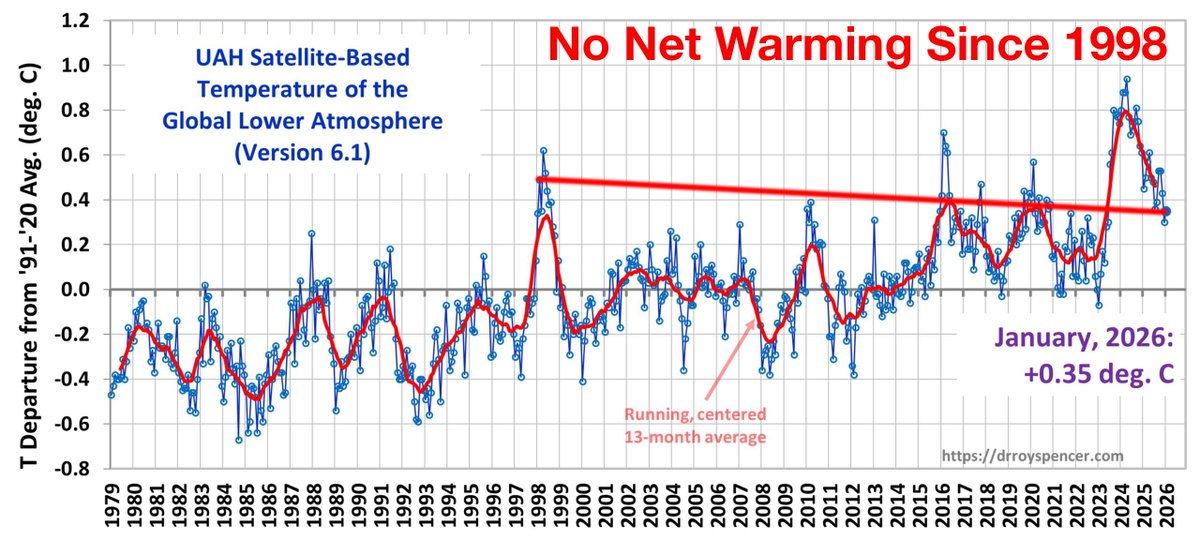
Just in from NASA satellites: No net "global warming" in 28 years. February 2026 was cooler than February 1998. If every emission warms and drives more warming of the planet, how is that possible?
Steve Milloy tweet media
English
429
1.4K
3K
1.8M
Bruce Calvert
Bruce Calvert@BruceTTCalvert·
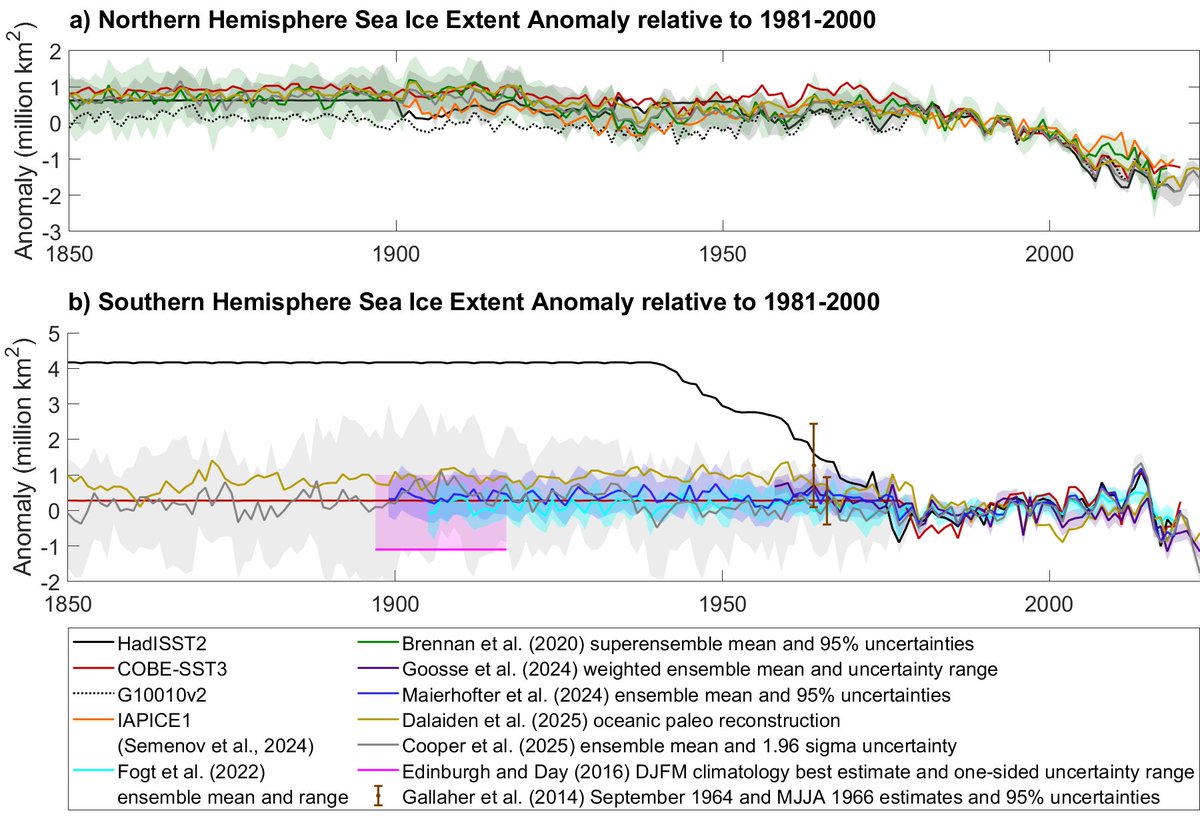
I intended for the graph to be accessible to red-green colorblind people, but authors kept finding additional recent reconstructions. Here is my attempt at a colorblind accessible version. Feedback would be welcome. The community paper is open for public comment until March 11.
Bruce Calvert tweet media
English
0
0
0
34
Bruce Calvert
Bruce Calvert@BruceTTCalvert·
However, many other datasets might underestimate #warming despite using HadISST2 since they often don’t account for climatological differences between #seaice and open sea. This issue is discussed in section 3 of the paper as well as in my 2024 paper (doi.org/10.1002/qj.4791).
English
1
0
0
8
Bruce Calvert
Bruce Calvert@BruceTTCalvert·
Regarding a recent community science paper on 1.5°C of #globalwarming (doi.org/10.5194/essd-2…), the graph I like the most shows #seaice extent anomalies for different datasets and reconstructions. The most striking feature is HadISST2 disagreement with Antarctic reconstructions.
Bruce Calvert tweet media
English
1
0
2
36
Ryan Alimento
Ryan Alimento@RyanAlimento·
Would love IEA reports with probabilistic scenarios and forecasts instead of roadmaps to NZE 2050
Steve Guest@SteveGuest

WATCH: Secretary of Energy Chris Wright calls out the International Energy Agency for focusing on Net Zero 2050: "We need to have the IEA focused on energy data and bettering lives. Every report has a Net Zero 2050 case in it. There is a 0.0 chance of the world hitting Net Zero 2050, 0.0%. Wright also says: "This organization has been pushed off course, and for 5 years, published energy scenarios going forward, none of which had any relevance to reality. They were all just based on climate ambitions, politics, local domestic politics." "If the European industrial powers want to continue to become forward industrial powers, that's your choice. I don't think it's a great choice, but that is your choice, but that is politics. If the European industrial powers want to continue to become forward industrial powers, that's your choice. I don't think it's a great choice, but that is your choice, but that is politics. That's not relevant to the global energy system, or to better people's lives. 
We need to have the IEA focused on energy data and bettering lives." Wright: "We need to have the IEA focused on energy data and bettering lives. Every report has a Net Zero 2050 case in it. There is a 0.0 chance of the world hitting Net Zero 2050, 0.0%. .... 
The attempt to do it has only had one impact. 
It's we've spent over $10 trillion to add 2.6% of global energy from wind, solar batteries, and all the extra transmission infrastructure combined. And everywhere it's deployed, in reasonable penetration rates, it's developed higher electricity prices. We've seen in the U.S. Every state within a renewable portfolio standard, on average, 50% higher electricity prices then the other states that didn't adopt that. 
We don't want to move industries out of Europe. We don't want to make life more expensive and impoverish people. We don't want to have 2 million people still dying because they don't have clean cooking fuel. 
We want to better energize the world. That's what IEA was founded for. That's what we want the IEA to do going forward. 
And I want to get the other support of all the nations in this noble organization to work with us to push the IEA to drop the climate, hat's political stuff. Let that be done at the government level. This organization should be about energy, energy security, and improving lives." Wright: "Together, we could move the organization and must move the organization back to what energy should always be about, which is humans and math. We only produce energy to better people's lives. The United States is all in on this trajectory."

English
1
1
3
1.7K
Bruce Calvert
Bruce Calvert@BruceTTCalvert·
@hausfath @RyanAlimento There is some literature on fully probalistic scenarios. Although, these usually replace modelling policies directly with a simplified Kaya identity approach. The most prominent example would be from Resources for the Future (rff.org). doi.org/10.1038/s41586…
English
1
0
1
28
Zeke Hausfather
Zeke Hausfather@hausfath·
Though probabilistic scenarios still need to be somewhat contingent on policy choices. E.g. it is (somewhat) straightforward to create probabilisitic scenarios for current policies (or NDCs), but harder to determine the likelihood of future changes in policy regimes. That being said, I do think the APS is much more useful than the NZE as it at least somewhat reflects stated goals rather than working backwards from a specific outcome.
English
2
1
8
774
Bruce Calvert
Bruce Calvert@BruceTTCalvert·
@BjornLomborg Do you know of any good studies that try to decompose forest land areas burdened into the influence from contributing factors? Even if climate change increases the prevalence of fire weather, fire suppression activities and land management practices would also affect outcomes.
English
0
0
0
21
Bjorn Lomborg
Bjorn Lomborg@BjornLomborg·
The world is burning less, not more That's contrary to the climate narrative Last year saw the 2nd-lowest burn ever, just 0.03 percentage point above the lowest-ever in 2022 Why does media not tell us this? Instead, they mislead us, showing only places where it burns more Data: from satellites circling the planet 24/7, earthdata.nasa.gov/data/catalog/l…, 2025 is 2.198%, 2022 is 2.169% Threads&refs: x.com/BjornLomborg/s…
English
15
126
427
11.1K
Bruce Calvert
Bruce Calvert@BruceTTCalvert·
@Electroversenet There have been changes in measurement practices of sea surface temperatures over time, from buckets to engine room intake to buoys. Buckets are biased cold. Engine room water is biased warm. Overall, these adjustments reduce rather than increase estimated warming since 1850.
English
0
0
0
94
Electroverse
Electroverse@Electroversenet·
In the early 2000s, climate models projected warming, but the actual observations did not follow. This gap between models and measurements became known as 'the global warming pause'. The response to this discrepancy was not to revisit the models, it was to revisit the measurements. More weather stations were added in the Arctic, the fastest warming region on earth, increasing its influence on the global average. Large areas with sparse measurements were filled using estimates. Stations in regions showing cooling, including parts of South America, were removed or down-weighted. Sea surface temperatures were also reprocessed. Older ship readings were adjusted cooler, with recent buoy data blended warmer. Homogenization algorithms lowered earlier temps and raised later ones, further steepening the trend. The models stayed fixed. The observations were adjusted to match them. That is how the pause disappeared. Climate scientists reversed the scientific method.
English
49
443
1.1K
34.8K
Bruce Calvert
Bruce Calvert@BruceTTCalvert·
@Electroversenet If you don't statistically infill unobserved regions then you can't properly estimate a global mean surface temperature. The Earth does not have perfect observational coverage, so you have to take advantage of spatial correlations to estimate temperatures of unobserved regions.
English
0
0
0
92
Bruce Calvert
Bruce Calvert@BruceTTCalvert·
@cohler Surface temperatures isn't meaningless. It affects the day-to-day lives of almost everyone on the planet. It affects crop production and heating/cooling expenses. Taking a surface area weighted average seems like a sensible way to calculate a summary statistic of it.
English
1
0
1
20
Jonathan Cohler
Jonathan Cohler@cohler·
All IPCC climate models are categorically falsified. They all rely on a physically meaningless quantity: global mean surface temperature (GMST). This is not “uncertainty.” This is categorical falsification. It’s no wonder they have been empirically falsified over and over again for decades now in the peer reviewed literature.
English
45
89
266
5K
Prof. Ryan Katz-Rosene
Prof. Ryan Katz-Rosene@ryankatzrosene·
They are not “predicting” 4 billion deaths by 2050. These are just the randomly crafted parameters for their definition of what might constitute “extreme” risk. They surmise that “extreme” OR “catastrophic” risk has a +60% likelihood of occurring… which is *extremely vague*, not particularly helpful, and - to me at least - a major overestimate. The *chances* of breaching 3C by 2050 are quite low actually (but uncomfortably, not zero, which is indeed concerning). The chances of it BOTH breaching 3C AND half our global population dying out by 2050 are *practically nil* in my opinion, based on existing trends in demographics, food production, health, development, lifespans, etc. Of course, none of this negates how severe climate change is, nor how catastrophic it has already been for many around the world, and how dangerous it will be at 2C. We don’t need a likely death toll of 4billion to act now, and urgently.
Climate Dad@ClimateDad77

“Mum, dad, what did you do when professional risk assessors predicted 4 billion deaths before my 40th birthday?”

English
15
11
84
11.7K
Bruce Calvert
Bruce Calvert@BruceTTCalvert·
@RogerPielkeJr Thanks for the informative blog post. As a point of nuance, figure 1 of the SSP3 paper shows that the AIM simulates 7 W/m^2 by 2100 under no climate policies for both SSP3 and SSP2. SSP3's high population projections are counteracted by aerosol emissions. doi.org/10.1016/j.gloe…
English
0
0
2
647