Finbar Curtin

30 posts

Finbar Curtin banner
Finbar Curtin

Finbar Curtin

@FinbarCurtin

2nd-year economics PhD student @ University of Wyoming | climate + development + macro

Laramie, WY Katılım Mart 2026
194 Takip Edilen212 Takipçiler
Finbar Curtin retweetledi
Matthew E. Kahn
Matthew E. Kahn@mattkahn1966·
I am a big fan of this paper and have learned about the robustness of my co-authored paper's estimates as a function of outlier observations. Macro/climate regressions are historical benchmarks and shouldn't be used to predict the future. Lucas Critique, Lucas Critique!!
Matt Burgess@matthewgburgess

Link: osf.io/preprints/soca… Comments and critiques welcome! 12/12 END

English
2
4
13
3.1K
Finbar Curtin
Finbar Curtin@FinbarCurtin·
@VincentGeloso Well put! The climate vulnerability generated by frail institutions (and poverty) is a huge motivator for me to focus on climate change in the developing world. Definitely an area I look towards next, so thanks for sharing the papers.
English
1
0
4
126
Vincent Geloso
Vincent Geloso@VincentGeloso·
One particularly important point (one I have emphasized for years, and which is closely tied to this paper and to what Matthew Kahn argues about adaptability reducing the social cost of carbon) is the role of institutions. The social cost of carbon is, at its core, an institutional question. Societies with strong property rights can internalize costs, create incentives for innovation that mitigates emissions, and lower the cost of developing and adopting new technologies. This has a key implication: the relationship between climate and economic outcomes is fundamentally conditional on institutional quality. Countries with open markets, secure property rights, and limited regulatory distortions are better able to adapt to climatic changes and will tend to follow trajectories like the “blue” line below. By contrast, countries with weak or predatory states (where property rights are insecure and protectionism is prevalent) are more likely to follow the “red” path, where climate change translates more directly into economic decline. These are some of the articles where I first discussed this idea of accounting for institutions. Desrochers, P., Geloso, V., & Szurmak, J. (2021). Care to Wager Again? An Appraisal of Paul Ehrlich's Counterbet Offer to Julian Simon, Part 1: Outcomes. Social Science Quarterly, 102(2), 786-807. Desrochers, P., Geloso, V., & Szurmak, J. (2021). Care to wager again? An appraisal of Paul Ehrlich's counterbet offer to Julian Simon, Part 2: Critical analysis. Social Science Quarterly, 102(2), 808-829. Geloso, V. (2022). Statogenic climate change? Julian Simon and institutions. The Review of Austrian Economics, 35(3), 343-358.
Finbar Curtin@FinbarCurtin

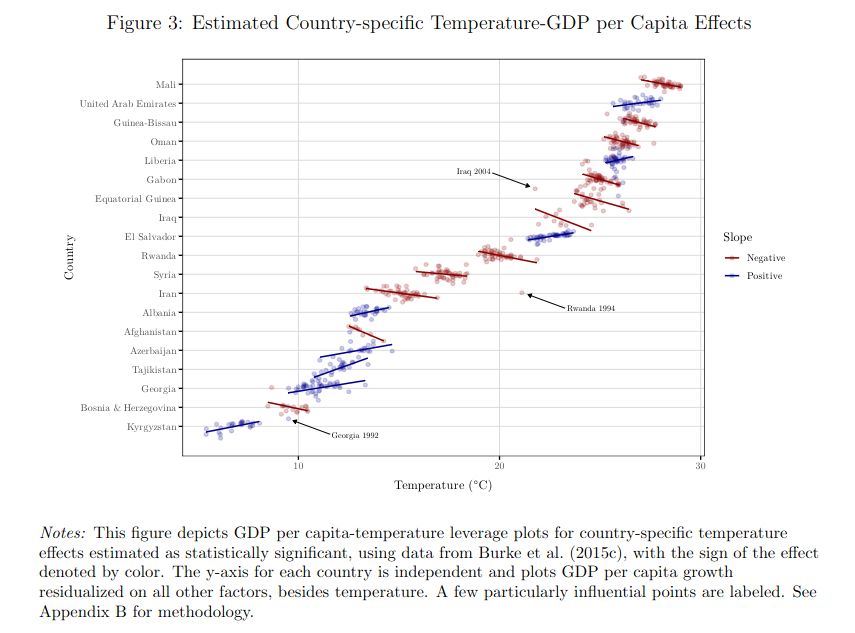
9/n) This figure shows within-country GDP-temperature relationships. El Salvador (tropical, service-based economy) and Iraq (desert, petrostate) have the same average temperature, but different within-country slopes. Pooling them in one regression assumes one global function.

English
4
3
32
5.2K
Finbar Curtin
Finbar Curtin@FinbarCurtin·
@BruceTTCalvert We briefly discuss this in our introduction, but our intuition is that these types of models are likely less reliable because they 1) cannot account for all possible sectors and 2) cannot sufficiently capture complex interactions/spillovers between sectors.
English
0
0
0
27
Bruce Calvert
Bruce Calvert@BruceTTCalvert·
@FinbarCurtin Can't you use bottom-up damage estimates instead (e.g., estimates from the GIVE or COACHH models) if the top down damage estimates are unreliable?
English
1
0
0
35
Finbar Curtin
Finbar Curtin@FinbarCurtin·
20/n) There is no SCC or projection of climate damages that is “the answer.” (An “answer” which seems to change depending on who is in the White House.) Climate damages are deeply uncertain, and policy makers should truly grapple with decision making under deep uncertainty.
English
2
1
9
1.8K
Finbar Curtin
Finbar Curtin@FinbarCurtin·
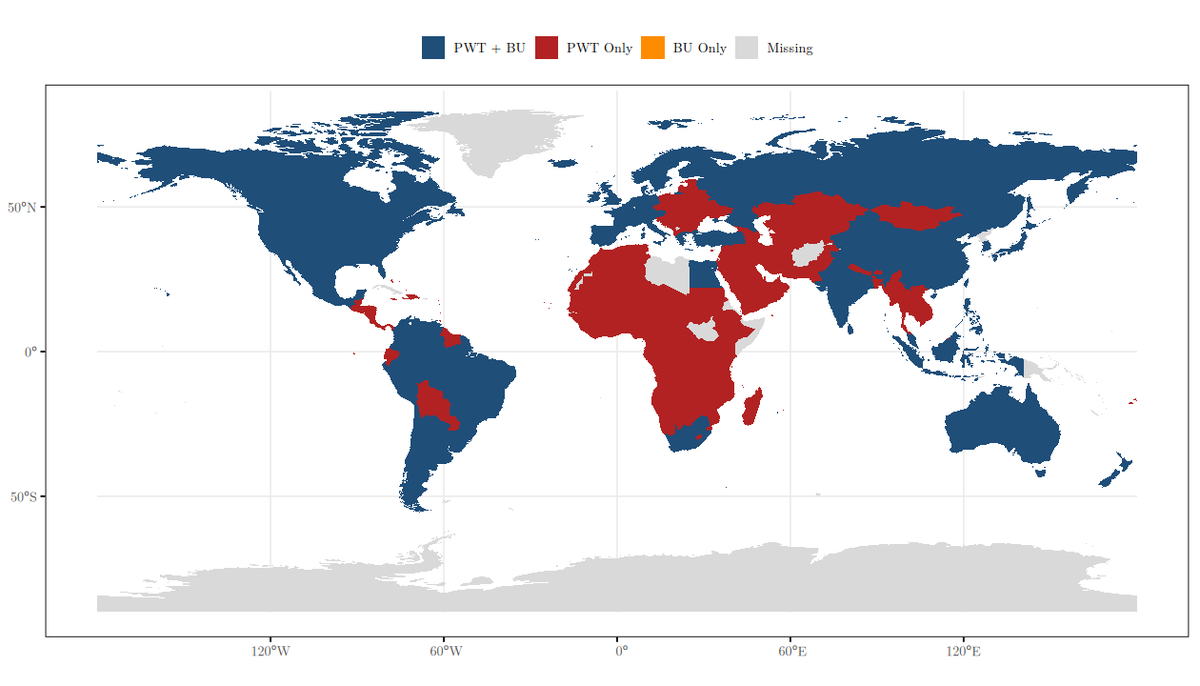
@ruiagmsousa Good catch! This was an ISO code matching issue for the R package I'm using. Here is the updated figure.
Finbar Curtin tweet media
English
1
0
1
18
Rui Sousa
Rui Sousa@ruiagmsousa·
@FinbarCurtin This is very interested. I am confused about the 'Missing' category of FRA and NOR. They seem to be in their panel dataset.
English
1
0
0
24
Finbar Curtin
Finbar Curtin@FinbarCurtin·
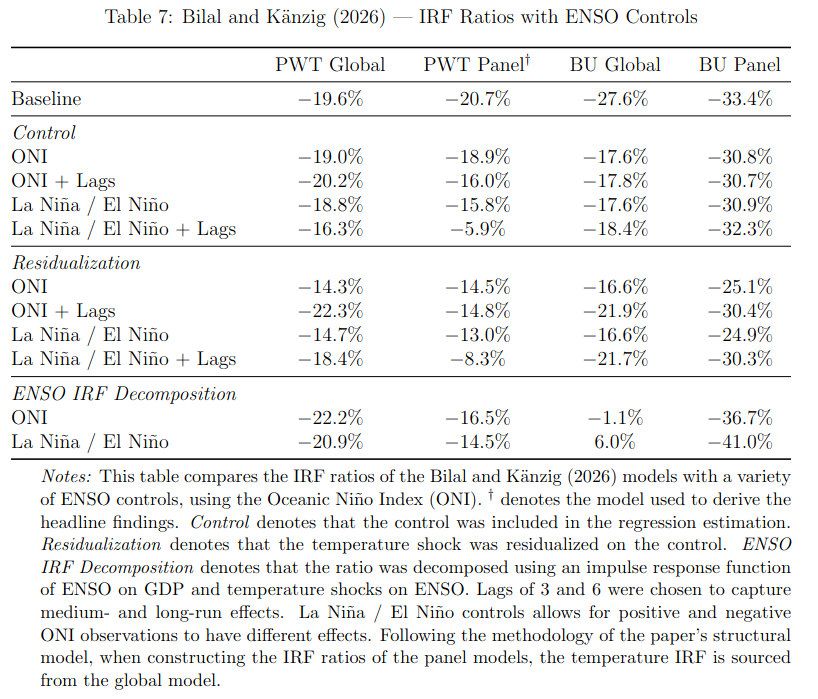
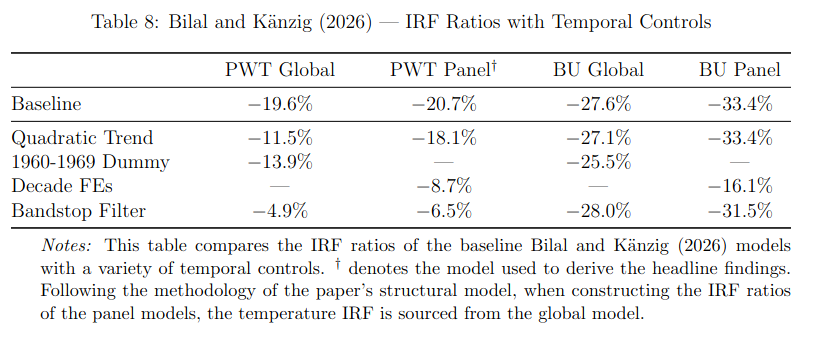
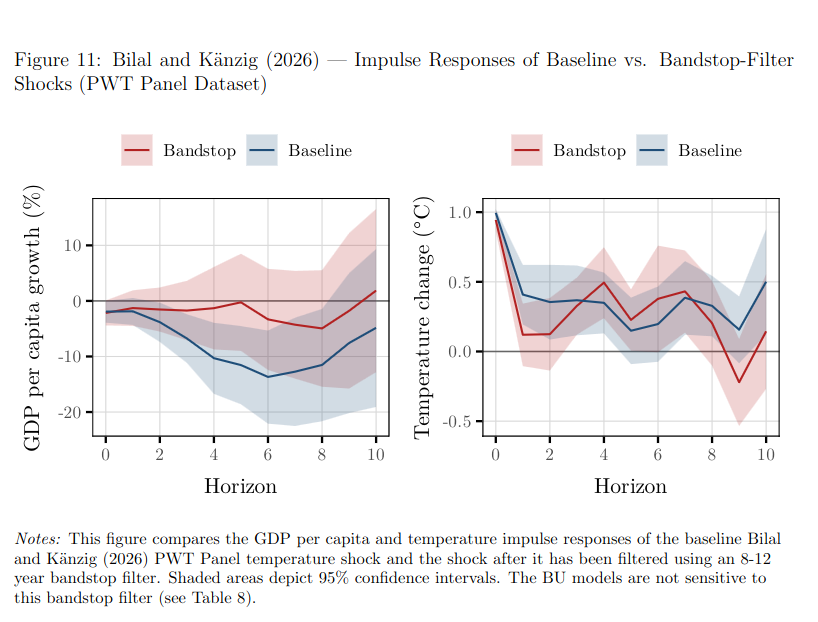
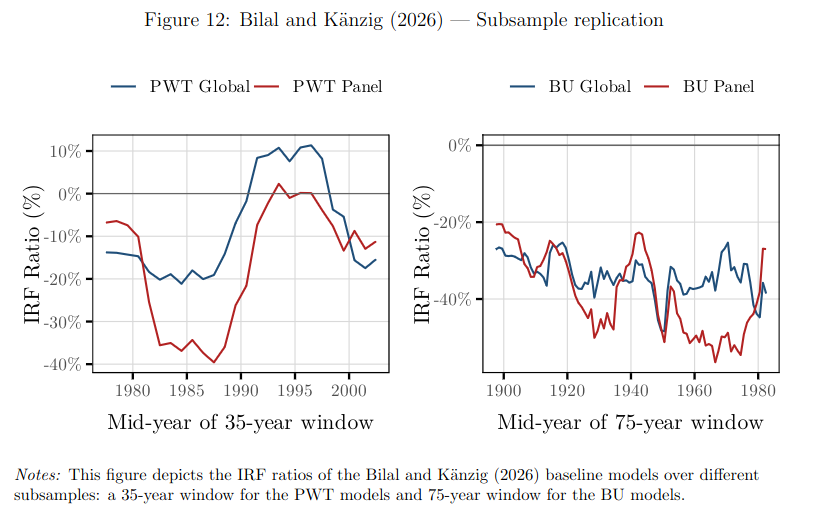
17/n) Bilal and Känzig (2026) use two datasets (PWT and BU). PWT results (used to calibrate their damage function) are ENSO-sensitive. They are also sensitive to a bandstop filter and long-run controls.
Finbar Curtin tweet mediaFinbar Curtin tweet mediaFinbar Curtin tweet mediaFinbar Curtin tweet media
English
1
0
6
2.1K
Finbar Curtin
Finbar Curtin@FinbarCurtin·
@hagertynw Exactly, we are on the same page. There is a wide menu of SCC and damage estimates to choose from, and it is policy makers who ultimately decide the "answer" to use in public decision making.
English
0
0
1
19
Nick Hagerty
Nick Hagerty@hagertynw·
@FinbarCurtin Are you alleging that academic economists change their estimates and modeling choices depending on who is president? Because if you're referring to the White House's estimate of the SCC, it is in fact White House staffers who change it with each new administration.
English
2
0
0
47
Finbar Curtin
Finbar Curtin@FinbarCurtin·
19/n) Read the paper for much more detail. What does all this mean for climate policy?
English
1
0
7
1.8K
Finbar Curtin retweetledi
Matt Burgess
Matt Burgess@matthewgburgess·
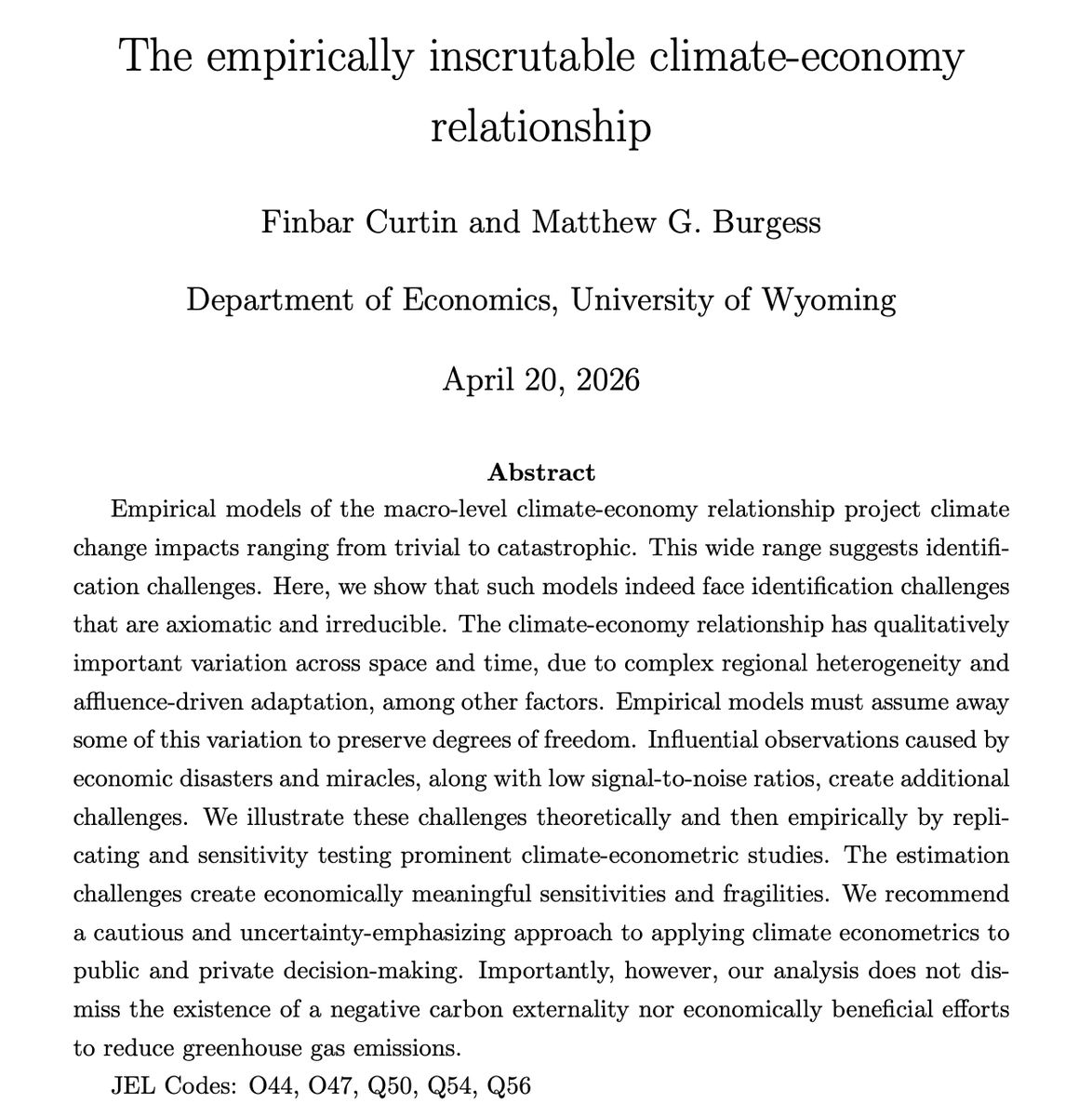
New working paper, led by @FinbarCurtin: "The empirically inscrutable climate-economy relationship". Link and quick 🧵 below. 1/
Matt Burgess tweet media
English
2
23
87
47.6K
Finbar Curtin
Finbar Curtin@FinbarCurtin·
23/END) We thank the authors of these papers, as well as colleagues at the University of Wyoming and University of Colorado-Boulder, for their thoughts and suggestions. We welcome any feedback for improvements!
English
0
0
15
1.8K
Finbar Curtin
Finbar Curtin@FinbarCurtin·
22/n) Importantly: we are *not* claiming that climate change is economically harmless. We're arguing that the magnitude of damages is deeply and irreducibly uncertain, and trillion-dollar decisions need to stop being made as if it isn't.
English
2
3
23
2.1K
Finbar Curtin
Finbar Curtin@FinbarCurtin·
16/n) The methodology of Bilal and Känzig (2026) requires that 0.1°C of climate change induce the same effect as 0.1°C of warming from ENSO, solar cycles, etc. Such is the result of reducing climate (and climate change) to a single variable.
English
3
0
7
2K
Finbar Curtin
Finbar Curtin@FinbarCurtin·
15/n) We argue that Bilal and Känzig (2026) rely on an unrealistic exclusion restriction: temperature shocks affect GDP only through temperature levels. If shocks coincide with other climate phenomena (e.g., ENSO), the effect isn’t well-identified.
English
1
0
11
2.1K
Finbar Curtin
Finbar Curtin@FinbarCurtin·
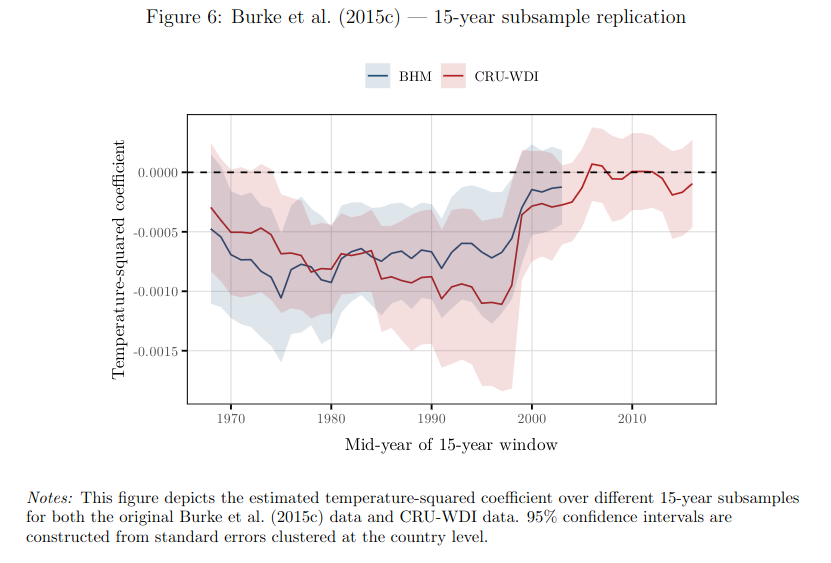
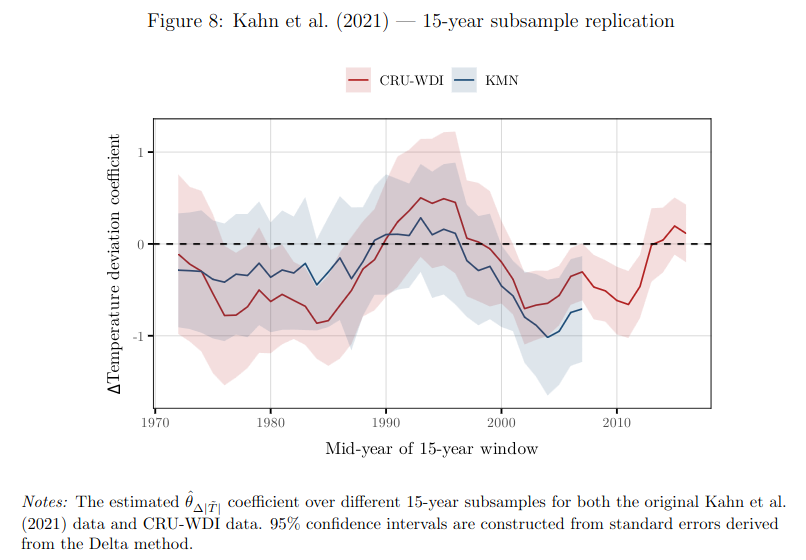
14/n) Restricting the data sample to certain time periods generates unstable estimates in all three papers, some of which attenuate over time. If the climate-economy relationship is temporally unstable, estimates are not externally valid for future projections.
Finbar Curtin tweet mediaFinbar Curtin tweet mediaFinbar Curtin tweet media
English
1
0
8
2.2K
Finbar Curtin
Finbar Curtin@FinbarCurtin·
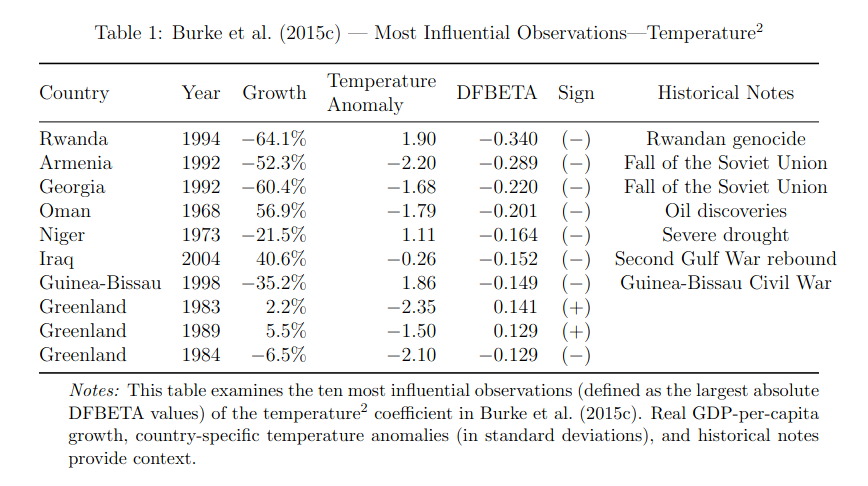
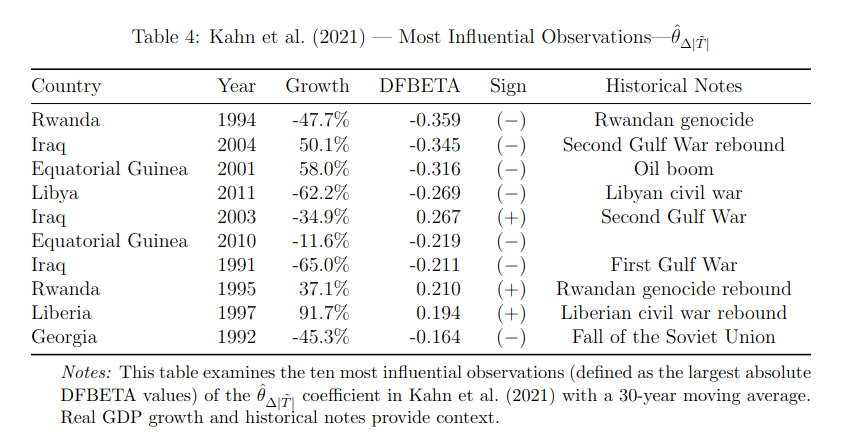
13/n) These influential observations make salient which countries receive more weight. Rwanda (with its hot-year genocide) and Armenia (with its cold-year USSR collapse) implicitly predict how America will experience climate change in such models.
English
1
0
15
2.3K
Finbar Curtin
Finbar Curtin@FinbarCurtin·
12/n) These are growth miracles and disasters, plausibly exogenous to climate, which happened to occur in particularly hot or cold years. Pooling countries in one regression means that heterogeneous relationships are averaged together according to some weighting scheme.
Finbar Curtin tweet mediaFinbar Curtin tweet media
English
1
0
18
2.6K
Finbar Curtin
Finbar Curtin@FinbarCurtin·
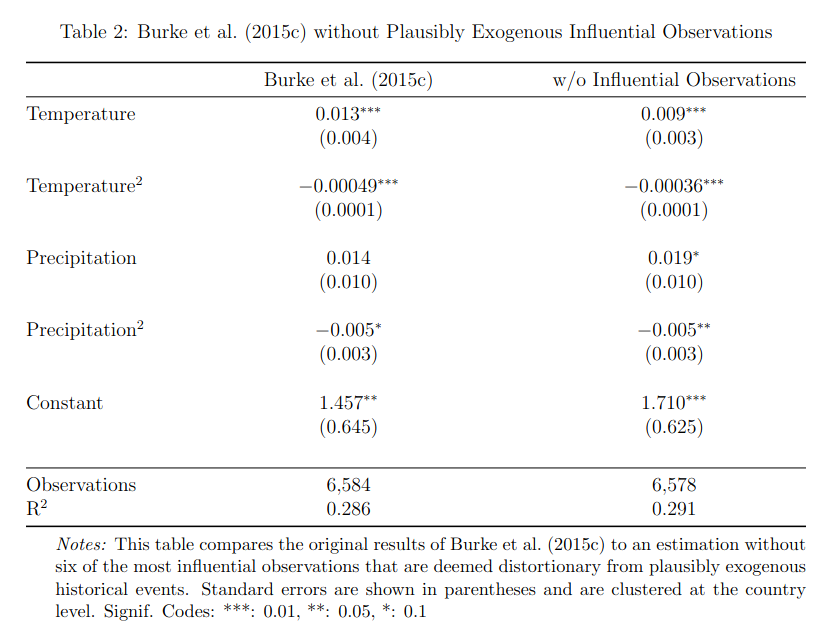
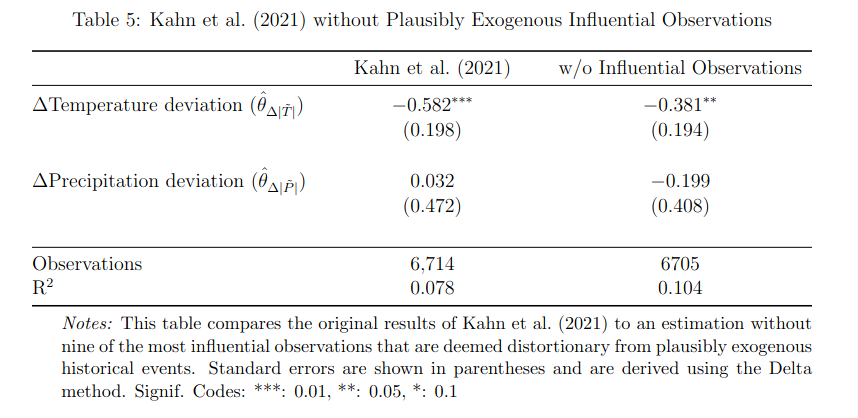
11/n) For example, we find that a handful of influential data points drive a large amount of the estimated effects. Removing 6 observations from Burke et al. (2015) (out of over 6,000) attenuates the estimated effect by ~25%. We find a similar pattern in Kahn et al. (2021).
Finbar Curtin tweet mediaFinbar Curtin tweet media
English
1
1
18
3.3K
Finbar Curtin
Finbar Curtin@FinbarCurtin·
9/n) This figure shows within-country GDP-temperature relationships. El Salvador (tropical, service-based economy) and Iraq (desert, petrostate) have the same average temperature, but different within-country slopes. Pooling them in one regression assumes one global function.
Finbar Curtin tweet media
English
1
7
57
37.5K
Finbar Curtin
Finbar Curtin@FinbarCurtin·
10/n) One of the consequences of pooling across heterogeneous countries is that idiosyncrasies in one can be estimated to have global implications.
English
1
0
14
3.4K