Bryan Cutsinger

2K posts

Bryan Cutsinger

Bryan Cutsinger

@BryanPCutsinger

AP at @faubusiness | AE at @_PublicChoice | Fellow at @AIER’s @SoundMoneyProj | Monetary History & Political Economy | Views my own

Boca Raton, FL Katılım Eylül 2022
1.1K Takip Edilen907 Takipçiler
Sabitlenmiş Tweet
Bryan Cutsinger
Bryan Cutsinger@BryanPCutsinger·
One of my students from last semester dropped by my office today to give me this gift. I’m truly blessed with amazing students. Thankful everyday that I get to share my love of economics with them.

Bryan Cutsinger tweet media
English
3
0
50
2.2K
Bryan Cutsinger retweetledi
Phil Magness
Phil Magness@PhilWMagness·
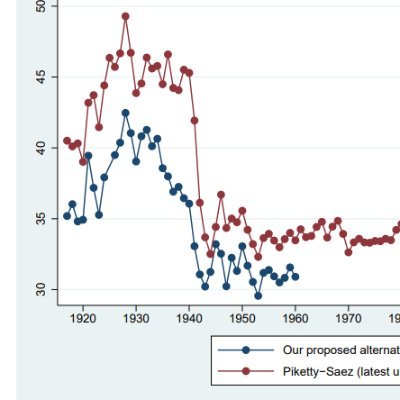
I caught Zucman red handed as he did this. By chance, I had downloaded his old datafile before he swapped them. The backlash against him from this discovery prompted him to restore the old files (which were attached to an already-published paper in the QJE). A few weeks later, he released a contrived rationalization of his new approach. That new approach has never gone through peer review, and contains multiple methodological choices that fail the smell test at the most basic levels. Receipts here: philmagness.com/2019/10/someth…
English
2
18
115
6.3K
Bryan Cutsinger retweetledi
Siri Terjesen
Siri Terjesen@siriterjesen·
Thanks @profgoose for the 🧵& featuring this work with @faubusiness colleague @BryanPCutsinger We find 87.5% of programmatic accreditor-association pairs are legally embedded or identical. In a fresh run of the data this morning, I also find that higher structural entanglement is associated with lower grad rates and higher borrower delinquency. Important context as the committee works through the governance proposals at @usdoegov this week!
Kyle Saunders@profgoose

3/ The empirical case underneath that fight just dropped on SSRN. Cutsinger and Terjesen's "Captured Gatekeepers" studies 32 accreditor-association pairs and finds 87.5% are legally embedded within or identical to the trade association they accredit programs for. The proposals are the defense.

English
0
3
4
629
Bryan Cutsinger retweetledi
Noah Williams
Noah Williams@Bellmanequation·
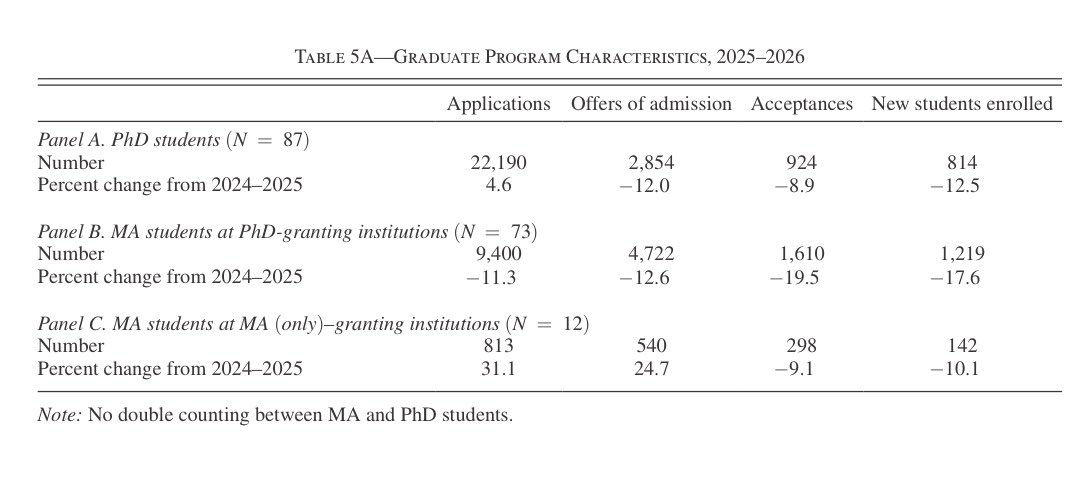
Economics graduate programs in decline: new PhD student enrollments down 12.5%, masters enrollment down 17.6%, according to @AEAjournals
Noah Williams tweet media
English
9
92
660
128.2K
Bryan Cutsinger retweetledi
Jacob Hall
Jacob Hall@jrhall97·
"Law & Economics" goes beyond the courtroom. In their 1994 paper, Anderson & McChesney took a model of why legal disputes "settle out of court" and used it to explain why relations between frontier settlers and Indian tribes devolved over time. tinyurl.com/mwwbxddv
English
1
11
22
1.4K
Bryan Cutsinger retweetledi
David Beckworth
David Beckworth@DavidBeckworth·
Scott Sumner on @BasilHalperin: "I see Halperin as a pragmatist in the tradition of Bennett McCallum, which is one reason why he’s my favorite young macroeconomist... Like McCallum, Basil Halperin seems to have absorbed both the best of New Keynesian economics and the best of Milton Friedman thought. He also favors NGDP targeting. He also seems to have excellent intuition about which sort of macro models are plausible and which are not—a skill that’s hard to teach. Even their personalities seem a bit similar, as both come across as being very polite." (1/2) scottsumner.substack.com/p/basil-halper…
English
2
11
66
18.9K
Bryan Cutsinger retweetledi
Hanno Lustig
Hanno Lustig@HannoLustig·
As economists, we've all been trained to believe that central banks will deliver as long as they're independent and have a sufficiently narrow mandate. As pointed out by @lugaricano last Friday at Hoover's monetary policy conference , the Eurozone's experience teaches us that independent central banks --with a super-narrow mandate-- who are not held accountable can actually stray very far from what those who wrote the mandate had in mind, especially in the face of serious fiscal challenges at home. Long-run outcomes could be worse. Accountability is key, but it's not always clear who's holding central banks accountable. Check out my post: Lessons from Maastricht. thetwocents.substack.com/p/lessons-from…
English
11
48
264
23.1K
Bryan Cutsinger retweetledi
William J. Luther
William J. Luther@WilliamJLuther·
It matters for those capable of sending the signal. Admission is surely not the only margin they care about. A strong signal might help them get into a better program or land a better job. It also offers strong outside options, in case they change their mind. Beyond mere signaling, there’s some evidence that studying economics improves analytical reasoning skills and, more generally, that cognitively demanding tasks improve cognitive endurance. sciencedirect.com/science/articl… academic.oup.com/qje/article/14…
English
1
1
1
85
Bryan Cutsinger retweetledi
Luis Garicano 🇪🇺🇺🇦
How much is the dollar reserve status worth? Price theory helps to answer. Arvid Krishnamurthy, calculated it at Hoover using a simple supply and demand framework (which is not in the paper) based on a 2026 cool paper with Jiang, @HannoLustig , and Richmond (2026). They argue that without reserve status, the dollar depreciates 8.8%, US long rates rise 87 basis points, and the US loses a capitalized $33 trillion (approx the US GDP) of seigniorage. Here is how he got there, graph below. Foreigners hold about 45% of US GDP in safe dollar debt: Treasurys, agency bonds, bank liabilities. They pay roughly 2% per year for the privilege, in the form of accepting yields below what a synthetic dollar asset would deliver (they calculated that in a 2021 JF paper). That 2% is the convenience yield. It is what the world pays the United States for the use of dollar debt as money. That payment funds part of the US trade deficit --about 1% of GDP (45% × 2%). The US sells IOUs that pay below-market rates and gets goods in return. Now ask: what if foreigners stop wanting safe dollar debt? First, think of the bond market (Panel C). When foreigners leave, the change in yield is 90 basis points, not the full 2%. US households absorb the bonds the foreigners drop, and they take some of the convenience yield for themselves. How much? It depends on the slope of the residual demand curve. Second, think of the goods market, the left panel. X-axis is the trade deficit. Y-axis is the exchange rate. The trade-balance line slopes up: a stronger dollar makes imports cheap and exports dear, so a stronger dollar means a bigger deficit. Two vertical lines mark the two regimes. The one on the right is where deficit = seigniorage (1% of GDP), the reserve-currency steady state. The dashed one near zero is where the deficit must be if the seigniorage disappears. Two parameters are relevant. The horizontal shift is fixed by the convenience yield and foreign holdings. The vertical drop depends on the slope of the trade-balance line, the trade elasticity. Low end is η = 1/3, in which case the depreciation is 8.8%. The more inelastic trade, the more the dollar has to fall when the propping stops. Krishnamurthy called the 8.8% figure modest. The seigniorage is 1% of GDP. Closing it requires a trade-balance swing of 1% of GDP. With reasonable elasticities, that does not need an enormous exchange-rate move. The DXY (dollar index) did more than 8% during the 2014-15 oil shock without anyone questioning reserve status. A perpetual stream of 1% of GDP, capitalized at a low real discount rate, is a multiple of US GDP. The privilege has been worth $15 to $33 trillion depending on the discount rate. In sum the dollar question reduces to two questions: By how much does foreign demand for safe dollar debt fall? How elastic are the curves? Bond demand elasticity governs the rate rise. Trade elasticity governs the dollar fall. papers.ssrn.com/sol3/papers.cf…
Luis Garicano 🇪🇺🇺🇦 tweet media
English
4
79
265
26.7K
Bryan Cutsinger retweetledi
Fernando Arteaga
Fernando Arteaga@ferarteaga·
Given the additions that have brought this slide deck into the 450-slide range, Jesús is being too generous in giving me credit. But I'll add this: as someone who spent five semesters in undergrad studying Marx, a single semester working through these slides would have been far more valuable. Not because Marx isn't worth reading, but because ideological immersion is not the same as genuine intellectual engagement. That is the standard we owe students: be charitable to opposing arguments, and ruthlessly exacting with your own.
Jesús Fernández-Villaverde@JesusFerna7026

Since I have posted so much on Marx vs. Weber, modernity, and development over the last few weeks, I have posted an updated slide deck of my lectures on Karl Marx and the Marxian Tradition (together with @ferarteaga) here: sas.upenn.edu/~jesusfv/ET_3_… This is a long deck: 437 slides in the last compilation! (It also takes a few seconds to upload.) If I were to teach it carefully, with plenty of class discussion, I would require a whole semester. Even then, some topics (e.g., the Frankfurt School) receive only a cursory treatment because I focus more on economics and political economy, broadly construed. I hope to extend the discussion of those someday. However, I cover topics rarely seen in these courses, such as Hans-Georg Backhaus and the Neue Marx-Lektüre, because most of the work is not translated into English and must be read in the original German. I don’t have an equivalent slide deck on Max Weber, as I haven’t lectured on him. Hopefully, one day I will. Comments and feedback are very welcome.

English
2
11
161
16.2K
Bryan Cutsinger retweetledi
Matthew E. Kahn
Matthew E. Kahn@mattkahn1966·
John Cassidy's "Capitalism and its Critics" is an important book. I learned from Dora about how an economic historian thinks about a history of economic thought. Our review offers some "Red meat" for fans of free market capitalism. aeaweb.org/articles?id=10…
English
3
17
69
3.4K