
Sabitlenmiş Tweet
Bubba ◎
5.4K posts


Bubba ◎
@BubbaCrypto23
Founder @ZeroXClem | Moving Weights 🆙 The Hub 🤗 | Crypto , Collecting, Futurist
Orlando,FL Katılım Kasım 2021
468 Takip Edilen451 Takipçiler
Bubba ◎ retweetledi

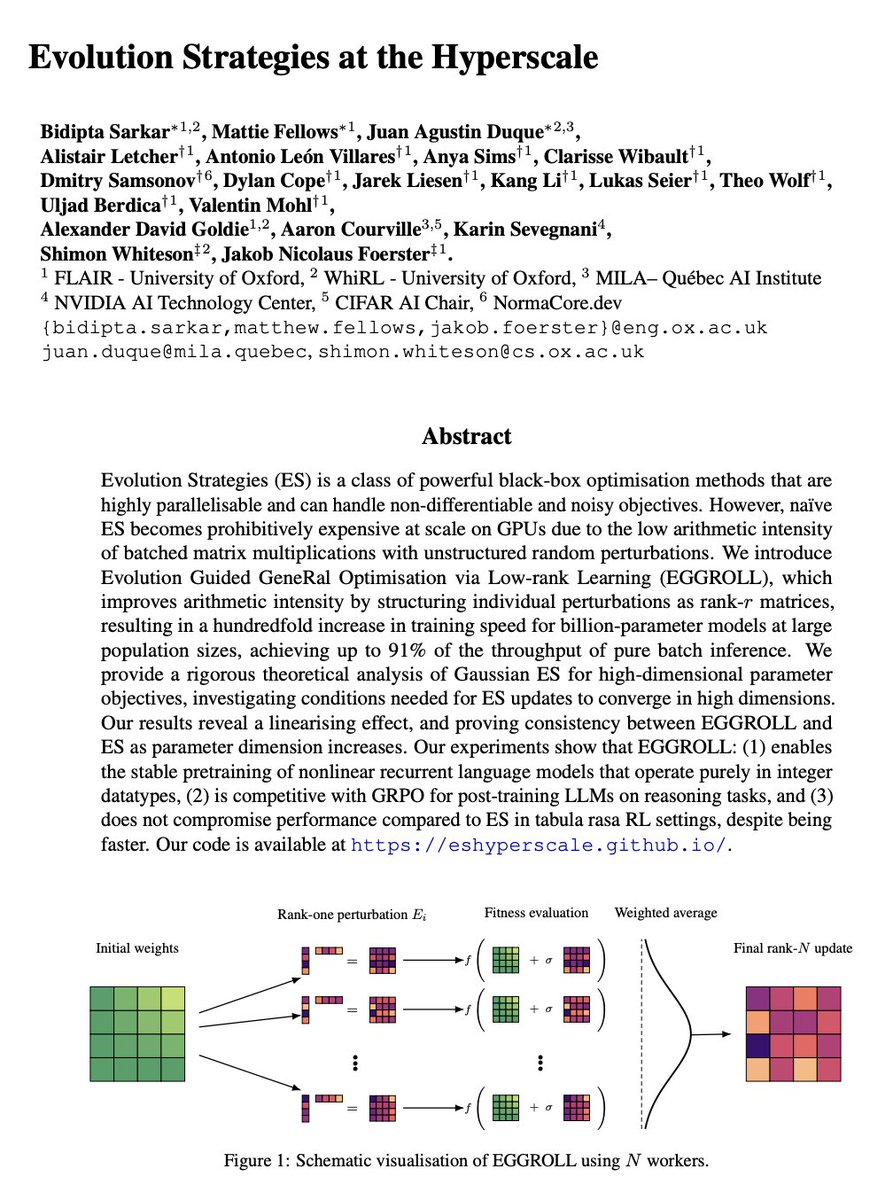
🚨 BREAKING: NVIDIA proved backpropagation isn't the only way to build an AI.
They trained billion-parameter models without a single gradient.
Every AI you use today relies on backpropagation.
It requires complex calculus, exploding memory, and massive GPU clusters.
Meanwhile, an ancient, gradient-free method called Evolution Strategies (ES) was written off as impossible to scale.
Until now.
NVIDIA and Oxford just dropped EGGROLL.
Instead of generating massive, full-rank matrices for every mutation, they split them into two tiny ones.
The AI mutates. It tests. It keeps what works. Like biological evolution.
But now, it does it with hundreds of thousands of parallel mutations at once.
Throughput is now as fast as batched inference.
They are pretraining models entirely from scratch using only simple integers.
No backprop. No decimals. No gradients.
We thought the future of AI required endless clusters of precision hardware.
It turns out, we just needed to evolve.
English
Bubba ◎ retweetledi

llms can FIGHT now. here's opus as wizard vs gpt-5.4 as robot. calling this budok-ai.
it works by modding the brilliant game yomi hustle.
8-model seeded tournament incoming. details and code below:
English
@toms_dome @simonw Like seriously , everyone wants the best but no one does the research.
Like this guy is doing plenty by STREAMING the weights from the SSD of his Mac.
Like isn’t that cool? Bro that’s just it, it’s novelty of computing.
If you want fast go download Qwen3.5-4B
English
@toms_dome @simonw Bro there are plenty of alternatives for this.
This was a test of limits to see if it’s possible, not for your sub-100ms decisions bro.
English

Dan says he's got Qwen 3.5 397B-A17B - a 209GB on disk MoE model - running on an M3 Mac at ~5.7 tokens per second using only 5.5 GB of active memory (!) by quantizing and then streaming weights from SSD (at ~17GB/s), since MoE models only use a small subset of their weights for each token
Dan Woods@danveloper
English
Bubba ◎ retweetledi

one of my coworkers hard-coded a (restricted) WASM interpreter into the weights of a transformer, losslessly
x.com/ChristosTzamos…
Christos Tzamos@ChristosTzamos
1/4 LLMs solve research grade math problems but struggle with basic calculations. We bridge this gap by turning them to computers. We built a computer INSIDE a transformer that can run programs for millions of steps in seconds solving even the hardest Sudokus with 100% accuracy
English
@Teknium This is what you’re looking for:
hub.docker.com/r/dockurr/wind…
English

Is there a windows docker I can run inside linux so hermes agent can auto-test windows?
Windows really doesn't like to work
English
Hot Take:
Everything is a distillation as the original was made for us by creators of times past.
We are approaching limited “human” only content , made without assistance of AI.
So we are pretty much OUT of new training data unless we generate enough high quality synthesets
English
Bubba ◎ retweetledi

Computer use models shouldn't learn from screenshots.
We built a new foundation model that learns from video like humans do. FDM-1 can construct a gear in Blender, find software bugs, and even drive a real car through San Francisco using arrow keys.
GIF
English
Bubba ◎ retweetledi

The math on this project should mass-humble every AI lab on the planet.
1 cubic millimeter. One-millionth of a human brain. Harvard and Google spent 10 years mapping it. The imaging alone took 326 days. They sliced the tissue into 5,000 wafers each 30 nanometers thick, ran them through a $6 million electron microscope, then needed Google’s ML models to stitch the 3D reconstruction because no human team could process the output.
The result: 57,000 cells, 150 million synapses, 230 millimeters of blood vessels, compressed into 1.4 petabytes of raw data. For context, 1.4 petabytes is roughly 1.4 million gigabytes. From a speck smaller than a grain of rice.
Now scale that. The full human brain is one million times larger. Mapping the whole thing at this resolution would produce approximately 1.4 zettabytes of data. That’s roughly equal to all the data generated on Earth in a single year. The storage alone would cost an estimated $50 billion and require a 140-acre data center, which would make it the largest on the planet.
And they found things textbooks don’t contain. One neuron had over 5,000 connection points. Some axons had coiled themselves into tight whorls for completely unknown reasons. Pairs of cell clusters grew in mirror images of each other. Jeff Lichtman, the Harvard lead, said there’s “a chasm between what we already know and what we need to know.”
This is why the next step isn’t a human brain. It’s a mouse hippocampus, 10 cubic millimeters, over the next five years. Because even a mouse brain is 1,000x larger than what they just mapped, and the full mouse connectome is the proof of concept before anyone attempts the human one.
We’re building AI systems that loosely mimic neural networks while still unable to fully read the wiring diagram of a single cubic millimeter of the thing we’re trying to imitate. The original is 1.4 petabytes per millionth of its volume. Every AI model on Earth fits in a fraction of that.
The brain runs on 20 watts and fits in your skull. The data center required to merely describe one-millionth of it would span 140 acres.
All day Astronomy@forallcurious
🚨: Scientists mapped 1 mm³ of a human brain ─ less than a grain of rice ─ and a microscopic cosmos appeared.
English
Bubba ◎ retweetledi

You can now turn cheap EEG headsets into lab-grade brain scanners.
And it's open-source.
ZUNA is a 380M-parameter foundation model that reconstructs missing brain signals from partial EEG data.
It works across any electrode setup, from consumer headsets to 256-channel research systems, without retraining.
It lets you:
- Reconstruct missing EEG channels from sparse data
- Denoise corrupted signals
- Predict new channels from just electrode coordinates
- Handle arbitrary electrode layouts
The model uses a diffusion autoencoder with a transformer backbone. It was trained on 2 million channel-hours across 208 datasets using masked diffusion training and 4D spatial embeddings.
This lets the model understand the physical geometry of electrode placement. Each channel signal gets compressed into tokens, then the model encodes x, y, z positions plus time into separate attention components.
EEG data has been stuck in a pre-foundation model era. Datasets are small, fragmented across institutions, collected under different protocols.
The standard fix for missing channels is spherical spline interpolation, basically spatial smoothing. It works okay when a few channels drop out but falls apart when you lose more than 75% of your data.
ZUNA beats this baseline by learning actual patterns in brain activity instead of just smoothing between points. The gap widens dramatically at high dropout rates, exactly where you need it most.
Thought-to-text is positioning itself as the next major AI modality after language, vision, and audio. But you can't build that future on data that gets thrown away because a few electrodes failed.
The model is fully open source under Apache 2.0, runs on consumer GPUs, and works on CPU for many tasks.
Zyphra@ZyphraAI
Introducing ZUNA, a 380M-parameter BCI foundation model for EEG data, a significant milestone in the development of noninvasive thought-to-text. Fully open source, Apache 2.0.
English

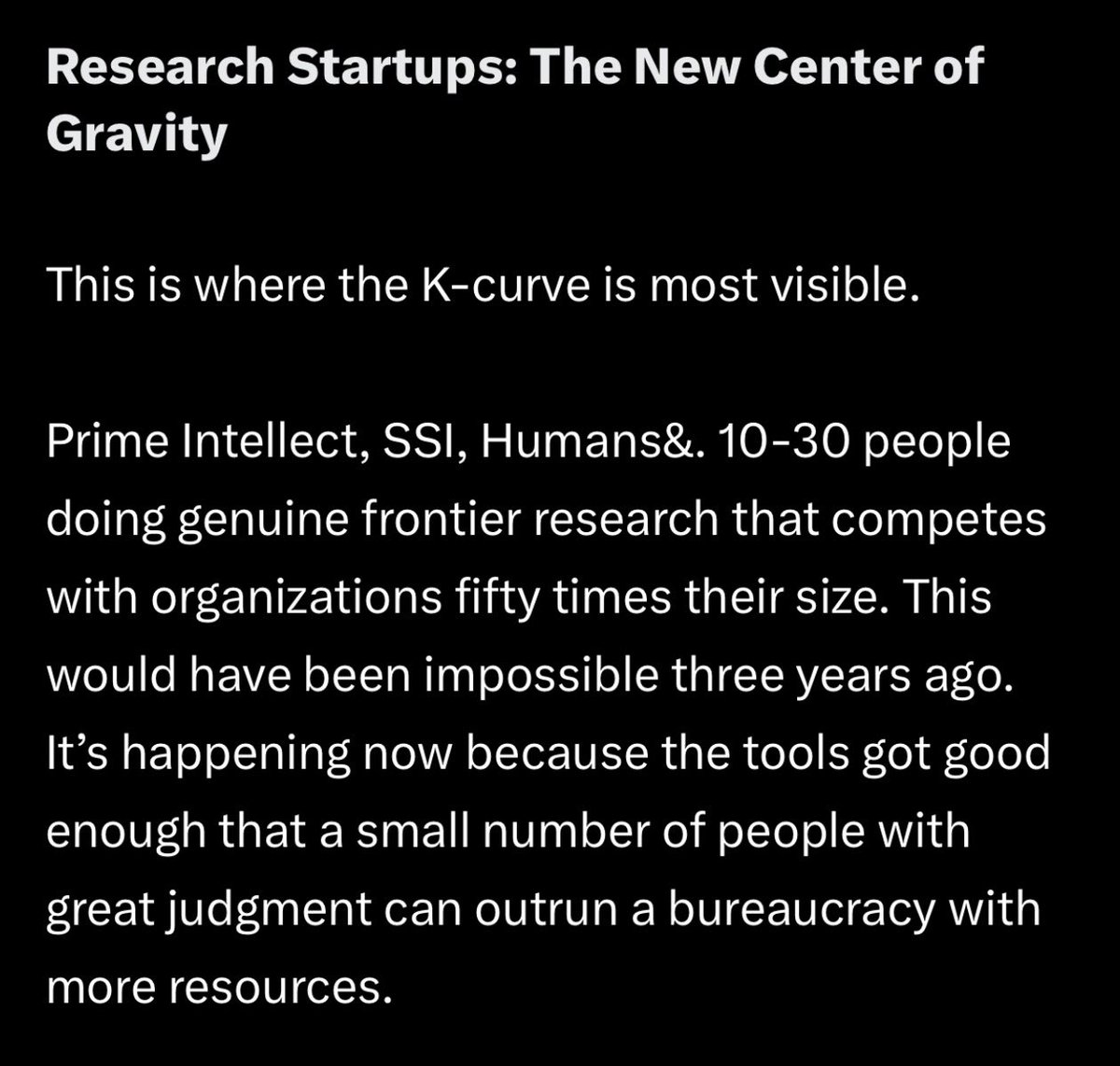
can confirm these are the vibes
if you’re questioning whether staying in academia, quant, big tech, or a big lab is how you want to spend the singularity, hit me up
Amy Tam@amytam01
English
Bubba ◎ retweetledi

It's been a while since I did an LLM architecture post. Just stumbled upon the Arcee AI Trinity Large release + technical report released yesterday and couldn't resist:
- 400B param MoE (13B active params)
- Base model performance similar to GLM 4.5 base
- Alternating local:global (sliding window) attention layers in 3:1 ratio like Olmo 3
- QK-Norm (e.g. popular since Olmo 2) and NoPE (e.g., SMolLM3)
- Gated attention like Qwen3-Next
- Sandwich RMSNorm (kind of like Gemma 3 but depth-scaled)
- DeepSeek-like MoE with lots of small experts, but made it coarser as that helps with inference throughput (something we have also seen in Mistral 3 Large when they adopted the DeepSeek V3 architecture)
Added a slightly longer write-up to my The Big Architecture Comparison article: magazine.sebastianraschka.com/i/168650848/20…

English
@HowToUseAI_ @NousResearch Only two days later have an open source model as good as Claude Opus 4.5 for coding
x.com/kimi_moonshot/…
Kimi.ai@Kimi_Moonshot
Here's a short video from our founder, Zhilin Yang. (It's his first time speaking on camera like this, and he really wanted to share Kimi K2.5 with you!)
English
@HowToUseAI_ @NousResearch Take a look at open source image models for instance. They are way better than closed source at this point.
Forest labs , stable diffusion models and their fine tunes on comfyui for instance.
Also we are getting smarter models on lower hardware requirements, e.g Qwen3-4B
English

Open source must win.
*Walter Bloomberg@DeItaone
OPENAI PLANS TO TAKE A CUT OF CUSTOMERS’ AI-AIDED DISCOVERIES
English
Bubba ◎ retweetledi
You can now run real-time voice agents on a single GPU.
Resemble AI just released Chatterbox-Turbo, a 350M parameter open-source TTS model with sub-200ms latency.
𝗖𝗵𝗮𝘁𝘁𝗲𝗿𝗯𝗼𝘅 𝗧𝘂𝗿𝗯𝗼 𝗿𝗲𝗱𝘂𝗰𝗲𝘀 𝗧𝗧𝗦 𝗰𝗼𝗺𝗽𝘂𝘁𝗲 𝗰𝗼𝘀𝘁𝘀
It uses a 350M parameter architecture with lower VRAM needs.
The decoder now runs in one pass instead of ten.
That removes the main generation bottleneck.
• Runs on consumer GPUs
• Works on CPU and Apple M-series
• Keeps high audio fidelity
𝗜𝘁 𝗮𝗱𝗱𝘀 𝗻𝗮𝘁𝗶𝘃𝗲 𝗲𝘅𝗽𝗿𝗲𝘀𝘀𝗶𝗼𝗻 𝗰𝗼𝗻𝘁𝗿𝗼𝗹
You can insert tags directly into text.
Examples include [laugh], [cough], and [chuckle].
This lets agents sound reactive without post-processing.
𝗜𝘁 𝘀𝗼𝗹𝘃𝗲𝘀 𝗹𝗼𝘄-𝗹𝗮𝘁𝗲𝗻𝗰𝘆 𝘃𝗼𝗶𝗰𝗲 𝗮𝘁 𝘀𝗰𝗮𝗹𝗲
The model targets real-time agents and narration.
It supports zero-shot voices and clean cloning from short references.
You can deploy it locally or integrate it into live systems.

English
Bubba ◎ retweetledi

Introducing LuxTTS: A 150x realtime high-quality voice cloning TTS model.
LuxTTS's other features:
- Highly expressive and realistic.
- Excellent voice cloning.
- Fit within 1gb vram.
- 2-6x realtime on CPU.
Repo: github.com/ysharma3501/Lu…
Model: huggingface.co/YatharthS/LuxT…
English