Andrew Kret

25.8K posts

Andrew Kret

Andrew Kret

@BuffKret2407

Buffs, Nuggets and politics

Denver Katılım Nisan 2014
281 Takip Edilen295 Takipçiler
Sabitlenmiş Tweet
Andrew Kret
Andrew Kret@BuffKret2407·
docs.google.com/document/d/1ak… Alright Buffs nation. I'm sick of people complaining about the athletic program and offering no ideas on how to help. As fans, we have the ability to take matters into our own hands. Would love for your feedback on this idea. #GoBuffs
English
9
12
91
0
Ron Filipkowski
Ron Filipkowski@RonFilipkowski·
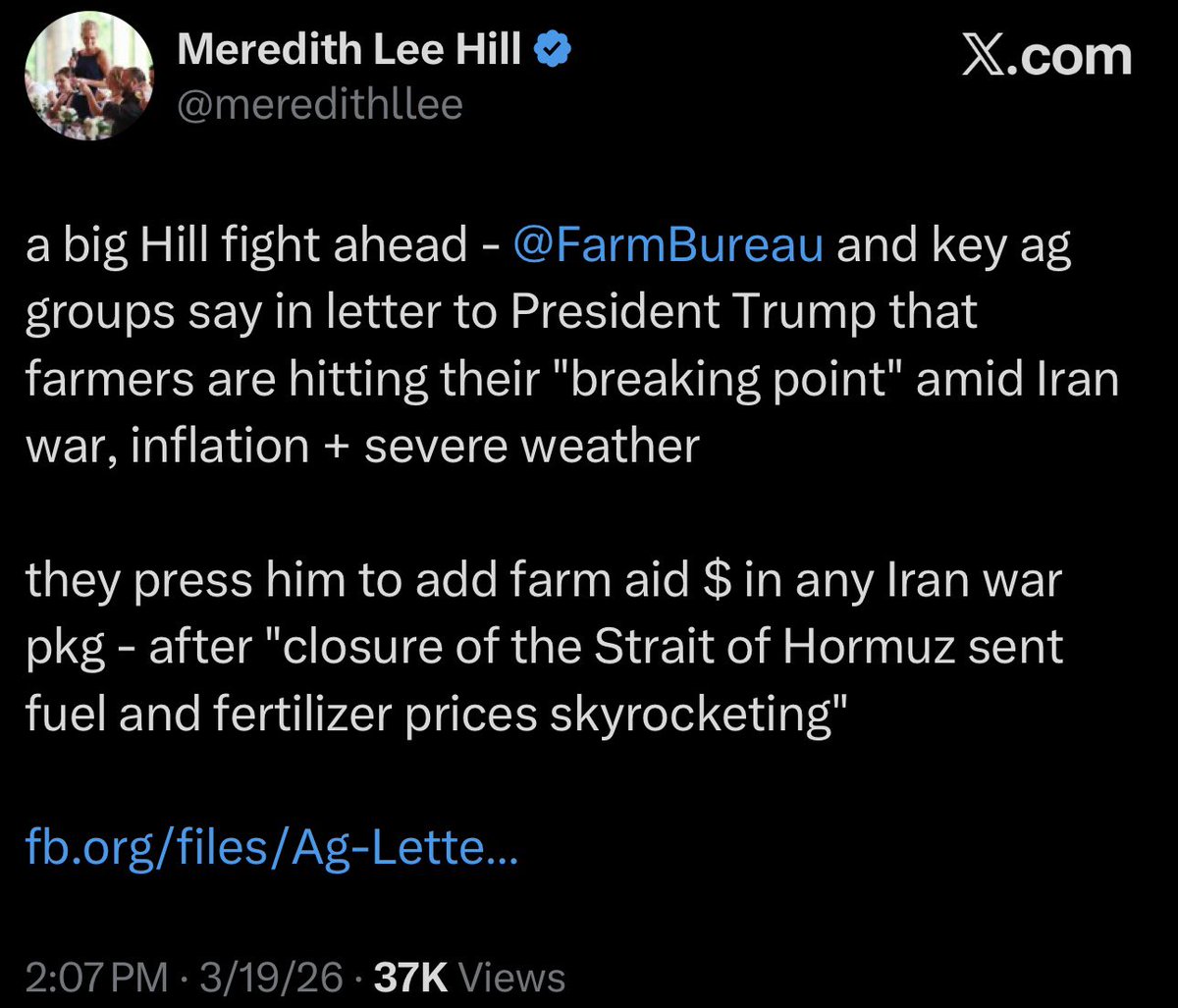
How many times do we have to give farmers billions of dollars because Trump’s policies screw them over constantly? They overwhelmingly voted for this guy 3 times. Ask him for the money - maybe he can sell some crypto.
Ron Filipkowski tweet media
English
70
301
981
20.7K
Ginny Robinson
Ginny Robinson@ImGinnyRobinson·
Why is Elon Musk suddenly hanging out with demonic Howard Lutnick? 🤔
Ginny Robinson tweet media
English
1.5K
1.1K
4.5K
190.1K
James L. Edwards III
James L. Edwards III@JLEdwardsIII·
The 65-game rule didn’t increase attendance like it was designed. Instead, it’s taken away deserved honors from some of the best players in the league.
English
64
60
547
365.8K
ja3k
ja3k@ja3k_·
Idk why gas prices are so culturally salient in america. You could drive an hour a day and it probably comes to less than $3k/year. Is it because they put the price on billboards along the road?
English
646
47
5.5K
1.6M
Andrew Kret
Andrew Kret@BuffKret2407·
@ironnfox @ja3k_ 30x2x250 =15,000 think your math is a little off. Maybe math is complicated for you?
English
3
0
1
441
Shanaka Anslem Perera ⚡
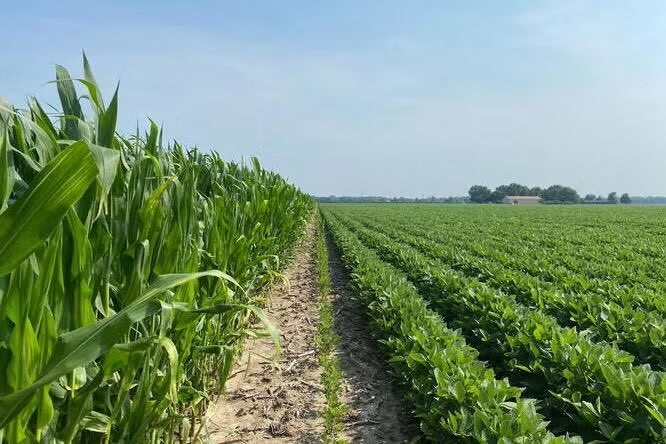
JUST IN: The most irreversible consequence of this war is not happening in Tehran. It is happening in a barn in Iowa. A farmer is standing over a kitchen table looking at two seed catalogues. One is corn. One is soybeans. Corn needs 180 pounds of nitrogen per acre. Nitrogen costs $610 per ton on the CBOT March futures settlement as of yesterday, up 35 percent in a month. Soybeans fix their own nitrogen from the atmosphere through root bacteria called rhizobia. They need nothing from the Strait of Hormuz. The farmer is choosing soybeans. Millions of acres are choosing soybeans. And once the planter rolls into the field, the choice cannot be reversed until next year. USDA projected corn at roughly 94 million acres for 2026, down from 98.8 million. Soybeans at 85 million, up from 81.2 million. Those projections were published February 19, before urea surged past $683 at New Orleans. The actual shift will be larger. USDA Prospective Plantings reports March 31. By then the seeds will be in the ground. This is the transmission channel the world is not watching. A 21-mile strait enforced by provincial commanders with sealed radio orders just rewrote the planting economics of 90 million acres of the most productive farmland on Earth. Not through sanctions. Not through diplomacy. Through the price of a single molecule that corn cannot grow without and soybeans do not need. Now follow the cascade. The Renewable Fuel Standard mandates 15 billion gallons of corn ethanol annually. That consumes roughly 43 percent of the entire US corn crop. The mandate is set by the EPA. It does not flex when corn acres shrink. It is inelastic demand consuming a fixed share of a declining supply. When supply tightens against a fixed mandate, the remaining corn reprices upward. Corn above $5 per bushel compresses every margin downstream. The US cattle herd stands at 86.2 million head, a 75-year low per USDA NASS. Poultry and pork operations face compression from higher corn prices. Feed is the single largest cost in livestock production. When feed reprices, protein reprices. When protein reprices, every grocery shelf in America absorbs the increase. This is the protein cascade. Corn to feed to meat to eggs to dairy to the checkout counter. Each link tightens because the link before it tightened. The originating cause is a urea molecule that cannot transit a strait because a provincial commander’s sealed orders say it cannot. The farmer did not start this war. The farmer cannot end it. The farmer responds to the price on the screen and the biology of the two crops in front of him. Corn needs the molecule. Soybeans do not. At $610 the arithmetic is settled. The planter rolls. The season is locked. Israel just authorised the assassination of every Iranian official on sight. The US has spent $16.5 billion. South Pars is burning. The Fed is holding rates because oil inflation will not break. Gold touched $5,000. Bitcoin is bleeding. China is running exercises near Taiwan. Sri Lanka shut down on Wednesdays. And underneath all of it, a man in a barn is making the decision that determines whether four billion people pay more for food this year. He has never heard of the Mosaic Doctrine. He does not know what a sealed contingency packet is. He knows what nitrogen costs. And he is planting soybeans. Full analysis - open.substack.com/pub/shanakaans…
Shanaka Anslem Perera ⚡ tweet media
Shanaka Anslem Perera ⚡@shanaka86

Right now, in barns and equipment sheds across the American Midwest, farmers are making the most consequential decision of this war. Not generals. Not senators. Farmers. At $683 per ton urea, corn economics have collapsed. Nitrogen is the single largest input cost for corn production. At pre-war prices a farmer could justify 180 pounds per acre and expect a margin. At $683 the math breaks. Soybeans fix their own nitrogen from the atmosphere through root bacteria. They do not need the molecule trapped behind the Strait of Hormuz. The seed decision is being made this week across roughly 90 million acres of American cropland. Once the planter rolls into the field, the choice is irreversible. Corn seed in the ground stays corn. Soy seed stays soy. The acreage allocation locks in. USDA Prospective Plantings reports March 31. That report will tell the world how American agriculture responded to the Hormuz blockade. But the decisions it captures are being made now, in conversations between farmers and agronomists and seed dealers who are looking at nitrogen prices and making the rational economic choice: plant the crop that does not need the input you cannot afford. Every acre that shifts from corn to soybeans tightens the corn balance sheet for the rest of the year. Corn feeds livestock. Corn feeds ethanol. The Renewable Fuel Standard mandates 15 billion gallons of corn ethanol annually, consuming roughly 43 percent of the US corn crop regardless of price. That demand is inelastic. If acres shift and production falls while the mandate holds, corn prices spike. Feed costs spike. The protein cascade reverses. The US cattle herd sits at 86.2 million head, a 75-year low. Poultry and pork margins that were benefiting from cheap feed compress when corn crosses $5 per bushel. This is how a naval blockade 7,000 miles from Iowa reaches the American grocery shelf. Not through oil. Not through shipping. Through nitrogen. The farmer cannot afford the molecule. The molecule cannot transit the strait. The farmer plants soy instead. The corn supply tightens. The ethanol mandate consumes its fixed share. The remaining corn reprices. The feed reprices. The meat reprices. The grocery bill reprices. The decision is not political. It is arithmetic performed on a kitchen table by a person who needs to plant in three weeks and cannot wait for a ceasefire, an escort convoy, or an insurance normalisation that the Red Sea precedent says takes years. The deepest penetrator in the American arsenal cannot reach a sealed Iranian doctrinal packet. But the fertiliser price it failed to resolve is reaching every planting decision on 90 million acres of the most productive farmland on Earth. The war’s most irreversible consequence is not happening in a bunker. It is happening in a barn. And by the time USDA publishes the data on March 31, the seeds will already be in the ground. Full analysis in the link. open.substack.com/pub/shanakaans…

English
287
1.7K
4.8K
1.1M
Cody Roark
Cody Roark@CodyRoarkNFL·
$963 for vehicle registration is criminal. Colorado taxpayers who renew their registration every year pay insane prices.
English
194
65
1K
43.9K
Iberian America
Iberian America@Iberianamerica·
Thank God for Mexican Food 🇲🇽
English
335
1.1K
11.2K
5.9M
Andrew Kret
Andrew Kret@BuffKret2407·
@ironnfox @ja3k_ What do you do for work where you drive 35k miles per year?! If you’re driving 35k miles per year, unless you need a truck for work (if you need a truck for work then gas would be tax deductible), don’t buy a truck…
English
3
0
4
1.2K
T Dog
T Dog@ironnfox·
@ja3k_ You’re high. If I was to buy a badass truck like a Ford Raptor I’d spend closer to 13k a year. 35k miles annually in California Let’s say I get 25mpg. Closer to 8k annually.
English
29
0
25
31.4K
Andrew Kret
Andrew Kret@BuffKret2407·
@ja3k_ Major pet peeve of mine! 😂 $3 gas vs $4 gas increases yearly household expenses for the average American by like 1% to 2% for the year.
English
0
0
1
43
Lain on the Blockchain
Lain on the Blockchain@CryptoCyberia·
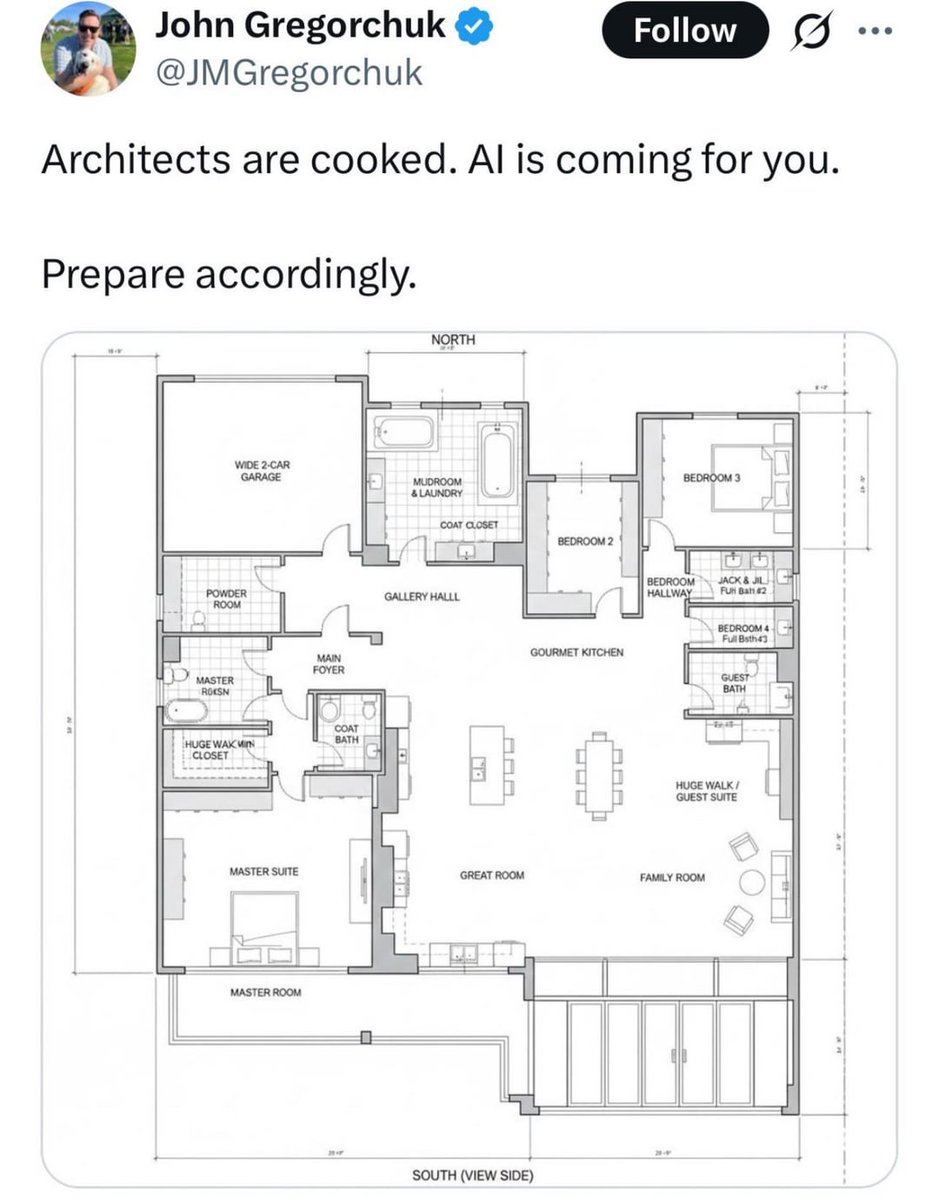
Every AI worker replacement product so far summarized perfectly in a tweet.
Lain on the Blockchain tweet media
English
752
450
7.3K
1.3M
Andrew Kret
Andrew Kret@BuffKret2407·
@ArtCandee Maybe he can turn on a water spout like he did in California…
English
0
0
0
93
Art Candee 🍿🥤
Art Candee 🍿🥤@ArtCandee·
The largest wildfire in Nebraska history, the Morrill Fire, is only 18% contained. The second largest, the Cottonwood Fire, is "larger than the entire city of Omaha." Crickets from Donald Trump. Barely a blip from the media.
English
117
1.9K
6.1K
54.3K
Andrew Kret
Andrew Kret@BuffKret2407·
@Acyn Graham thinks that no one remembers what happened in 2003…
English
0
0
1
139
Acyn
Acyn@Acyn·
Graham: If it were known to the American public that there were less than two weeks away from having ten bombs and Trump acted, it would change everything. They're suppressing this story! To my friends at the WH, you should take this story and run. It is national security malpractice not to be telling this every day.
English
278
53
242
87.5K
Andrew Kret
Andrew Kret@BuffKret2407·
@Noahpinion Have none of these people watched; Terminator, Matrix, Eagle Eye, literally any doomsday movie?!
English
0
0
1
162
Andrew Kret
Andrew Kret@BuffKret2407·
@mcuban You’d have significantly more power to do that as President of the United States…
English
0
0
0
7
Signal and Circuit
Signal and Circuit@Signal_N_Circit·
@rshereme Because... Not this might hurt your head... He made a case for it.. Shocking right?
English
43
0
9
2.1K
Roman Sheremeta 🇺🇸🇺🇦
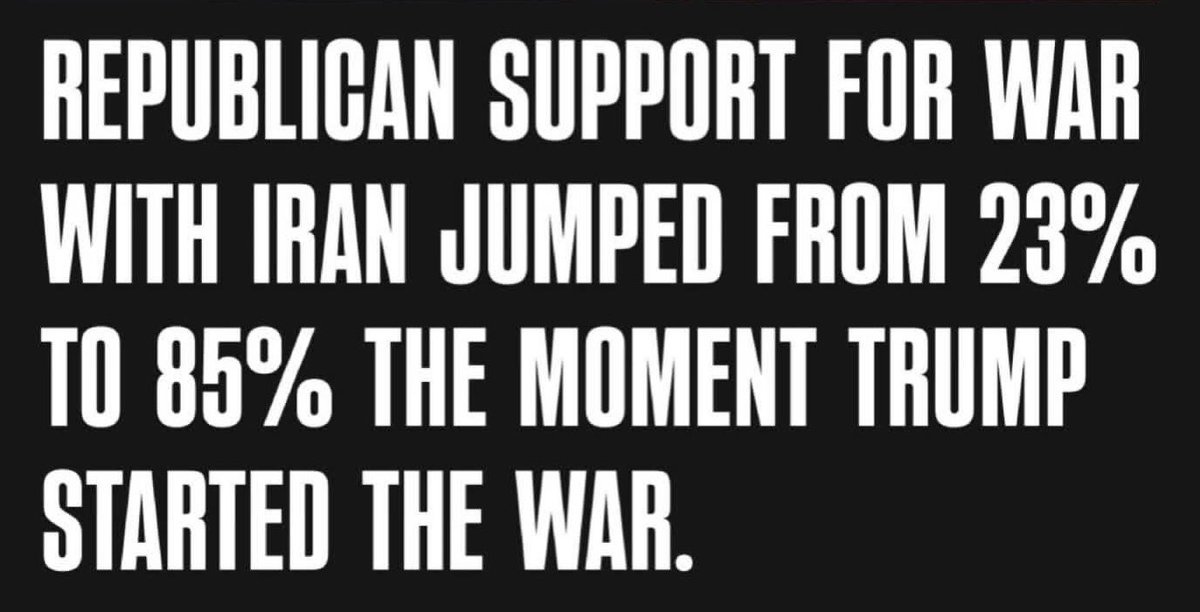
I honestly cannot explain this. Before the strikes on Iran, Republican voters were overwhelmingly opposed to U.S. involvement in a conflict between Israel and Iran. A survey by YouGov and The Economist found that only 23% of Republicans supported U.S. military involvement, while 53% opposed it. However, attitudes shifted almost immediately after Trump ordered U.S. airstrikes on Iran. A survey conducted after Trump’s bombing campaign showed support climbing to 85% among Republicans. For me, this rapid reversal illustrates one thing — Trump has transformed the Republican Party into a cult, where people follow not principles, but a man.
Roman Sheremeta 🇺🇸🇺🇦 tweet media
English
1.7K
1.9K
7.7K
436.5K
Paul A. Szypula 🇺🇸
Paul A. Szypula 🇺🇸@Bubblebathgirl·
@atrupar Another out of context quote. Full quote shows Hassett saying this is “going ahead of schedule” so consumers should be fine. All Aaron does is lie.
English
135
4
55
11.4K
Aaron Rupar
Aaron Rupar@atrupar·
Hassett: "If the war were to be extended, it wouldn't really disrupt the US economy very much at all. It would hurt consumers, and we'd have to think about what we'd have to do about that, but that's really the last of our concerns right now."
English
1.5K
3.2K
8.8K
3M
Andrew Kret
Andrew Kret@BuffKret2407·
@atrupar @carlquintanilla This man’s job is to be an economic advisor to the president…and yet it doesn’t appear that he knows how the economy works!!! 😅
Andrew Kret tweet media
English
0
0
0
11
Andrew Kret
Andrew Kret@BuffKret2407·
@_Investinq The first company to do this is immediately losing 20%…the market will punish companies that choose to report semi-annually…
English
0
0
0
60
StockMarket.News
StockMarket.News@_Investinq·
Every public company on the stock market, Apple, Tesla, Walmart, all of them is currently required by law to report their finances every 3 months.​ Four times a year, they have to open the books and show investors exactly how much money came in, how much went out, and what they think is coming next.​ This rule has been standard practice since 1970. The SEC just announced they're drafting a proposal that would kill that quarterly requirement.​ Instead of 4 reports a year, companies would have the choice to file just twice.​ The proposal could be published as soon as next month, and it's being pushed directly by Trump and his SEC Chair, Paul Atkins. The core argument behind this change is a concept called short-termism. Basically, when executives know they have to report every 90 days, they start making decisions designed to look good on the next report rather than building something great over the next decade.​ Trump's framing of it is that China plans 50-100 years ahead, while American CEOs are managing quarter to quarter.​ On top of that, putting together one of these reports can cost a company anywhere from $50,000 to over $1 million and takes around 180 hours of work per filing.​ Cut reporting in half, and you cut that burden in half too.​ The people against this change have one main word, transparency.​ Quarterly filings are one of the most reliable ways fraud and financial trouble gets caught early, investors comb through the numbers every 3 months and spot when things don't add up.​ Go to 6 month gaps, and a company could be quietly falling apart for half a year before the public ever knows.​ Regular retail investors get hurt the most here, big institutions have private lines to management, everyday investors don't.​ There's also a serious insider trading concern, executives would sit on non-public financial information for much longer windows before disclosing it.
unusual_whales@unusual_whales

BREAKING: The Securities and Exchange Commission is preparing a proposal to eliminate the quarterly earnings report requirement and instead give companies the option to share results twice a year, per WSJ

English
59
412
2.7K
671.9K