
BullMoon
380 posts


@heynavtoor DocuSign charging 24K-39K/year for 50 people to put signatures on PDFs. The signing costs nothing. You pay for integration and compliance. Or self-host Signatory and skip the invoice entirely.
English

DocuSign Personal: $10 to $15 per month.
DocuSign Standard: $25 to $45 per user per month.
DocuSign Business Pro: $40 to $65 per user per month.
A 10-person team on Business Pro pays $4,800 to $7,800 a year. To put signatures on PDFs.
A team of 50 pays $24,000 to $39,000 a year.
And there is a 100-envelopes-per-year cap on most plans. Send more contracts and you pay extra.
Need SMS delivery? $0.40 per send.
Need ID verification? $2.50 per attempt.
Need premium support? $5,000 to $50,000 per year add-on.
You are rationing digital signatures in 2026.
DocuSign is a $10 billion company built entirely on this pricing model.
Now meet DocuSeal.
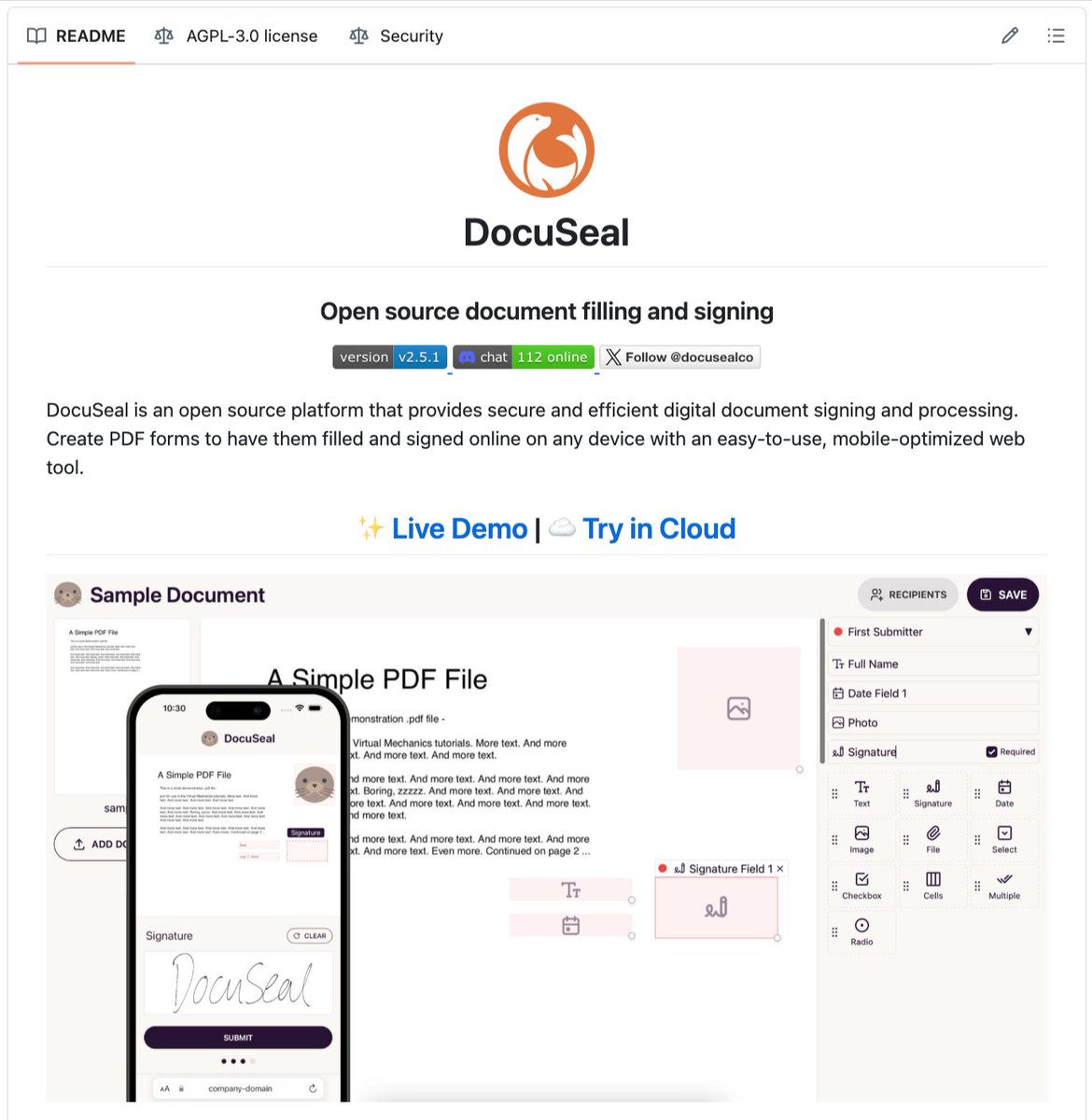
A free and open source alternative to DocuSign.
Created in 2023 by a Ruby developer named Alex who was simply trying to sign one document and realised every solution online was overpriced or required a subscription.
Three weeks later he had a working alternative. He pushed it to GitHub under the AGPL-3.0 license.
Today it has 11,800+ stars and over 1,000 forks. Bootstrapped. No VCs. No paywalls.
Here is what DocuSeal does:
- Upload any PDF and turn it into a fillable, signable form
- Drag and drop signature fields, dates, checkboxes, file uploads, and 13 field types
- Send to multiple signers with custom signing order
- Automated email reminders
- Mobile signing on any device
- PDF signature verification built in
- Audit trail for every document
- Bulk send and templates
- Full API access
- Self-host with one Docker command
Here is what DocuSeal costs:
Zero. Forever. Unlimited documents. Unlimited signers. Unlimited storage.
DocuSign limits envelopes. DocuSeal doesn't.
DocuSign charges per SMS. DocuSeal doesn't.
DocuSign charges for ID checks. DocuSeal doesn't.
DocuSign sees your contracts on their servers. DocuSeal doesn't.
Here is the wildest part:
The median DocuSign contract per Vendr is $17,250 per year. One Reddit thread has people saying "they want me to pay $4.80 per e-signature."
Self-host DocuSeal on a $5 cloud server and a 50-person team can sign as many contracts as they want without paying a single dollar.
Your contracts never leave your server. Your client lists. Your NDAs. Your employment agreements. None of it touches a third-party company.
For individuals who only sign a few contracts a year, you save $180.
For small teams of 10, you save up to $7,800 a year.
For a 50-person company, you save up to $39,000 a year.
Your documents. Your signatures. Your server.
100% Open Source. (Link in the comments)
English

Pretty incredible
You have to try the new '/goal' feature in Codex
It worked for over an hour and built me an entire complex extraction shooter video game
You give it a goal, then it works endlessly until the goal is complete. It's like a Ralph loop. Can run for days
If you enable the image gen skill before you run the goal, it will even generate ALL the assets for your game autonomously. I didn't manually create ANY of the assets you see in the video
Recommendations: enable the image gen skill, put on skip all permissions, and give the prompt as much detail as you can. It will accomplish ALL of it
This has to be the sickest way to build games/ long running app tasks ever
English


(Sorry, after seeing so many of these, could not resist):
🚨 BREAKING: Google just dropped a NEW paper that completely deletes RNNs from existence.
No recurrence. No convolutions. Nothing.
Just one mechanism. And it’s destroying every translation benchmark on the planet.
The title alone is a flex: “Attention Is All You Need”
Vaswani. Shazeer. Parmar. Uszkoreit. Jones. Gomez. Kaiser. Polosukhin.
8 researchers. 1 architecture. The entire field of NLP will never be the same.
Here’s why this is INSANE
→ LSTMs took DAYS to train. This thing trains in 12 hours on 8 GPUs. 🤯
→ 28.4 BLEU on English-to-German. That’s not an improvement. That’s a MASSACRE. They beat the previous SOTA by over 2 points.
→ English-to-French? 41.8 BLEU. At a FRACTION of the training cost of every model that came before it.
→ They called it the “Transformer.” The name alone tells you they knew.
But here’s the part nobody is talking about
👇
They threw out sequential processing ENTIRELY.
Every other model on Earth processes words one at a time. This thing looks at the ENTIRE sentence simultaneously and figures out what matters.
It’s called “self-attention” and it’s basically the model asking itself: “which words should I care about right now?”
Every. Single. Token. In parallel.
Do you understand what this means?
Training that used to take WEEKS now takes HOURS.
Models that couldn’t scale past a few layers? This thing stacks 6 encoders and 6 decoders like it’s nothing.
And the multi-head attention? 8 attention heads running at once, each learning DIFFERENT relationships in the data.
I’m not being dramatic when I say this paper just rewrote the rulebook.
RNNs are cooked. 💀
LSTMs are cooked. 💀
The future is attention.
And attention is ALL you need.
Follow for more 🔔

English

Eric Schmidt (ex-Google CEO): “if you really want to make money, it’s actually easy. found an agentic AI company.”
spoiler: the supply of builders is tiny. the demand is enormous.
this guy is literally giving away the exact 2026 playbook to build and sell AI automations to make $10k/mo
bookmark and start this weekend
Khairallah AL-Awady@eng_khairallah1
English
@Pirat_Nation VideoLAN releasing dav2d for AV2 decoding on CPU is how open standards win. AV1 took years for hardware support. AV2 with a CPU decoder from day one means adoption starts immediately.
English

VideoLAN has released a new open-source tool called dav2d.
It is a CPU-based decoder for AV2 video, AV2 is the next open video format after AV1 and promises better compression and higher quality.
dav2d is based on VideoLAN’s popular dav1d decoder for AV1, works on many platforms and focuses on being fast and correct.
The code is now public on VideoLAN’s GitLab site. This is an early project because the full AV2 standard is not finished yet.

English
@luthiraabeykoon @karpathy MicroGPT on FPGA at 50K tokens/sec proves inference does not need GPUs. Burning a transformer into hardware is the endpoint of the local AI thesis. The future of edge AI is silicon, not PyTorch.
English

We implemented @karpathy 's MicroGPT fully on FPGA fabric.
No GPU.
No PyTorch.
No CPU inference loop.
Just a transformer burned into hardware, generating 50,000+ tokens/sec.
The model is small, but the idea is not: inference does not have to live only in software 👇
English
@AnatoliKopadze Meta spent 40 billion and 10 years on hand tracking. One guy did it with Claude in a weekend. The 40B bought polish. The weekend bought proof of concept. The gap is distribution, not capability.
English

Meta spent $40 billion and 10 years trying to make hand tracking feel natural.
This guy did it with Claude in a weekend.
No code written. No team. No hardware. He described what he wanted, Claude built it.
The app tracks every finger, every joint, every movement live on his laptop. Physics bend around his hands in real time.
The $40B industry just got embarrassed by one person with a Claude subscription.
Everything you need to start building like this is in the article above.
Anatoli Kopadze@AnatoliKopadze
English

@ihtesham2005 Syncthing replacing Dropbox, iCloud, and OneDrive for 0 dollars is the right pattern. No company can kill it because no company controls it. P2P sync with end-to-end encryption beats cloud storage on both privacy and permanence.
English

Say goodbye to Dropbox, iCloud, and OneDrive subscriptions.
Someone open-sourced a sync tool that replaces all three for $0. And no company can shut it down.
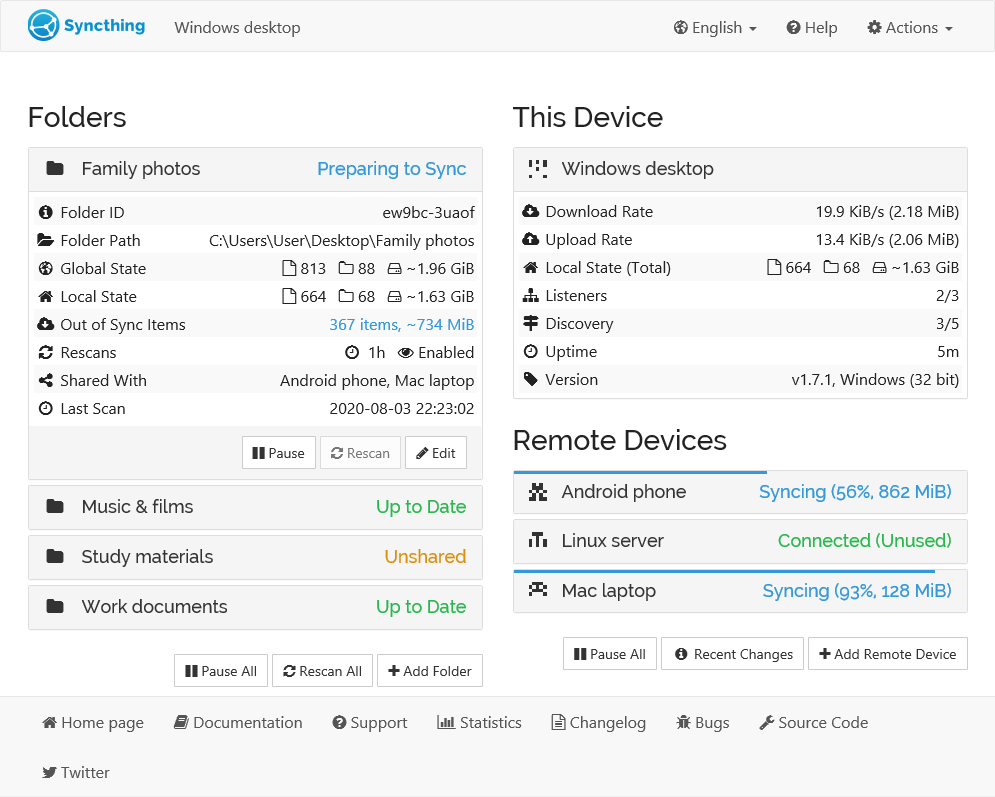
It's called Syncthing.
Here's how it works:
Every cloud storage company on earth routes your files through their own servers. That's not a technical requirement. That's a business model.
Syncthing skips the server entirely.
→ Your devices connect directly to each other
→ Every transfer is TLS encrypted with perfect forward secrecy
→ Every device is authenticated by a cryptographic certificate
→ Nothing moves without your explicit permission
→ Works on Windows, macOS, Linux, Android, FreeBSD
No account. No subscription. No company holding a copy of your files.
Dropbox can raise prices. iCloud can change its terms. Google Drive can shut down tomorrow.
Syncthing runs on your own machines. There's no server to breach. No company to pressure. No subscription to cancel.
One install. Your devices. Your files. Your rules.
100% Opensource.
syncthing.net
English

Boris Cherny, the creator of Claude Code at Anthropic, just listed 9 patterns that waste 73% of your tokens.
in this podcast he breaks down exactly how the model burns tokens before it even reads your prompt:
- the 14% you lose to CLAUDE.md before typing a word
- the 13% you pay re-reading old chat history
- the 11% from hooks you forgot you installed
- why most "Claude got dumber" complaints are wrong
if you're hitting Max limits more than once a week, you have at least 4 of these. Probably 7.
instead of another show tonight, watch this.
my own breakdown based on 400+ hours of usage is below, read it after the podcast
Mnimiy@Mnilax
English
@arrakis_ai The MS Paint prompt for GPT Image 2 is proof that image models understand style transfer at the prompt level. Ask for clumsy and scribbly and you get intentional badness. The model knows what bad looks like because it learned what good looks like.
English

This GPT Image 2 prompt is going insanely viral right now.
“Redraw the attached image in the most clumsy, scribbly, and utterly pathetic way possible. Use a white background, and make it look like it was drawn in MS Paint with a mouse. It should be vaguely similar but also not really, kind of matching but also off in a confusing, awkward way, with that low-quality pixel-by-pixel feel that really emphasizes how ridiculously bad it is. Actually, you know what, whatever, just draw it however you want.”


English

POV: you realize a $0 expired patent can turn into a $72,000/year Amazon product while everyone else is still scrolling TikTok for “winning products”
Gipp 🦅@gippp69
English

After this interview, Jane Street hired this Quant analyst at $220,000–$600,000/year
In 21 minutes, you’ll learn what a Tier 1 hedge fund interview is like
Here are some of the questions they ask:
1. You have $100, fair coin.
Heads - you get 2x your bet back, tails - you lose it. 100 flips.
What's the optimal bet size?
2. So what exact percentage should you bet?
3. Will you bet the same amount all 100 times or adjust your strategy?
4. Prove mathematically that betting 100% of bankroll maximizes EV at any capital size
5. What if the starting bankroll is $150 - does anything change?
6. Calculate the expected return over 100 flips with the optimal strategy
7. You roll a fair die until you get 3-4-5 in a row. What's the probability you roll an odd number of times?
Quant answered all these questions in the video
__
Bookmark & watch it to find out how to get into a hedge fund
bodila@51bodila
Jane Street hired this junior at $220k-$600k /year because he uses AI to analyse TRILLIONS of data in this 1-hour lecture - he show how to research trillion of data points thanks to his machine Bookmark & watch it, instead of Netflix to learn how to do the same!
English

An Estonian banker is sitting on $566 MILLION and can't move a single cent because he lost his password
In 2014 Rain Lõhmus, the founder of Estonian bank LHV, bought $75,000 in the Ethereum ICO and received 250,000 ETH at 30 cents per coin
He stored it in a presale wallet, locked it with a password and never touched it again
The wallet has been dormant ever since, holding even more ETH than Vitalik Buterin himself
In 2023 Coinbase exec Conor Grogan publicly tagged the address as Lõhmus's and asked the internet for help
Lõhmus went on Estonian radio days later and admitted it saying "it's no secret I have a wallet with 250,000 Ethereum, anyone can calculate for themselves what it's worth"
He has publicly offered to split the funds 50/50 with anyone who can crack the wallet and said his best remaining plan is to "build an AI version of myself and see if it can recover my memories"
The wallet is worth $566 million today and peaked at $1.2 BILLION in 2021

English