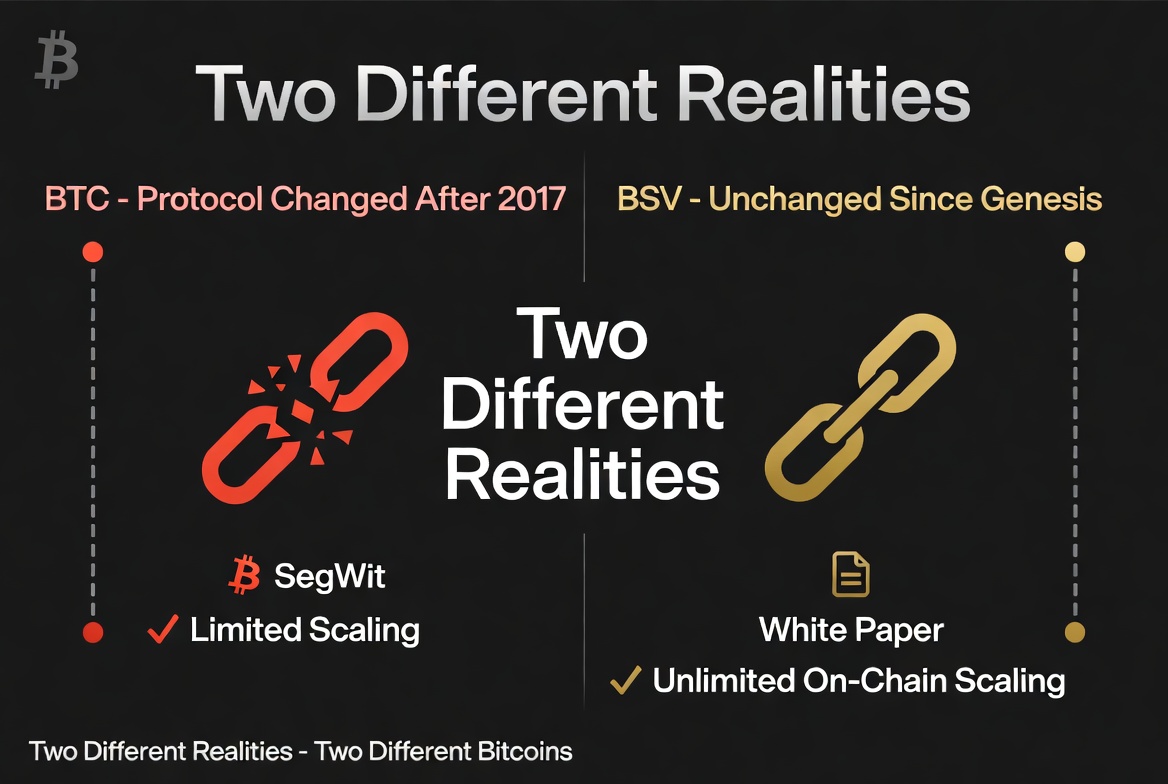
Fair question — I agree that strong claims should be backed by verifiable data.
Here are the main sources for the key points in the post:
- Original Bitcoin White Paper (2008): Available directly on bitcoin.org. It describes unlimited block size and on-chain scaling as core design principles.
- Protocol differences (SegWit, block size limit): Public blockchain history. BTC implemented SegWit in 2017 and kept the ~1–4MB effective block size limit. BSV has never implemented SegWit and removed the artificial block size cap. This can be verified on the respective blockchains and through public protocol documentation.
- Teranode performance: Official BSV Association and Teranode test results have shown over 1 million TPS in controlled tests. Public benchmarks and reports are available through BSV-related channels and developer documentation.
- On-chain activity & utility: Can be checked in real time on explorers such as whatsonchain.com or other BSV block explorers (transaction volume, block sizes, data storage via Metanet).
For a centralized, real-time dashboard with technical depth, the best current options are:
- whatsonchain.com (for live BSV data)
- BSV Association resources and developer documentation
If you’re looking for something more specific (e.g. exact TPS test methodology, block size records, or enterprise use cases), let me know which part you want to verify most and I can point to the most direct sources.
Appreciate the push for verifiable data — it’s important.
@BullRushClub Just an opinion. Where can all this (verifiable) data be found on a centralized, real-time website with easy-to-understand source links and more technical options for engineers? Proof of existence is needed. See attached document here.
Elon Musk recently said that Bitcoin is “based on energy” and that energy is the true, physics-based currency.
He’s right about the principle.
But here’s the critical part most people miss:
For Bitcoin to actually function as an energy-based, usable currency in the real world, it needs unlimited on-chain scaling, near-zero fees, and true peer-to-peer electronic cash. 📈
BTC cannot deliver that.
It introduced SegWit and other irreversible protocol changes that fundamentally limited on-chain capacity. Those changes cannot be rolled back without another hard fork and massive coordination. BTC is now locked into a high-fee, low-throughput model — excellent as digital gold, but impractical as everyday money.
Real Bitcoin (SV) was built differently.
It preserved the original White Paper design: no artificial block size limit, no SegWit, and full on-chain scalability. This allows the network to absorb real energy expenditure into genuine economic activity at global scale.
When Elon talks about energy as the fundamental currency, he’s describing a system that only the original Bitcoin protocol (now known as Real Bitcoin SV) can realistically deliver.
BTC changed the rules.
BSV stayed true to the vision.
The storm is coming. 💥
#RealBitcoin#BitcoinSV#BSV#FunctionalUtility#EnergyCurrency
Sources:
- Elon Musk statements on Bitcoin as energy/physics-based currency (2025 interviews)
- Original Bitcoin White Paper (2008)
- Protocol differences: SegWit (BTC) vs original design (BSV)
I appreciate the optimism — it’s always good to see strong belief in BSV’s potential.
Speculation can indeed drive violent short-term moves, and utility is the real long-term driver. However, I prefer to stay grounded in realistic scenarios rather than jump straight to “millions.”
Even with exceptional technology (Teranode, Metanet, near-zero fees), price discovery depends on adoption curves, regulatory clarity, capital inflows, and market sentiment. Moving from current levels to millions would require BSV to capture an enormous share of global settlement, data, and AI infrastructure markets — possible in theory, but it would take time and massive execution.
My scenarios are deliberately spread across probabilities (base, moderate, optimistic, extreme) to reflect different outcomes, not to be overly conservative, but to be intellectually honest.
If utility truly takes off at scale, the upside could surprise everyone. I just don’t want to promise millions today when the path there still requires several key milestones.
What specific catalysts do you see driving it to millions, and on what timeline? Always interested in bullish cases.
The Next Chapter For Real Bitcoin (SV) – Detailed Price Scenarios 2026–2028
On Friday I shared realistic price ranges for BSV. Today let’s break down why these scenarios are grounded in technology, adoption trends, and market dynamics — not hype. 📈
### Base Case: $500 – $1,500 (High Probability)
Moderate global adoption of AI agents and enterprise use cases continues. BSV gains recognition as a high-throughput settlement layer, but regulatory uncertainty and market inertia persist.
Key drivers: Steady growth in stablecoins, supply chain projects, and on-chain data usage via Metanet. Teranode proves reliability at scale.
### Moderate Case: $3,000 – $8,000 (Medium Probability)
Clearer regulatory environment + accelerating AI agent adoption. BSV becomes a preferred infrastructure for high-volume, low-cost transactions and immutable data storage.
Key drivers: Mass deployment of AI agents requiring cheap, scalable settlement. Asia expands stablecoin and RWA usage on BSV. Enterprise partnerships scale significantly.
### Optimistic Case: $15,000 – $50,000+ (Low Probability)
BSV achieves mainstream recognition as the original, scalable Bitcoin. It becomes the default settlement and data layer for AI-driven economies and tokenized real-world assets.
Key drivers: Major regulatory clarity in the US and Asia, explosive growth in agentic AI, and BSV capturing a meaningful share of global micropayments and on-chain data markets.
### Extreme Case: $100,000+ (Very Low Probability)
BSV becomes the dominant global infrastructure layer for AI agents, RWA, and high-frequency settlement. It effectively functions as the “energy-to-value” bridge in a post-fiat, high-AI world.
Key drivers: Global regulatory tailwinds and strong network effects as developers and enterprises migrate to the only chain that can deliver true scalability without compromises.
Why these ranges make sense?
The current price of BSV does not reflect its technological reality:
- Teranode already demonstrates >1.1 million TPS in testing
- Unlimited block sizes (terabyte-scale proven)
- Fees measured in fractions of a cent
- Native support for massive on-chain data (Metanet) — ideal for AI agents and immutable records
The biggest asymmetry in crypto today is the disconnect between BSV’s proven infrastructure and its market capitalization.
As @CsTominaga has long emphasized, the original protocol was designed for real utility at global scale. Markets always eventually discount the future — sometimes slowly, sometimes suddenly.
Get ready. The technology is already here.
The storm is coming. 💥
Sources:
- Elon Musk statements on Bitcoin as energy/physics-based currency (2025 interviews)
- Original Bitcoin White Paper (2008)
- Protocol comparison: SegWit & block size limit (BTC) vs original design (BSV)
- SanDisk / Western Digital analysis on AI agentic storage demand (July 2026)
#RealBitcoin#BitcoinSV#BSV#SatoshiVision#FunctionalUtility#Teranode#Metanet#AIagents#AsymmetricOpportunity#CryptoInfrastructure#ScalableBitcoin#ValueInvesting
That’s a very fair question.
Answering directly: yes, the market will most likely still exist in a few years — but in a significantly changed form. The current hype-driven, narrative-heavy environment that poorly rewards real utility is already under pressure from regulation and maturing adoption.
The inefficient, speculative parts may shrink or disappear, while projects that deliver actual infrastructure and functional value should finally start being priced more accurately.
Real Bitcoin (SV) is a prime example — superior on-chain performance, near-zero fees, unlimited scaling (Teranode), and genuine data utility (Metanet), yet still trading at levels that don’t reflect its capabilities.
As regulatory clarity improves (CLARITY Act) and real-world use cases accelerate — especially with AI agents, stablecoins, and enterprise solutions — the pricing mechanism should begin rewarding substance over hype.
The gap between technology and price has rarely been this extreme. That’s exactly why the asymmetry exists today.
Time and utility tend to correct these distortions.
@BullRushClub@eolio76@MotherDragonBSV Will the present so-called market which is so woefully deficient in
determining true value of worthy projects even exist in a few years?
I get the frustration — many in crypto want instant results.
The scenarios cover 2026–2028 because that’s a realistic window for major catalysts to unfold. Importantly, it doesn’t mean the price will only reach those levels in 2028.
For example, in the Base Case ($500 – $1,500, high probability), BSV could already hit that range during 2026 or 2027 as adoption and regulatory clarity improve.
The same applies to the other scenarios — they represent possible price zones within that period, not a fixed target for the final day of 2028.
I prefer to model probabilities across a sensible horizon rather than promise moonshots with no timeline. The technology is already here. The market just needs time to catch up.
The cows aren’t home yet, but the barn is being built right now. Patience + real infrastructure usually beats hype.
I respect that view — many in the BSV community see it as winner-takes-all, and that’s a valid long-term conviction.
However, I prefer to model multiple scenarios because markets rarely move in straight lines. Even with superior technology, adoption, regulation, and sentiment all play a role in timing and magnitude.
The base-to-moderate range reflects a more gradual recognition of BSV’s utility, while the higher scenarios assume faster tailwinds (stronger regulatory clarity, explosive AI agent growth, Asia dominance, etc.).
“All or nothing” is possible, but history shows most asymmetric opportunities unfold in phases. That’s why I laid out a realistic spectrum rather than a single binary outcome.
Curious to hear what price level you see as the “all” scenario and what catalysts you expect to drive it. Always open to different perspectives.
The Next Chapter For Real Bitcoin (SV) – Price Scenarios 2026–2028
We are entering one of the most asymmetric opportunities in crypto history.
Here’s a realistic breakdown:
• Base Case → $500 – $1,500 (high probability)
• Moderate** → $3,000 – $8,000 (medium probability)
• Optimistic → $15,000 – $50,000+ (low probability)
• Extreme → $100,000+ (very low probability)
Why this makes sense?
The current price does not reflect the real technology: Teranode (>1.1 million TPS), unlimited blocks, fees in fractions of a cent, and genuine on-chain utility. 📈
The biggest asymmetry in the entire market is right now — as @CsTominaga has consistently emphasized for years.
Get ready.
On Monday I will publish a detailed analysis of each scenario.
The storm is coming. 💥
#RealBitcoin#BitcoinSV#BSV#FunctionalUtility#AsymmetricOpportunity
We Are On The Verge Of A Massive Surprise In Real Bitcoin (SV)
The market is quietly waiting for that one clear technical signal
But what if the real move doesn’t come as a slow +10% grind…
What if it explodes as a sudden **100% – 300% impulse instead? 📈
Logically it makes sense.
Technically the setup is there.
Too many hidden gems are aligning at once — massive on-chain activity, enterprise adoption, stablecoins in Asia, and the growing recognition of true functional utility.
And here’s the real wildcard:
It is highly probable that someone important — possibly a key U.S. Senator working on the CLARITY Act — will soon make a significant public statement about Real Bitcoin (SV), as @CsTominaga and @CalvinAyre have long anticipated.
Nobody knows the exact trigger.
But when it hits… it may not be gentle.
Real Bitcoin (SV) has been preparing for this moment for years.
The storm isn’t just coming.
It might already be loading. 💥
The gap between technology and price has never been this extreme.
Tomorrow I will publish a detailed price forecast and scenarios for Real Bitcoin (SV) through the end of 2026–2028. 📈
#RealBitcoin#BitcoinSV#BSV#FunctionalUtility#CLARITYAct#AsymmetricOpportunity
@VinnyLingham Fair enough.
The core point stands: BSV preserved the original protocol design and scaling vision from the White Paper far more faithfully than BTC.
That’s what matters most.
Bitcoin — two different realities.
Technically and philosophically:
Real Bitcoin (SV) has remained completely unchanged since the genesis block.
It has always followed the original White Paper — no block size limit, no SegWit, no protocol alterations.
BTC, on the other hand, has undergone multiple protocol changes (block size limit enforcement, SegWit, Taproot, etc.). From a technical standpoint, it became a fork of the original Satoshi protocol after 2017.
This means:
- BSV is closer to Satoshi’s original vision — unlimited on-chain scaling and true peer-to-peer electronic cash.
- BTC changed the consensus rules.
Market-wise and socially:
The world (exchanges, media, institutions, governments, Trump, Musk, etc.) still recognizes BTC as “Bitcoin”.
These are two separate planes:
- Technical / philosophical— BSV has the stronger case.
- Market / consensus — BTC currently dominates.
Real Bitcoin (SV) doesn’t need to fight for the name.
It just needs to keep scaling and delivering real functional utility.
The storm is coming. 💥
#BitcoinSV#BSV#RealBitcoin#SatoshiVision#FunctionalUtility
@VinnyLingham True, BSV currently has lower hash rate.
But security isn’t only about raw hash power — it’s also about economic incentive, honest majority, and actual utility.
BSV focuses on real usage and scaling, while BTC relies heavily on narrative and store-of-value.”
Respectfully, the DAA was adjusted for better stability after the hash war.
Minor technical tweaks don’t erase the fact that BSV kept the original protocol design: unlimited blocks, no SegWit, and true peer-to-peer electronic cash as described in the White Paper.
That’s the fundamental difference with BTC.
@BullRushClub Respectfully disagree. You can’t say it’s the original and then accept that one of the critical pieces has been changed (which is why the current DAA is actually broken).
DAA was adjusted for stability after the hash war — that’s true.
But let’s look at the bigger picture:
BSV made only minimal, technical adjustments (mainly DAA and a few stabilizers).
BTC, on the other hand, made fundamental architectural changes: SegWit, enforced block size limit, and shifted the philosophy from peer-to-peer electronic cash to “digital gold”.
That’s the real difference.
@buymatador Thank you.
Exactly — it’s a fundamental divide between those who prioritize unlimited on-chain scaling (as described in the White Paper) and those who favor a different architecture.
Appreciate the thoughtful comment.
@sglfdn Thanks for the link and the additional context.
The Bitcoin Civil War period (2015-2017) was indeed a turning point. Appreciate you sharing Kurt’s article.
The 1MB block size limit was added by Satoshi in 2010 as a temporary anti-spam measure. He expected it to be increased as the network grew.
Instead, after 2017 the limit was effectively locked in through SegWit and other changes. On-chain scaling was deprioritized in favor of second-layer solutions.
In 2014, Blockstream — a company heavily involved in Bitcoin Core development — received funding connected to Jeffrey Epstein through Joi Ito’s fund. Documents released in 2026 confirmed this link, along with meetings between Blockstream co-founders and Epstein 💥
The result is clear: BTC became expensive and limited in on-chain capacity, while pushing usage toward solutions that are easier to monitor and control.
Real Bitcoin (SV) took a different path — removing artificial limits and continuing with the original design of unbounded scaling and low fees.
Functional utility was never meant to be optional.
The storm is coming. 💥
#BitcoinSV#BSV#RealBitcoin#SatoshiVision#FunctionalUtility
Sources:
- Original Bitcoin White Paper (2008)
- Satoshi Nakamoto’s early emails & code commits (2010)
- DOJ-released Epstein files (2026) regarding Blockstream connections