Bully Watch

2.2K posts

Bully Watch banner
Bully Watch

Bully Watch

@BullyWatchUK

Raising awareness of the scale of large Bully-related dog attacks and fatalities in the UK. We advocate for regulation of Pitbull type dogs.

United Kingdom Katılım Temmuz 2023
44 Takip Edilen5.4K Takipçiler
Sabitlenmiş Tweet
Bully Watch
Bully Watch@BullyWatchUK·
What next for dangerous dog policy? A new Labour administration will still face the continued policy problem of how to effectively deal with dangerous dogs within communities. This is not a unique problem to the UK; dog fatalities have steadily increased in Europe and the United States. The data is consistent regarding the vastly disproportionate role of pit bull-type dogs in the rise of fatalities and as a proportion of serious attacks in virtually every country where their population has increased. However, other large, powerful dogs are also having an impact. The current situation has been exacerbated by successive Labour and Conservative Governments who have refused to give political time and capital to dog control policy as a whole. It is our view that the single most effective and transformational policy change a Labour administration can make both to prevent dog attacks and to increase canine animal welfare is to regulate dog breeding by mandating that every single dog litter comes from a licensed breeder. There is no doubt that dangerous dogs impacts working-class areas and communities the most. Looking at exemption data for XL Bullies, ownership of XL Bullies is concentrated in areas of high deprivation. Fourteen of the top 25 areas for ownership per capita are in deprived communities within Liverpool. We also know that dog bites are higher in areas of low socio-economic deprivation. The highest area of dog bites in Wales, for example, is in Swansea Bay, an area with some of the highest levels of deprivation in the entirety of the UK. Large social factors at play here can't be tackled in isolation, and Labour's policy agenda as a whole will help address this to some extent. There are also clear connections between the ownership of powerful "status" dogs and anti-social behaviour. Someone can purchase or obtain a large dog with no checks and brandish it within dense urban communities in the same way one would brandish a knife or a gun. For instance, in Swansea just a few days ago, a man decided to walk his large Dogue de Bordeaux off-lead through a group of 90 primary school children picking litter off a beach. It turns out this dog had already attacked a number of other dogs before. While in theory, the Dangerous Dogs Act (DDA) could be applied in this situation, in practice, securing a conviction would likely be challenging (not to mention expensive). Taking intimidatory incidents like the above in aggregate, it becomes impractical under current regulations for police and dog wardens to manage the ownership of large, powerful dogs given finite resources for enforcement. Police can only realistically act after someone has been significantly injured. We see time and time again where communities know which dogs are dangerous, but police are unable or unwilling to act before an incident takes place. In addition, dog control is costly. Local authorities are legally obliged to collect and kennel stray dogs. Police are legally obliged to seize and kennel dogs that are dangerously out of control. Kennelling costs can easily reach thousands of pounds for a single dog. Indeed, the Metropolitan Police spends millions of pounds each year on kennelling dogs alone. There is also the cost in terms of staff time to prosecute dangerous dog offences both to the police and the CPS, who can easily be tied up further or dismissed on technicalities if cases go through the appeals process. Additionally, there is the cost to the NHS in treating victims of dog attacks, and finally, the cost to rescue centers largely funded by public donations in rehabilitating dogs. What this means in practice is that the public are continuously subsidizing the ownership of large, powerful dogs. The question, therefore, is what do you do to tackle this going forward? We firmly believe that all reform should be rooted within breed-specific legislation - a model which is now adopted by the majority of the world when it comes to dog ownership. Certain breeds should have additional barriers to ownership and further checks and balances. Breed-neutral legislation has, over time, been shown to be a radical policy position which hasn't produced the desired results it initially promised and is almost entirely rooted within American pit bull advocacy which peaked during the early 2010s. We'll actually go a step further - in countries where breed neutral approaches have been rolled out, most notably Italy, it has now become an unmitigated disaster. All of the arguments against it in terms of ineffectiveness and breed identification issues have been produced with the sole aim of lobbying for pit bull ownership. Breed-specific legislation allows a targeted and preventative approach. The idea of cracking down on all irresponsible dog owners is a complete fantasy. We spend billions a year trying to tackle the fallout from irresponsible parents. The annual expenditure in the UK for children's social care is 11.1 billion pounds. Councils employ 33,000 social workers and 7,500 agency workers for children. Even then, we are still unsuccessful. NSPCC estimates 1 in 10 children will be neglected. 1 in 14 children will be physically abused. In comparison, there are roughly 400 dog wardens and 120 dog legislation officers covering the same number of dogs. That roughly works out to one person employed for every 20,000 dogs. A targeted approach allows us to funnel scarce resources where it can be most effective. A roadblock for dangerous dog reform continues to be campaigning groups and animal welfare organisations who put forward ineffective and impractical policy solutions with no consideration of costs. The RSPCA and others have pushed for a Calgary-like licensing model because it's conveniently the only breed-neutral model which campaign groups claim has been effective. But there are two issues. First, the equivalent cost for the UK to adopt the Calgary model would be anywhere from £300 to £600 million pounds per year. Calgary meets roughly half this shortfall by charging a licensing fee - the rest is subsidized by the city of Calgary. (There is also a separate challenge for Labour - in light of pledges not to raise taxes, attempting to introduce a licensing fee could be interpreted by the public as a Dog tax.) Second, the Calgary model hasn't actually worked. It's under immense strain due to increases in the popularity of pit bulls. In recent years, it has tried to propose additional measures but has been rebuffed by campaign groups. Two years ago, a grandmother was mauled to death by her neighbor's three pit bulls. He was a pit bull advocate. Calgary publishes data on dog attacks and severity by breed. Despite only being a small population of the resident dog population, pit bulls are responsible for the most severe dog attacks by far. So what is the solution? Inaction is unacceptable. Inaction is what led in part to the proliferation of the American XL Bully despite a longstanding pit bull ban in the UK. It's clear something needs to happen. Regulate Dog Breeding Fundamentally, the problem starts with breeding, and we believe pound for pound the best preventative public investment that can be made both for animal welfare and in reducing dog attacks is to crack down on breeders. We follow a number of backyard breeders online and have seen how they have been able to continue operating with impunity. Occasionally, some are prosecuted due to joint RSPCA and police investigations over animal welfare concerns where they receive pitiful sentencing. In practice, they can continue to operate freely. Part of the problem is there is far too much ambiguity in the requirements for licensing of breeders. It currently stands that you need to either produce more than three litters a year or be able to pass a "business test." In reality, this provides far too much wiggle room for abuse. The threshold requirement for licensing should be reduced from three litters to one. In addition to the licensing fee, we would propose an additional fee charged per litter of dogs registered. If we assume there are 70,000 litters per year, then this has the potential to raise £7,000,000 a year from licensing as well as additional income for local authorities through mandatory licensing. The funds can be used to hire an additional 150 licensing officers to manage registrations and work with local police and the CPS to crack down on backyard breeders of status dogs. We propose the Government seed fund for the first three years of the scheme's operation before it becomes self-sustaining and commit to a target of at least 200 prosecutions a year. The message has to be clear - if you breed status dogs for profit the police will be coming for you. Demand for dogs is inelastic; the price people were willing to pay for dogs during Covid demonstrated that. The result of these changes would be to create the first steps in dog ownership infrastructure while simultaneously supporting improvements in animal welfare. There are other policy decisions which would make a significant impact. We laid them out almost a year ago now in our report - consolidating existing dog control legislation, establishing a database of dog bite incidents, regulating dog training and bite work, reforming sentencing and penalties for dog-related offences, and introducing mandatory third-party insurance so that victims can effectively seek compensation, but we believe that a focus on dog breeding would produce the best outcomes over the long term and should be prioritised. The victims of dog attacks throughout these past years deserve better. We hope a Labour Government makes sure that their sacrifices have not been in vain and finally addresses longstanding issues in dog ownership - the alternative of inaction can not be afforded once again.
Bully Watch tweet media
English
15
17
60
30.7K
Bully Watch
Bully Watch@BullyWatchUK·
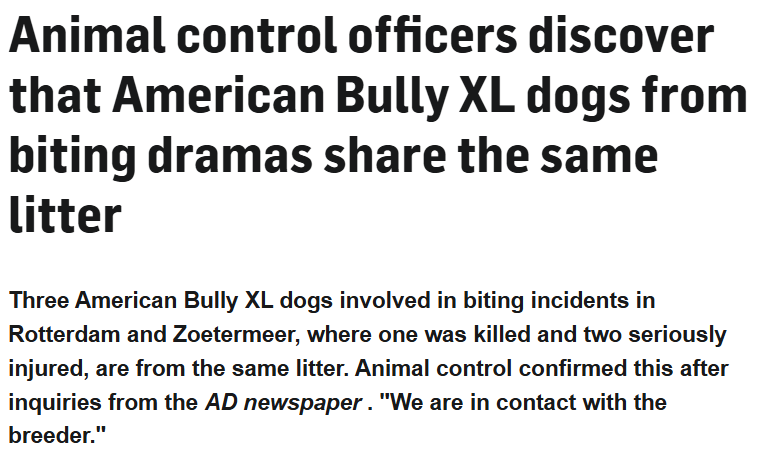
In the Netherlands, three Bully XLs involved in a fatality and two serious injuries were found to have come from the same litter. ad.nl/binnenland/die…
Bully Watch tweet media
English
0
5
11
1.1K
Bully Watch
Bully Watch@BullyWatchUK·
Our thoughts are with the victims friends and family at this time.
English
0
0
8
1.4K
Bully Watch
Bully Watch@BullyWatchUK·
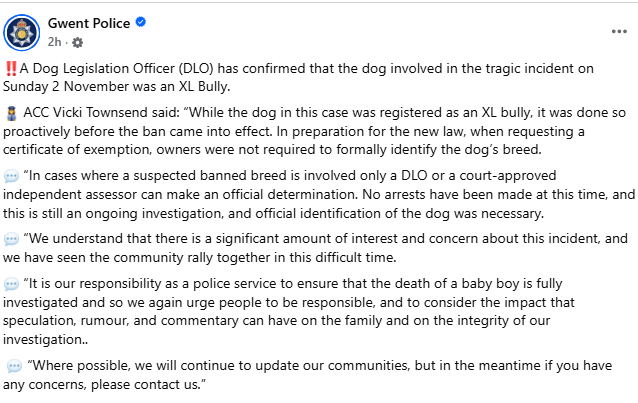
An nine-month baby boy was killed by a 6-year exempt bully XL in Rogiet. Neighbours say the dog could have been spooked by fireworks. This is the 24th person in the UK to be killed by an XL Bully, XL Bully cross or pit bull terrier since November 2021.
Bully Watch tweet media
English
4
9
23
7.1K
Bully Watch
Bully Watch@BullyWatchUK·
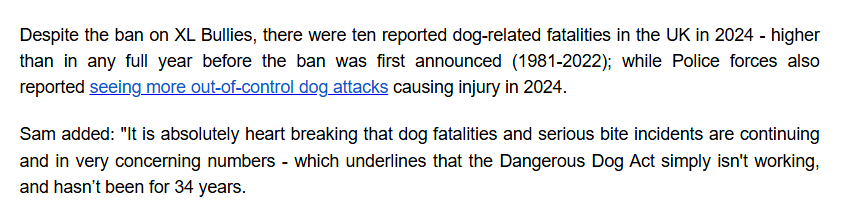
The RSPCA continue to be incredibly disingenuous. Out of 10 fatalities last year, 6 were caused by XL Bullies and 1 caused by a APT. Out of the 2 fatalities this year, both were caused by XL Bullies. It's really hard to take their call for an evidence based approach seriously.
Bully Watch tweet media
English
1
5
19
2K
Bully Watch
Bully Watch@BullyWatchUK·
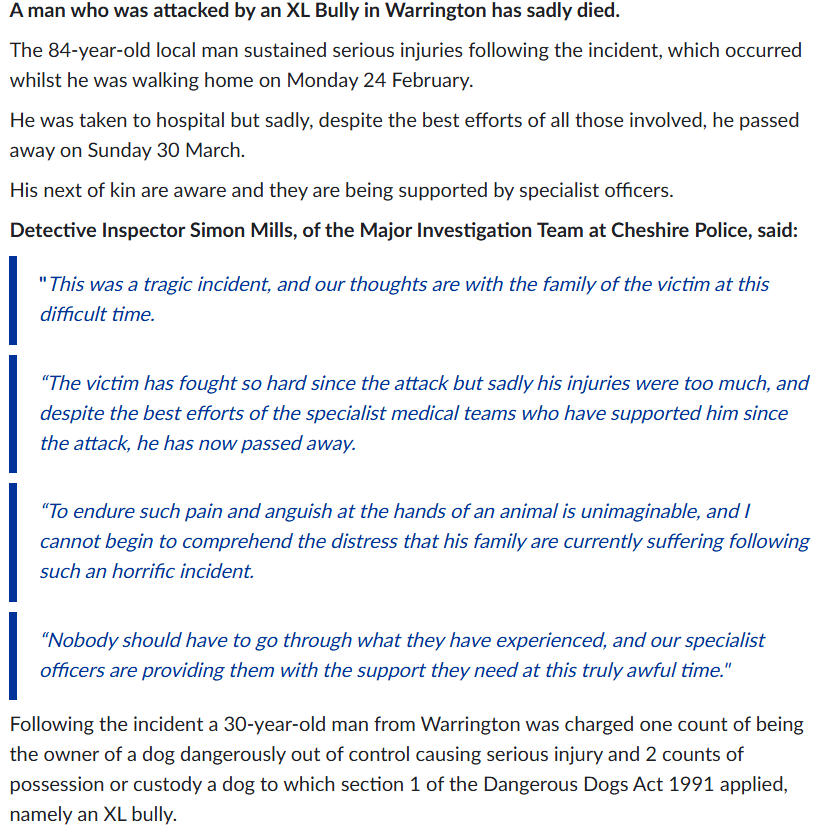
An 84 year old man in Warrington who was attacked by an escaped XL Bully while walking in February has sadly passed away from his injuries. This is the 23rd person in the UK to be killed by an XL Bully, XL Bully cross or pit bull terrier since November 2021.
Bully Watch tweet media
English
12
49
130
10.1K
Bully Watch
Bully Watch@BullyWatchUK·
Morgan Dorsett from Shropshire is the 22nd person in the UK to be killed by an XL Bully, XL Bully cross or pit bull terrier since November 2021. 19 years old. Whole life ahead of her. Rest in peace Morgan.
Bully Watch tweet media
Bully Watch@BullyWatchUK

The death of Michelle McLeod marks the 20th person in the UK to be killed by an XL Bully or XL Bully cross since November 2021. That number rises to 21 when you add the death of Akif Mustaq to a pit bull. 7 people have been killed by a pit bull or XL bully this year alone.

English
8
52
172
19.3K
Bully Watch
Bully Watch@BullyWatchUK·
27 days later.
Bully Watch tweet media
English
5
20
120
5.8K
Bully Watch
Bully Watch@BullyWatchUK·
A 19 year old girl was killed by a suspected XL Bully in Bristol yesterday. This marks the 21st person in the UK to be killed by an XL Bully or XL Bully cross since November 2021. Our thoughts go out to her friends and family.
Bully Watch tweet media
English
16
39
164
75.4K
Bully Watch
Bully Watch@BullyWatchUK·
@BenedictTreloar @dsquareddigest @stianwestlake See here for a write up if you're interested! x.com/BullyWatchUK/s…
Bully Watch@BullyWatchUK

📚Long Read: As Parliament debates Breed Specific Legislation (BSL) today, let’s remember the original proponents for BSL - the RSPCA, Dogs Trust, Kennel Club, the BVA, and the RCVS. There has been a far amount of revisionism in discussing what led to the Dangerous Dogs Act (DDA) of 1991. The movement to ban Pit Bulls in the DDA was a result of RSPCA lobbying and the act had the principled support of the BVA, RCVS, the Dogs Trust (Canine Defence League) and the Kennel Club. In fact, animal welfare organisations spent 10 years campaigning to ban Pit Bulls, essentially advocating for Breed Specific Legislation. It was the Government at the time that wanted to maintain Breed Neutral Legislation astoundingly using at the time almost word for word the arguments used today by the RSPCA, et. al. RSPCA experts labelled the American Pit Bull Terrier in 1991 as fundamentally dangerous. The secretary of the Kennel Club likened the American Pit Bull Terrier to “buying a gun without realising that it might go off one day.” It advised its member to not deal or own them. One of the most senior inspectors of the RSPCA was left alone with two American Pit Bull Terrier puppies when they first entered the country in the 1970s. He said in hindsight that if he could turn back the clock, he would have put them both down there and then. The legislation may have been knee-jerk but the sentiment behind it at the time was hardly a knee jerk reaction. It was being pushed for years, due to the prevalence of dog fighting, significant attacks and the number of fatalities being recorded at the time from Pit Bulls in the United States. One RSPCA hospital was having to treat dogs from 2 or 3 fights per day. There were significant attacks which pushed the Government’s hand (BNL advocates are quick to say these were non-fatal – omitting how truly horrific these attacks and their circumstances were). On 8 May, Frank Tempest (pictured below), aged 54, had his face ripped off by two escaped pit bull terriers as he walked home from his shift at a bakery in a Lincoln suburb. The attack lasted 30 minutes. Had there not finally been public intervention, he would have almost certainly died. On 17 May, police constable John Cooper received bites to his throat by a pit bull terrier in Newcastle. What tipped public sentiment at the time was certainly the attack on Rukhsana Khan shortly afterwards, a 6 year old girl in Bradford. She was tossed around like a rag doll on the street by a pit bull terrier for 15 minutes while onlookers struggled to free her. It took a group of men using bricks and sticks to beat the dog off her before she could be taken to hospital with more than 30 wounds from the dog's attack. A doctor said the injuries were the worst he had ever seen. She too barely escaped death. The DDA was popular at the time. However, it would soon encounter difficulties with its implementation and enforcement as well as public backlash of healthy dogs being put down. Initially stakeholders felt the act was successful. It significantly reduced the population of Pit Bulls from 10,000 in 1991 to 1,067 in 2007. And indeed – fatalities from dogs were relatively low in the 1990s. The Dangerous Dogs Act: Implementation and Challenges Over time cracks emerged. Proving a dog was a Pit Bull “type” in court proved incredibly costly, resource intensive, and only half of prosecutions were upheld. (It still is) Muddying the waters further, criminals began crossing pit bull terriers with other breeds (such as the Staffordshire Bull Terrier) to circumvent DDA typing. Local police began seeing many more incidents of weaponised Staffy crosses used as status dogs and for low level dog fighting. A lack of effective enforcement bolstered the underground commercial business in the breeding of pit bull terriers. Dog fighting boomed again. It’s understandable why major stakeholders felt under the circumstances that the DDA needed a rethink. It’s intended purpose was to not only tackle fatalities, but dog attacks and dog fighting – and there is clear evidence that it wasn’t working sufficiently. In the early 2000s, Pit Bulls began appearing again. Between 2004 to 2008, the RSPCA saw a 12-fold increase in calls reporting dog fighting. Between 2008 and 2009 the number of Pit Bulls seized by the Metropolitan police increased by 65%. Weaponised dogs and dogs for dog fighting accounted for the greatest proportion of those accused of dangerous dog offences. At the same time, bull breeds began to account for almost half of all dogs homed at Battersea – which was more than double the proportion five years ago. Muddying the waters further, 2007 also marked the start of a concerted US lobby effort to rebrand the pit bull from dangerous fighting dog to a “family friendly pet” alongside the extensive publicity of Michael Vick’s dog fighting case. Animal Farm Foundation (AFF), a prominent anti-BSL group, started as a horse rescue in 1985, then shifted focus to pit bull dogs when the founder adopted a pit bull and "discovered that 'pit bull' dog owners were not welcome in a lot of communities and spaces. Media campaigns were launched to sanitise the reputation of pit bulls. A private research body was purchased by AFF called the National Canine Research Council which critics say employs tobacco industry tactics by cherry picking and misrepresenting data, arguing over terminology, and dismissing independent media statistics. Many of the studies used to try and argue against BSL and obfuscate empirical data comes from the NCRC – including those used by the RSPCA. As the population of pit bulls grew again in the UK, so did pit bull fatalities. From 2005 to 2018 – there were 31 fatalities involving dog attacks in England and Wales. Despite being a banned breed with restricted ownership, Pit Bulls were still involved in 6 of these. In hindsight– its undeniable that the DDA, with all its flaws, still successfully saved lives by restricting pit bull ownership. In comparison, between 2005 to 2019 in the United States – Pit Bulls killed 346 people. Adjusting for relative populations, Pit Bulls were 941% more lethal in the United States than in the UK. Enter the American Bully It is absolutely no surprise then, when a dog that is functionally a Pit Bull type, gains popularity and enters general ownership, that fatalities in the UK skyrocket. We believe that at least 14 deaths in the UK can be attributable to the American Bully from 2021 to 2023. Fundamentally, the American Bully is a legal type of Pit Bull. The American Bully was developed through crossbreeding the American Pitbull Terrier and the American Staffordshire Terrier by a small group of Pit bull enthusiasts in the United States during the 1990s. The goal was to develop a Pit bull with an exaggerated musculature through line breeding (inbreeding) – not initially to develop a new breed. Every individual dog's ancestry can be traced back to these two Pit Bull breeds. Increased demand and popularity during the late 1990s and 2000s pushed the American Bully into becoming a designer dog. The breed was bred further from a limited genetic pool. Breeders also started producing different colours, aesthetic features, and sizes after noticing these productions could fetch higher prices. This led to the development of the XL variety as breeders crossbred these dogs with working line Mastiffs. However, due to papering (the forging of pedigrees) we are unable to ever confirm which other breeds fully have been incorporated. Bully Watch has seen over 25 self-reported DNA tests which strongly suggests that the modern Bully XL is roughly 50% American Staffordshire Terrier, 20 – 25% American Pit Bull Terrier and any number of combinations of different mastiffs and bull breeds for the remaining 25%. The breed was imported to the UK sometime around 2015. It was inbred aggressively once again by an even narrower handful of breeders, further reducing the genetic pool. The breed was first reported in mainstream media in 2017, when four American Bully XLs escaped the garden of a breeder and mauled a toddler close to death in Dingle. The breed began gaining popularity with UK breeders in 2019. However, it was Covid and the pandemic which triggered an explosion of first-time breeders and the involvement of criminal gangs in dog breeding. The Bully XL was aggressively bred with puppies selling for anywhere between £3,000 - £5,000 pounds. The breed was directly responsible for the explosion of canine fertility clinics as well as the development of co-ownership models to allow for further breeding. The American Bully should be genetically considered a type of pit bull as opposed to an entirely new breed. The American Pitbull Terrier is the product of roughly 500 years of selective breeding for traits including jaw strength, a high tolerance for pain, gameness, bite style and an increased prey drive. First though bull baiting starting in the 1500s then through dog fighting starting in the 1880s. Due to this selective breeding, pit bulls are highly dog aggressive. We do not believe it possible, through a handful of generations, to create a safe companion animal through the use of pit bull stock and indeed we are troubled that some American Bullies can trace their lineage to champion fighting stock APT from the 1980s and 1990s. Breed Specific Legislation or Breed Neutral Legislation A central challenge for any dangerous dog legislation is how can you successfully legislate to prevent the constant of Pit Bull fatalities. A challenge that all policy makers struggle with. The empirical data, no matter how much pit bull advocates attempt to water it down, is overwhelming. From 2018 to 2021, 17 peer-reviewed scientific papers, based on hospital data, consistently found that pit bull-type dogs were responsible for the highest number of dog bites requiring hospitalization and resulted in the most severe injuries. Sadly, Breed Neutral Legislation (BNL) is not a panacea. BNL has not been found to be an effective either. Denver repealed BSL in 2020, and in the following years, Pit Bulls still accounted for more reported bites than any other breed. 21% of these bites were classified as Level 4 or Level 5 on the Dunbar Scale. New York abolished BSL in 1991, yet between 2015 and 2017, Pit Bulls were responsible for 30% of all dog bites – over seven times more than any other breed. Calgary, which is held up as the gold standard of BNL, saw Pit Bulls responsible for 16% of all dog bites in 2014, despite comprising only 3% of the dog population. Tragically, in 2022, an 86-year-old woman was mauled to death by her neighbours’ three escaped Pit Bulls, with no criminal charges filed against the owner. Conversely, data suggests that BSL can be effective. Cities and counties in at least 14 U.S. states have reported successful outcomes after enacting breed-specific legislation. These states include Arkansas, California, Colorado, Iowa, Kansas, Maryland, Michigan, Missouri, Nebraska, Pennsylvania, Rhode Island, South Carolina, Washington, and Wisconsin. Similarly, the province of Ontario in Canada, following its 2005 Pit Bull ban, and Manitoba have reported positive results. Globally and in Europe, the issue of Pit Bull-related fatalities is increasingly a concern. Incidents from this year alone in Europe include: ● In Germany, a relative’s American Bully mauled an 87-year-old grandmother to death. ● In Austria, a 60-year-old jogger was fatally attacked by a leashed American Staffordshire Terrier, identifiable only by her clothing due to the severity of her injuries. ● In Italy, an 86-year-old woman was killed by an escaped Pit Bull. ● In the Netherlands, a baby was mauled to death by a family Pit Bull. ● In Greece, a mother was found dead, killed by her son’s Pit Bulls. ● In Poland, two men were killed by their own Pit Bulls. ● In Spain, two women were fatally attacked by Pit Bulls, one of whom had recently rescued the animal. It is worth adding, despite its flaws, the UK police have continuously supported as a policy the principle of BSL and in particular – the ban on pit bulls. The empirical evidence on dog bite fatalities, particularly involving Pit Bull type breeds, is compelling and difficult to dispute. It raises serious questions about the public messaging of the RSPCA and other animal welfare organizations, which often assert that breed is not a predictor of risk. This stance frequently relies on studies produced not by scientific bodies but by lobbying groups. Empirical data suggests that pit bulls are consistently disproportionately represented in fatality and attack data. Our stance is unequivocal. We believe that the only policy effectively safeguarding public safety is one that either phases out or significantly restricts Pit Bull type breeds. This position is rooted in a tragic reality: even if BNL were enacted, eventually the prevailing evidence would strongly suggest a subsequent need to reintroduce a ban on Pit Bulls. Any policy which doesn’t, as a matter of principle, target pit bull breeds is fundamentally flawed. BNL rests on the assumption that humans don’t make mistakes themselves. And it rests on the assumption that one has to wait for the “deed” to be committed before judging a dog. Sadly, in the case of pit bulls – once the deed is committed – for some it will be far too late. Keep this in mind when parliament debates American Bullies and breed specific legislation today.

English
0
0
0
372
Dan Davies
Dan Davies@dsquareddigest·
for some reason the dangerous dogs act is always cited by good government types as an example of bad legislation, but it seems to have served exactly the purpose it was intended
Tom Wall@_tomwall

The XL Bully ban, which requires muzzles on registered bullies in public places, has been in place for almost 1 year. There have been no fatal bully attacks in public places - but a series of fatal attacks in owners' homes. My latest for the Observer 👇theguardian.com/uk-news/2024/d…

English
2
0
46
5.9K
Bully Watch
Bully Watch@BullyWatchUK·
XL Bullies due to their pitbull heritage have a high tendency of dog aggression. Its what they were bred for. We saw them regularly kill maim/other pet dogs. Let it stand on the record that @RSPCA_official is so blinded by BSL that it doesn't care for you own pet dog's welfare.
Bully Watch tweet media
English
8
19
87
6.1K
Bully Watch
Bully Watch@BullyWatchUK·
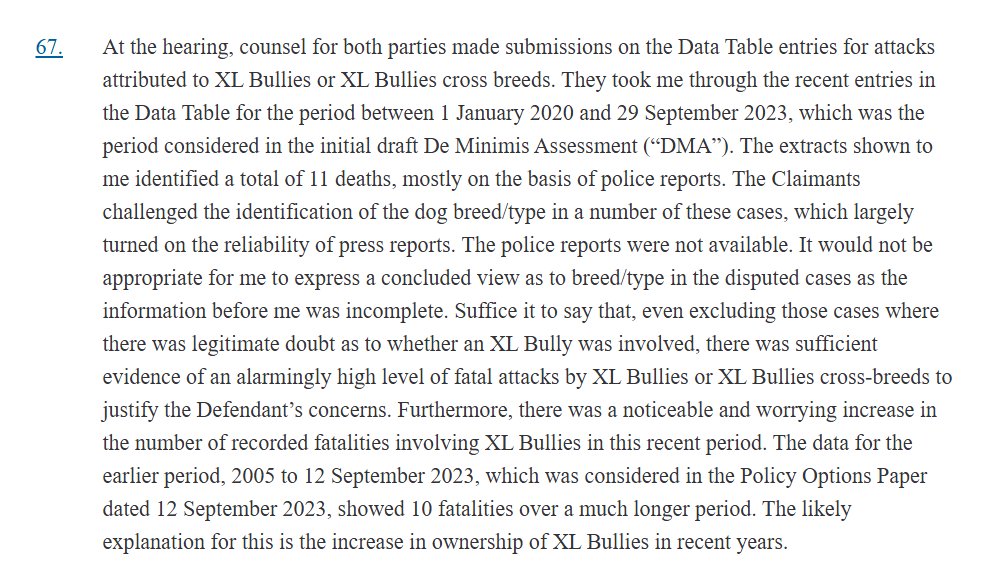
The high court judgement for the unsuccessful appeal of the XL Bully ban is now public. For months, we were labelled as misinformation and fake news. Let the record show there is now no doubt with the evidence in full that XL Bullies are disproportionately involved in fatalities.
Bully Watch tweet media
English
4
25
119
12.6K
Bully Watch
Bully Watch@BullyWatchUK·
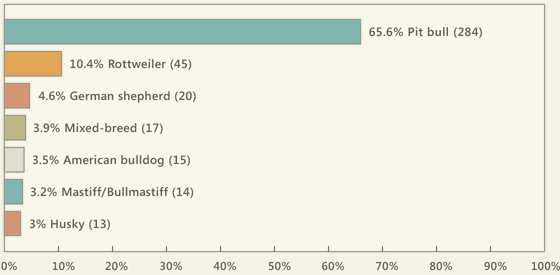
@Alexlewicki @TedHectorMess None of that is really on fatal and severe dog attacks is it though? The point being that even in the 70s when GSDs were popular they killed at a significantly far lesser rate then pit bulls.
English
1
1
4
153
Bully Watch
Bully Watch@BullyWatchUK·
Seven people have been killed by Bully XLs since the Government acted over the death of Ian Price last year. There is no more debate to have over the danger these dogs pose. The fact people think this a somehow a media conspiracy is completely delusional.
Bully Watch tweet media
English
3
18
95
5.1K
Bully Watch
Bully Watch@BullyWatchUK·
@Alexlewicki @samue47419 There is a well documented issue of huskies with infants and new born children. You don't find huskies killing adults and grown children. Name a different example if you can.
English
1
0
0
285
Bully Watch
Bully Watch@BullyWatchUK·
@Alexlewicki @samue47419 You can't find any data that shows they aren't responsible for the majority of deaths - no. In most countries.
English
1
0
1
262
Bully Watch
Bully Watch@BullyWatchUK·
@Alexlewicki @samue47419 Aha. The no true Scotsman defence. We have real time data thankfully in terms of people being maimed to death which is pretty reliable if you ask me.
English
1
0
2
248
Bully Watch
Bully Watch@BullyWatchUK·
@Alexlewicki @samue47419 I'm not sure what point you're making. If the reason for the increase in dog bites is poor socialisation then we would see a rise in all dogs killing at similar rates. We don't. It's pit bulls. It's always been pit bulls. And that's because it is in fact the breed thats the issue
Bully Watch tweet media
English
1
0
0
193
Bully Watch
Bully Watch@BullyWatchUK·
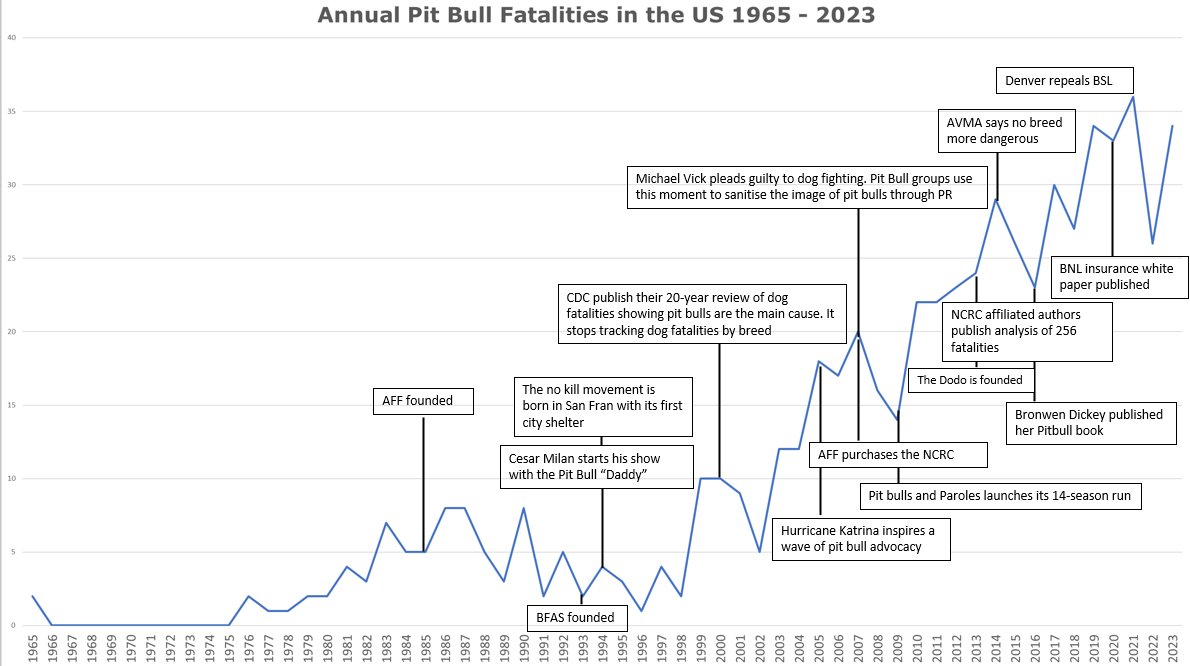
@Alexlewicki @samue47419 Nope. Pit bull deaths have spiked relative to the pit bull population. The bans in the 90s actually decreased deaths.
Bully Watch tweet media
English
1
0
1
164
Bully Watch
Bully Watch@BullyWatchUK·
@Alexlewicki @samue47419 And we cited 14 different medical papers based on hospitalisation figures which all point to the same thing. Pit bulls bite not only bite more but those bites cause significantly more damage. Good luck finding anything current that says otherwise.
English
1
0
2
206
Bully Watch
Bully Watch@BullyWatchUK·
@Alexlewicki @samue47419 Working sled huskies - and that's if you compare historic deaths when there were no pit bulls. Now, pit they are overrepresented. You're the one cherry picking a handful of out dated papers. The current death rate speaks volumes.
English
2
0
1
257