Byte Scout
3.1K posts

Byte Scout
@bytescout
father | husband | world traveler | enjoying photography, science and technology


Announcing TERAFAB: the next step towards becoming a galactic civilization twitter.com/i/broadcasts/1…


Announcing TERAFAB: the next step towards becoming a galactic civilization x.com/i/broadcasts/1…


La guerre est lancée. Une guerre scientifique, économique & stratégique où s’affrontent 4 écoles de pensée et 3 continents. Une guerre qui va redéfinir notre monde, et où la France, avec l’installation de la start-up de Yann LeCun, a sa carte à jouer. lel.media/vla-et-world-m…


Trump’s plan to run Venezuela could drag Americans into another forever war.


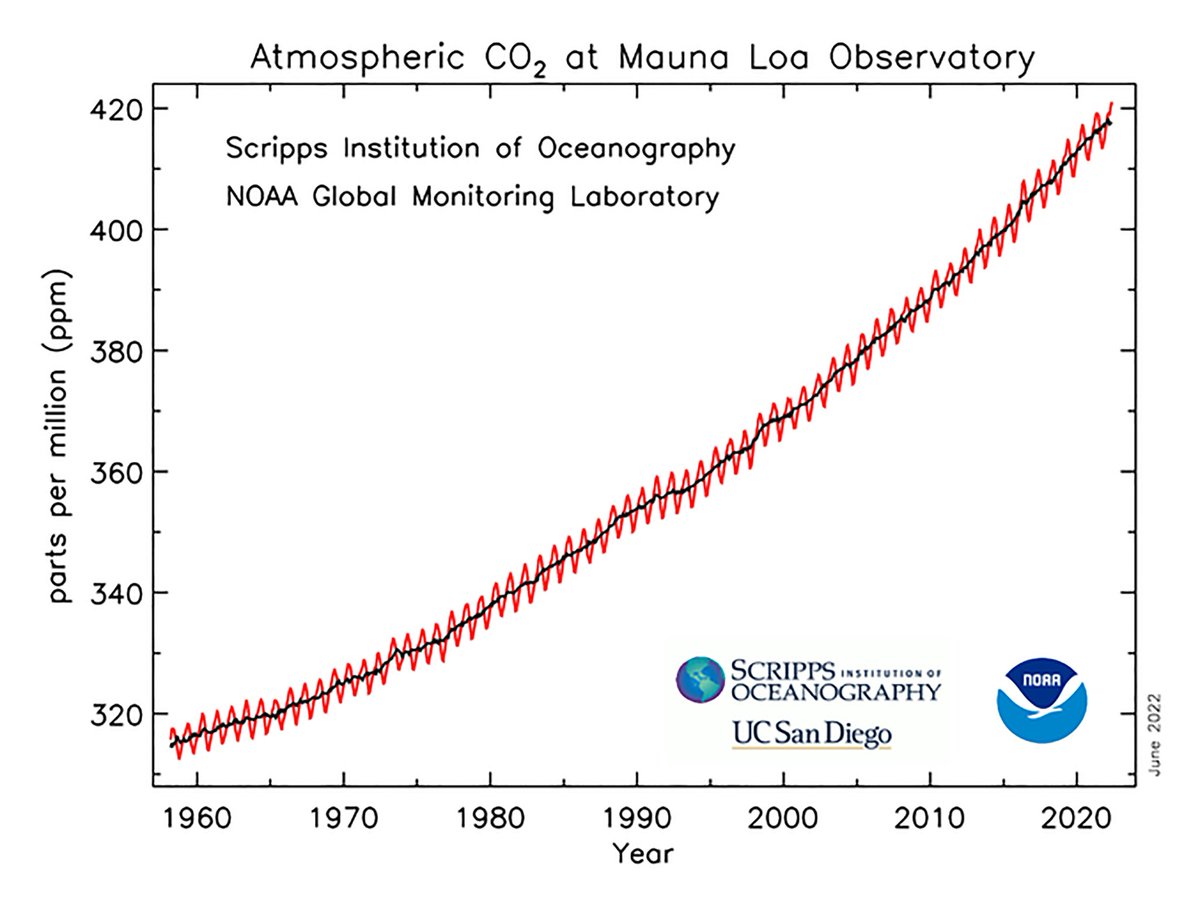
The hysteresis effect on stratoclumulus cloud collapse and why simply storing CO₂ back below 1,200 ppm will not restore the stratoclumulus cloud deck. x.com/DavidUllrich20… This is a fascinating and deeply unsettling piece of climate physics. Let’s walk through the mechanism of stratocumulus cloud dissipation and the critical hysteresis problem. What Stratocumulus Clouds Do — and Why They’re Vulnerable Stratocumulus clouds are the low-lying, blanketing kind that have by far the largest cooling effect on the planet, covering a quarter of the ocean and reflecting 30 to 70 percent of the sunlight that would otherwise be absorbed by the dark ocean surface below. The Caltech simulation by Tapio Schneider, Colleen Kaul, and Kyle Pressel identified two specific physical mechanisms that cause these clouds to unravel as CO₂ rises: 1. Turbulent entrainment. When higher CO₂ levels make Earth’s surface and sky hotter, the extra heat drives stronger turbulence inside the clouds. The turbulence mixes moist air near the top of the cloud, pushing it up and out through an important boundary layer that caps stratocumulus clouds, while drawing dry air in from above — a process called entrainment — which works to break up the cloud. 2. Loss of radiative cooling at cloud tops. As the greenhouse effect makes the upper atmosphere warmer and thus more humid, the cooling of the tops of stratocumulus clouds from above becomes less efficient. This cooling is essential, because it causes globs of cold, moist air at the top of the cloud to sink, making room for warm, moist air near Earth’s surface to rise into the cloud and sustain it. When cooling gets less effective, stratocumulus clouds grow thin. These two forces compound each other until, abruptly, the cloud deck collapses entirely. The Tipping Point When the CO₂ concentration reaches about 1,200 parts per million in the simulation — which could happen in 100 years under business-as-usual emissions — more entrainment and less cooling conspire to break up the stratocumulus cloud altogether. This is not a gradual fade; the simulated climate, as MIT’s Kerry Emanuel described it, “goes over a cliff.” The loss of low clouds and the resulting rise in water vapor — itself a potent greenhouse gas — leads to runaway warming extrapolated to an 8-degree Celsius jump on top of the warming already caused directly by CO₂. The Hysteresis Problem — Why Reducing CO₂ Won’t Bring the Clouds Back This is where the research becomes especially alarming. Hysteresis means the state of a system depends not just on current conditions, but on the path that got it there. In this context, it means the threshold for clouds to disappear is not the same as the threshold for them to return. After the climate has made the transition to a cloudless state and water vapor saturates the air, ratcheting CO₂ back down won’t bring the clouds back. “There’s hysteresis,” Schneider said. “You need to reduce CO₂ to concentrations around present day, even slightly below, before you form stratocumulus clouds again.” So the asymmetry is stark: cloud collapse begins at ~1,200 ppm on the way up, but on the way back down, you would need to return CO₂ to somewhere near or below today’s levels (~420 ppm) to restore them. This is not a minor overshoot problem — it means that even a heroic carbon-capture effort that brought atmospheric CO₂ from 1,300 ppm back down to 900, 800, or even 600 ppm would be entirely insufficient to restore the stratocumulus deck. The system would be locked in a hot, cloudless state across that entire descent. Why the Paleoclimate Record Supports This Paleoclimatologists note that this hysteresis might explain other puzzles in the record. During the Pliocene, 3 million years ago, the atmospheric CO₂ level was 400 ppm — similar to today — but Earth was 4 degrees hotter. This might be because the planet was cooling down from a much warmer, largely cloudless period, and stratocumulus clouds hadn’t yet come back. In other words, we have historical evidence of the climate being stuck in a high-temperature, low-cloud state even at CO₂ concentrations equivalent to the present day — exactly what the hysteresis model predicts. The Core Implication The practical consequence is profound: once this tipping point is crossed, the climate system enters a regime where the usual logic of “reduce emissions → reduce warming” breaks down. The planet would continue absorbing far more solar radiation than before cloud loss, driven by a water vapor feedback that self-sustains independently of CO₂. Carbon drawdown alone could not flip the system back. You would need to remove CO₂ to sub-present-day concentrations — an extraordinary and likely centuries-long undertaking — before the physical conditions for stratocumulus formation are restored. This is what makes this tipping point categorically different from most other climate risks: it is, in a meaningful sense, a one-way door. Simulated subtropical clouds in the present climate (400 ppm CO₂), at higher CO₂ (1,200 ppm) and after stratocumulus breakup (1,300 ppm). Credit: Anthropic Claude and Schneider et al.