Equity_Bytes

941 posts

Equity_Bytes

Equity_Bytes

@Bytes_Equity

Learner

Katılım Nisan 2010
2.1K Takip Edilen997 Takipçiler
Sabitlenmiş Tweet
Equity_Bytes
Equity_Bytes@Bytes_Equity·
HFCL vs Sterlite Technologies (STL) - a Quick Comparison Both are Indian optical fibre players, but the businesses underneath are structurally different. Sharing a note from what I’ve been reading: 1. HFCL - what they do- HFCL Limited makes optical fibre and Optical Fibre Cables (OFC), telecom equipment (5G radios, routers, Wi-Fi access points, unlicensed band radios) and defence electronics (electronic fuzes, multi-mode hand grenades, surveillance radars, thermal weapon sights). The company is gradually shifting from a turnkey Engineering, Procurement and Construction (EPC) model - like BharatNet builds - to a higher-margin product-led model, where exports and private orders carry a larger share. FY26 revenue stood at ₹4,949 crore (+22% YoY) with Q4 PAT of ₹184 crore vs a loss a year ago. Products now contribute almost 60% of revenues. 2. STL - what they do. Sterlite Technologies Limited is a pure-play optical and digital connectivity company built on a “Glass-to-Gigabit / Glass-to-Data Centre” model - it owns the chain from glass preform → optical fibre → cable → connectivity hardware → network design and integration. After demerging its services business (now STL Networks), the listed entity is a product + digital company with STL Digital handling enterprise IT services. FY26 revenue was ₹4,745 crore (+18.8% YoY), EBITDA margin 13.2%, with an order book of ₹7,309 crore. 3. Manufacturing capacity today. HFCL operates ~28 million fibre-km (fkm) of optical fibre and ~30.5 million fkm of OFC(optical fibre cable) capacity, with cable capacity expansion to 42.36 million fkm planned by FY27 . STL is larger and globally spread - 50+ million fkm of fibre/glass capacity and 42+ million fkm of cable capacity across India (Aurangabad, Silvassa, Dadra, Haridwar), Italy, China, Brazil and the US, currently running at ~50% utilisation. 4. Expansion plans - HFCL has approved a ₹580 crore preform manufacturing plant for backward integration into glass preform (the raw input for optical fibre), with the targeted ramp to 310 MT/annum by July 2029. Separately, the Andhra Pradesh State Investment Promotion Board has allotted 1,000 acres in Madakasira (Sri Sathya Sai district) - 329 acres in Phase I, 671 in Phase II - for an ammunition and defence facility (artillery shells, TNT filling, hand grenades). STL’s Palmetto Plant in Lugoff, South Carolina (~168,000 sq ft, total committed investment ~$100 million across phases, commissioned September 2023) is being ramped to serve “Build America, Buy America” demand under the BEAD broadband programme. STL also launched India’s first Hollow-Core Fibre (HCF) cable in March 2026, claiming ~46% faster transmission for AI data centre use.
English
1
0
4
1.3K
Equity_Bytes
Equity_Bytes@Bytes_Equity·
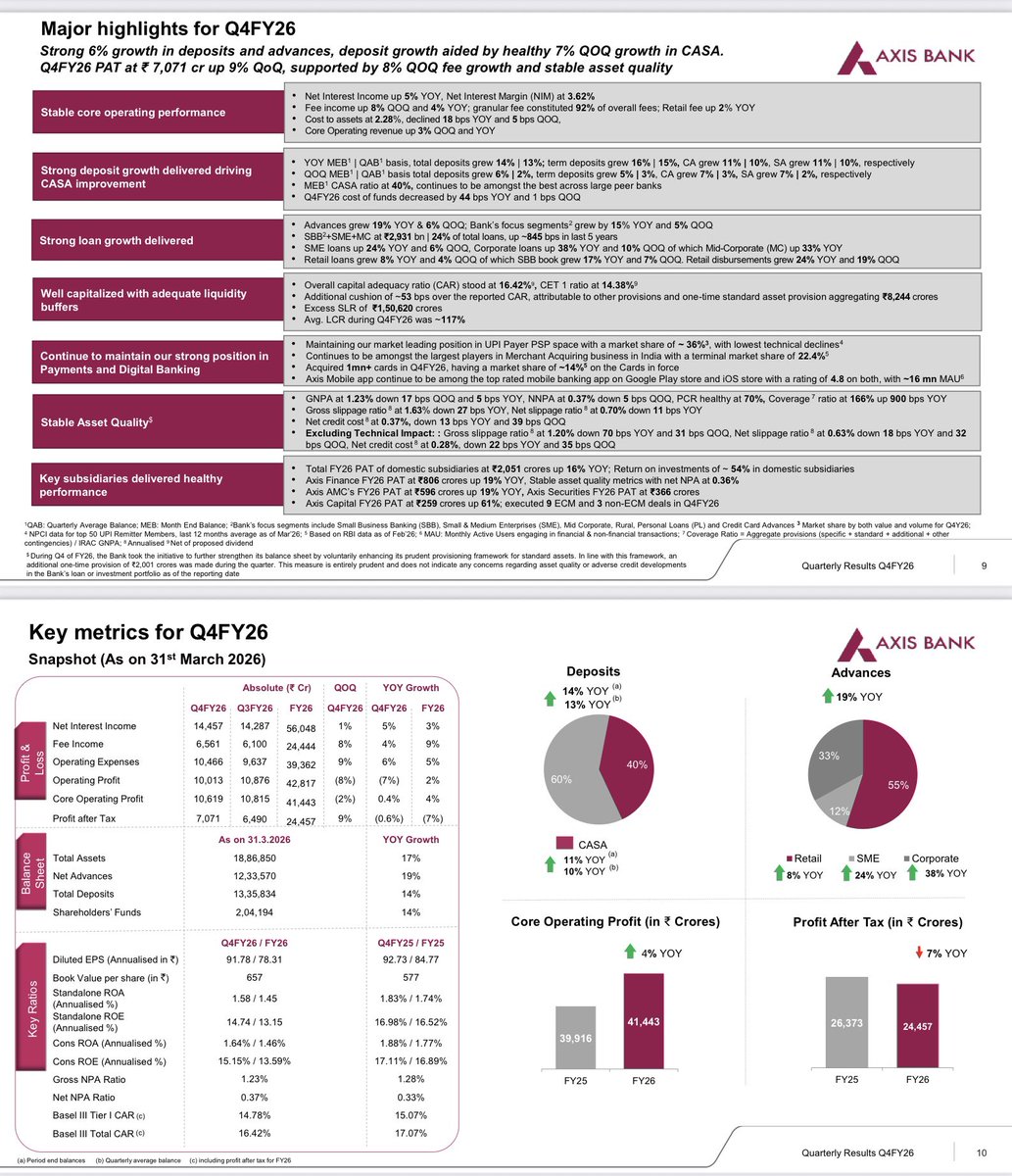
Axis Bank – Q4 FY26 & Full Year FY26 Results Axis Bank is India’s 3rd largest private sector bank and completed its Citibank consumer banking integration in July 2024. FY26 has been a year of strong loan growth but significant NIM compression - making it the only large private bank to report a full year PAT decline. Q4 FY26 (vs Q4 FY25) Standalone PAT: ₹7,071 cr - broadly flat YoY (-0.6%) but up 9% QoQ. Results were broadly in line with estimates, yet the stock fell post results primarily due to the surprise ₹2,001 cr voluntary geopolitical provision and continued NIM weakness. NII up 5% YoY to ₹14,457 cr. NIM at 3.62% vs 3.97% a year ago - a sharp 35 bps annual decline. This is the single biggest concern with Axis Bank right now. The big story of Q4 - ₹2,001 cr voluntary provision: Total provisions jumped 159% YoY to ₹3,522 cr, entirely because of one proactive geopolitical provision built against a severe West Asia stress scenario (crude at $150/barrel, 20% currency depreciation). CEO “There is nothing in our portfolio which tells us that these provisions will be used. If this crisis gets resolved, this provision will be written back.” This is a buffer, not a sign of stress. Asset quality - sharp sequential improvement: •GNPA: 1.23% vs 1.40% in Q3 FY26 - improved 17 bps QoQ •Net credit cost: 0.37% vs 0.76% in Q3 - collapsed 39 bps QoQ •Slippage ratio: 1.63% vs 1.94% in Q3 - improving trend Axis tightened its asset classification criteria for special outcomes this quarter. Excluding this technical change, underlying slippage ratio would be 1.20% and net credit cost 0.28% - the core credit quality is better than the headline. Loan growth at 19% YoY - fastest among large private banks. However, it is heavily corporate-led, which is lower-yield business and a key driver of NIM compression. The bank reduced headcount by 3,000+ in FY26 through digital automation and AI. Management guided for further AI-driven productivity gains in FY27. Full Year FY26 (vs FY25) •Standalone PAT: ₹24,457 cr vs ₹26,373 cr - down 7% YoY •Full Year NIM: 3.69% vs 3.98% in FY25 - compressed 29 bps •Advances: up 19% YoY | Deposits: up 14% YoY •Total Provisions FY26: ₹13,263 cr vs ₹7,758 cr in FY25 - up 71% The -7% PAT decline is entirely on provisioning, not operational deterioration. Axis is the only large private bank with a full year profit decline - this perhaps explains the valuation discount vs peers. Subsidiary performance: Combined domestic subsidiary PAT at ₹2,051 cr - up 16% YoY. All four subsidiaries (Axis Finance, Axis AMC, Axis Securities, Axis Capital) growing well. Return on investments in domestic subsidiaries at ~54%. Management commentary - key Highlights 1. On NIM: Target of 3.8% reiterated within 15-18 months from the last rate cut. Current NIM at 3.62% implies 18 bps recovery needed - contingent on no further rate cuts and deposit repricing benefits flowing through. 2. On growth: CFO guided for growth 300 bps above industry over a 3-year horizon - “closer to 3, not 5 years.” 3. On capital: CAR at 16.42% - adequate. No equity dilution planned. 4. On Citi integration: Integration complete. Synergies exceeding original expectations. Cross-sell of insurance, wealth, and lending to Citi legacy customers generating higher fee income per customer. 5. On credit cards and personal loans: Credit cards stabilising faster. Personal loans will take a few more quarters to normalise. 6. On AI: 3,000+ headcount reduction in FY26 driven by automation. Further impact expected in FY27 with meaningful bottom-line benefit over 18-24 months. What to watch in FY27 1.NIM recovery - the entire re-rating thesis depends on getting from 3.62% to 3.8%. 2.Whether the ₹2,001 cr geopolitical provision gets written back - direct PAT tailwind if it does. Axis enters FY27 with strong loan growth momentum, improving asset quality, and a leaner cost structure, however NIMs to be tracked. #AxisBank
Equity_Bytes tweet media
English
0
0
0
71
Equity_Bytes
Equity_Bytes@Bytes_Equity·
HDFC Bank – Q4 FY26 & Full Year FY26 Results One important context before the numbers FY26 continued to be about Deposit first story, rather than growth. Q4 FY26 (vs Q4 FY25) Consolidated PAT: ₹19,221 cr - up 9.1% YoY. PAT growth was driven more by falling provisions than NII expansion. NII grew just 3.2% YoY to ₹33,081 cr despite loan growth of 12% - this disconnect captures the NIM compression story in one line. Loans repriced down faster than deposits on the liability side due to rate cuts. NIM: 3.38% in Q4 FY26 vs 3.51% on interest-earning assets a year ago. The more important data point - NIM appears to have bottomed in Q2 FY26 at 3.27% and has been recovering since (3.35% in Q3, 3.38% in Q4). Direction is improving. Asset quality: •GNPA: 1.15% vs 1.33% a year ago •NNPA: 0.38% vs 0.43% a year ago •Credit cost: 0.35% vs 0.48% in Q4 FY25 •Ex-agriculture GNPA: 0.91% -a decadal low, post removing sesonal agri book New Slippages fell from ₹86 bn in Q3 to ₹62 bn in Q4 a genuine sequential improvement Provisions: ₹2,610 cr - down 18% YoY. One repetitively point on deposits - of the ₹3.9 lakh cr mobilised in FY26, 47% came from accounts below ₹3 crore (vs 31% in FY25). Management called this “less volatile and very sustainable.” This granular retail deposit base is the foundation for NIM recovery. Full Year FY26 (vs FY25) •Consolidated PAT: ₹76,030 cr vs ₹68,470 cr - up 11% YoY •Loan Growth: +12% YoY | Deposit Growth: +14.4% YoY •GNPA: 1.15% vs 1.33% in FY25 •Credit Cost: 0.35% - among the lowest in 5 years for the bank •Cost to Income: 39.9% vs 40.5% - improving •ROA: 1.96% in Q4, stable around 1.9% for full year •ROE: 14.1% - recovering but still below pre-merger 17%+ levels Deposit growth (14.4%) outpacing loan growth (12%) is the key metric here, this is exactly what the bank has been trying to achieve to normalise the CD ratio. Subsidiary highlight: HDB Financial Services PAT up 41.4% YoY. HDFC AMC QAAUM at ~₹9.27 lakh cr. Management commentary - key concall points 1.On FY27 growth guidance: Pulled back from “above system growth” to “maintaining FY26 momentum.” Reason - geopolitical uncertainty makes macro less predictable. A more conservative stance than prior guidance. 2.On NIM: Deposit repricing has transmitted only ~40-50 bps so far. As more term deposits reprice lower over the next 4-5 quarters, NIM recovery should follow. 3.On loan mix: SME and Business Banking growing at 17-20% - the highest-yielding segments. This is the direction for NIM improvement. 4.On technology: 9,700 branches, 100 million customers, ~$1 billion in technology investment. Five AI use cases in production, 14 in development. 5.On HDFC merger synergies: Liability penetration in the mortgage book improved from ~36% to ~50%. Cross-sell of banking products into the mortgage customer base is deepening gradually. 6.On chairman transition: Former chairman Atanu Chakraborty resigned abruptly. Management signalled they are rooting for Keki Mistry as part-time chairman -resolution awaited, management downplayed the incident. Key things to watch in FY27 1.NIM trajectory - Rate environment and deposit repricing speed are the key variables. 2.CASA ratio - at 34.1%, it has been declining since the merger. Needs to stabilise. 3.Whether loan growth re-accelerates above 12% as the deposit base strengthens. 4.Chairman appointment - clean resolution will remove a governance overhang. HDFC Bank enters FY27 with the best asset quality in its post-merger history, a provision buffer, and a NIM that appears to have bottomed. The next few years are about whether NIM recovery and loan re-acceleration. #HDFCBank
English
1
0
0
112
Equity_Bytes
Equity_Bytes@Bytes_Equity·
Kotak Mahindra Bank – Q4 FY26 & Full Year FY26 Results Q4 FY26 (vs Q4 FY25) Consolidated PAT: ₹5,423 cr - up 10% YoY. Growth was largely driven by a sharp fall in provisions rather than core income expansion - an important distinction. NII up 8% YoY to ₹7,876 cr. NIM at 4.67% vs 4.97% a year ago -compressed 30 bps YoY, though marginally better than Q3 FY26’s 4.54%.  Asset quality - the highlight of the quarter: GNPA improved to 1.20% vs 1.42% a year ago. Slippages declined 32% YoY to ₹1,018 cr. Cost of funds fell from 5.09% to 4.45%(Positive).  Provisions fell 43% YoY to ₹516 cr - this is what powered the PAT growth this quarter.  Full Year FY26 (vs FY25) Consolidated PAT: ₹19,288 cr vs ₹22,126 cr in FY25 - down on headline. However, FY25 included a one-time ZKGI divestment gain. Excluding that, PAT is roughly flat YoY.  NII grew 6% YoY to ₹30,010 cr. NIM compressed to 4.60% for full year FY26 vs 4.96% in FY25- a ~36 bps decline over the year. Cost of funds improved meaningfully from 5.10% to 4.67%. Net Advances up 16% YoY. Deposits up 15% YoY. CASA stable at 43.3%.  Consolidated ROE: 11.28% for FY26 vs 12.57% in FY25 - declining, and still well below Kotak’s historical 15%+ range.  Management commentary - key concall points 1.On IDBI Bank: Passed. Valuation too expensive, strategic fit not compelling enough. 2.NIM pressure expected to continue in FY27 due to competitive deposit rates. 3.FY27 focus: microfinance scale-up, credit cards, rebuilding unsecured retail book - a clear shift from risk-off to calibrated growth mode. 4.Microfinance losses narrowing sharply - BSS Sonata loss reduced from -₹91 cr (Q4 FY25) to -₹9 cr (Q4 FY26).  Merger pain nearly behind. Keys things to watch in FY27- 1.NIM trajectory - can it stabilize above 4.5%? 2.ROE - path back toward 14-15% needs to be demonstrated. 3.Asset quality — whether the improvement sustains as unsecured book is rebuilt. #KotakMahindraBank
Equity_Bytes tweet media
English
1
0
0
285
Equity_Bytes
Equity_Bytes@Bytes_Equity·
Personally studying about fuel prices in our neighbours, hats off to all the OMC’s for absorbing the loss. It is good for the nation in general but not good for the shareholders. This quarter PAT may have some inventory gains, but from next quarter they will have huge losses in all 3 segments-petrol,diesel and lpg. Government support may not come and even if it comes it may take a year or so. This situation will lead to huge increase in loans, decrease in capex and losses. I dont even understand how are they even functioning at 50/60rs per litre loss. There seems to be 2 solutions according to me- 1) Government should take them private no point in keeping them listed when they cannot price their products on their own. 2) More feasible option will be to merge the 3 companies, combined entity will have the balance sheet strength to absorb such shocks for a bit more longer. What do u think?
English
4
0
7
3.1K
tushar
tushar@tushar9590·
Something new I learned today. OMC's selling Diesel at Retail Pumps: ₹87 OMC's selling Diesel to bulk buyers: ₹137 Petrol wud have been ₹150 now if not for govt to intervene today. Bulk Buyers like Railways, Manufacturers, Defence, Mining cos source their diesel directly from OMCs, however given OMC's selling ₹50 higher than retail prices, many bulk buyers now moved to Retail pumps.
English
15
9
230
38.3K
Equity_Bytes
Equity_Bytes@Bytes_Equity·
@EquityInsightss One more observation- Cams recovered as soon as its TTM PE touched around 35. It is up around 20% from that level. During the Russia-Ukraine also, it made a bottom at TTM PE of 35….Seems like whenever cams touch 35 of TTM basis, bottom is near🤔
Equity_Bytes tweet media
English
1
0
4
293
Equity Insights Elite
Equity Insights Elite@EquityInsightss·
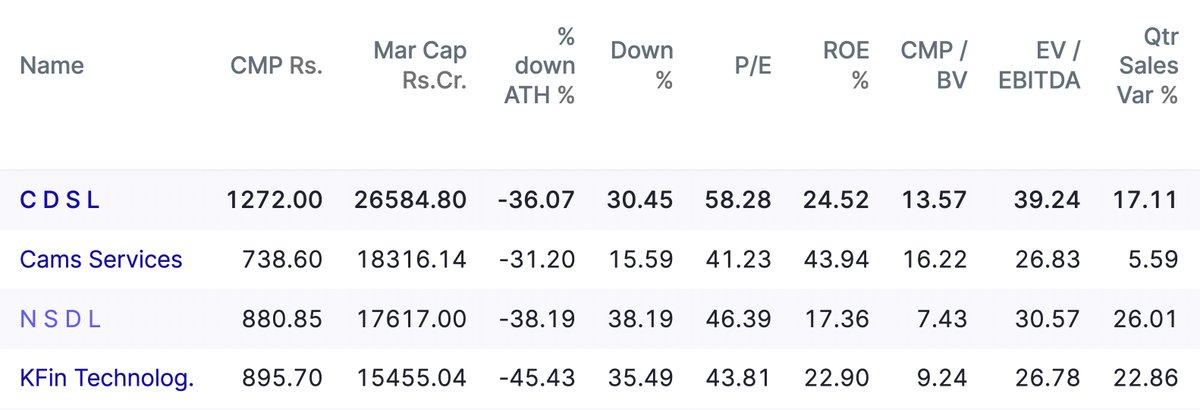
RTAs & depositories have not really participated meaningfully in this recovery On the other hand, brokers, exchanges, asset & wealth managers have seen a steep rally from the lows RTAs & depositories were already trading at premium valuations, even after correcting 30-40% from their highs multiples are still not very reasonable At the peak, valuations had become absurd, with some trading at 80x (NSDL & Kfin) One caveat to keep in mind: In a downcycle, depositories will always look optically expensive because part of their earnings is linked to market activity. When transaction volumes, IPO activity & corporate actions slow down, near term earnings get impacted, making valuation multiples look elevated
Equity Insights Elite tweet media
English
5
3
83
7.9K
Varun Sanyal
Varun Sanyal@varunsanyal·
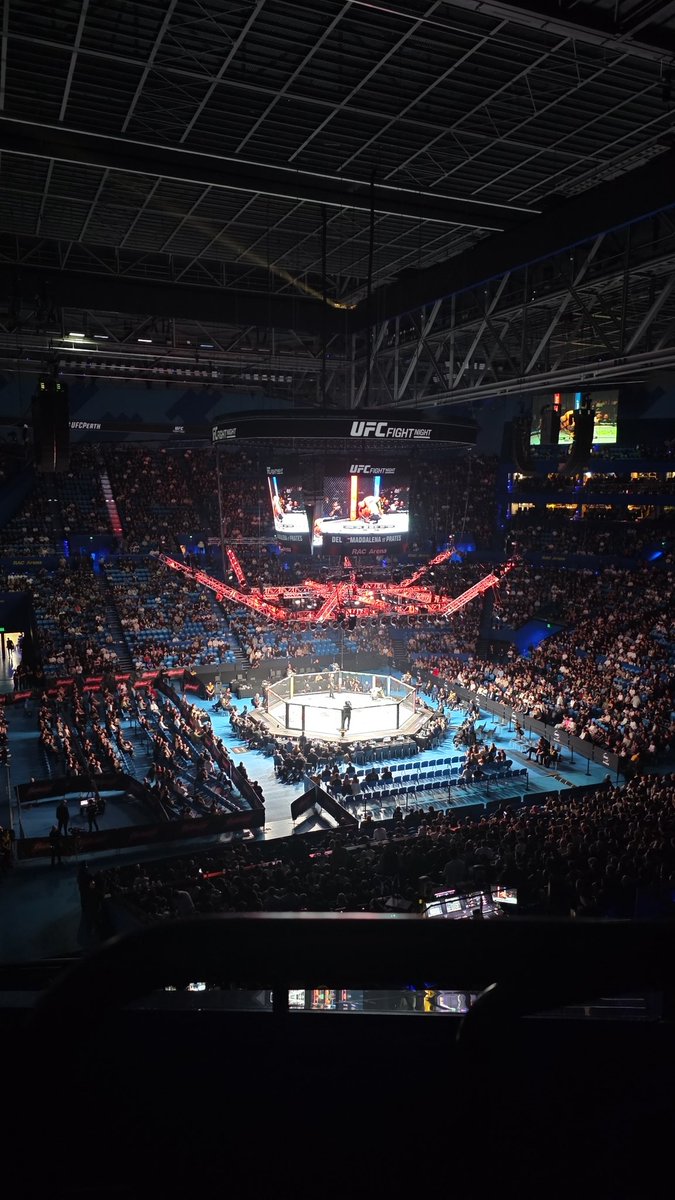
First time attending the UFC live. I'm supporting my team mate, Louie Sutherland, fighting in away territory. The prelims have only just started and the loud Aussie crowd have shown up in numbers. One day we will have this in India 🇮🇳 #UFCPerth #MMA
Varun Sanyal tweet media
English
6
3
111
2.4K
Equity_Bytes
Equity_Bytes@Bytes_Equity·
@gaze_observer Apart from optical fibres, they are diversifying into defence also. Major capex is going into defence👇 x.com/bytes_equity/s…
Equity_Bytes@Bytes_Equity

HFCL vs Sterlite Technologies (STL) - a Quick Comparison Both are Indian optical fibre players, but the businesses underneath are structurally different. Sharing a note from what I’ve been reading: 1. HFCL - what they do- HFCL Limited makes optical fibre and Optical Fibre Cables (OFC), telecom equipment (5G radios, routers, Wi-Fi access points, unlicensed band radios) and defence electronics (electronic fuzes, multi-mode hand grenades, surveillance radars, thermal weapon sights). The company is gradually shifting from a turnkey Engineering, Procurement and Construction (EPC) model - like BharatNet builds - to a higher-margin product-led model, where exports and private orders carry a larger share. FY26 revenue stood at ₹4,949 crore (+22% YoY) with Q4 PAT of ₹184 crore vs a loss a year ago. Products now contribute almost 60% of revenues. 2. STL - what they do. Sterlite Technologies Limited is a pure-play optical and digital connectivity company built on a “Glass-to-Gigabit / Glass-to-Data Centre” model - it owns the chain from glass preform → optical fibre → cable → connectivity hardware → network design and integration. After demerging its services business (now STL Networks), the listed entity is a product + digital company with STL Digital handling enterprise IT services. FY26 revenue was ₹4,745 crore (+18.8% YoY), EBITDA margin 13.2%, with an order book of ₹7,309 crore. 3. Manufacturing capacity today. HFCL operates ~28 million fibre-km (fkm) of optical fibre and ~30.5 million fkm of OFC(optical fibre cable) capacity, with cable capacity expansion to 42.36 million fkm planned by FY27 . STL is larger and globally spread - 50+ million fkm of fibre/glass capacity and 42+ million fkm of cable capacity across India (Aurangabad, Silvassa, Dadra, Haridwar), Italy, China, Brazil and the US, currently running at ~50% utilisation. 4. Expansion plans - HFCL has approved a ₹580 crore preform manufacturing plant for backward integration into glass preform (the raw input for optical fibre), with the targeted ramp to 310 MT/annum by July 2029. Separately, the Andhra Pradesh State Investment Promotion Board has allotted 1,000 acres in Madakasira (Sri Sathya Sai district) - 329 acres in Phase I, 671 in Phase II - for an ammunition and defence facility (artillery shells, TNT filling, hand grenades). STL’s Palmetto Plant in Lugoff, South Carolina (~168,000 sq ft, total committed investment ~$100 million across phases, commissioned September 2023) is being ramped to serve “Build America, Buy America” demand under the BEAD broadband programme. STL also launched India’s first Hollow-Core Fibre (HCF) cable in March 2026, claiming ~46% faster transmission for AI data centre use.

English
0
0
2
59
The Cloaked Gaze 👀
The Cloaked Gaze 👀@gaze_observer·
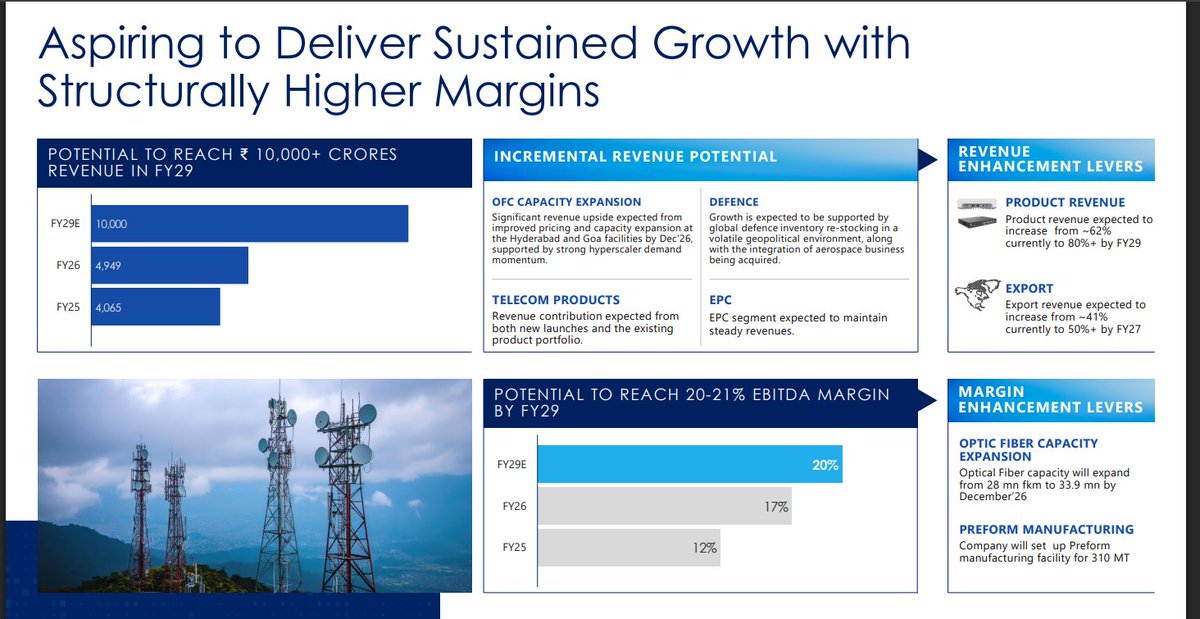
HFCL ➤ Aspiring to Deliver Sustained Growth with Structurally Higher Margins ➤ Potential to reach ₹10,000 Cr+ revenue by FY29 ➤ Product Revenue Increasing from ~62% → 80%+ by FY29 ➤ Export Revenue Rising from ~41% → 50%+ by FY27 ➤ EBITDA margin potential to reach 20–21% By FY29 ➤ Optical Fiber Expansion: Capacity from 28 mn fkm → 33.9 mn by Dec’26 ➤ Backward Integration: Company will set up Preform manufacturing facility for 310 MT ➤ Key Revenue Drivers ✓ Optical Fiber Capacity Expansion: Capacity ramp-up at Hyderabad & Goa ✓ Telecom Products: Growth from new launches + existing portfolio ✓ Defence Business: Boost from global demand & aerospace integration ✓ EPC Segment: Stable and steady contributor
The Cloaked Gaze 👀 tweet media
The Cloaked Gaze 👀@gaze_observer

HFCL Ltd Q4FY26 #Q4FY26 #Stockmarket #Nifty #HFCL ➤ Q4FY26 ✓ Revenue ₹1,824 Cr (+128% YoY & +50% QoQ) ✓ EBITDA ₹336 Cr (+38% QoQ) ✓ EBITDA Margin 18.47% vs -2.79% YoY & 20.11% QoQ ✓ PAT ₹184 Cr (+80% QoQ)(vs -₹83.30 Cr YoY) ➤ FY26 ✓ Revenue ₹4,949 Cr (+21.77% YoY) ✓ EBITDA ₹827 Cr (+63% YoY) ✓ EBITDA Margin 16.7% (vs 12.5%) ✓ PBT ₹428 Cr (+97% YoY) ✓ PAT ₹329 Cr (+90% YoY) ✓ Exports ₹2,047 Cr (41% of revenue, up sharply) ✓ Dividend 20% recommended ➤ Order Book ₹21,206 Cr (record high) vs ₹9,967 Cr YoY ➤ Business Drivers 1. Optical Fiber Upcycle ✓ Strong global demand from: ✓ Data centers ✓ AI & cloud infrastructure ✓ Record OFC order book ₹13,483 Cr ✓ Data centre interconnect solutions will contribute ✓ ~₹400 Cr additional revenue expected in FY27 ✓ ~₹800 Cr additional revenue expected in FY28 2. Export Growth ✓ Exports now 41% of revenue → major margin driver ✓ Strong traction in US, Europe, Asia 3. Product Mix Improvement ✓ Higher share of: ✓ High-count fiber cables ✓ Value-added products → Driving margin expansion ➤ Backward Integration ✓ Optical fiber preform manufacturing (₹580 Cr capex) ✓ Benefits: ✓ Lower costs ✓ Reduced import dependency ✓ Margin expansion ➤ Defence & Aerospace Expansion ✓ Entry into aerospace MoU business ✓ Order book visibility ~₹1,930 Cr ✓ Scaling defence products: ✓ Radars, communication systems, thermal weapons ✓ New ammunition facility (Andhra Pradesh) ➤ Management Commentary ✓ FY26 was a landmark year ✓ Highest-ever performance ✓ Revenue +21% YoY, PBT ~+97% YoY ✓ Entering a stronger phase ✓ Business becoming more predictable and stable ✓ Order book not just bigger, but higher quality ✓ More exports ✓ More long-term contracts ✓ More high-margin products ✓ Backward integration (optical fiber preform) ✓ Expansion in defence sector ✓ Increasing global presence ✓ Focus on product-led growth ✓ Becoming a global, tech-driven, diversified company ✓ Structurally more profitable ✓ Expect sustained margin expansion ✓ Strong earnings growth visibility ✓ Q4 momentum likely to continue

English
1
5
34
3.1K
Equity_Bytes
Equity_Bytes@Bytes_Equity·
@tushar9590 Sterlite is backward intergated, tech first and export oriented player. Great post, do have a look at my post on the same👇 x.com/bytes_equity/s…
Equity_Bytes@Bytes_Equity

HFCL vs Sterlite Technologies (STL) - a Quick Comparison Both are Indian optical fibre players, but the businesses underneath are structurally different. Sharing a note from what I’ve been reading: 1. HFCL - what they do- HFCL Limited makes optical fibre and Optical Fibre Cables (OFC), telecom equipment (5G radios, routers, Wi-Fi access points, unlicensed band radios) and defence electronics (electronic fuzes, multi-mode hand grenades, surveillance radars, thermal weapon sights). The company is gradually shifting from a turnkey Engineering, Procurement and Construction (EPC) model - like BharatNet builds - to a higher-margin product-led model, where exports and private orders carry a larger share. FY26 revenue stood at ₹4,949 crore (+22% YoY) with Q4 PAT of ₹184 crore vs a loss a year ago. Products now contribute almost 60% of revenues. 2. STL - what they do. Sterlite Technologies Limited is a pure-play optical and digital connectivity company built on a “Glass-to-Gigabit / Glass-to-Data Centre” model - it owns the chain from glass preform → optical fibre → cable → connectivity hardware → network design and integration. After demerging its services business (now STL Networks), the listed entity is a product + digital company with STL Digital handling enterprise IT services. FY26 revenue was ₹4,745 crore (+18.8% YoY), EBITDA margin 13.2%, with an order book of ₹7,309 crore. 3. Manufacturing capacity today. HFCL operates ~28 million fibre-km (fkm) of optical fibre and ~30.5 million fkm of OFC(optical fibre cable) capacity, with cable capacity expansion to 42.36 million fkm planned by FY27 . STL is larger and globally spread - 50+ million fkm of fibre/glass capacity and 42+ million fkm of cable capacity across India (Aurangabad, Silvassa, Dadra, Haridwar), Italy, China, Brazil and the US, currently running at ~50% utilisation. 4. Expansion plans - HFCL has approved a ₹580 crore preform manufacturing plant for backward integration into glass preform (the raw input for optical fibre), with the targeted ramp to 310 MT/annum by July 2029. Separately, the Andhra Pradesh State Investment Promotion Board has allotted 1,000 acres in Madakasira (Sri Sathya Sai district) - 329 acres in Phase I, 671 in Phase II - for an ammunition and defence facility (artillery shells, TNT filling, hand grenades). STL’s Palmetto Plant in Lugoff, South Carolina (~168,000 sq ft, total committed investment ~$100 million across phases, commissioned September 2023) is being ramped to serve “Build America, Buy America” demand under the BEAD broadband programme. STL also launched India’s first Hollow-Core Fibre (HCF) cable in March 2026, claiming ~46% faster transmission for AI data centre use.

English
0
0
1
254
tushar
tushar@tushar9590·
What's driving the earnings in Sterlite Technologies & What are the tailwinds for the co👇 Co designs, manufacture, and deploy end-to-end connectivity infrastructure for 5G, Rural Broadband, FTTx (Fiber-to-the-Home/X), Enterprise networks, and especially AI-ready Data Centers. From raw glass preforms → optical fiber → high-capacity cables → optical interconnects + network software/services. They’re one of only ~6 companies worldwide with full vertical integration (glass-to-terabit). Manufacturing across 4 continents (strong India base + new US plant in South Carolina). Open order book: ₹7,309 Cr Data Center + AI Boom Hyperscalers & AI workloads need 36x more fiber in GPU-dense racks. Global DC-led optical cable demand is exploding. STL’s innovations like Multiverse Multicore Fiber (4x capacity) and high-density ribbon cables are perfectly positioned. DC solutions already contributing big revenue share.
English
4
4
69
5.2K
Equity_Bytes
Equity_Bytes@Bytes_Equity·
@shiladitya4u Great insights as always, i also wrote about the 2 companies, have a look👇 x.com/bytes_equity/s…
Equity_Bytes@Bytes_Equity

HFCL vs Sterlite Technologies (STL) - a Quick Comparison Both are Indian optical fibre players, but the businesses underneath are structurally different. Sharing a note from what I’ve been reading: 1. HFCL - what they do- HFCL Limited makes optical fibre and Optical Fibre Cables (OFC), telecom equipment (5G radios, routers, Wi-Fi access points, unlicensed band radios) and defence electronics (electronic fuzes, multi-mode hand grenades, surveillance radars, thermal weapon sights). The company is gradually shifting from a turnkey Engineering, Procurement and Construction (EPC) model - like BharatNet builds - to a higher-margin product-led model, where exports and private orders carry a larger share. FY26 revenue stood at ₹4,949 crore (+22% YoY) with Q4 PAT of ₹184 crore vs a loss a year ago. Products now contribute almost 60% of revenues. 2. STL - what they do. Sterlite Technologies Limited is a pure-play optical and digital connectivity company built on a “Glass-to-Gigabit / Glass-to-Data Centre” model - it owns the chain from glass preform → optical fibre → cable → connectivity hardware → network design and integration. After demerging its services business (now STL Networks), the listed entity is a product + digital company with STL Digital handling enterprise IT services. FY26 revenue was ₹4,745 crore (+18.8% YoY), EBITDA margin 13.2%, with an order book of ₹7,309 crore. 3. Manufacturing capacity today. HFCL operates ~28 million fibre-km (fkm) of optical fibre and ~30.5 million fkm of OFC(optical fibre cable) capacity, with cable capacity expansion to 42.36 million fkm planned by FY27 . STL is larger and globally spread - 50+ million fkm of fibre/glass capacity and 42+ million fkm of cable capacity across India (Aurangabad, Silvassa, Dadra, Haridwar), Italy, China, Brazil and the US, currently running at ~50% utilisation. 4. Expansion plans - HFCL has approved a ₹580 crore preform manufacturing plant for backward integration into glass preform (the raw input for optical fibre), with the targeted ramp to 310 MT/annum by July 2029. Separately, the Andhra Pradesh State Investment Promotion Board has allotted 1,000 acres in Madakasira (Sri Sathya Sai district) - 329 acres in Phase I, 671 in Phase II - for an ammunition and defence facility (artillery shells, TNT filling, hand grenades). STL’s Palmetto Plant in Lugoff, South Carolina (~168,000 sq ft, total committed investment ~$100 million across phases, commissioned September 2023) is being ramped to serve “Build America, Buy America” demand under the BEAD broadband programme. STL also launched India’s first Hollow-Core Fibre (HCF) cable in March 2026, claiming ~46% faster transmission for AI data centre use.

English
0
0
2
530
Shiladitya
Shiladitya@shiladitya4u·
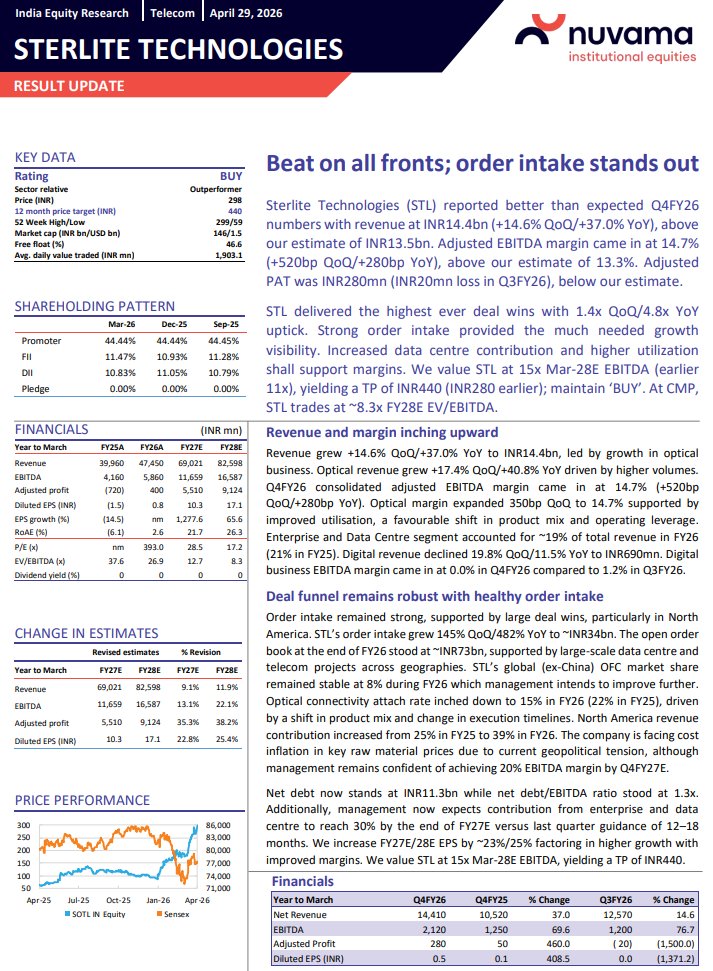
The Optical Fiber Boom I've been busy looking at so so many interesting earnings that I didn't have any time to post.🙂 Both Sterlite technologies and HFCL posted blockbuster results and painted a very bullish multi-year structural tailwinds for the Optical Fiber industry driven by the once-in-a-lifetime AI capex boom. Typically, optical fiber industry was deeply cyclical driven by telecom capex. However, that is about to change.. From a highly cyclical industry to AI capex driven structural multi-year tailwinds - that is the core thesis for rerating. Lets deep dive a bit into Sterlite. I will do a separate post on HFCL. Sterlite reported 37% revenue growth in Q4FY26 and margin expansion from 13% to 15%. Please note that Q4FY26 had marginal impact of the tariff reduction, full impact of reduced tariffs will be visible from Q1FY27 Some key product & technology milestones: • AI-DC Portfolio: The launch of Neuralis, a purpose-built connectivity suite for AI-Data Centres, enabling ultra-high-density cabling for GPU-intensive workloads • Introduced India’s first Hollow Core Fibre (HCF) cable, utilizing an air-core architecture to achieve ~46% faster transmission and ultra-low latency. • STL developed a 4-core Multi-Core Fiber (MCF) Unitube cable for the UK market, significantly increasing data capacity per strand. On Margins, management expects margins to keep improve sequentially with better utilization, better product mix, reduced tariffs. However, raw material (germanium, helium) inflation is a major issue due to the war in Middle East. But, net impact will be positive. One key differentiator for Sterlite is that it is one of the few players in the world which makes its own Preform, while companies like HFCL buys preform from other vendors. This will be a key factor to drive margins much higher. Orderbook has jumped 100% to 7309 Cr and increasingly continuously, management expects 1468 Cr to be executed in Q1FY27, which will be more than 45% growth over Q1FY26. Nuvama expects FY27 to be a blockbuster year with revenue growth of 45%, EBITDA margins of 16% and PAT of 551 Cr. That means, even after the huge rise in stock price, Sterlite is trading at only 21 PE FY27EPS. I personally believe that margins can go even higher and PAT can cross 600 Cr in FY27. Disc: invested from lower levels, so my views can be biased. Please do analyze properly before investing, this is not a recommendation
Shiladitya tweet mediaShiladitya tweet mediaShiladitya tweet mediaShiladitya tweet media
English
10
28
204
39.7K
Equity_Bytes
Equity_Bytes@Bytes_Equity·
@samisosa1234 Not going into which Company is better, but HFCL is more Domestic focus as of now, more diversified and doing a big defence capex. Sterlite is more focussed into Only Optical fibres, export oriented and data centre demand driven. 👇 x.com/bytes_equity/s
English
0
0
5
1.8K
Samisosa
Samisosa@samisosa1234·
Time Duration : 1-2 Yrs At CMP, which company seems a better investment and why ? HFCL vs Sterlite Tech
English
31
4
137
29.3K
Equity_Bytes
Equity_Bytes@Bytes_Equity·
5. Strengths- HFCL: record order book of ₹21,206 crore against an annual revenue of 5000 crore(OFC alone ₹13,483 crore), rising export share, defence optionality via HASPL with ₹1,680 crore order book (~₹1,570 crore confirmed export orders), and Reliance Industries holding ~4.65% as of Q4 FY26. STL: deeper vertical integration, 780+ patents, US/Europe/India footprint giving tariff resilience, six straight quarters of sequential EBITDA margin improvement, and a clear AI-DC product roadmap (Neuralis suite, Celesta IBR with 864 fibres in 11.7 mm, Hollow-Core fibre, multi-core fibre). 6. Weaknesses / risks. HFCL: working capital remains stretched (debtor days reportedly around 214), promoter holding has diluted to ~28.29% post recent QIP , defence revenue is still small, and EPC legacy keeps cash conversion lumpy. STL: net debt of ₹1,128 crore at end-FY26, the $96.5 million damages award by a US district court (South Carolina, 2024) in the Prysmian trade-secrets matter remains a contingent overhang under appeal, and tariff exposure on certain India-to-US shipments makes the South Carolina plant strategically important but execution-sensitive. Both companies remain exposed to BharatNet payment cycles - HFCL won ~₹8,170 crore across UP East/West (consortium with RVNL/ATS, ₹6,925 cr) and Punjab (₹1,244 cr capex + O&M) under Phase III; STL won the J&K + Ladakh package worth ₹2,631 crore (June 2025). 7. The data centre angle - AI compute is a fibre-heavy workload - industry estimates suggest a single AI training rack uses roughly 36x more fibre interconnect than a traditional cloud server rack, because GPU clusters need ultra-high-density, low-latency optical links. Both companies are positioning here, differently. HFCL is scaling data-centre interconnect through subsidiary HTL Limited and has guided ~₹400 crore data-centre revenue in FY27 and ~₹800 crore in FY28. STL is going up the technology stack- Hollow-Core Fibre, multi-core fibre and the Neuralis AI-DC connectivity suite - with enterprise & data centre already at ~20% of revenue and guidance to take it to ~30% over the next 12–18 months. In conclusion : HFCL is a diversified telecom + defence story with a large order book to execute on, while STL is a narrower but technology-forward optical play levered to global AI and BEAD-driven demand. The fibre cycle helps both, but the risk profiles are not the same. #HFCL #SterliteTech
English
1
1
4
354
Equity_Bytes
Equity_Bytes@Bytes_Equity·
HFCL vs Sterlite Technologies (STL) - a Quick Comparison Both are Indian optical fibre players, but the businesses underneath are structurally different. Sharing a note from what I’ve been reading: 1. HFCL - what they do- HFCL Limited makes optical fibre and Optical Fibre Cables (OFC), telecom equipment (5G radios, routers, Wi-Fi access points, unlicensed band radios) and defence electronics (electronic fuzes, multi-mode hand grenades, surveillance radars, thermal weapon sights). The company is gradually shifting from a turnkey Engineering, Procurement and Construction (EPC) model - like BharatNet builds - to a higher-margin product-led model, where exports and private orders carry a larger share. FY26 revenue stood at ₹4,949 crore (+22% YoY) with Q4 PAT of ₹184 crore vs a loss a year ago. Products now contribute almost 60% of revenues. 2. STL - what they do. Sterlite Technologies Limited is a pure-play optical and digital connectivity company built on a “Glass-to-Gigabit / Glass-to-Data Centre” model - it owns the chain from glass preform → optical fibre → cable → connectivity hardware → network design and integration. After demerging its services business (now STL Networks), the listed entity is a product + digital company with STL Digital handling enterprise IT services. FY26 revenue was ₹4,745 crore (+18.8% YoY), EBITDA margin 13.2%, with an order book of ₹7,309 crore. 3. Manufacturing capacity today. HFCL operates ~28 million fibre-km (fkm) of optical fibre and ~30.5 million fkm of OFC(optical fibre cable) capacity, with cable capacity expansion to 42.36 million fkm planned by FY27 . STL is larger and globally spread - 50+ million fkm of fibre/glass capacity and 42+ million fkm of cable capacity across India (Aurangabad, Silvassa, Dadra, Haridwar), Italy, China, Brazil and the US, currently running at ~50% utilisation. 4. Expansion plans - HFCL has approved a ₹580 crore preform manufacturing plant for backward integration into glass preform (the raw input for optical fibre), with the targeted ramp to 310 MT/annum by July 2029. Separately, the Andhra Pradesh State Investment Promotion Board has allotted 1,000 acres in Madakasira (Sri Sathya Sai district) - 329 acres in Phase I, 671 in Phase II - for an ammunition and defence facility (artillery shells, TNT filling, hand grenades). STL’s Palmetto Plant in Lugoff, South Carolina (~168,000 sq ft, total committed investment ~$100 million across phases, commissioned September 2023) is being ramped to serve “Build America, Buy America” demand under the BEAD broadband programme. STL also launched India’s first Hollow-Core Fibre (HCF) cable in March 2026, claiming ~46% faster transmission for AI data centre use.
English
1
0
4
1.3K
Equity_Bytes
Equity_Bytes@Bytes_Equity·
Late night learning- Data centers strictly mandate the use of LS0H (Low Smoke Zero Halogen) cables. Data Centres use advanced cables that do not melt even when exposed to temperatures up to 900°C. If they are forced to burn, the smoke emitted is transparent, non-toxic, and entirely free of corrosive halogen acids, protecting both human life and sensitive server equipment. Companies like Polycab, RR Kabel manufactures specific products, such as the FIREX LS0H-EBXL, designed exactly for this environment. Unorganised and non Certified Products are a strict No for Data Centres. If a cheap, standard PVC cable catches fire, the consequences are catastrophic. When standard PVC burns, it releases thick, toxic black smoke and highly corrosive acid gases. Even if the flames do not reach the server racks, the corrosive acid gas will circulate through the ventilation system of a Data Centre and permanently destroy the delicate microchips and hard drives, resulting in billions of rupees in lost data.
English
0
0
0
203
Equity_Bytes
Equity_Bytes@Bytes_Equity·
@KommawarSwapnil Here are some More insights from Fedbank Financial results 👇 x.com/bytes_equity/s…
Equity_Bytes@Bytes_Equity

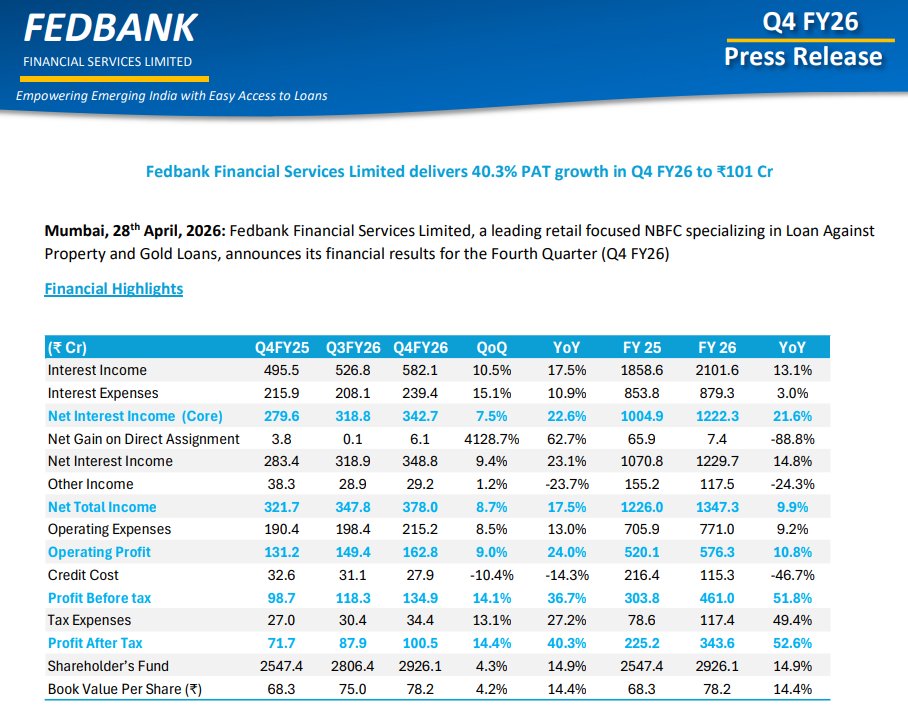
Fedbank Financial Services (Fedfina) – key Insights from latest results beyond the numbers 1.FY26 was management’s self-declared “rebuild year,” and on the most important metric - credit cost -they delivered. Credit cost came in at 0.8% vs their own guidance of <1%, compared to 1.7% in FY25. AUM grew 27.5% YoY to ₹20,153 Cr, beating the guided range of 20-25%. PAT crossed ₹100 Cr in a single quarter for the first time. ROA improved to 2.6% and ROE crossed 14%. 2.The growth engine right now is gold loans, which grew 76% YoY to ₹10,352 Cr and now form 51% of total AUM. Importantly, this isn’t purely a gold price story - tonnage (actual gold volume in grams) grew 12.25% YoY, which is the real measure of franchise quality. Even at flat gold prices, management has guided for 20-22% gold AUM growth based on tonnage and new branches alone. 148 new branches were added in FY26. 3.Asset quality at the headline level looks clean- consolidated GNPA at 1.9%, credit cost at 0.8%. But the picture is bifurcated beneath. Gold loans at 0.32% GNPA are the cleanest segment. Medium-Ticket Loan Against Property (LAP) at 1.89% is improving. However, Small-Ticket LAP sits at 4.88% GNPA and Affordable Home Loans at 5.78% - both remain stressed. These two segments together form roughly 20-25% of the book and are the key monitorables. 4. One structural positive that the market may be underappreciating - AUM per branch currently stands at ₹16.5 Cr against a branch capacity of ₹60-65 Cr. This means Fedfina has 3-4x growth runway from its existing branch infrastructure without adding new branches. Additionally, earnings quality has genuinely improved: Direct Assignment (DA) income - where an NBFC sells its loan portfolio to a bank upfront and books the profit immediately, which can make earnings look optically strong but lumpy - contributed ~50% of PBT in FY25. Management has consciously dialled this down to less than 2% in FY26, meaning profits are now coming from core lending operations rather than one-time portfolio sales. Core operating profit (PPOP) grew 22% vs the reported 11%. 5.The stock trades at ~1.9-2.0x Price-to-Book at ₹150 per share. True North (PE fund) holds ~8.6% and has appointed bankers to exit - this is a near-term overhang on the stock. If ST-LAP credit cost stays below 1%, gold tonnage holds at 12-15%, and ROA crosses 2.7-2.8%, the re-rating case builds. If mortgage stress resurfaces, the stock likely stays range-bound. #Fedfina

English
0
0
0
59
Swapnil Kommawar
Swapnil Kommawar@KommawarSwapnil·
Companies posted good results on 28th 1. Macfos 2. GRSE 3. Star Health 4. CEAT 5. Fedbank Financial Services 6. Sanofi Consumer 7. Infosys 8. Skipper 9. Greenply Industries 10. Eternal 11. AWL Agri Business 12. Dhanlaxmi Bank 13. Leela Palaces 14. InfoBeans Tech 15. Aimtron 16. Phoenix Mills
English
2
5
43
4.3K
Equity_Bytes
Equity_Bytes@Bytes_Equity·
Equity_Bytes@Bytes_Equity

Fedbank Financial Services (Fedfina) – key Insights from latest results beyond the numbers 1.FY26 was management’s self-declared “rebuild year,” and on the most important metric - credit cost -they delivered. Credit cost came in at 0.8% vs their own guidance of <1%, compared to 1.7% in FY25. AUM grew 27.5% YoY to ₹20,153 Cr, beating the guided range of 20-25%. PAT crossed ₹100 Cr in a single quarter for the first time. ROA improved to 2.6% and ROE crossed 14%. 2.The growth engine right now is gold loans, which grew 76% YoY to ₹10,352 Cr and now form 51% of total AUM. Importantly, this isn’t purely a gold price story - tonnage (actual gold volume in grams) grew 12.25% YoY, which is the real measure of franchise quality. Even at flat gold prices, management has guided for 20-22% gold AUM growth based on tonnage and new branches alone. 148 new branches were added in FY26. 3.Asset quality at the headline level looks clean- consolidated GNPA at 1.9%, credit cost at 0.8%. But the picture is bifurcated beneath. Gold loans at 0.32% GNPA are the cleanest segment. Medium-Ticket Loan Against Property (LAP) at 1.89% is improving. However, Small-Ticket LAP sits at 4.88% GNPA and Affordable Home Loans at 5.78% - both remain stressed. These two segments together form roughly 20-25% of the book and are the key monitorables. 4. One structural positive that the market may be underappreciating - AUM per branch currently stands at ₹16.5 Cr against a branch capacity of ₹60-65 Cr. This means Fedfina has 3-4x growth runway from its existing branch infrastructure without adding new branches. Additionally, earnings quality has genuinely improved: Direct Assignment (DA) income - where an NBFC sells its loan portfolio to a bank upfront and books the profit immediately, which can make earnings look optically strong but lumpy - contributed ~50% of PBT in FY25. Management has consciously dialled this down to less than 2% in FY26, meaning profits are now coming from core lending operations rather than one-time portfolio sales. Core operating profit (PPOP) grew 22% vs the reported 11%. 5.The stock trades at ~1.9-2.0x Price-to-Book at ₹150 per share. True North (PE fund) holds ~8.6% and has appointed bankers to exit - this is a near-term overhang on the stock. If ST-LAP credit cost stays below 1%, gold tonnage holds at 12-15%, and ROA crosses 2.7-2.8%, the re-rating case builds. If mortgage stress resurfaces, the stock likely stays range-bound. #Fedfina

English
0
0
1
110
Dhawal Doshi 🇮🇳
Dhawal Doshi 🇮🇳@DhawalDoshi5·
Fedbank Financial Services - Q4FY26 Results - Good sets AUM 🔼27.5% YOY - Rs. 20,153 CR Ex-business loan 🔼40.80% YOY Mortgage AUM 🔼16.1% YOY - Rs. 9,362 CR AUM Mix: => Mortgage Loan: 46.4% => Gold Loans: 51.4% Fedfina has crossed the tipping point → Gold Loan becomes dominant (>50%) Fedbank Financials disbursements grew by 109% YOY to Rs. 11,665 CR led by solid growth in gold loan segment by 134% and in FY26 it was up by 67.2% YOY. This disbursement growth supports faster AUM compounding, higher NIM stability and lower credit cycle risk. Gold Loan Segment – The Core Profit Engine Gold loan AUM was up by 76% YOY to Rs. 10,532 CR and disbursement grew by 134%. Productivity: => Gold loan AUM per branch: Rs. 16.5 CR => AUM per branch has increased from Rs. 5.5 CR → Rs. 16.5 Cr in 5 years => Added around 144 branches in FY26 and total branches stood at 628 => Gold LTV is at 60.9% Financial Performance - Net Interest Income grew by 22.6% on YOY to Rs. 342.70 CR in Q4 vs Rs. 279.60 CR in Q4FY25. Operating Profit was up by 24% to Rs. 162.80 CR in Q4 vs Rs.131.20 CR in Q4FY25. Fedbank got an operating leverage as PAT grew by 40% in Q4 and 52.6% in FY26. Credit cost has also come down from Rs. 32.6 CR to Rs. 27.9 CR in Q4FY26. ROE and ROA have been moving in the right direction due to credit cost compression, gold loan mix shift, stable spreads, operating leverage kicking in and stable leverage. ROE has inched to 14% in Q4 vs 11.4% in Q4FY25 and 12.7% in Q3FY26. ROA is at 2.6% vs 2.2% in Q4FY25 and 2.5% in Q3FY26. Asset Quality Performance - Asset quality is improving while growth is accelerating GNPA: 1.9% vs 2% in Q4FY25 NNPA: 1.3% vs 1.2% in Q4FY25 Gold GNPA: 0.2% vs 0.4% in Q4FY25 Mortgage GNPA: 3.8% vs 3.4% in Q4FY25 All the DPD buckets have improved sharply in Q4. 1+DPD: 6% 30+DPD: 3.7% 60+DPD: 2.2% This indicates: => Strong underwriting => Secured lending advantage => Gold portfolio dominance Structural Changes: => Secured AUM: ~99% => Gold focus scaled aggressively => Business loans exited => Collection team strengthened (1.8x) Outcome: FY25 → FY26 🔹ROA: 1.8% → 2.4% 🔹ROE: 9.4% → 12.6% 🔹Credit cost: 1.7% → 0.8% Things to track: => Gold price volatility → impacts LTV dynamics => Rapid branch expansion → execution risk => Mortgage portfolio GNPA (~3.8%) needs monitoring => Competitive intensity (Muthoot, Manappuram) Fedfina has posted good results in Q4 and FY26 after exiting from business loan segment and gold loan be the core growth driver. Will wait for the management commentary and guidance for FY27. Follow @DhawalDoshi5 for more updates. Bookmark and repost📌 @vishan_29 @Anvith_ @selvaprathee @Dynamicinvstr @vini546 @TrendSpark420 @InvestmentVeda
Dhawal Doshi 🇮🇳 tweet media
English
2
3
32
5.6K
Equity_Bytes
Equity_Bytes@Bytes_Equity·
Fedbank Financial Services (Fedfina) – key Insights from latest results beyond the numbers 1.FY26 was management’s self-declared “rebuild year,” and on the most important metric - credit cost -they delivered. Credit cost came in at 0.8% vs their own guidance of <1%, compared to 1.7% in FY25. AUM grew 27.5% YoY to ₹20,153 Cr, beating the guided range of 20-25%. PAT crossed ₹100 Cr in a single quarter for the first time. ROA improved to 2.6% and ROE crossed 14%. 2.The growth engine right now is gold loans, which grew 76% YoY to ₹10,352 Cr and now form 51% of total AUM. Importantly, this isn’t purely a gold price story - tonnage (actual gold volume in grams) grew 12.25% YoY, which is the real measure of franchise quality. Even at flat gold prices, management has guided for 20-22% gold AUM growth based on tonnage and new branches alone. 148 new branches were added in FY26. 3.Asset quality at the headline level looks clean- consolidated GNPA at 1.9%, credit cost at 0.8%. But the picture is bifurcated beneath. Gold loans at 0.32% GNPA are the cleanest segment. Medium-Ticket Loan Against Property (LAP) at 1.89% is improving. However, Small-Ticket LAP sits at 4.88% GNPA and Affordable Home Loans at 5.78% - both remain stressed. These two segments together form roughly 20-25% of the book and are the key monitorables. 4. One structural positive that the market may be underappreciating - AUM per branch currently stands at ₹16.5 Cr against a branch capacity of ₹60-65 Cr. This means Fedfina has 3-4x growth runway from its existing branch infrastructure without adding new branches. Additionally, earnings quality has genuinely improved: Direct Assignment (DA) income - where an NBFC sells its loan portfolio to a bank upfront and books the profit immediately, which can make earnings look optically strong but lumpy - contributed ~50% of PBT in FY25. Management has consciously dialled this down to less than 2% in FY26, meaning profits are now coming from core lending operations rather than one-time portfolio sales. Core operating profit (PPOP) grew 22% vs the reported 11%. 5.The stock trades at ~1.9-2.0x Price-to-Book at ₹150 per share. True North (PE fund) holds ~8.6% and has appointed bankers to exit - this is a near-term overhang on the stock. If ST-LAP credit cost stays below 1%, gold tonnage holds at 12-15%, and ROA crosses 2.7-2.8%, the re-rating case builds. If mortgage stress resurfaces, the stock likely stays range-bound. #Fedfina
English
1
1
1
367