

California Energy Report
1.1K posts
California Energy Report
@CAEnergyReport
Publishing on events in the energy markets as they relate to California.
California Katılım Temmuz 2025
290 Takip Edilen114 Takipçiler
California Energy Report retweetledi

This is fantastic @SteveHiltonx.
It is absolutely insane that Gavin shut down refineries and made California dependent on Iraqi oil.
BUT please do not fall into the liberal “Bunker fuel is nasty” talking point.
Historically, sailors slept in bunks and kept their belongings in a bunker.
Both are Scots/English words for a box.
A box to sleep in and a box to store your stuff.
After Columbus discovered hammocks in North America, many ships adopted them for sleeping.
The boxes became known as sea chests, and the compartment where you stored your hammock kept the word bunker.
Bunker became the term for a ship’s storage compartment, separate from the cargo hold.
When coal first arrived, distances were limited, so you did not need to carry months of supplies.
The bunkers were used to store the coal.
As ships grew more complex, you needed different words for the same thing.
Coal became the fuel fed into the steam engine. Bunkers became the coal in long term storage.
So if a captain asked how much coal was used, he wanted to know how much was fed into the engine.
If he asked how much bunkers were used, he wanted to know how much had been moved from long term storage.
Then oil-fired steamships were invented, but the first designs could burn oil OR coal.
So the word evolved again.
Bunker became an umbrella term for both.
At the start of WWII, over half of the world’s steamship tonnage still burned coal. But there was a massive overcapacity of ships after the war, so most of the coal ships were scrapped.
Diesel ships became increasingly popular.
The name “Bunkers” remained an umbrella term.
Old steamships were highly inefficient and burned a lot of crude oil.
After WWII, technology improved the diesel engine and allowed steamships to burn cheaper residual fuel.
Grades of bunker fuel emerged:
Bunker A: lighter fuel oil, roughly like No. 2 diesel / distillate fuel.
Bunker B: intermediate fuel, heavier than A but lighter than C.
Bunker C: heavy residual fuel oil, roughly No. 6 fuel oil.
Bunker D: the really nasty dregs.
Very few ships ran on Bunker D because it has to be heated heavily before you can pump it and is nasty to clean up.
Then President Eisenhower began building the highway system, and demand rose for the nasty stuff: asphalt.
So Bunker D was never really a thing.
Diesels were far more efficient but slow. Steamships burned a ton of oil but were fast.
The oil embargo of the 70s settled the debate. After that, the world’s fleet began shifting to diesel.
It took decades, but by the early 2000s, almost all ships had moved to diesel engines .
Confusing everything, technology improved so very large diesels could run Bunker C but it’s a moot point because in 2020 the UN basically outlawed Bunker A, B & C. You could burn certain grades with scrubbers that eliminate the nasty stuff from exhausts, or you could buy very low sulfur diesel.
(Yes marine engineers… I am oversimplifying)
Today many ships are being built with diesel engines that can also burn LNG.
So right now the word “Bunkers” refers to any fuel used to propel a ship. A handful of old vessels, mostly in government service, still burn Bunker C.
The problem is that environmentalists have hijacked the word. Google “Bunker Fuel” and the AI and search results steer you straight to the nasty Bunker C.
No commercial tankers supplying California use Bunker C without scrubbers (and probably not at all)
They use diesel. If they have a stack scrubber, they may burn lower grade diesel with sulfur at sea, then switch to clean diesel as they approach shore.
But no tankers are using “Bunker fuel, the most polluting transportation fuel there is.”
They are using marine diesel. And ships are 10x more efficient than trains, which are 10x more efficient than trucks, which also burn diesel.
Few in the industry call it “Bunker Fuel” anymore. That term is redundant.
We just say “Bunkers” to mean any fuel
The nasty stuff is always specified as “Bunker C”
Tom Sauer@thomasbsauer
English
The Sable saga continues.
mercurynews.com/2026/05/01/cal…
English
@yui_torikata Don’t worry—everyone who knows knows it was a typo.
English

@CAEnergyReport 😭am sorry ! And thank you for pointing out! Yes 2,000,000! But can fix this as I have no access to correct my “tweet”…
English
鉄道輸送は北米など中心に一定量存在しますが、効率で考えると水上輸送には歯が立ちませんよね。300bbls (一説には680-700bblsとも)という事は100両編成でも30,000bbls…長距離原油輸送に使う大型船VLCCが一隻約2,00,000bbls…
ハルカエル@Harukael_ver2
原油を積むタンク内は爆発しないように酸素濃度を下げたイナートガスを注入しなくてはいけません。 タンカーではボイラーの排ガスなどを使ってこのイナートガスを生成してタンクに注入しますが、鉄道ではどうやってこの課題を解決するのだろう? あとポンプの問題もありますね。 積んだ油はポンプで揚げないといけません。各車両にポンプをつけるのでしょうか?1車両300バレル程度の容量とのことなので、200万バレル分だと各車両にポンプをつけると7000台弱のポンプが必要になる。VLCCみたいに配管でタンクを繋いで少ないポンプで揚げることも可能だが、その場合、車両を繋ぐ配管が必要になり、クネクネ曲がる鉄道では配管に亀裂が入る可能性があり向いていないように感じる。 じゃあ、1車両のサイズを大きくすれば解決?と聞かれるとそうでもない。この場合は自由水影響が発生して、液体の動きによってスロッシングという現象が生じる。要は津波みたいな水の衝撃が発生して、下手すると鉄道の加減速でタンクがぶっ壊れるリスクがある。 原油の輸送は実は見た目ほど簡単ではない。
日本語
What's happening in OQD Oman is interesting ... trying to get rid of those barrels.
English
California Energy Report retweetledi

🇺🇸 San Francisco is importing crude oil from 🇱🇾 Libya.

English
Natural gas prices may have bottomed in California as the meagre snowpack portends lower hydro generation and the Aliso Canyon injections season begins. Prices have been much below the national benchmark for months now. Higher natural gas prices mean higher electricity bills. Nonetheless in February retail electricity prices in CA were nearly twice the national average.
naturalgasintel.com/news/disappear…
English
Gas prices in California are high, but not the highest we've seen, which was in 2022 due to the war in Ukraine. Current regulations which have resulted in two refineries closing down were imposed as a result of those prices.
fox40.com/news/californi…
English
The last time CA imported gasoline from China was at the end of 2024 ... given the situation that might start again. Some of those barrels would be refined from Iranian and Russian crude.
Javier Blas@JavierBlas
Important development: China has given state-owned refiners the green light to export some gasoline, diesel and jet-fuel to a handful of regular customers (in Asia), signaling the country is effectively easing an earlier ban on shipments.
English
West coast not seeing large crude draws. California neither with stocks recovering from March lows. Also true of gasoline.
Z4 Energy Research@ZmansEnrgyBrain
We posted our view of regional physical breaking points at the end of last month. Tick tock, tick tock #OOTT
English
@mercoglianos I'm long but California's inventories, though low, are up from March and PADD 5 is too. Not fitting the narrative.
English

This decline matches the slop of previous years, but the issue is if that curve stabilizes or curves back up.
Based on global demand, it probably will not.
HFI Research@HFI_Research
Oh my god.
English
California Energy Report retweetledi

Brace yourself. The $#@! is hitting the fan today in oil. Spot gasoline is up 18cts/gal in most of the country and 28cts/gal higher in Gr. Lakes' states. Diesel up 25cts/gal in most regions and an incredible 75-90cts/gal in Great Lakes thanks to murmurs about a refinery problem.
English
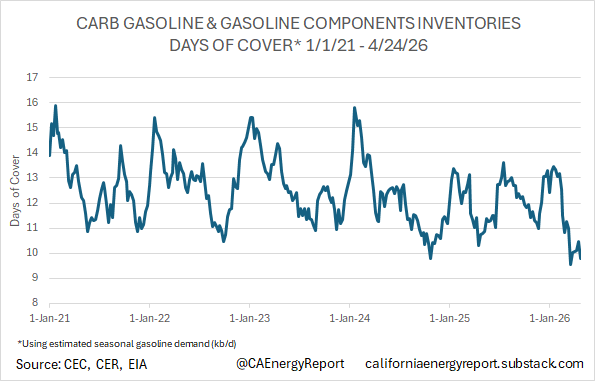
Per today's California Energy Commission data for the week ended April 24, gasoline stocks are low but above the nadir seen in March:

English
CEC data have California crude stocks up 5% April 24 from the week before--on the low end of the dataset, but higher than March. EIA has PADD 5 (West Coast) stocks down slightly (0.8%) week over week, but well within the 5 year range. The predicted disaster has yet to strike California. (EIA's total US oil stocks (crude, products, and SPR) down 1.4% week over week.)
English
The state's largest data center is set to be built in Imperial Valley. Will its water requirements be too stressful for the Imperial Irrigation District?
insideclimatenews.org/news/29042026/…
English
Environmentalist arguing that any wastage by large industrial processes is unacceptable.
sacbee.com/opinion/op-ed/…
English
The CEC has approved through its Opt-In Certification Program the 300 MW Soda Mountain Solar Project, which includes up to 300 MW/1,200 MWh of BESS, in San Bernardino County, subject to BLM approval.
enerdata.net/publications/d…
English