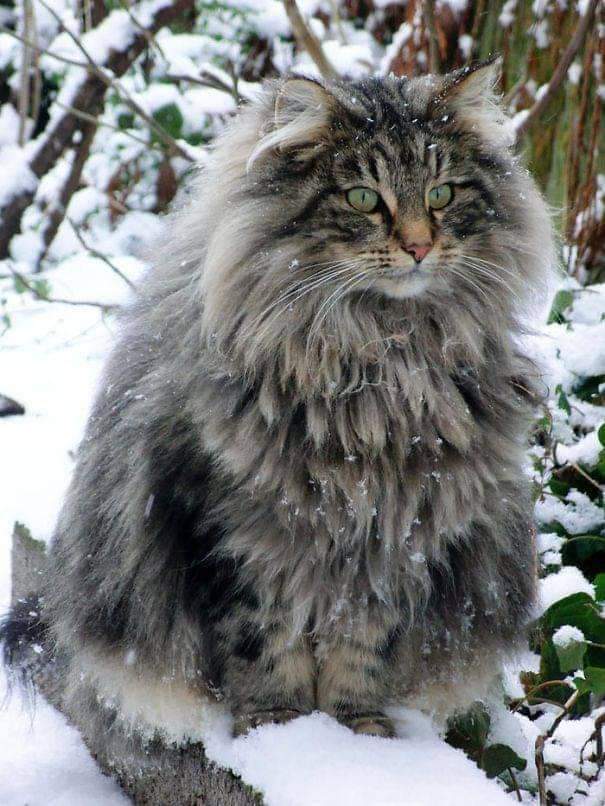
Norwegian forest cat is known for its large size, expert climbing skills and its ability to withstand colder climates. Native to Northern Europe, the cat breed is rumored to have been brought to Norway by the Vikings circa 1000 AD.
Easygoing and personable, the Norwegian forest cat has been a longtime favorite of families, particular in France, Sweden, Iceland and Norway. Although the rumors can’t be verified, many cat fanciers believe that Norwegian forest cat began its journey in Great Britan and traveled with Vikings and Crusaders to Norway in 1000 AD, where they lived in Norwegian forests for hundreds of years, fine-tuning their hunting and climbing skills.
Recent genetic research has shown that these seafaring Nordic explorers brought domesticated cats on board their ships to kill rodents, helping the furry felines spread across the globe. But the Vikings also appear to have raised cats for another, even less savory reason: harvesting their pelts to wear as clothing. Now, as reported in Science magazine, a team of scientists at the University of Copenhagen have mined the skeletons of cats recovered from Viking-era mass graves and other archaeological sites across Denmark to investigate how Iron Age, Viking, and medieval cats differed from modern house cats.
The new study, published in the Danish Journal of Archaeology, found that while most animals tend to shrink when they become domesticated—dogs, for example, are on average about 25% smaller than their nearest wild relative, the grey wolf—exactly the opposite is true for cats. In fact, cats have grown about 16% bigger, on average, since the Viking era.
Scientists have established that domesticated cats (Felis catus) are all descended from a single subspecies, Near Eastern wildcat (Felis silvestris lybica), which still roams wild today in the Middle Eastern desert. A large scale genetic study published in 2017 suggested that cats spread from Southwest Asia and Africa into Europe and beyond in two distinct waves. Viking-era cats descend from the second wave, which began as early as 1700 BC, as sailors began bringing cats with them on their ancient voyages for rodent control, and accelerated after 5th Century AD. To find the valuable cache of cat skulls, femurs, tibias and other bones used in new study, which range in age from Bronze Age to 1600s, new study’s co-author Julie Bitz-Thorsen, then an undergraduate at the University of Copenhagen, had to dig through dozens of bags of mixed animal remains at the city’s Zoological Museum. Dog, horse and cow bones are much more common at many archaeological sites, making her task particularly difficult.
Cat remains were relatively sparse in Denmark before the Viking Age (650-1050 AD), when they began to show up more frequently, particularly around urban settlements. Many of the remains Bitz-Thorsen found came from Viking-era pits, and bore marks of their grisly origins. “You can tell the cats were skinned—they have cut marks, or the neck has been broken,” she told Science.
As time went on, cats spread to rural settlements and estates as well as towns and, as the new study shows, they began to grow in size. While it’s not clear yet why exactly why this growth occurred, it may have something to do with increased access to food, and better living conditions, especially after more and more people began treating cats as beloved house pets rather than strictly rodent hunters (or sources of fur). Beginning in the late Middle Ages, Bitz-Thorsen pointed out, cats became increasingly well-fed and well-treated, beginning their rise to the status of popular pet they hold today.
#archaeohistories
BREAKING 🚨 Former California Governor, Arnold Schwarzenegger stuns America saying immigrants have to come to America the LEGAL WAY 🔥
“When you come to America, you are a guest and you have to BEHAVE like a guest”
Everybody needs to watch this 👏
What did Michelle Obama do for $122K a month paid for by the taxpayers??? Since 2009 she has taken $21,960,000 from our pockets. Considering that Obama was somehow receiving royalties from his failed Obamacare..we start to understand why they have a net worth over 300M. 🤬
"I worked with Hillary Clinton.
She was evil. The stories agents around her have, and have kept bottled up inside, are horrendous.”
“Working on her detail was generally considered a punishment assignment.”
“You will never meet a more mercenary and destructive public figure in your lifetime.”
“She hates you. All of you."
- Dan Bongino
Now that he's officially been named Deputy Director of the FBI, Hillary KNOWS she's in TROUBLE.
Dan has been waiting for this moment for a LONG TIME.