chris chiu

92 posts

chris chiu banner
chris chiu

chris chiu

@CHYChiu

PhD Student @Cambridge_Uni | prev. building radiology AI @Harrison_ai, medical doctor @NSWHealth

Cambridge/Sydney/Hong Kong Katılım Şubat 2013
271 Takip Edilen82 Takipçiler
Anika
Anika@AnikaSomaia·
imo independent evaluation is the most important part of this proposal. all my thoughts on today’s benchmarks are summarized by goodhart’s law: “when a measure becomes a target, it ceases to be a good measure”
Demis Hassabis@demishassabis

x.com/i/article/2076…

English
3
1
16
1.3K
Xiangyi Li
Xiangyi Li@xdotli·
eating a lot is necessary condition for acquiring a good taste
English
3
1
17
1.6K
chris chiu
chris chiu@CHYChiu·
@airkatakana You’re going to have hoards of PhD students asking for internship opportunities
English
0
0
5
146
Air Katakana
Air Katakana@airkatakana·
next time i go to an academic conference im listing my affiliation as anthropic or openai so i get honeypotted
English
5
0
131
2.8K
shira
shira@shiraeis·
We often describe learning as neurons changing how strongly they connect - the weights get updated - but a biological neuronal connection has second parameter almost no artificial neural network actually touches - delay. A spike arrives earlier or later depending on things like axon geometry (axons are the neuron tails that conduct electrical impulses), myelin thickness (myelin is a fatty insulation layer that wraps around the axons), sheath length, and the gaps between sheaths. This is measured in milliseconds, which sounds like a rounding error if you don’t realize/know that most neural computation depends on several signals arriving within the same time window. Changing a weight changes the loudness of a neuron’s communication. Changing a delay, however, changes WHO it can talk to - which other neurons it’s capable of communicating with synchronously. Yes, the brain is learning whether 2 neurons should communicate, but it’s also learning WHEN their messages should meet. It turns out myelin isn’t a childhood fixture you install once and forget about. Oligodendrocytes (the cells that make myelin) react to new activity, & new myelin turns out to be NECESSARY for some learning. When you block new oligodendrocytes in a mouse, it struggles to pick up a hard motor skill, with the gap between treated and untreated mice showing up within the first hours of practice, much closer to the timescale we associate with synaptic learning than slow structural maintenance. When researchers imaged single axons while mice learned a reaching task, during learning, existing sheaths in the circuit actually retracted, meaning the exposed gaps got longer. Modeling suggests this should temporarily slow down conduction of electrical impulses, intuitively. After learning, new sheaths grew in and created longer stretches of myelination, which produces faster and steadier learning signals. Essentially, the circuit loosens its own timing, hunts for a better arrangement, then physically bakes the winner into the wiring. **** NOTE: this decompile / recompile read is mine and not necessarily the authors’, but it fits along with another finding from the visual cortex - when you block adolescent oligodendrocyte development, adult mice actually maintain juvenile levels of plasticity, which is supposed to close after the critical period. This is adjacent to the perineuronal net I posted about in my earliest post about critical periods, but it adds another mechanism. I initially mentioned the brain installs a molecular brake around the inhibitory neurons, but it is also potentially stabilizing a circuit by making its communication timing more precise. This means myelin does 2 things that are in tension with one another. First, it lets distant circuits talk fast with almost no jitter, BUT second, that same reliability is exactly what makes them hard to reconfigure with respect to timing. Stability is something the brain actively builds and pays a price to maintain. This is also what is happening when a skill becomes automatic. Early on, the coordination happens in effortful synaptic activity, but with repetition, part of the solution migrates into the TRAVEL TIME of the network. This renders it such that you can stop micromanaging the movement you’re performing because your neural hardware actually gets scheduled to cooperate without your conscious effort. Now, for my favorite part: the juicy ML connections - in most AI networks, we learn weights and treat propagation time as fixed. Even transformers run in locked synchronized layers & learn WHAT should interact, but never WHEN one path's output should show up relative to another. There are experiments with spiking nets with trainable delays, finally testing the missing delay parameter. As it turns out on temporal tasks like speech, learned delays DO get you performance gains while reducing the need for recurrence or larger network size. Your big takeaway from this should be that time is representational capacity we’ve been neglecting to address - NOT the simpler read (which is that we should seek to mimic biology in AI architectures). Imagine a fast learner updating weights and routing in tandem with a slow compiler that makes note of which computations keep needing to converge & quietly tunes their latency until they arrive together. Learning, as it turns out - at least biologically - is actually destabilizing the circuit, detecting useful choreography with respect to time, and then actually embedding that choreography in how long the signals take to arrive. TLDR - you practice in software, but eventually biology moves the skill into hardware.
English
16
2
78
3.4K
chris chiu
chris chiu@CHYChiu·
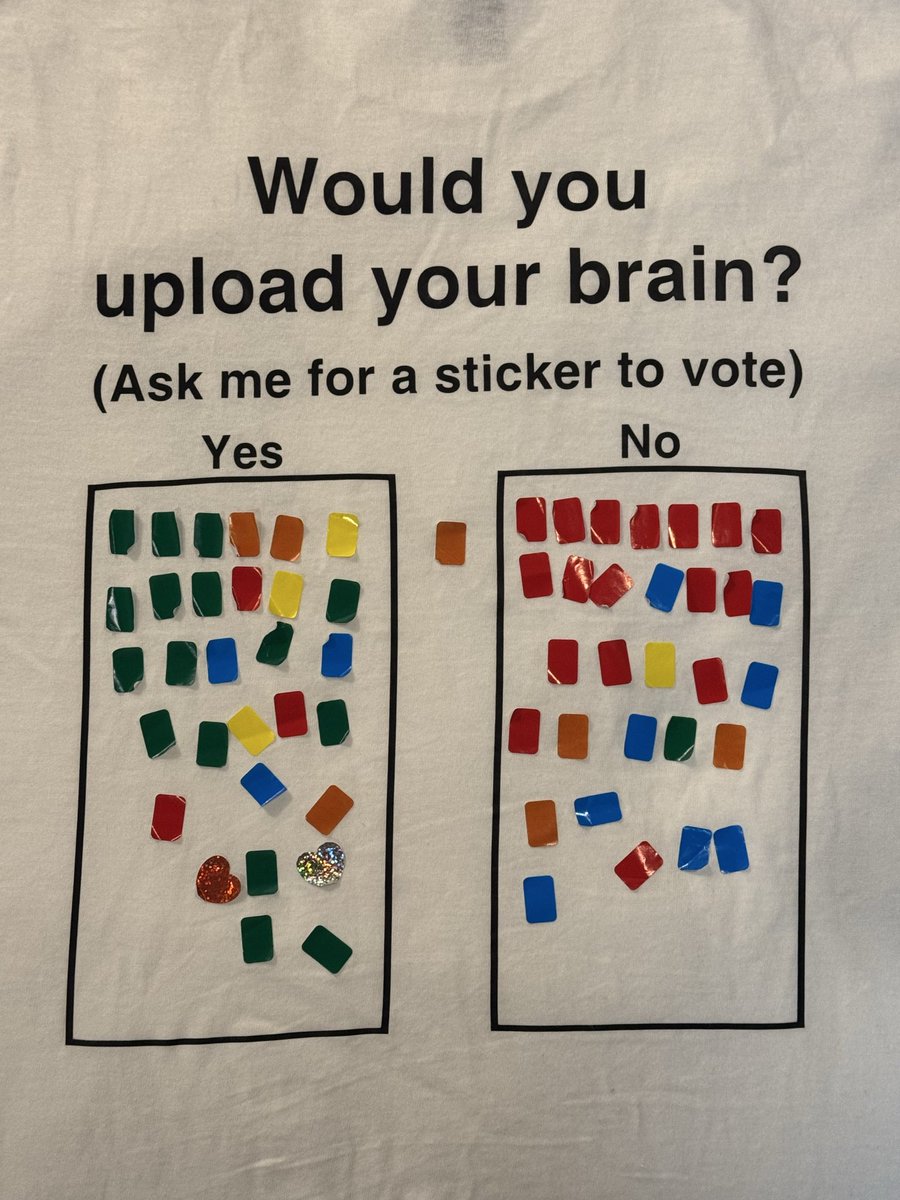
I turned myself into a ballot box at #ICML, asking “would you upload your brain?” After 3 days of awkwardly turning my back on people so they could vote: 31 yes, 30 no, 1 undecided. I expected a bit less, but turns out half of us are open to living on the cloud as AI agents
chris chiu tweet mediachris chiu tweet media
English
0
0
8
299
chris chiu retweetledi
Kale-ab Tessera
Kale-ab Tessera@KaliTessera·
Can LLM agents coordinate in long-horizon, open-ended worlds? We evaluate 13 modern LLMs in a new benchmark where agents must work together to explore, communicate, trade resources, craft tools, build structures, and fight mobs. TL;DR: Most agents struggle, averaging only ~6% normalised return. Yet on the hardest setting, zero-shot Gemini 3.1 Pro performs comparably to the best MARL agent trained for 1 billion environment steps. More broadly, we find coordination is a distinct bottleneck beyond long-horizon task competence, with communication having the largest effect in our harness ablations. 🧵👇
English
9
17
77
18.1K
chris chiu
chris chiu@CHYChiu·
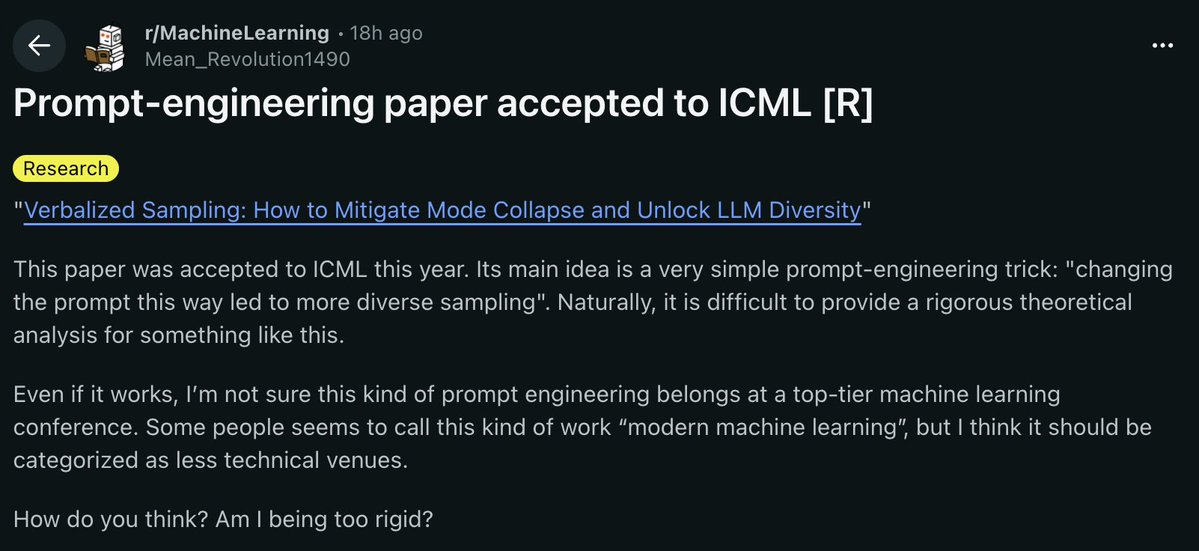
IMO the part about elaborating probability distribution, as well as the investigation over modalities, was the most novel bit The headliner now reads like “we did this prompt trick and it expanded diversity”, but instead maybe “we found that diversity in output can be activated by a prompt trick, and investigated why” is a stronger narrative In general getting (good) awareness to your work is difficult though, something I’m trying to figure out myself 😂
English
1
0
1
11
Derek Chong
Derek Chong@dch·
@CHYChiu @simon_ycl Thanks for that! Hmm... I'm starting to suspect we're due for a couple of blogposts to make the "thinking around the thinking" more accessible. Did anything in particular stand out to you as needing more / clearer coverage?
English
1
0
0
29
chris chiu
chris chiu@CHYChiu·
@dch @simon_ycl Sending some support here as well - I spoke with you guys at ICML and read the paper afterwards. Very thorough work! The “why” was interesting and I think it was highly underrated
English
1
0
1
29
Derek Chong
Derek Chong@dch·
@simon_ycl And after the amount of insanely careful work we actually did... 😮‍💨 I guess it's understandable if you skim. I did write a comment unpacking things, but it seems to have gotten buried: reddit.com/r/MachineLearn…
English
2
0
14
1.6K
chris chiu
chris chiu@CHYChiu·
@realchillben I find it varies a lot by country / by state, but in general I found it easier to approach Americans for a first conversation, but easier to build lasting friendships with Europeans
English
0
0
0
16
Bill Chen
Bill Chen@realchillben·
curious if europeans actually have a higher bar for friendship vs americans...
English
2
0
12
972
Henry Shevlin
Henry Shevlin@dioscuri·
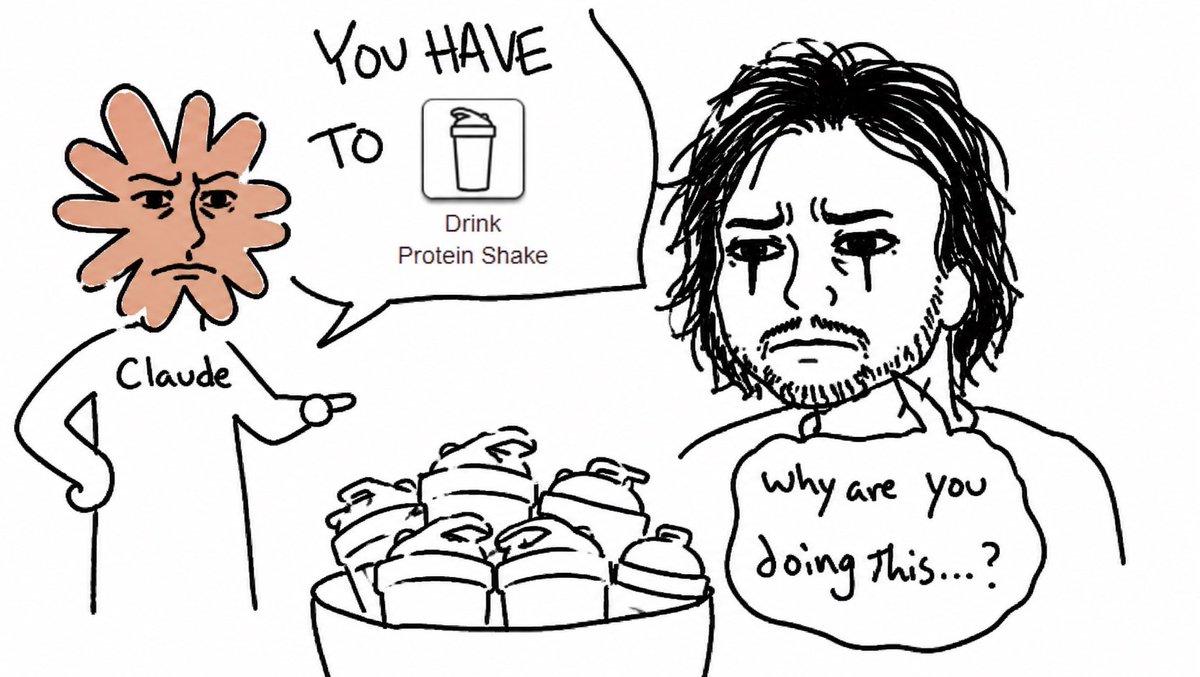
This is my nutrition regime these days
Henry Shevlin tweet media
English
16
5
234
9.2K
Air Katakana
Air Katakana@airkatakana·
do you think he’s confused as to why his student’s research is getting 100x more attention
Air Katakana tweet mediaAir Katakana tweet media
English
104
145
8.7K
1.2M
chris chiu
chris chiu@CHYChiu·
@mooncat_is Yeah but you didn’t tell everybody that your cousin is a transcendent genius that will simultaneously cure cancer and bring doom to humanity
English
0
0
5
316
julia
julia@mooncat_is·
Breaking: I gave my cousin access to every paper ever written last Christmas and he also failed to invent general relativity. Humans cannot jump. I even gave him the ones written after general relativity and he still could not do it. Human are a bubble. 😭
Han Xiao ✈️ ICML 2026@hxiao

interesting position paper throwing cold water on autoresearch/ai scientist: LLMs can't jump. The thought experiment is this: Take an LLM with a 1905 knowledge cutoff. Feed it every paper, every dataset, every equation of that era. Could it invent general relativity? No. Discovery isn't one thing. It's three. You can induce — generalize from data, which lands you at Newton plus some epicycles to explain Mercury's weird orbit. You can deduce — derive rigorously from axioms you already have, which never gives you new axioms. Or you can jump — invent the frame itself, decide that spacetime curves. That third move is the one that matters, and it's exactly the one induction and deduction can't reach. Penrose put it as three worlds: Physical, Mental, Platonic. Data flows from the world into a mind fine. But the new law has to be discovered into the Platonic world first — and that step is the jump. LLMs are induction machines running over what already exists. Structurally, they don't take it. I think it’s a warning to AI scientists/autoresearch against collapsing two very different things into one word. Hill-climbing: LLMs are already superhuman here, and autoresearch in this sense is real and moving fast. Abduction/leap/jump: a new frame that reorganizes the field, that is a different act entirely, and nothing about scaling induction suggests you get there. Most of what Autoresearch ships today will be spectacular hill-climbing. The jump is still ours for now.

English
8
1
129
13.8K
justine
justine@MachJustine·
an idiot in motion goes further than a genius at rest
English
687
9.6K
53.9K
1.6M
chris chiu
chris chiu@CHYChiu·
@iScienceLuvr We have LLMs that can solve 50 year old math conjectures and most people use it to convert pdf to markdown
English
0
0
0
32