Biff #SARSisAirborne 🍉@Biff234523
🧵💉🇨🇦 Summary of where we stand on 2025 #Novavax access for Canada:
There is obviously *a lot* of demand to bring @Novavax back to Canada, but I’ve noticed a lot of the energy is being used on the wrong pathways here.
For a while now, there has been a very pervasive myth that Novavax is lacking approval in Canada. That is not true, Novavax’s JN.1 formulation received approval from Health Canada on September 19th, 2024, and remains approved today.
Source: covid-vaccine.canada.ca/nuvaxovid-jn1/…
So why was there no availability for the 2024 season?
Essentially, there has been an ongoing dispute about the manufacturing location. The federal government's purchase contract with Novavax was dependent upon Novavax producing the doses in Canada. In 2021, Novavax planed to set up a manufacturing facility in Montreal, but that plan never materialized. As a result, the feds did not place any orders for the 2024 season, and they officially tore up the contract in March of this year: barrons.com/news/canada-ca…
Even though the federal government, Public Services and Procurement Canada (PSPC) @PSPC_SPAC, and PHAC @PHAC_GC were not willing to place a purchase order, they did make it clear that individual provinces would still be able to place an order on their own. Most (or all) of the provinces investigated the possibility, but determined that they were unable to meet Novavax’s minimum order requirement, which has been reported as being 500,000 doses.
In this article (cbc.ca/news/canada/ne…), Health Canada spokesperson Nicholas Janveau and New Brunswick Department of Health spokesperson Sean Hatchard both confirm the general idea:
"However, Canada's current contract with Novavax only provides access to domestically manufactured vaccines, which Novavax has been unable to confirm for the 2024/25 season," Janveau said.
If Novavax's JN.1 vaccine does get approved, provinces and territories "may choose to procure independently from Novavax from supply produced in India for their fall vaccination campaigns," he added.
But "New Brunswick and other provinces have investigated and are unable to find other options to procure this vaccine," according to Department of Health spokesperson Sean Hatchard.
"The amount of vaccine that needed to be ordered to procure it independently was too large based on the minimal demand in the province," he said.”
This article (globalnews.ca/news/10789020/…) highlights the fact that most provinces were aware of the situation and also independently decided to either not place an order or that they could not meet the minimum requirement:
“As of Tuesday afternoon, several provinces – including Alberta, Saskatchewan, Ontario, Nova Scotia, P.E.I. and Newfoundland and Labrador – confirmed to The Canadian Press that they aren’t placing orders for Nuvaxovid.”
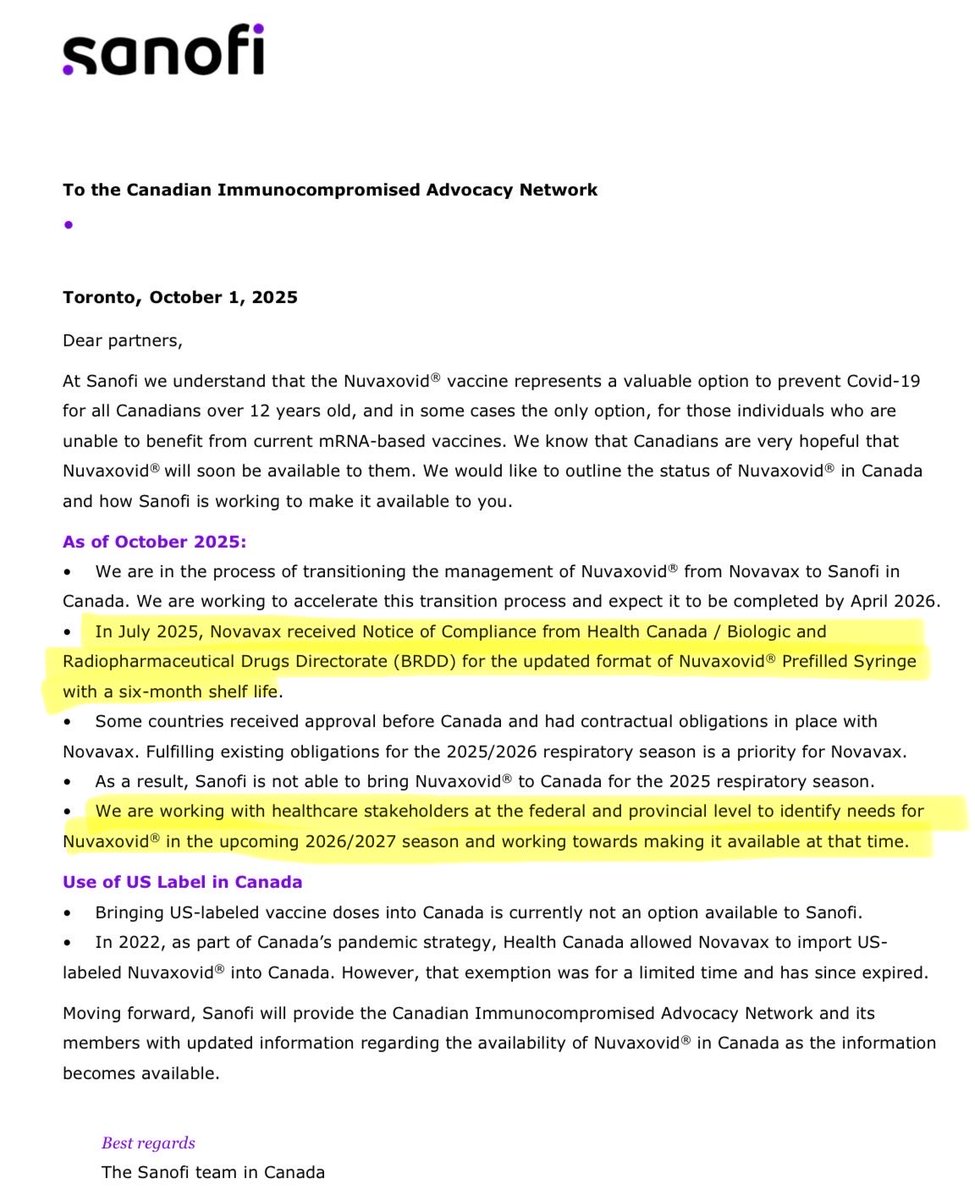
Things do have the opportunity to change this year, obviously, because we’re dealing with 2 new parties at the table - The @MarkJCarney administration, and @sanofi, who will be booking sales and distribution for Novavax beginning this year.
However, in writing, Sanofi has told us this: “Please note that we do not plan to bring Nuvaxovid® to the Canadian market for the upcoming 2025 fall season at this time."
But, we still need to push them for more details on where they stand, like trying to figure out if they would fulfill a purchase order from the federal government or a province if approached, and what their minimum purchase requirement would be.
This recent letter (covidsociety.ca/wp-content/upl…) is a good start, sent to Sanofi’s Canadian office by @CanCovSoc and @immunocompCA.
I’d encourage individuals to follow their lead of reaching out to Sanofi Canada to offer support but also demand more answers, as well as expressing your desire directly to the Carney administration, PSPC, and provincial leaders/health departments. The one thing that is NOT needed is to contact Health Canada or Novavax over the approvals process.