Phillips P. OBrien

28.4K posts

Phillips P. OBrien banner
Phillips P. OBrien

Phillips P. OBrien

@PhillipsPOBrien

Professor of Strategic Studies, @univofstandrews; Author of War and Power (Summer 2025) https://t.co/al9SES8ncC

Scotland, Boston and Sicily (whenever possible) Katılım Şubat 2015
1.7K Takip Edilen210.9K Takipçiler
Sabitlenmiş Tweet
Phillips P. OBrien
Phillips P. OBrien@PhillipsPOBrien·
Hi All, my latest book, War and Power: Who Wins Wars and Why, is being released in North America in two weeks. The Publisher, Basic Books/Hatchette, has just released a discount code for 20% if you buy through them. Code is WAR&POWER (not case sensitive). publicaffairsbooks.com/titles/phillip…
English
36
91
316
271.2K
Phillips P. OBrien retweetledi
David Frum
David Frum@davidfrum·
If you wonder why Europeans flinch from helping US in Gulf - in January, NATO allies were seriously preparing for a US sneak attack on Greenland, planning to blow up runways to prevent a Trump re-enactment of Putin's failed strike on Kyiv.
Orla Joelsen@OJoelsen

Denmark prepared for a possible U.S. attack: Flew blood supplies to Greenland and planned to blow up runways Key sources in Denmark and Europe are now revealing for the first time what happened during the most critical days, when Donald Trump threatened to take Greenland “the hard way.” When Danish soldiers were rapidly deployed to Greenland in January this year, they brought explosives with them. The plan was to destroy runways in Nuuk and Kangerlussuaq to prevent American military aircraft from landing troops on the island, should the U.S. president ultimately decide to seize Greenland by force. They also transported blood supplies from Danish blood banks so wounded personnel could be treated in case of combat. This is reported by DR, which over the past year has spoken with central sources in the Danish government, top military officers, and high-ranking officials and intelligence sources in Denmark, France, and Germany. All sources have played—and continue to play—key roles in the international crisis triggered by the United States’ demand for control over Greenland. Together, the sources describe an unprecedented year marked by sleepless nights. None of them had concrete intelligence of specific American attack plans against Greenland. Still, many feared in January that the historically important ally, the United States, could attack at any moment. At the same time, Denmark reached out to its European allies, leading to closer cooperation. “With the Greenland crisis, Europe realized once and for all that we must be able to handle our own security,” said a French senior official involved in the intense period. A rapid-response force consisting of Danish, French, German, Norwegian, and Swedish soldiers was first deployed to Nuuk and Kangerlussuaq. Shortly after, a main force followed, including: -Soldiers from the Danish Dragoon Regiment in Holstebro -Elite troops from the Jaeger Corps -French alpine troops trained for cold and mountainous warfare At the same time, Danish fighter jets and a French naval vessel were sent to the North Atlantic. According to several sources, the goal of having multinational troops on the ground was to ensure that any U.S. attempt to take Greenland would require a large-scale hostile action—thereby deterring such an attempt. “We have not been in such a situation since April 1940,” said a Danish defense source, referring to the days before Denmark’s occupation during World War II. Unlike in 1940, when Denmark chose not to resist militarily, the government and defense leadership this time decided—after extensive confidential discussions—to take the opposite approach: If the U.S. attempted an attack, Danish forces would be armed and ready to fight. Danish F-35 fighter jets deployed north were also fully armed. All this despite the understanding that Denmark could not realistically withstand a U.S. military attack. “The cost for the U.S. had to be raised. The U.S. would have to carry out a hostile act to take Greenland,” said a senior Danish defense source. Source: DR

English
527
2K
8.1K
510.7K
Phillips P. OBrien retweetledi
Jay in Kyiv
Jay in Kyiv@JayinKyiv·
Hegseth announces that Ukraine is cut off. Serving Putin is the core focus of the Trump administration.
English
501
2.7K
9.1K
315.2K
Phillips P. OBrien retweetledi
Euromaidan Press
Euromaidan Press@EuromaidanPress·
The US is lifting sanctions on Belinvestbank, the Belarusian Development Bank, and the Finance Ministry This comes on the same day as Belarus announced large-scale military exercises near the Polish border euromaidanpress.com/2026/03/19/rus… 📹 Pul Pervoho
English
5
75
159
15.1K
Phillips P. OBrien
Phillips P. OBrien@PhillipsPOBrien·
Watching Trump teeter on the edge of blowing up the world economy because of a combination of hubris, strategic incoherence, mendacity and outright stupidity, might be the most extraordinarily depressing thing I have observed in my entire life, or read about in any other period.
English
394
2.4K
10K
238.8K
Phillips P. OBrien
Phillips P. OBrien@PhillipsPOBrien·
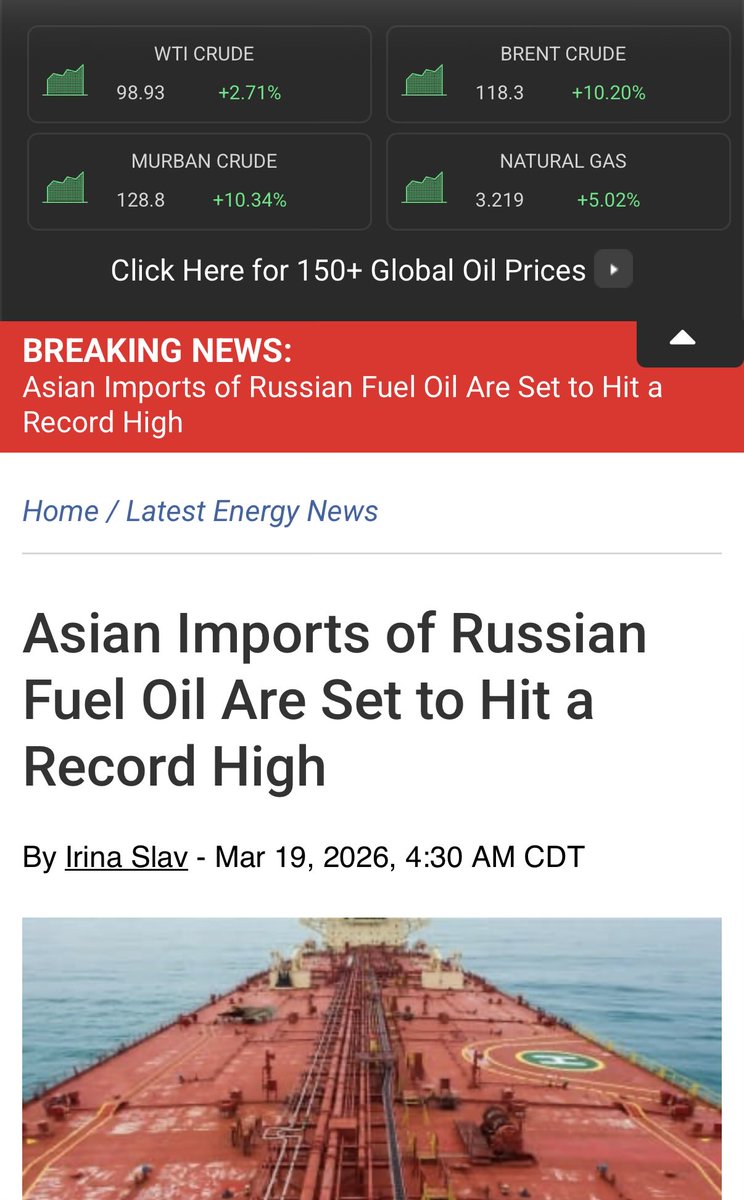
Trump is all about winning for Russia. He has gifted Putin a windfall at a vital time.
Phillips P. OBrien tweet media
English
11
242
570
15K
Phillips P. OBrien retweetledi
Arnaud Bertrand
Arnaud Bertrand@RnaudBertrand·
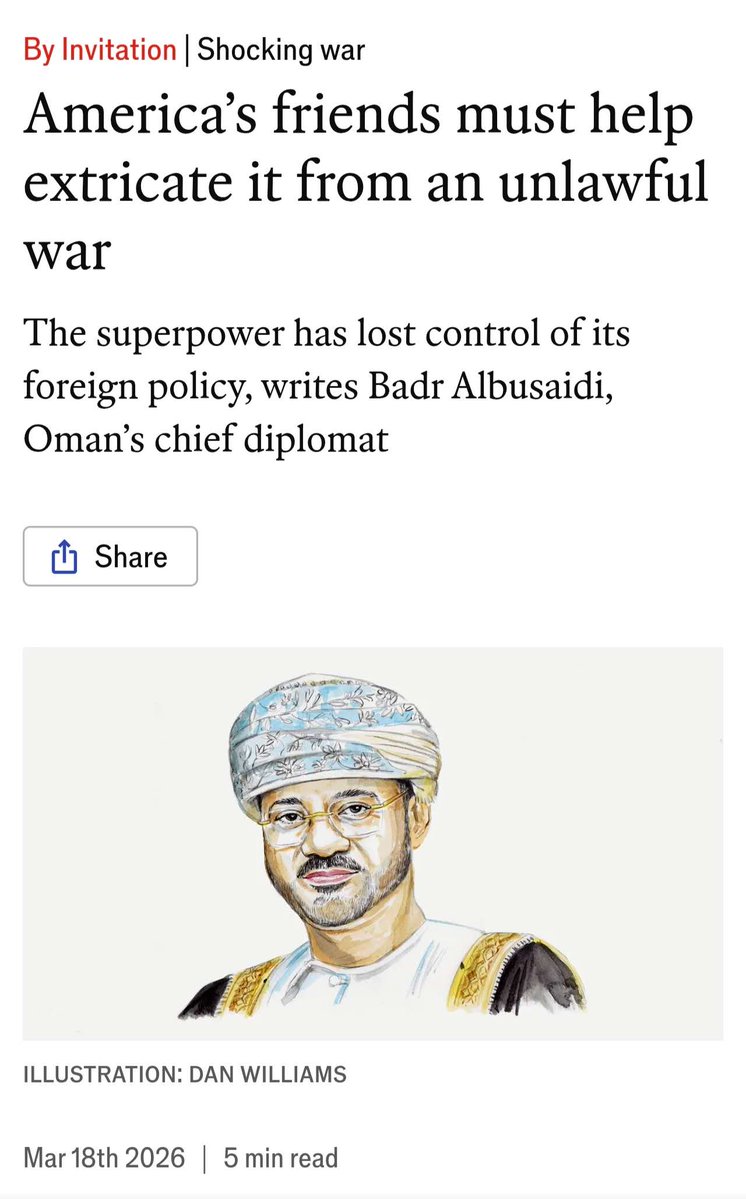
This is probably the most important article of the month: an op-ed by Oman's Foreign Minister, who mediated the talks between the U.S. and Iran, in which he writes that the U.S. "has lost control of its foreign policy" to Israel. He repeats that a deal was possible as an outcome of the talks (something confirmed by the UK's National Security Advisor, who also attended: x.com/i/status/20341…) and that the military strike by the U.S. and Israel was "a shock." Interestingly, given he is one of Iran's neighbors and given that Oman has been struck multiple times by Iran since the war began (en.wikipedia.org/wiki/2026_Iran…), he writes that "Iran’s retaliation against what it claims are American targets on the territory of its neighbours was an inevitable result" of the U.S.-Israeli attack. He describes it as "probably the only rational option available to the Iranian leadership." He says the war "endangers" the region's entire "economic model in which global sport, tourism, aviation and technology were to play an important role." He adds that "if this had not been anticipated by the architects of this war, that was surely a grave miscalculation." But, he adds, the "greatest miscalculation" of all for the U.S. "was allowing itself to be drawn into this war in the first place." In his view this was the doing of "Israel’s leadership" who "persuaded America that Iran had been so weakened by sanctions, internal divisions and the American-Israeli bombings of its nuclear sites last June, that an unconditional surrender would swiftly follow the initial assault and the assassination of the supreme leader." Obviously, this proved completely wrong, and the U.S. is now in a quagmire. He says that, given this, "America’s friends have a responsibility to tell the truth," which is that "there are two parties to this war who have nothing to gain from it," namely "Iran and America." He says that all of the U.S. interests in the region (end to nuclear proliferation, secure energy supply chains, investment opportunities) are "best achieved with Iran at peace." As he writes, "this is an uncomfortable truth to tell, because it involves indicating the extent to which America has lost control of its own foreign policy. But it must be told." He then proposes a couple of paths to get back to the negotiating table, although he recognizes how difficult it would be for Iran "to return to dialogue with an administration that twice switched abruptly from talks to bombing and assassination." That's perhaps the most profound damage Trump did during this entire episode: the complete discrediting of diplomacy. If Iran was taught anything, it is: don't negotiate with the U.S., it's a trap that will literally kill you. The great irony of the man who sold himself as a dealmaker is that he taught the world one thing: don't make deals with my country. Link to the article: economist.com/by-invitation/…
Arnaud Bertrand tweet media
English
295
8K
18.3K
1.1M
Phillips P. OBrien retweetledi
Timothy Snyder
Timothy Snyder@TimothyDSnyder·
Phillips is completely right here. It is absurd to repeat an obviously false framing. And it is harmful, because once stated in the NYT it becomes credible.
Phillips P. OBrien@PhillipsPOBrien

Very disappointed by the @nytimes framing here. Two allies of the Russian economy had their sanctions lifted, using the pretense of the oil price. Lifting sanctions on these two individuals will not make any difference to world oil prices. Its ludicrous and a gift to Putin

English
8
572
1.7K
55.9K
Phillips P. OBrien retweetledi
Nolan Peterson
Nolan Peterson@nolanwpeterson·
I still see many Western military experts misunderstanding how Ukrainians’ employment of drones makes them so lethal in combat. Ukrainians don’t just have a drone guy in every platoon, and they don’t treat drones as discrete weapons. They have dedicated drone battalions that field a range of drones of varying functions, creating low altitude, ‘air littoral’ stacks analogous to the manned aircraft stacks the USAF flew in Afghanistan & Iraq. These drone warfare units comprise an architecture of systems that complement each other. And it’s the interplay between these systems that delivers effects to ground forces that were previously out of reach without air superiority.
English
21
273
1.6K
80.9K
Phillips P. OBrien
Phillips P. OBrien@PhillipsPOBrien·
Trump is using any and every opportunity now to support Putin. He is not even pretending whose side he is on.
English
12
86
623
12K
Phillips P. OBrien
Phillips P. OBrien@PhillipsPOBrien·
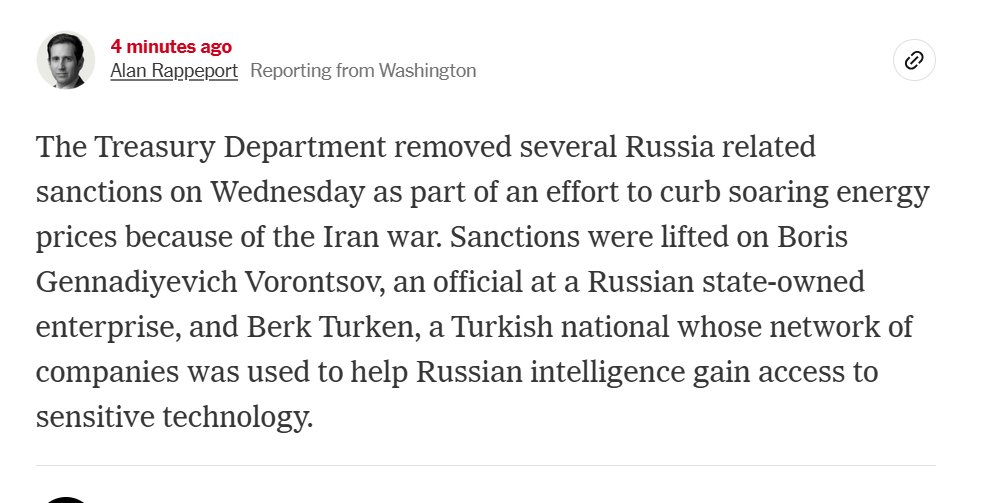
Very disappointed by the @nytimes framing here. Two allies of the Russian economy had their sanctions lifted, using the pretense of the oil price. Lifting sanctions on these two individuals will not make any difference to world oil prices. Its ludicrous and a gift to Putin
Phillips P. OBrien tweet media
English
18
473
1.4K
83.4K
Phillips P. OBrien
Phillips P. OBrien@PhillipsPOBrien·
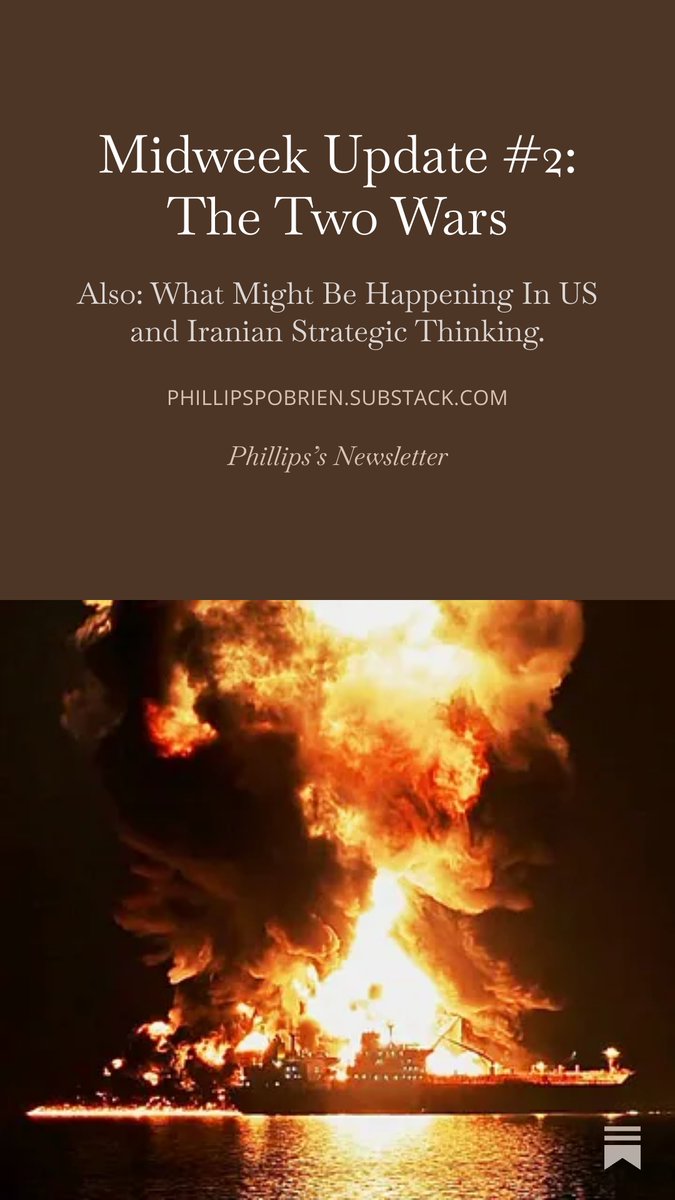
Just sent out free midweek update #2. We are not seeing one war between the US/Israel and Iran--but two very different wars. In that way both sides can be winning and losing simultaneously. Also, what is happening in US strategic thinking. Its not pretty.
Phillips P. OBrien tweet media
English
2
17
69
7.1K
Phillips P. OBrien
Phillips P. OBrien@PhillipsPOBrien·
Ive said for more than a year that it might be better for Europe if the US left NATO. The US is now bullying and unreliable and would probably not fight for Europe against Putin anyway. Better for Europe to move on, especially with Ukraine a key anchor of its future security.
English
115
221
1.3K
44.1K
Phillips P. OBrien retweetledi
Edward Stringer
Edward Stringer@edwardstrngr65·
Useful to have the time for a more discursive chat. Didn’t put everything across as well as I might, in retrospect, but a good tour d’horizon of UK Defence today.
Winston Marshall@MrWinMarshall

“This Is a Disgraceful Moment for Britain” 🇬🇧 Former Air Marshal Edward Stringer (@edwardstrngr) joins me for a stark conversation about the shrinking size of Britain’s armed forces and the risks facing the UK in a more dangerous world. We discuss defence cuts, declining readiness, the future of air power, and how drones, missiles, cyber warfare, and space are transforming modern conflict. A sobering discussion about deterrence, military capability, and whether Britain still has the will and capacity to defend itself. Podcast out now on all platforms | Links in replies

English
7
31
121
28.4K
Phillips P. OBrien retweetledi
Michael Weiss
Michael Weiss@michaeldweiss·
Attacking allies as deadbeats, fake countries, U.S. colonies and/or threatening to invade them doesn't, in fact, make them want to rush into a kill box in the Gulf. Go figure.
Lindsey Graham@LindseyGrahamSC

Just spoke to @POTUS about our European allies’ unwillingness to provide assets to keep the Strait of Hormuz functioning, which benefits Europe far more than America. I have never heard him so angry in my life. I share that anger given what’s at stake. The arrogance of our allies to suggest that Iran with a nuclear weapon is of little concern and that military action to stop the ayatollah from acquiring a nuclear bomb is our problem not theirs is beyond offensive. The European approach to containing the ayatollah’s nuclear ambitions have proven to be a miserable failure. The repercussions of providing little assistance to keep the Strait of Hormuz functioning are going to be wide and deep for Europe and America. I consider myself very forward-leaning on supporting alliances, however at a time of real testing like this, it makes me second guess the value of these alliances. I am certain I am not the only senator who feels this way.

English
59
517
2.4K
95.1K
Phillips P. OBrien retweetledi
Illia Ponomarenko 🇺🇦
Illia Ponomarenko 🇺🇦@IAPonomarenko·
Excuse me, where exactly is this "panic" in Ukraine over Zelensky's yet another visit to the UK and where exactly is this "don't forget about me" here and how is the current tour any different from any other previous tours to the UK and other countries over the years?
The Telegraph@Telegraph

🇺🇦🇬🇧 Volodymyr Zelensky is visiting London today for talks with Sir Keir Starmer and to deliver a clear message Read Joe Barnes's dispatch here ⤵️ telegraph.co.uk/world-news/202…

English
37
93
1.3K
68.9K