Joel Miller

255 posts

Joel Miller

Joel Miller

@CS_Synthesist

PhD student asking "what would economics look like if people had friends?" at UIC, Microsoft Research, and Gitcoin. 0.1X engineer


Katılım Temmuz 2020
248 Takip Edilen242 Takipçiler
Joel Miller retweetledi
EAAMO
EAAMO@EAAMO_ORG·
#Crowdfunding algorithms often assume people act alone. But what if fairness depends on our connections? 🤝This paper explores a new approach called Connection-Oriented Quadratic Funding, which gives more weight to community ties and shared purpose - arxiv.org/abs/2509.18343
EAAMO tweet media
English
1
2
3
671
Joel Miller retweetledi
Yancey Strickler
Yancey Strickler@ystrickler·
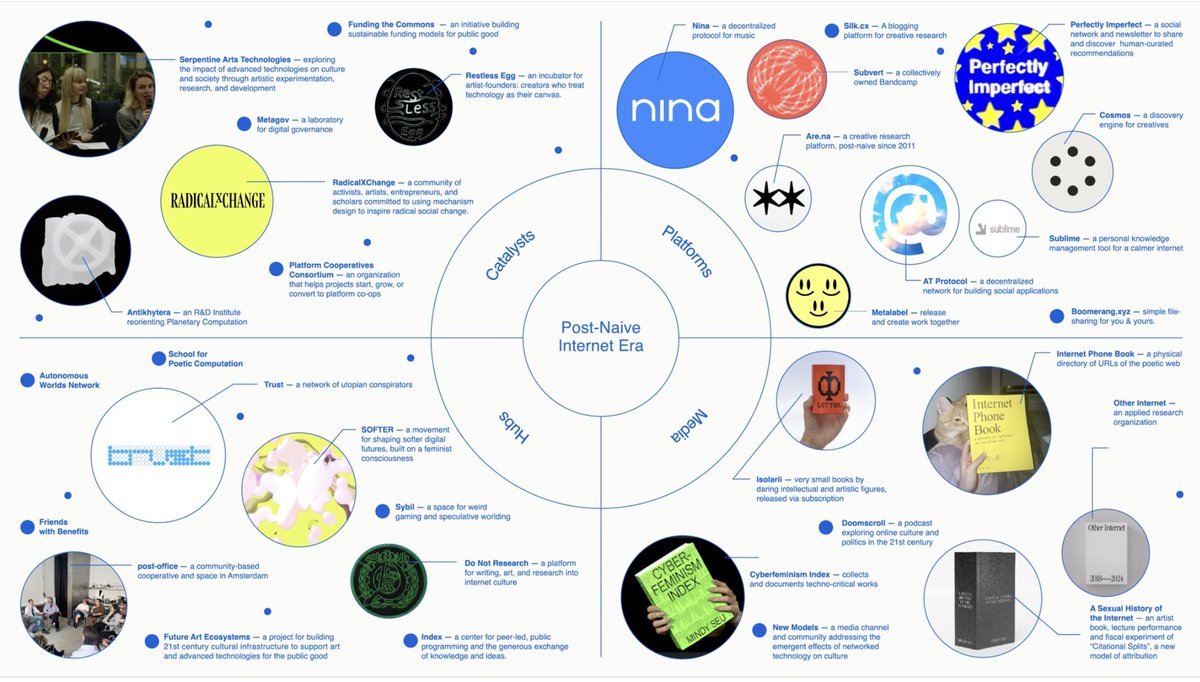
The "Post-Naive Internet Era" via @mozilla
Yancey Strickler tweet media
English
22
102
1.1K
234.6K
Kelsie Nabben
Kelsie Nabben@kelsiemvn·
This paper considers the intersection of governance and attention in digital contexts-arguing for the analysis of human attention as a resource to governance surfaces (the means available for organisational adaptation and action)osf.io/preprints/medi… @ntnsndr @rtk254 @mZargham
Kelsie Nabben tweet media
English
19
15
68
5.3K
Joel Miller retweetledi
Metagov
Metagov@metagov_project·
We've got an incredibly packed agenda tomorrow. Here's our programming for Day 1 of the 2025 Grants Summit organized by the Grant Innovation Lab (GIL) at @metagov_project with support from @OctantApp @StellarOrg @Scroll_ZKP and @DAOstar_One - Designing Grants That Grow With Your Ecosystem by @anke_g_liu - EF Grants with @fedeebasta - Rethinking Web3 Grants with Capital Design by @feemschats - Using Passive Quadratic Funding to Decentralize Philanthropy with @RobbieHeeger - Octant Accelerator with @arlery - Fair Collective Decision Making Through Plurality: Results from Gitcoin by @CS_Synthesist - Grants Vs Markets: Case study with @noturhandle - AI do's and don'ts with @rubinovitz - Filling the Gap: Funding in Latin America with @0xcush Signup here to get a reminder: lu.ma/vj3csdz1
Metagov tweet media
English
7
26
77
5.7K
Joel Miller retweetledi
Metagov
Metagov@metagov_project·
Introducing our next speaker: Joel Miller @CS_Synthesist is a PhD Researcher at University of Illinois, Chicago. Miller is studying mechanism design and the social sciences, focusing on the ways communities realize their shared human values through algorithms. Recently, he led an overhaul of Gitcoin's funding distribution system. To hear from Joel and other industry leaders, sign up to our 2025 Grants Summit: lu.ma/vj3csdz1
Metagov tweet media
English
2
2
26
701
Joel Miller
Joel Miller@CS_Synthesist·
@abcdentminded OH yes I remember loving this at the reveal that his head isn't attached
English
2
0
0
1.1K
abcdent
abcdent@abcdentminded·
A few months ago my friends and I were putting on bad music videos and I vaguely remembered this and put it on. Hard to describe what happened next, ten seconds in everyone was genuinely concerned about me, I was laughing so hard I was choking and crying for four minutes straight
English
586
2.2K
46.2K
2.9M
Devansh Mehta
Devansh Mehta@devanshmehta·
Honestly the end of the residency was a big relief, it took as much effort to organize as an Indian wedding 🥵 I'm very proud of our end outputs: 22 submissions from participants! I think we've shown a new way to do these sorts of gatherings; 1. Book a coworking 2. Book airbnbs around coworking 3. Put people into airbnbs with room mates depending on who you think they would vibe with 4. Have cool outings on the weekend 5. during the week people work with clear expectations on what they should be producing as an output for the end Overall we can put these residencies or popups into 2 categories. The first involves  people paying (large) amounts to attend. They arrive with a more consumer mindset so it's essential to have good activities and vibes that give them a bang for the buck. @joinedgecity comes to mind as the best in this category . I've seen many relationships take place during their popups 🫥 The second are builder residencies that bring people together for making something l in a thematic area. Since these are (usually) paid for , the vibe is  more of a producer mindset where participants want to show they were worth the investment to bring and feed them. It's important to create feelings of specialness in such gatherings. Our iceland retreat & @FundingCommons stand as examples in this category Gonna take a break now and write up some of my favorite outputs in the residency
Devansh Mehta@devanshmehta

The evening session today dug into retroactive public goods funding systems with @cryptoeconlab At a larger level, the problem to solve is certain projects like dashboards, OSS or network R&D are good for an ecosystem but hard to build an ecosystem around But give too much and we have laffer curve dynamics where people flee the ecosystem (like UK currently) & give too little & we leave Pareto efficiencies on the table Filecoin addresses these challenges with 2 approaches: Proactive funding programs & retroactive ones. As much as distributing capital, it is also about surfscing signal across the ecosystem & setting a course for the network Filecoin has distributed around 500k+ FIL ($1-10 million depending on price over time) via 2 rounds of retro funding. They break up these programs into 3 parts; 1. Measure stage where you map the ecosystem & take in applications 2. Evaluate projects thru high context badgeholders 3. Channel rewards, which they now do via @dripsnetwork so they can map out dependency graphs in their ecosystem Their initial learnings from round 1 were - information too vague for judges too properly assess projects - confusion over whether to support mixed goods or only public spirited ones - distribution being too flat whereas it should be more power law like - dislike on 0 voting where judges could single handedly bring down a projects score by giving a zero to them - confusion over impact gap vs direct impact The last point reminds me of what @dwddao brought up, that retro funding is actually harder than proactive since it needs to subtract aggregate impact from a counterfactual where the project didn't exist, which is hard to do Whereas proactive can simply identify gaps & have a theory of change to execute on These learnings led to RPGF 2 where 33 badgeholders voted in a way that a few projects got a lot but also had a long tail giving money to smaller projects Post discussion we realized that for retro funding to be truly meaningful, we either 1. Keep a long window between announcement of the round and it's eventual reward, so teams have enough time to deliver. Similar to conferences in many ways, that have an annual deadline teams work towards 2. Have really short monthly cycles that create regularity in funding cadence, in a way that doesn't balloon overhead for the judges We were particularly excited by digital AI twins of the badgeholders that allocate 10% of the funds monthly, and every 3-6 months the human version reviews projects and releases the remaining 90% Overall while round 3 is going to continue being predictable, i expect major changes incoming for filecoin RPGF from round 4 onwards

English
9
4
69
6.2K
Joel Miller retweetledi
Nick Stares
Nick Stares@nick_stares·
Nick Stares tweet media
ZXX
2
2
18
1.1K
Joel Miller
Joel Miller@CS_Synthesist·
Huge thanks to @Shakaleikaumaka for recording this talk and being an overall great person!
English
1
0
1
97
Joel Miller
Joel Miller@CS_Synthesist·
Human creativity is unparalleled: that's the driver of my talk at the @protocollabs Impact Evaluator research retreat. I discuss pitfalls of cybernetic systems like IEs, how humanistic design can overcome them, and give a case study with Condorcet voting. youtu.be/fJzCm0OWZE8
YouTube video
YouTube
English
3
4
25
1.5K
Jonathan Blow
Jonathan Blow@Jonathan_Blow·
If you keep posting Screenshots every Saturday, then after enough Saturdays go by, your game will be done! Maybe....
Jonathan Blow tweet media
English
38
31
1.1K
41.3K
Devansh Mehta
Devansh Mehta@devanshmehta·
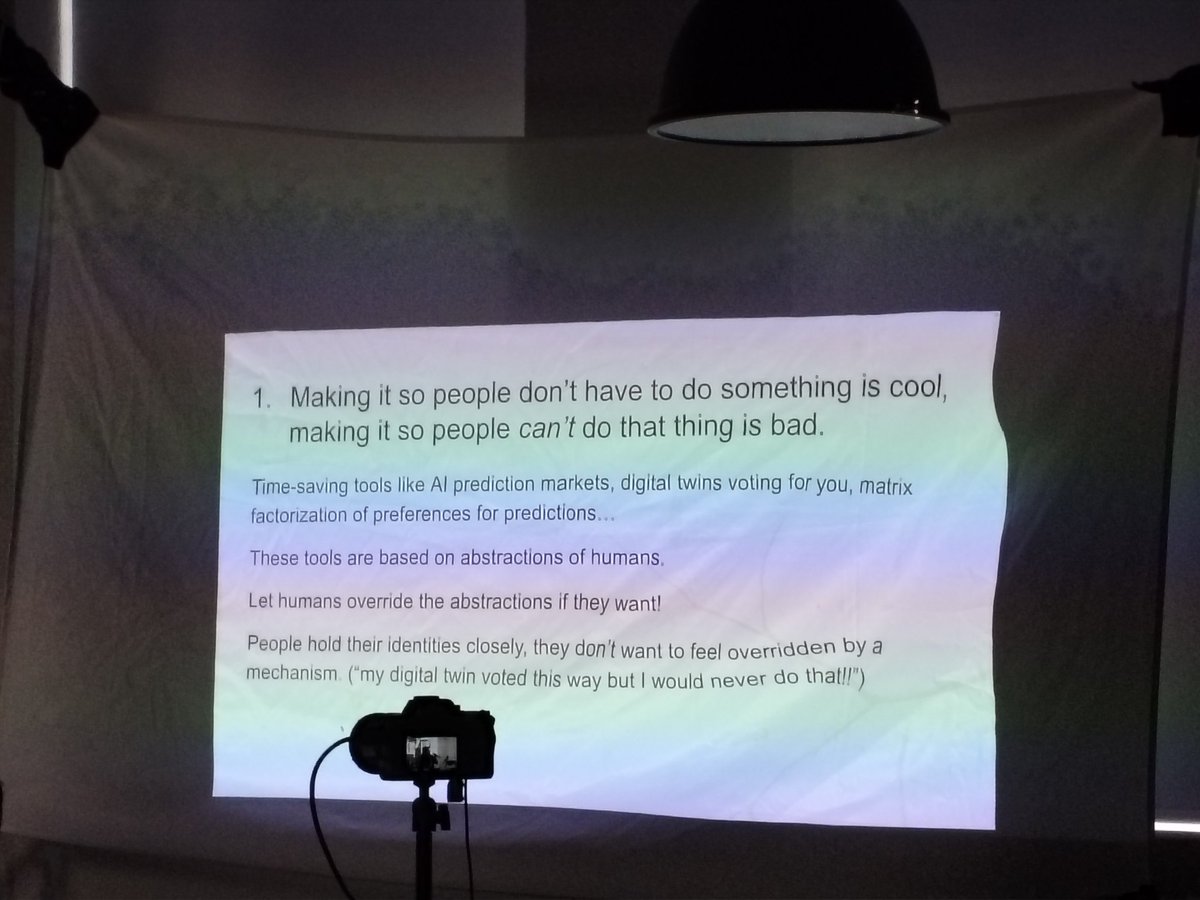
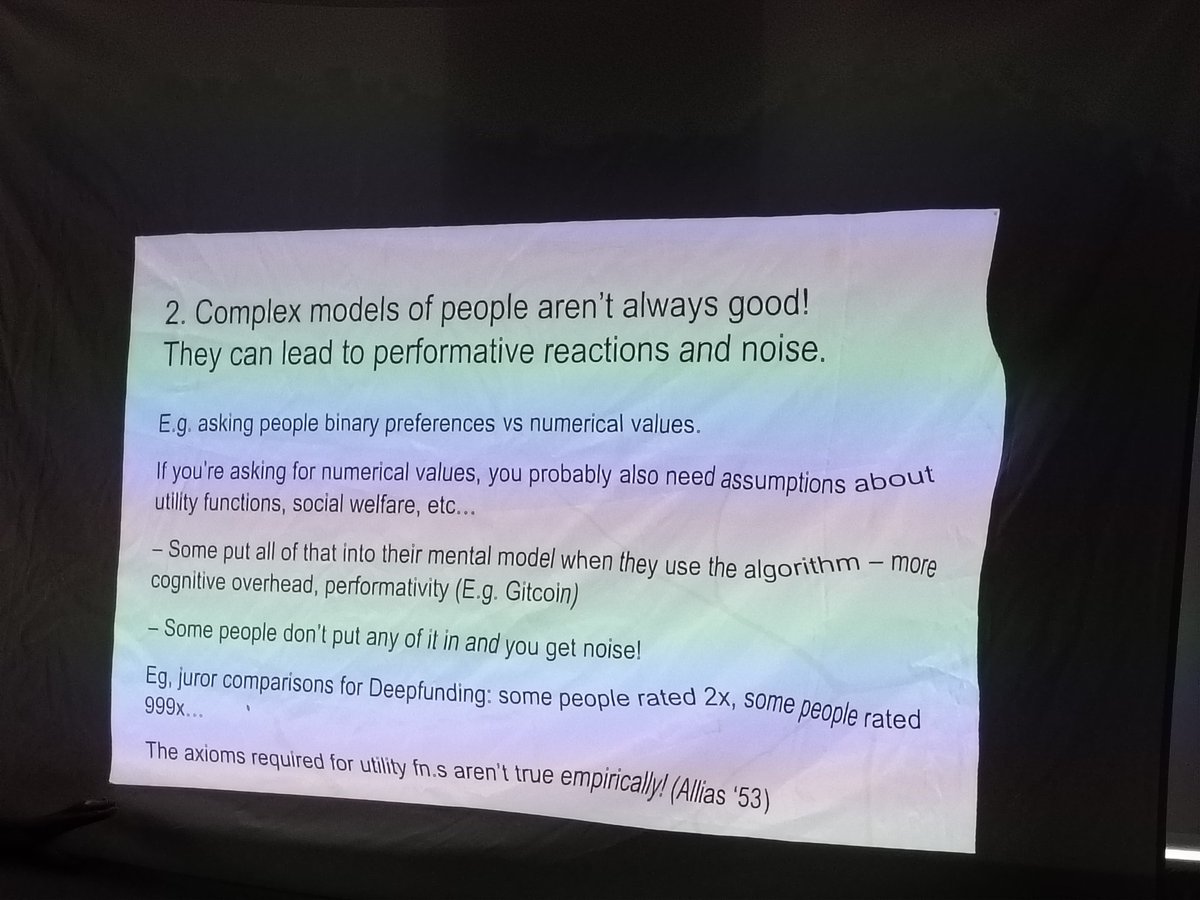
The first part of @CS_Synthesist talk was more generally around cybernetic systems that use feedback loops to regulate themselves & principles to keep in mind while designing them One of the biggest dangers is humans start acting like how they have been modelled (or even their opposite) He saw this in @gitcoin where after the switch to cluster QF some comments in the forum were, "how should I donate now", so there is some incentive to internalize how they are being modelled in cybernetic systems His main takeaways when designing such loops ; 1. Since they rely on feedback loops, get actual feedback! 2. Design for self expression & freedom, so that people can override the default option for them if need be. Man should always be greater than model of a man 3. What is mathematically optimal may not be socially optimal. Some nudges feel right but others don't, so complexity can lead to performativity
Devansh Mehta tweet mediaDevansh Mehta tweet mediaDevansh Mehta tweet mediaDevansh Mehta tweet media
Devansh Mehta@devanshmehta

One effect of the impact evaluator residency in Iceland has been getting me to look much deeper into condorcet voting They conform with insights @JonasSFT shared on not having human do quantification but only rankings @CS_Synthesist gave a talk today on 4 ways of implementing it. It's one of those rare ideas that academics all agree is good in theory but there are few empirical case studies of how it works in practice At a broad level Condorcet does away with strategic voting by only having voters rank different options. It then uses computation to emerge with a winner through pairwise matchups of each candidate based on the rankings provided (there is an edge case or condorcet paradox where no winner is declared) Classic condorcet works well when there are few options so voters can actually rank all of them. However it functions with a static list of items as new entrants affect the ranking order In 2024 Brandl proposed a new version of it called the urn mechanism that overcame both issues by letting people propose new options at any time & reducing cognitive by not asking for exhaustive rankings but only answering a few binary questions It's main drawback is the heavy computation required, for 20 people with 5 options it took 50k steps to finally have results computed 😨 So then we come to more experimental setups like simulated urn condorcet, where people can state that "any distribution is fine so long as A = 2x B , C> A, etc or even give their preferred split & vote based on how close it is to that split. While faster to converge, the main drawback is that like classic condorcet it works only with a static list of projects to rank as introduction of a new entrants screws up the rules you put in place So then we come to the final version of it that @williamhwgeorge helped brainstorm: have a reigning option that can be displaced by one other competitor So we need some quality control on who gets to propose a candidate against the current split but it allows for input & creativity along with dynamism in letting new objects enter without messing up earlier calculations So what are some use cases we are targeting here? For one, to choose between different domains or mechanisms. We hope to propose this on @gitcoin as a way for the network & stewards to come to consensus on which domains deserve the most support in GG24 If it works well here, we can see more ambitious uses like letting a larger network comes to consensus on resource distribution between different mechanisms like QF, time weighting, deep funding, etc or even between direct projects themselves One unnadressed question here, although condorcet can give us a ranked ordering it isn't clear how we distribute funds based on the list. Is it a power law where the top winner gets orders of magnitude more or a peanut butter spread that's more even? Overall i like the ambitiousness of empirically testing out condorcet in some way & think the residency would pay off its RoI on simply this pilot taking place!

English
1
0
8
1.6K
Joel Miller
Joel Miller@CS_Synthesist·
Volcano report 👍🏻
Español
0
0
5
121
Joel Miller
Joel Miller@CS_Synthesist·
Cats of Iceland
Joel Miller tweet mediaJoel Miller tweet mediaJoel Miller tweet mediaJoel Miller tweet media
English
2
4
13
672