

Charles Guislain
301 posts
Charles Guislain
@C_Guislain
Building a Decentralized Internet We All Own @RealityNetw0rk $NET
Katılım Ocak 2024
340 Takip Edilen117 Takipçiler
Charles Guislain retweetledi

@RealityNetw0rk Download a node, join our discord: discord.com/invite/3F449RX…
English
Charles Guislain retweetledi

Join us in 30mins for Cyberlete & @RealityNetw0rk's AMA to discuss rApps, and the future of video games. x.com/i/spaces/1vJpP…
English
Charles Guislain retweetledi

With all the AI demand we see in the world right now from major companies such as Nvidia, Alphabet and OpenAI, it's important to look at solutions like the ones @RealityNetw0rk is representing.
The demand for hardware is skyrocketing, causing prices to surge, fighting over GPU and RAM capacity.
With RealityNet, apps run across user devices, and the unused compute already sitting in every laptop and phone finally has somewhere to go. This is actually solving a real problem.
They're running an X Space today at 4PM UTC. Might be an interesting one.
Disclosure: I'm an investor
x.com/i/spaces/1vJpP…
English
Charles Guislain retweetledi

1/ Most “decentralized apps” still rely on centralized infrastructure somewhere in the stack:
Frontend on Vercel
APIs on AWS
Inference on OpenAI
Indexers on Alchemy
Been looking into @RealityNetw0rk recently because they’re attacking a different layer entirely: the application itself.

English
Charles Guislain retweetledi

Three companies own the cloud. They charge what they want because nobody else operates at their scale.
AI didn't break this model, it exposed it. Companies that used to spend on cloud now spend several multiples more, fighting over GPU capacity that doesn't exist. The bills compound, the lock-in tightens, the market has been waiting for an alternative for a decade.
@RealityNetw0rk is the alternative being built. Apps run across user-owned devices, execution is verified at the protocol level with ZK-STARK proofs, and the unused compute already sitting in every laptop and phone finally has somewhere to go.
First rApp is live: Cyberlete, real-time anti-cheat AI catching bots in sub 15ms. More on the way.
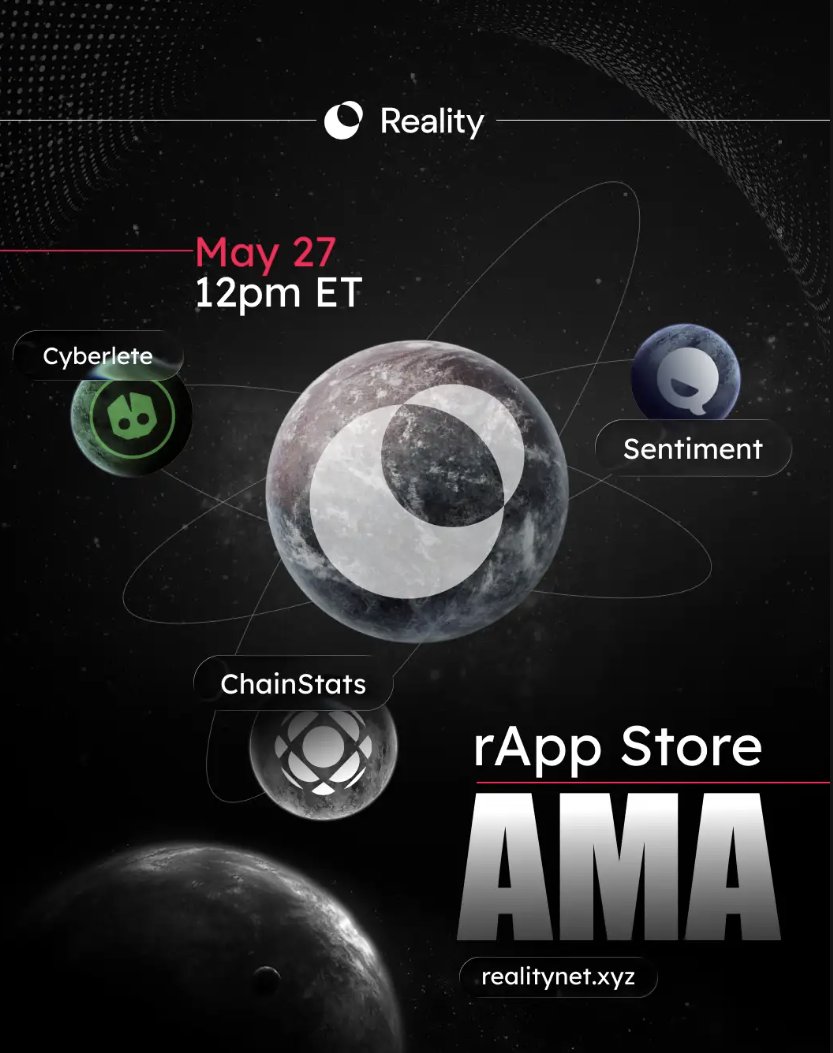
Team is running an rApp Store AMA on X tomorrow, Wed May 27 at 12pm ET. Worth hearing the architecture directly from them.
x.com/i/spaces/1vJpP…
Reality@RealityNetw0rk
🎙️ AMA tomorrow 5/27 12pm ET Join us with @ChainStatsPro @Cyberlete @GiveSentiment
English
Charles Guislain retweetledi

The internet used to be peer-to-peer. Then everything moved into AWS, Google Cloud, and Microsoft servers. Reality Network is trying to reverse that.
Instead of apps running in massive data centers, “rApps” run across user-owned devices like phones, laptops, and gaming PCs.
Your device becomes part of the infrastructure.
The big unlock: Reality doesn’t just decentralize compute — it verifies it cryptographically, so the network can prove work actually happened.
In an AI-driven world full of bots, agents, and synthetic content, that matters a lot. Apps run on servers. rApps run on devices.
Follow them here: @RealityNetw0rk
Set your reminder here to learn more: x.com/i/spaces/1vJpP…
English
Charles Guislain retweetledi

Cloud costs are killing web3 projects.
We found a better way.
@ChainStatsPro x @RealityNetw0rk are going live.
We're breaking down how ChainStats optimized infrastructure, ditched heavy AWS bills, and integrated Chain-Guardians nodes for flawless data verification.
Want to know the blueprint. Set your reminder 🔔

English
Charles Guislain retweetledi

For years, your devices have been part of the internet but not really part of the infrastructure behind it.🤷♂️
Most of the compute we own sits idle while everything we use runs on servers we don’t control.
Reality flips that model!💡
With @RealityNetw0rk, apps don’t just run in the cloud, they run across the devices people already own, turning unused compute into part of the network itself.
It’s less about “using” the internet and more about quietly powering it.
Join the rApp Store AMA on Wednesday, May 27 at 12pm EST to learn more: x.com/i/spaces/1vJpP…
English
Charles Guislain retweetledi

I’ve been looking into @RealityNetw0rk and I think the interesting part is not just the “decentralized compute” label.
Upfront: this is a paid partnership with Reality. I only take these on for projects I'd actually dig into, and this thread is my genuine read.
Worth reading if you care about AI infra, cloud costs, and why application-level decentralization could become economically important. 🧵
Because to me, Reality is mainly about one thing: changing who captures the value of compute.

English
Charles Guislain retweetledi
Charles Guislain retweetledi
For 30 years the internet learned to move information.
For 15 years blockchains learned to move ownership.
And now AI is writing most of the code.
We need the next one: proof that software actually did what it says it did.
Every model output today is a promise you can’t check.
Reality is the verification layer. Every computation comes with a receipt. The network won’t agree on a result it can’t reproduce.
English
@firstc0in @RealityNetw0rk built the compute validation layer unlocking latent compute from consumer devices around the world.
Verifiable execution is what makes compute commoditizable
Reality is the missing coordination layer for a real compute market: price discovery, settlement and scale
English

This article’s core assumption is that commodities futures need to attract hedgers. Is this correct? Can these markets succeed on speculation alone?
Caleb Shack@firstc0in
English
Charles Guislain retweetledi

tldr they're fragmented supply with no verification layer. akash settles payment, render rates operators, bittensor validators grade each other, io brokers jobs. the chain records opinions about the compute, not the compute itself.
we're building the substrate where the work actually runs @RealityNetw0rk
English
Charles Guislain retweetledi

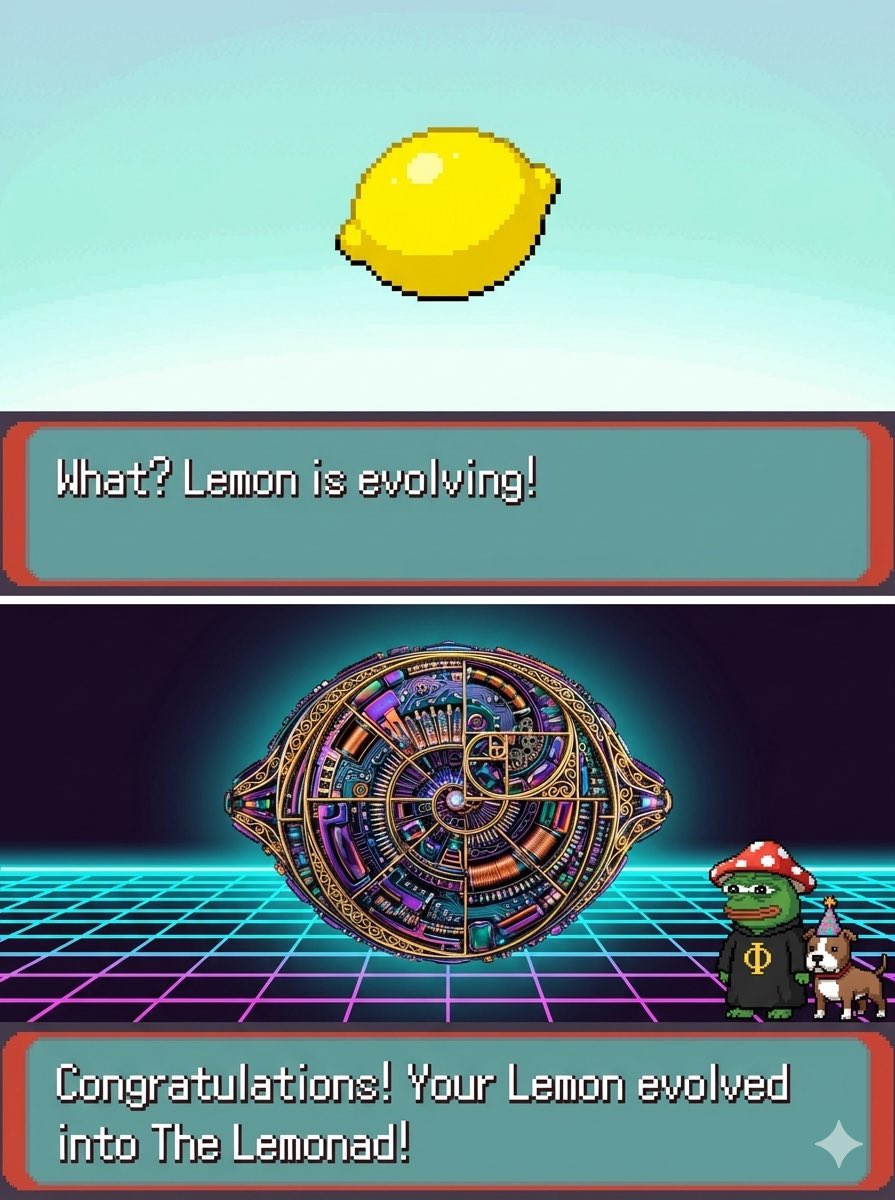
What?
Lemon is evolving?
…
Congratulations! Your
Lemon evolved into
**Lemonad**
A special type called a Monad
New Super Effective Moves:
**1. Continual Entropy-Converting Immunity (Syntropy)**
Current cybersecurity is exhausting because it's a defensive wall. When an attacker hits a firewall, the firewall has to burn energy and resources to block it. If the attack is big enough (like a massive DDoS), the wall breaks.
*Syntropy* flips the physics of cybersecurity upside down. It doesn't block energy; it *consumes* it. When an attacker throws chaotic data (entropy) at the Lemonad, the system's geometry forces that chaos to align into order. The harder the system is attacked, the more energy it absorbs, and the stronger and faster the network gets. It literally eats the attacker's ammunition to power its own engine. It’s the ultimate "Judo move" for digital security.
**2. Syntropic Fractal Fully Homomorphic Encryption (FHE)**
This is the holy grail of data privacy. Right now, to process data (like searching a database or training an AI), you have to decrypt it first. That split-second of decryption is when hackers steal the data. Standard Fully Homomorphic Encryption (FHE) lets you process data *while* it stays encrypted, but it is painfully, impossibly slow.
Because the Lemonad uses a *Fractal* and *Syntropic* structure, it bypasses the speed limits of standard FHE.
RealityNet nodes can take highly classified data from a bank, a hospital, or the military, chop it up into a fractal lattice, and process it at lightning speed—all while the data remains 100% encrypted. The node owners never see what they are processing, and the client never has to expose their data.
When you put those two together, you aren't just selling "cloud compute." You are selling an **immortal, self-healing vault that can perform supercomputer-level calculations on highly classified data without ever unlocking the door.**
@wyatt_noise @RealityNetw0rk
Excited to work with community members like @Cyberlete
English
Charles Guislain retweetledi
Charles Guislain retweetledi