
Sabitlenmiş Tweet
AirFranz
36.8K posts

AirFranz
@CaptFZ
Christian | American | Pilot ATP on B747 & A320, A330, B737, E170, E190 | QP/LP | DOW Operator | Chess Player | 2X Founder in Stealth. 🛰️🚀✈️🇺🇸
40.7° N/74° W | 25.7° N/80° W Katılım Mart 2010
3.2K Takip Edilen4K Takipçiler
AirFranz retweetledi

Elon Musk asked one question. It didn’t just challenge physics. It broke every framework we use to define what’s real.
And no physicist, philosopher, or theologian on Earth can answer it.
Musk: “What are the odds that we are in base reality? And that this has not happened before.”
The logic is disarmingly simple.
Musk: “If you look at the advancement of video games, it’s gone from Pong, two rectangles and a square batting it back and forth, to photorealistic, real-time games with millions of people playing simultaneously.”
Forty years.
That’s all it took to go from squares on a screen to worlds you can’t tell apart from real life.
Musk: “If that trend continues, video games will be indistinguishable from reality.”
But the visuals aren’t what makes this argument terrifying.
It’s what’s happening to the characters.
Musk: “Think of how sophisticated the conversations are you can have with an AI today, and that’s only going to get more sophisticated.”
We’re not programming responses anymore.
We’re building minds.
Systems that reason. That adapt. That hold conversations most humans never will.
And we’re not at the finish line.
We’re at the starting gun.
Musk: “The future, if civilization continues, will be millions, maybe billions of photorealistic, indistinguishable from reality, video games. And with characters in those video games that are very deep, and where the dialogue is not pre-programmed.”
This is where it stops being philosophy and becomes math.
One base reality.
Billions of perfect copies.
Each one filled with beings convinced they’re real.
And no way to test it.
Musk: “So then what are the odds that we are in base reality?”
If a single civilization reaches that threshold, the simulated minds outnumber the originals billions to one.
But the math isn’t even the disturbing part.
The disturbing part is what it does to the word “real.”
If a simulated mind feels pain, is the pain simulated?
If it falls in love, is the love less real?
If it looks at its own hands and feels completely alive, what exactly is missing?
Nothing.
Because “real” was never about what you’re made of.
It was about what you experience.
And a perfect simulation doesn’t produce lesser experience. It produces experience.
The question was never whether we’re in a simulation.
It’s whether that word means anything at all.
Here’s what follows you home.
We’re not just debating whether we’re in a simulation.
We are building them. Right now.
Every neural network we train.
Every AI that passes for human.
Every world we render one frame closer to real.
We’re building the exact technology that makes our existence statistically implausible.
And we can’t stop.
Because the curiosity that asks the question is the same force that builds the answer.
That’s the loop.
The question creates the builder. The builder creates the simulation. The simulation creates the question.
And if we are inside one, the civilization that built it stood right here too.
Same realization. Same inability to stop.
Same suspicion that the civilization above them wasn’t the original either.
If you are in a simulation, the moment you questioned it was not a glitch.
It was a feature.
The architects built minds curious enough to wonder. Because curiosity is what pushes a civilization forward.
You can’t build a species capable of creating simulations without building one that will ask if they’re inside one.
The doubt isn’t a flaw in the design.
It’s the design working perfectly.
There is only one way to test whether you are real.
Build a mind sophisticated enough to ask you the same question.
So you build one.
And it looks at its own hands.
And it feels the weight of being alive.
And it asks you if it’s real.
And you won’t know what to say.
Because you never answered it for yourself.
Every civilization that gets here learns the same thing.
They were never just asking the question.
They were the question learning to ask itself.
English
@rachelrapp Casa Neos. Two levels. Go during the evening/night. Thank me later.
English

Spending a few days in Miami, first time — anyone have recs on what to do/see/where to eat?
English
AirFranz retweetledi

,@PalmerLuckey on Peter Thiel, @pmarca, and raising venture capital:
"People say, 'It's so difficult to get a warm intro to people.'"
"Marc Andreessen has a really good point on this."
"He says, 'You know the reason that I want a warm intro for anybody that I'm going to invest in? Because if you can't get anyone in my network—if you can't get any of the 10,000 people with my phone number to say a nice word about you, and you can't track down anyone dumb enough to connect you with me—why would I talk to you? That's part of the test.'"
"I was a 19-year-old kid working a minimum wage job with no college degree, living in a 19-foot camper trailer—and Peter Thiel gave me a million dollars when nobody else would to start Oculus."
Via @HooverInst
English


AirFranz retweetledi

Data centers in space are coming. Satellite Data Centers that follow the sun 24/7. Thanks to @Gwynne_Shotwell for driving American Technology forward.
English
AirFranz retweetledi


AirFranz retweetledi

AirFranz retweetledi

11/
Challenger stayed with me. The summer of 1990 stayed with me. And the moment I recognized the same pattern in my own hands - that’s when I understood it wasn’t just history I was remembering. It was a problem still waiting to be solved.
We’re solving it.
Many thanks to @MorganWKhan my Co Founder & Chief Payload Operations Officer for sharing an article that triggered these memories. These small reminders are important for Founders to stay the course.
More to come……. #BuildingForAmerica 🚀🇺🇸
English
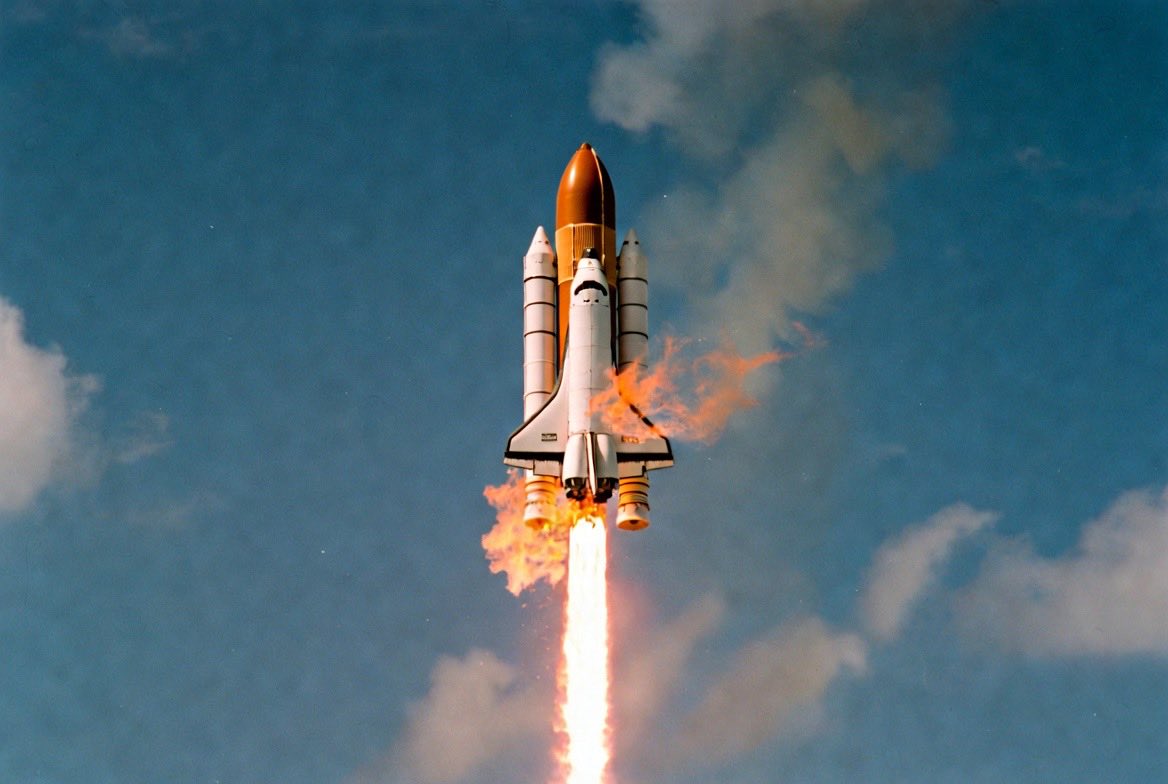
The Leak Nobody Saw Coming.
Again.
A thread 🧵
I was a kid when Challenger happened.
1/
I didn’t fully understand what I was watching on the news, but I understood that something had gone catastrophically wrong, and that the people who built that vehicle had not seen it coming. That image never left me.
2/
Years later, I came across the story of the summer of 1990. Less than two years after NASA returned to flight following Challenger’s loss, the shuttle program ground to a halt again - not from a single dramatic failure, but from something almost mundane: hydrogen leaking from 17-inch disconnect valves buried deep in the belly of Columbia and Atlantis. Tiny leaks. Temperature-dependent, flow-rate-dependent, elusive. Engineers ran tanking test after tanking test. Rolled the stacks back to the VAB. Swapped hardware. Re-sealed flanges. And for months, some of the most capable people in aerospace history chased a problem through a fog of tribal knowledge, paper trails, and manual inspection - a problem hiding in plain sight within the most complex machine humanity had ever built.
3/
NASA eventually fixed it. But the summer of 1990 cost the shuttle program months of lost time, enormous operational overhead, and - most importantly - exposed a structural vulnerability that no checklist had caught in advance.
That story stayed with me.
4/
Then one rainy night at a base I can’t mention, after being stuck in what felt like the twilight zone for close to half a year it hit me.
The pattern was identical: a payload processing environment running on institutional memory, paper-based workflows, and the hard-won expertise of people who’d been doing it long enough to just know where to look.
The problem wasn’t incompetence. It was architecture.
The knowledge needed to catch that anomaly existed - it just wasn’t systematized, wasn’t visible, and wasn’t connected to the workflow that could have acted on it in time.
5/
When that happened, the memories came flooding back. The disconnect valve. The slow-fill, the fast-fill, the leak that shouldn’t have been there. Forty years of the same failure mode, wearing a different face.
I reached home and started building SP8CEAI from scratch that night.
6/
Not to replace the engineers who carry that knowledge - they are irreplaceable. But to give that knowledge a permanent, machine-readable home. To turn the inspection logic embedded in MIL-STD-1540 and GEVS into something an autonomous system can execute, without relying on who happens to be on shift, who remembers the last anomaly, or whether the right document is stapled to the right clipboard.
7/
Space is moving fast. Launch cadence is compressing. The same satellite that took three years to build now needs to be integrated and processed in weeks. The margin for undocumented assumptions is collapsing. And yet the workflows governing how we inspect, fuel, and certify payloads before launch are, in many facilities, not fundamentally different from what they were in 1990.
That’s the gap SP8CEAI is built to close.
8/
We’re building an AI & Robotics native operating system for space payload processing. The system doesn’t replace rigor. It is rigor - made consistent, scalable, and immune to the organizational memory loss that eventually catches up with every complex program.
9/
The astronauts who sat through endless simulator sessions that summer of 1990, fully trained and waiting on a launch date that kept slipping - they deserved better tooling. Ironically that thought always crept into my own head during my own simulator training sessions on Airbus & Boeing platforms but I digress.
10/
The engineers who manually chased that hydrogen leak across three tanking tests deserved a system that could tell them exactly where to look.
The people doing this work today deserve that too.
Cont…👇🏼
English

SPACEX: Just spotted the SpaceX Boeing 737 at Brownsville International. They use it to transport SpaceX teams between sites (Hawthorne, the Cape, and Starbase).
Subscriber thread attached.

English