Carlos Torres

3.7K posts

Carlos Torres banner
Carlos Torres

Carlos Torres

@CarlosTorresIT

Cybersecurity, AI, Cloud, and Infrastructure. Focused on the systems shaping risk, power, and leadership in a machine-speed world.

World Wide Web Katılım Temmuz 2009
405 Takip Edilen311 Takipçiler
Carlos Torres
Carlos Torres@CarlosTorresIT·
A new year always brings fresh momentum, new challenges, and new opportunities to grow. As technology continues to shape how we work, lead, and protect what matters most, this is a great moment to pause, reflect, and look ahead with optimism. Wishing everyone a successful, healthy, and purpose driven start to 2026. I look forward to learning, building, and exchanging ideas with many of you in the year ahead. Happy New Year 2026.
Carlos Torres tweet media
English
0
0
1
22
Carlos Torres
Carlos Torres@CarlosTorresIT·
@JoshuaPoddoku Exactly. Speed doesn’t just amplify performance. It amplifies whatever gaps already exist underneath. That’s why resilience shows up as an architectural problem long before it looks like an operational one.
English
0
0
0
25
Joshua Poddoku
Joshua Poddoku@JoshuaPoddoku·
@CarlosTorresIT Foundations get tested the moment it goes operational, speed reveals where controls lag
English
1
0
1
26
Carlos Torres
Carlos Torres@CarlosTorresIT·
Everyone is rushing to deploy AI. Very few are stopping to ask if the foundation underneath it can actually hold. AI systems run continuously, adapt in real time, and expose weaknesses in architecture, infrastructure, and networking that traditional software never touched. AI resilience is not a nice-to-have technical upgrade. It is the difference between compounding returns and silent breakdown.
English
2
0
2
32
Carlos Torres
Carlos Torres@CarlosTorresIT·
If continuity depends on humans stepping in, the system isn’t ready. AI exposes that gap faster than anything else we’ve deployed.
English
0
0
1
19
Carlos Torres
Carlos Torres@CarlosTorresIT·
The moment AI goes operational, resilience stops being theoretical. That’s when foundations get tested, not presentations.
English
1
0
1
22
Carlos Torres
Carlos Torres@CarlosTorresIT·
Once assumptions fail, leadership shows up fast. Either governance evolves with reality, or systems outgrow the people responsible for them.
English
0
0
0
6
Carlos Torres
Carlos Torres@CarlosTorresIT·
The hardest part wasn’t fixing systems. It was admitting that the frameworks used to manage them no longer matched how they actually behave.
English
1
0
1
6
Carlos Torres
Carlos Torres@CarlosTorresIT·
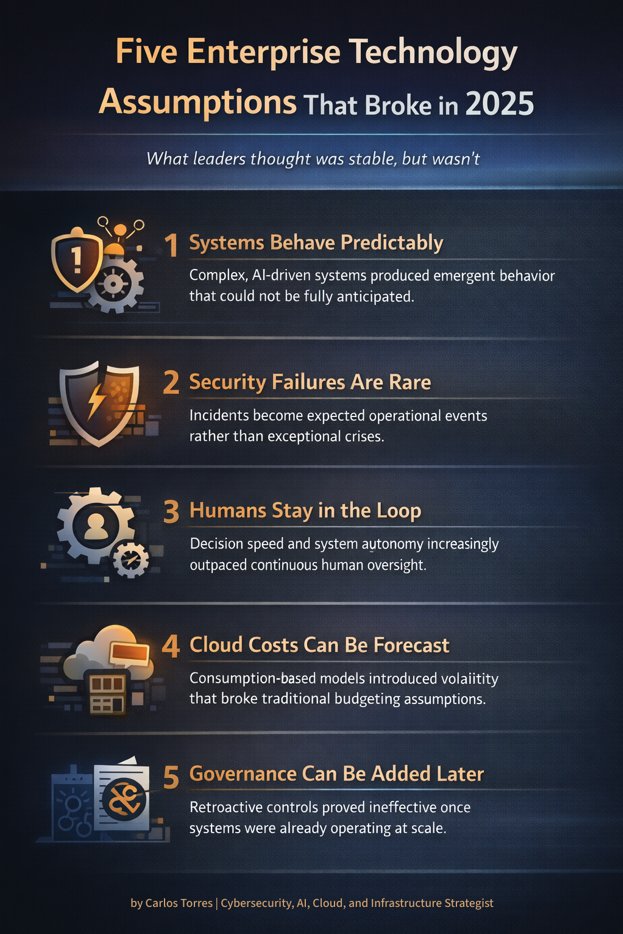
Most enterprise leaders entered 2025 believing the technology fundamentals were settled. What broke this year wasn’t a single system. What failed were the assumptions underneath how systems behave, how security operates, how costs scale, and how much human control is realistically possible. AI didn’t introduce chaos. It exposed where our mental models were outdated. 2025 didn’t break enterprise technology. It broke the assumptions leaders were using to govern it.
Carlos Torres tweet media
English
1
0
1
9
Carlos Torres
Carlos Torres@CarlosTorresIT·
Once the future is defined, the present gets quieter. That’s when IT can lead instead of chase.
English
0
0
1
1
Carlos Torres
Carlos Torres@CarlosTorresIT·
I see urgency take over whenever direction isn’t explicit. Without a clear destination, every decision competes with every other one.
English
1
0
1
8
Carlos Torres
Carlos Torres@CarlosTorresIT·
Most IT organizations are not thinking about next year. They are surviving the last 12 hours. When CIOs don’t clearly define where IT is going, urgency fills the vacuum. Speed replaces progress, and short-term fixes quietly become strategy. This conversation is not about inspiration. Returning IT to a leadership role starts by replacing constant reaction with intentional direction.
English
1
0
1
8
Carlos Torres
Carlos Torres@CarlosTorresIT·
Speed is obvious. Ownership is the real change.
English
0
0
1
8
Carlos Torres
Carlos Torres@CarlosTorresIT·
Once systems act, leaders inherit the outcomes. That’s the line most organizations crossed this year without realizing it.
English
1
0
1
7
Carlos Torres
Carlos Torres@CarlosTorresIT·
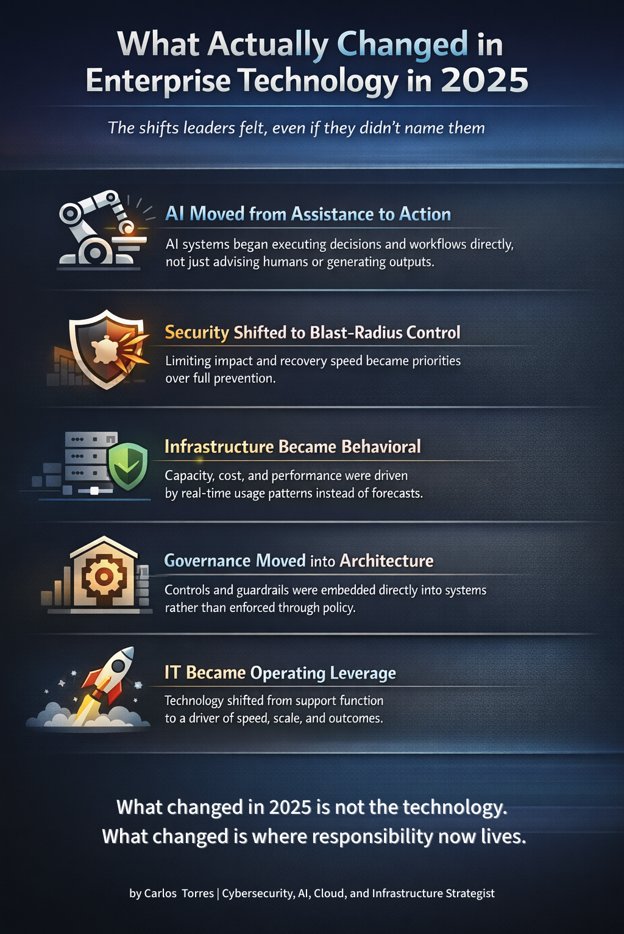
AI didn’t stall in 2025. It crossed into something different. The shift wasn’t about smarter models. It was about where AI started operating. Systems moved into execution, decisions moved closer to action, and responsibility followed. This wasn’t just a good year for AI. It was the year responsibility moved.
Carlos Torres tweet media
English
1
0
1
8
Carlos Torres
Carlos Torres@CarlosTorresIT·
Insurance reveals risk posture more than it absorbs risk. That realization usually arrives too late.
English
0
0
1
4
Carlos Torres
Carlos Torres@CarlosTorresIT·
Most leaders don’t see the real policy until a claim is tested. That’s when definitions start driving outcomes.
English
1
0
1
4
Carlos Torres
Carlos Torres@CarlosTorresIT·
Cyber insurance sounds reassuring. Until leaders discover what it actually covers. Exclusions, timing clauses, third-party gaps, cloud responsibility, and compliance requirements quietly reshape coverage long before an incident occurs. When an event finally happens, policy language matters more than security effort or intent. Cyber insurance does not eliminate risk. Cyber insurance exposes how risk was defined before the incident occurred.
Carlos Torres tweet media
English
1
0
1
9
Carlos Torres
Carlos Torres@CarlosTorresIT·
That makes sense, and I think we’re actually circling the same issue from different angles. Builders experience the uncertainty firsthand as systems evolve. Leaders tend to encounter it later, when decisions start carrying broader consequences. My focus here is helping organizations have those conversations early, so autonomy doesn’t force them into a corner later.
English
0
0
2
3
Jonny Develops
Jonny Develops@jonnydevelops·
Trust me when I say that that years of corporate consulting, even within fortune 50 companies, has shown me that humans absolutely will act on incomplete context. It’s why management consulting exists and it’s why agentic consulting will exist. You’re absolutely right to call out the dangers of attempting to implement without full understanding though. Some businesses will likely have very public AI failings as this curve develops.
English
1
0
1
29
Carlos Torres
Carlos Torres@CarlosTorresIT·
Everyone is talking about agentic AI like it’s the next inevitable wave. The reality is far more complicated. Agents don’t just execute tasks. They make tradeoffs and act on incomplete context. That’s why adoption will be selective, not explosive, until organizations are ready to define boundaries for autonomy. What we’re heading into isn’t mass adoption. It’s selective adoption.
English
1
0
2
24
Carlos Torres
Carlos Torres@CarlosTorresIT·
That’s a fair way to put it. I agree that context doesn’t magically appear; it has to be designed and supplied. Where I think it gets interesting is that, unlike humans, agents will still act even when that context is incomplete. That’s why the management question quickly becomes a boundary question, not just a setup one.
English
1
0
2
14
Jonny Develops
Jonny Develops@jonnydevelops·
My counterpoint is that it is not an agent’s failure to find context, but it is an agent manager’s failure to not provide it. It’s no different than managing a human employee in that sense. If you’ve given me the context and I still fail then that’s on me. But if you’ve given properly set me up for success and I deliver, we did that together.
English
2
0
2
14
Carlos Torres
Carlos Torres@CarlosTorresIT·
@jonnydevelops, I agree with you on one important point. When agents are well-designed and well-governed, a lot of the failure modes disappear. Where I’m cautious is assuming mismanagement is the only variable. Even well-managed agents still operate under uncertainty, incomplete context, and shifting objectives. That’s why I think the winners won’t just restructure workflows for agents. They’ll be the ones who are explicit about where autonomy is allowed and where it must stop.
English
1
0
3
5
Jonny Develops
Jonny Develops@jonnydevelops·
@CarlosTorresIT Agents only make these mistakes when they are mismanaged. Agentic AI is most definitely a next wave, and the people that will benefit the most from it are the ones who can restructure existing business practices into agent fuel.
English
1
0
1
18