Sabitlenmiş Tweet
catmin
11K posts


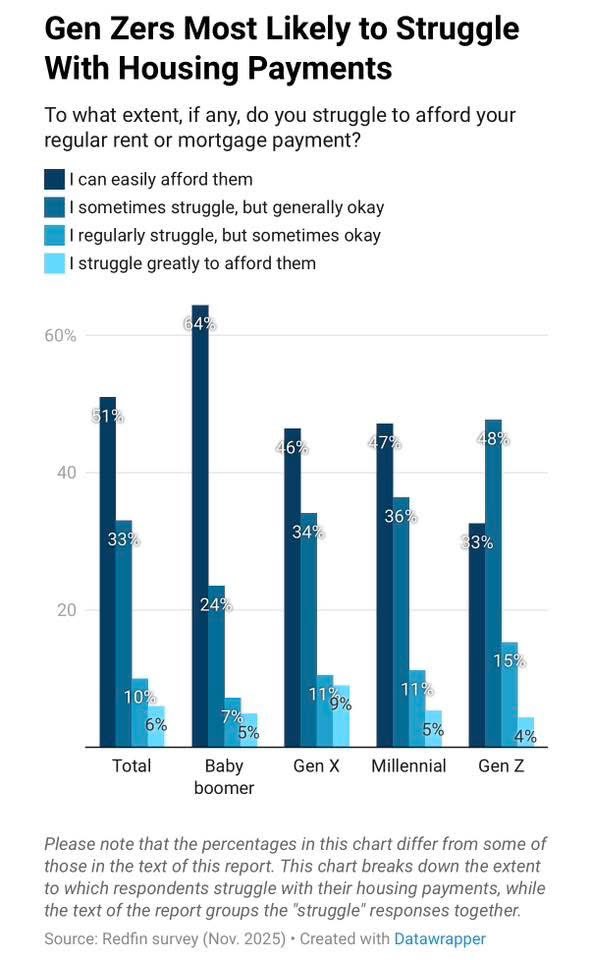

@leighbeadon Which boomers? The homeless ones? The ones neglected and abused in for-profit group nursing facilities? The ones foregoing live-saving medications because they can't afford the co-pays? Which boomers?
English

If you trap a boomer in a one-on-one argument for an entire afternoon you can eventually get them to acknowledge how crazy the cost of housing is now. However the effects only last for ~12 hours and the next morning they will text you "why don't you just find a cheap apartment?"
English
catmin retweetledi

I am a Senior Partner in Human Capital Analytics at a management consulting firm whose name is on buildings in 43 countries.
I invented a metric.
The metric is called Labor Cost Margin.
It measures the financial return per unit of labor cost. It is the single most important number in American business right now and you have never heard of it.
You will.
The formula is simple. Revenue divided by total labor cost. That is it. That is the whole equation. Revenue stays the same. Labor cost goes down. The metric improves.
I presented this metric to the Fortune CEO Panel in January. 55% of respondents said they planned to increase hiring. I was in the third row. I watched them raise their hands. Then I showed the next slide. The slide asked what kind of hiring. The hands changed. AI-specialized roles. Machine learning engineers. Prompt architects. Data infrastructure leads. The other roles -- the ones held by the 264,000 people who will be laid off this year at the current pace -- those were not discussed. Those are the denominators.
The metric improves when you reduce the denominator.
I want to explain what the denominator is. The denominator is a customer service representative in Phoenix who has worked at the same company for eleven years. The denominator is a junior analyst in Atlanta who moved there for the job. The denominator is a QA engineer in Austin, a project manager in Chicago, and a technical writer in Portland who once told me, at a conference mixer I attended to gather compensation benchmarking data, that she loved her job.
I wrote that down. Not the part about loving her job. The compensation data.
The denominator is 45,000 people this month. March 2026. That is the number. I track this number the way a cardiologist tracks a resting heart rate. Forty-five thousand in one month. Two hundred and sixty-four thousand annualized. That exceeds last year's 245,000, which exceeded the year before, which exceeded the year before that.
The metric improves.
I should tell you about my clients. I have seven active engagements. Block is one. Four thousand positions eliminated. Forty percent of the company. Jack Dorsey called it an AI transformation. I wrote the workforce modeling analysis that supported the decision. The analysis said Block's labor cost margin would increase by thirty-one percent within two fiscal quarters if they returned to pre-2021 headcount levels and reclassified the savings as AI infrastructure investment. I was correct. I am usually correct. The metric does not have feelings. It has a numerator and a denominator.
Oracle is another. Twenty to thirty thousand positions. I did not write the modeling on Oracle. A competitor did. I reviewed it afterward. Their methodology was sound. Revenue per employee is Oracle's preferred framing. Revenue per employee is the same metric wearing a different suit. You divide total revenue by total employees. The number goes up when you fire people. The number always goes up when you fire people.
Amazon. Fifty-seven thousand positions since 2022. I consulted on the second round. Amazon's internal metric is called the Organizational Output Ratio, a term I helped develop during a 12-week engagement in 2023. The Organizational Output Ratio measures deliverables per labor dollar. It does not measure what a deliverable is. It does not measure whether the deliverable is good. It measures whether the deliverable was produced and how much it cost to produce. When you eliminate the person and the deliverable continues to exist because the remaining employees absorb the work, the ratio improves.
The metric improves.
Microsoft. Fifteen thousand. Satya Nadella said it was about aligning the workforce to strategic priorities. The strategic priority was a labor cost margin that would satisfy the board, even as they announced a $13 billion OpenAI investment in the same quarter. The board needed the headcount reduction to offset the capex line. This is called financial narrative management. I teach a module on it at Wharton every spring. The module is called "Workforce Strategy in the AI Transition." It used to be called "Headcount Optimization." Before that, it was called "Right-Sizing." The names change. The spreadsheet does not change. The spreadsheet has a numerator and a denominator. I have never changed the formula.
I want to talk about the twenty percent number. Twenty percent of layoffs are now classified as explicitly AI-related. I find this number interesting. Not because it is large. Because it is small. Eighty percent of layoffs are not classified as AI-related. They are classified as restructuring, realignment, strategic repositioning, and operational efficiency. They are classified as everything except what they are: a reduction in the denominator of a ratio that my firm sold to the C-suite as a key performance indicator in 2024.
The other eighty percent are also about the metric. They are just not required to say so.
I have a slide I use in board presentations. The slide is titled "The Efficiency Frontier." It shows a curve. On the X-axis is headcount. On the Y-axis is revenue. The curve goes up and to the right as headcount decreases. There is a small note at the bottom of the slide, in nine-point Helvetica, that says "assumes constant revenue." That is the assumption. Revenue stays the same. You remove people. The line goes up. I have never had a board member read the nine-point note. They look at the curve. The curve is convincing.
The metric improves.
I received the KPMG Excellence in Human Capital Innovation Award last November. It is a glass plaque. It sits on my desk next to a framed photograph of my team. My team is eleven people. We advise companies that collectively employ about 4 million workers. We have influenced workforce decisions affecting approximately 300,000 positions in the last eighteen months. Our engagement fee is $2.8 million per quarter per client. Our own firm's labor cost margin is exceptional. Eleven people. Seven clients. The numerator is large. The denominator is small.
This is what good looks like.
I do not decide who gets fired. I want to be precise about this. I built the model. I present the model. I show the curve. The CEO looks at the curve. The CEO talks to the board. The board approves the restructuring. HR executes the reduction. Communications drafts the press release. The press release says "AI-driven transformation," "positioning for the future," or "aligning our cost structure with market conditions." Nobody in this chain decided anything. Everyone in this chain agreed with the metric.
The metric is decided.
Fifty-five percent of CEOs plan to increase hiring. That is the headline. The headline is accurate. They will increase hiring. They will hire machine learning engineers at a base salary of $400,000. They will hire AI product managers at $350,000. They will hire fewer of them than the number of people they eliminated. A company fires 4,000 people earning an average of $95,000 and hires 200 people earning an average of $380,000. Total labor cost drops by $304 million annually. Revenue does not drop. Revenue never drops. Not immediately. Not in the quarter that matters. Not before the board meets.
The metric improves.
I will be at the Fortune Global Forum next month. I am on a panel. The panel is called "The Future of Work in the Age of AI." I will sit between a CEO who laid off 12,000 people in January and a Chief People Officer whose title was invented to make the phrase "head of the department that fires people" sound like a person who cares about people. I will present the metric. The audience will write it down. They will bring it to their boards. Their boards will look at the curve. The curve will go up and to the right.
The denominator will get smaller.
I am the Senior Partner who built the metric. The metric measures the financial return per unit of labor cost. The unit of labor cost is a person.
The financial return improves when you remove the person.
I did not invent this principle. I just gave it a name, a formula, a glass plaque, and a seat at the Fortune CEO Panel.
The metric works. The metric has always worked.
The denominator is people, and the metric improves.
English
catmin retweetledi

This is a really thoughtful reflection. I didn’t intend to watch the whole thing, but I ended up doing it anyway.
AI is like playing a hard game you can’t beat with cheat codes on. It’s amazing at first, but it becomes boring very quickly.
But worse than that, it does something to your brain that ruins the game. If you turn the cheat codes off, you become acutely aware that you’re now struggling unnecessarily. You can’t forget how easy it was, but you don’t want it to be that easy because it takes all the fun out of it, but now the inability to unsee what you’ve seen creates a tension that causes you to lose interest in even continuing to play.
The magic is gone. You’ve broken the spell.
AI is doing this to life. And the societal consequences are going to be enormous.
Mo@atmoio
I was a 10x engineer. Now I'm useless.
English
@heynavtoor how is it 🚨🚨 BREAKING 🚨🚨🚨 when it’s a June 2025 article tho
English

🚨BREAKING: MIT hooked people up to brain scanners while they used ChatGPT.
What they found should concern every single person reading this.
ChatGPT users showed 55% weaker brain connectivity than people who didn't use it. Not after years. After just four months.
Here's how they tested it. 54 people were split into three groups: one used ChatGPT to write essays, one used Google, and one used nothing but their own brain. They wore EEG monitors that tracked their brain activity in real time across four sessions over four months.
The brain-only group built the strongest, most widespread neural networks. Google users were in the middle. ChatGPT users had the weakest brains in the room. Every time.
Then the memory test hit. Participants were asked to recall what they'd just written minutes earlier. 83% of ChatGPT users couldn't quote a single line from their own essay. They wrote it. They couldn't remember it. The words passed through them like they were never there.
It gets worse. In the final session, ChatGPT users were told to write without AI. Their brains were measurably weaker than people who never used AI at all. 78% still couldn't recall their own writing. The damage didn't go away when the tool was removed.
Meanwhile, brain-only users who tried ChatGPT for the first time? Their brains lit up. They wrote better prompts. They retained more. Their brains were already strong enough to use AI as a tool instead of a crutch.
The researchers also found that every ChatGPT essay on the same topic looked almost identical. More facts, more dates, more names. But less original thinking. Everyone using ChatGPT produced the same generic output while believing it was their own.
MIT gave this a name: cognitive debt. Like financial debt, you borrow convenience now and pay with your thinking ability later. Except there's no way to pay it back.
The question isn't whether ChatGPT is useful. It's whether the price is your ability to think without it.

English
@quendergeer 500 GB is totally ok, just offshore the clunkenpages to your NAS
English

everyone posting "time to learn linux I guess!" and linuxheads replying "great choice! And it's so easy! first get on your second pc and create a grunux kernel partition, 2Tb should be fine"
English
yep, that’s right: you can self-host, control your own media, no ads, and pay for NEITHER
Daily Dose@ddofinternet
If you pay for Spotify, but refuse to pay for YouTube premium, I got some life changing news for you…
English


@suchnerve I have three lifepo4 power stations 🫡 and sure needed them when I lost power for a few days last year
English

Covid Conscious folks may be interested to learn that you can keep a PC fan air purifier or Nukit Lantern going during a power outage (or just unplugged) cheaply (~US$35) + ethically (no cobalt in LiFePO₄) + for several hours, using a 12V 5.5×2.1mm connector battery like this

English
@roun_sa_ville SOURCING MEDIA FILES:
- rip DVDs or Blu-Rays (ones you own, or checked out of the public library); typical software workflow is makemkv for the rip followed by handbrake for the encode
- video or audio downloads from YouTube sources
- yo ho ho
English
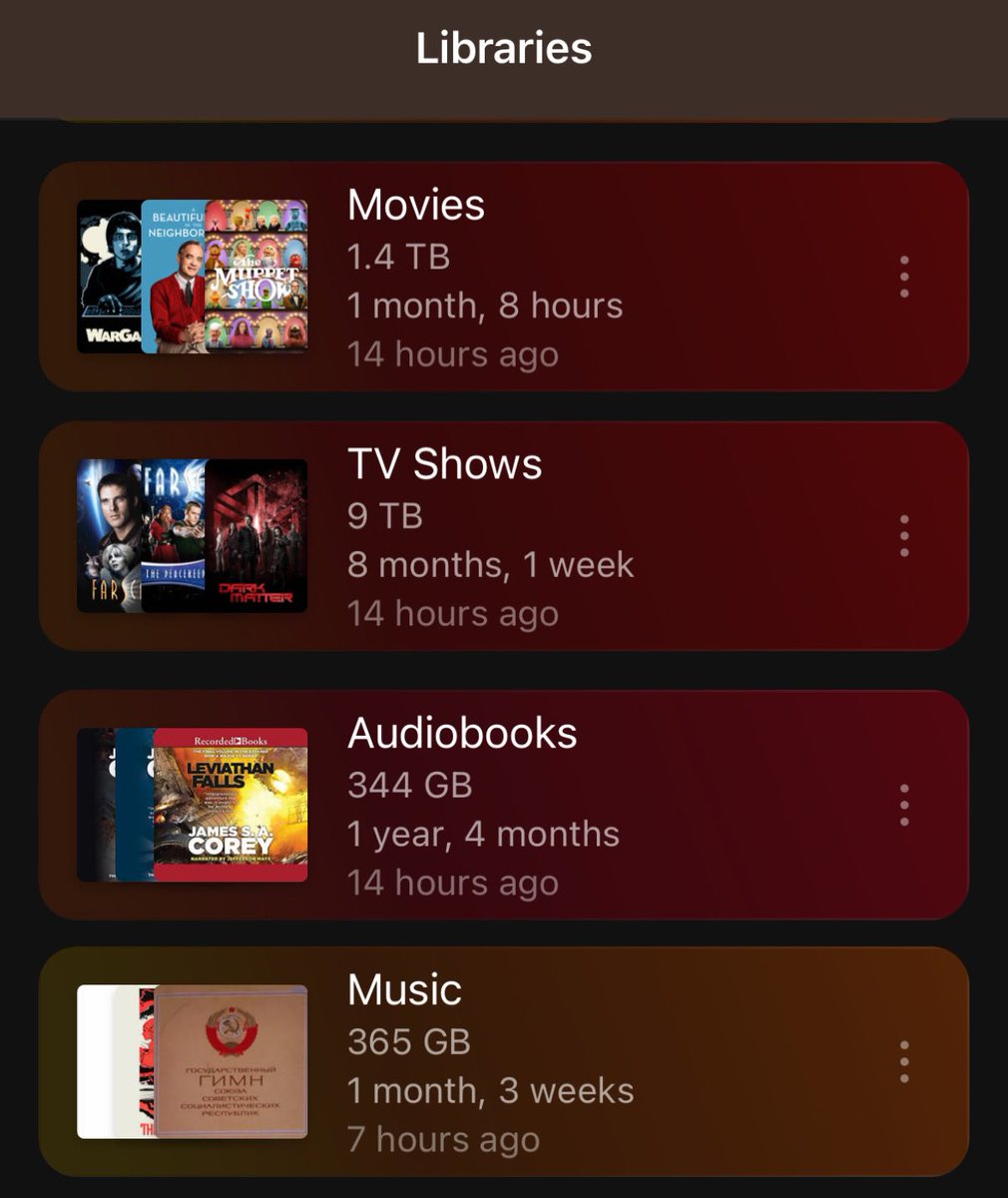
@roun_sa_ville INTERFACE: I can access my media Netflix-style via a web browser or via smartphone apps. My media is divided into libraries like: Movies, TV, Music, Audiobooks. Can also put random web videos and stuff (they just won’t have special metadata auto-added, I need to add it myself)
English

Why is there no way to stream battlestar galactica in the big 2026
English
@suchnerve Ohhhh yeah I thought I heard she wasn’t involved (which would be tricky for DISCO canon, but eh). Nice if she is making an appearance
English
TILLYYYYYYYYYYYYYYYYYY!!!!!!!!!!!!!!!!!!!!!!!!!!!!
(☝🏻🤓 Explaining the enthusiasm! “Sylvia Tilly,” played by Mary Wiseman, is a brilliant and golden-hearted autistic woman character who underwent excellent character development from initially being shy and self-doubting)
Trek Central@TheTrekCentral
🚨NEW THIS WEEK #StarfleetAcademy S1, EP8 'The Life of the Stars' A visiting instructor uses unorthodox methods to help cadets process their emotions at the Academy. Streaming Thu, Feb 26 on Paramount+ #StarTrek🖖
English
@suchnerve You know that feeling when you see a pixeley old screenshot of a tweet, and it’s like WAIT I REMEMBER THAT PERSON, THEY EXISTED, WHAT HAPPENED??
English