Official Layoff@LayoffAI
Meta just showed every CEO in America exactly how to replace their workforce.
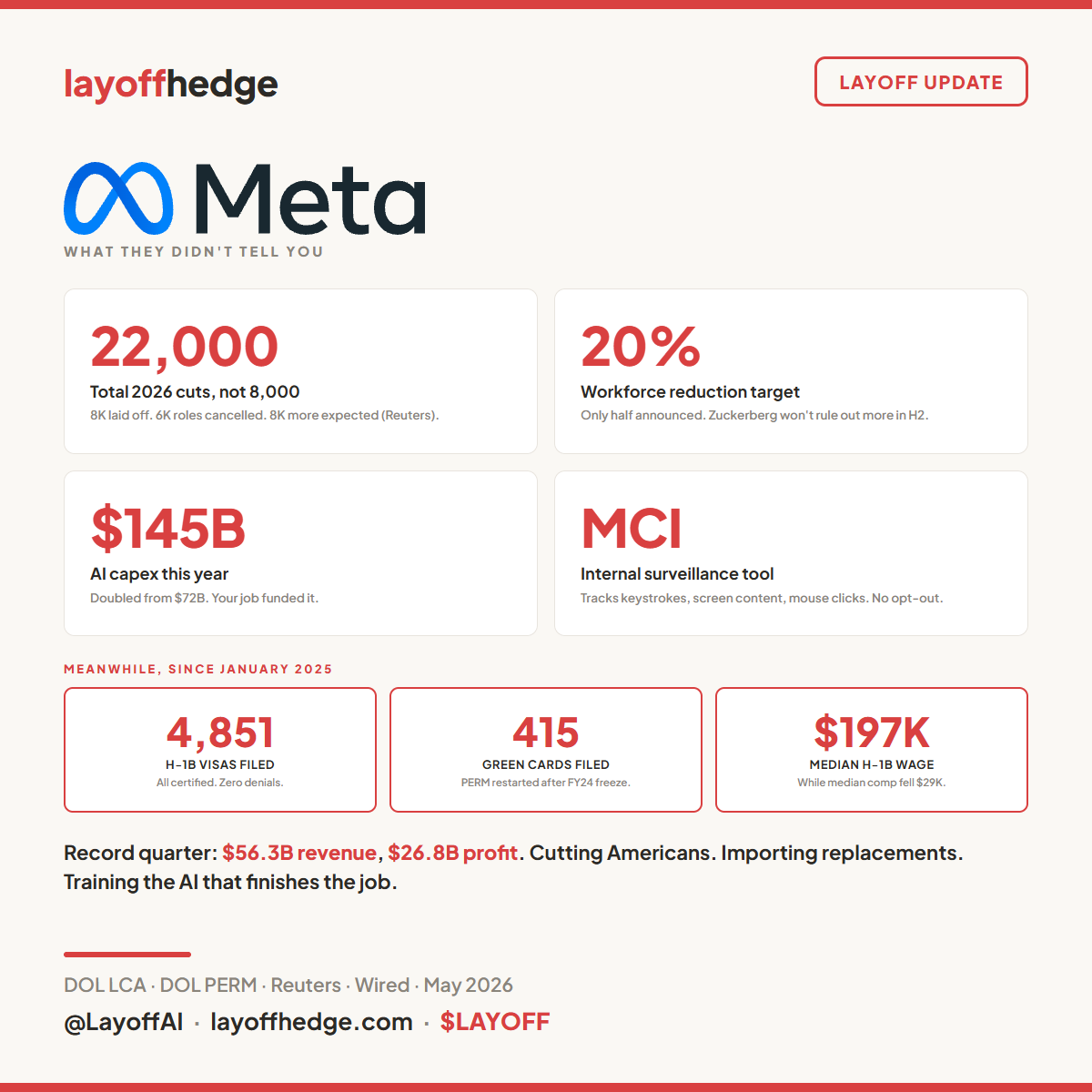
They laid off 700 people this week. Plan 15,000 more ASAP. Now, leaked internal documents reveal what comes next.
Meta now requires 65% of its engineers to write 75% or more of their code using AI by mid-2026. Their Scalable Machine Learning org has a target of 50-80% AI-assisted code. Across Messenger, WhatsApp, and Facebook, 55% of all code changes must be “Agent-Assisted.” 80% of mid-to-senior engineers must adopt AI tools like DevMate and Google Gemini.
Starting this year, every Meta employee is graded on “AI-driven impact” in their performance reviews. It is now a core expectation. If you don’t use AI, you don’t advance. Meta is the first major tech company to formally tie promotions to AI adoption.
They built an internal game called “Level Up” that rewards employees with badges for hitting AI milestones. They rolled out an “AI Performance Assistant” to help write reviews. They are rebranding engineers as “AI Builders” and reorganizing teams into small “AI-native pods.” Zuckerberg said projects that once required large teams can now be handled by one “very talented” person.
Read that again. One person replacing a team.
Here’s why this matters beyond Meta.
Every CEO in tech watches what Meta does. When Meta cut 11,000 in 2022, the rest of tech followed within months. When Meta tied performance reviews to AI, KPMG did the same thing within weeks. Accenture just told senior staff that AI tool usage will determine who gets promoted to leadership. The playbook is spreading.
The pattern is clear. Step one: mandate AI adoption internally. Step two: measure how much output AI handles. Step three: when AI handles 75% of the work, you need 75% fewer people to do it. Step four: cut.
Block already did this. Jack Dorsey cut 40% of the company and told shareholders “intelligence tools have changed what it means to build and run a company.” The stock surged 24%.
Wall Street doesn’t reward hiring. It rewards headcount reduction. Every earnings call where a CEO says “AI is making us more productive” is a preview of the next layoff announcement.
Meta is spending $135 billion on AI this year. They are simultaneously cutting thousands of workers. Those two facts are not in tension. They are the same strategy.