@emmywayne64 I mean it is difficult. Especially for an inherent airbender. But my guess is just time. I mean, Team Aang be building a damn city in their teenage years.
People should really learn etymology instead of these inaccurate AI stuff. It’s called a bathroom because historically toilets are in a separate room from baths. Architecture and design wise, a bathroom today is essentially a toilet with a bath inside and a powder room is essentially one without a bath that prioritizes freshening up (mirrors) for guests. Restroom and toilet (French, ‘toilette’ which means cloth/grooming) are polite terms/euphemisms and Lavatory is the formal British term which was deemed antiquated and too posh (also a bit too vivid since it comes from Latin, lavare, which means ‘to wash’) so they started calling it the “Loo” (from lieux d'aisances which means place of ease). Washroom originated mostly in Canada and other parts of North America because prior to the advent of plumbing, they are literally just small rooms with a basin and a pitcher to wash yourself with. Lavatory was then used by global standards as a legal term hence why they’re used in airlines so there are no confusion on what they are: toilet bowl + mirror + wash basin w/ amenities that can be used as a place to freshen up. This video is senseless and just overcomplicates things. Call them what you want in your own country and just learn what they’re called in others when you travel. That’s it.
They hold festivals every season and they travel to each temple all the time. If you read Dawn of Yangchen, it explains there that travel is a “religious duty” in the life of an air nomad to prevent earthly attachments and build spiritual attachments with people of all nations of “the same spirit” which explains why Aang has a lot of friends from other nations growing up. Even before TLOK, air nomads were already brokering peace between nations and resolving conflict via nonviolent means hence why Avatar Yangchen is known for espionage and psychological warfare. So how it works is that air nomads will meet up in one of the festivals, form quick relationships, do the deed, and when a female airbender realizes that she is pregnant, she gives birth at the nearest air temple during her travels which is usually not their own temple. She leaves the child there under the care of a high ranking monk or nun. Neither parents will truly know which child is theirs and even if they do, they have a spiritual obligation not to form attachments as soon as their duty to procreate has been fulfilled. Fun fact, Jesa, Avatar Kyoshi’s mother was an air nomad that chose to abandon the life of a nun and traveling to become a mother. She abandoned her spiritual duties and her airbending got significantly weaker which urged her to start using fans to support her bending. Fans that Avatar Kyoshi would then inherit to learn the practice. As far as the novels are concerned, the life of an air nomad is defined by the lives of their sky bisons. A sky bison is the only constant friend an air nomad actually has, that’s why they are chosen based on spiritual qualities. Appa is the only thing that Aang is technically allowed to form attachments with which would explain why the Ba Sing Se arc was so painful for him.
We know the Northern and Southern Air Temples were for male Air Nomad monks, while the Eastern and Western Air Temples were for female Air Nomad nuns. If the monks and nuns lived in separate temples and didn’t get married, how did new Airbenders continue to be born?
Larry, let's keep this conversation grounded in the actual math of how New York functions. You keep saying these owners "don't use" services, but that ignores how a city budget actually works. If you’re as well-versed in market dynamics as you claim, help me understand these points:
1. Security Subsidy. You say they don’t use the police or fire departments. However, if the NYPD and FDNY didn’t exist to protect those $20 million assets 24/7, the insurance premiums alone would make the properties untouchable. Why should the people who actually live in NYC full-time provide the tax revenue that secures the value of a billionaire’s offshore asset?
2. Revenue Gap. A neighbor living in an identical luxury unit pays property tax plus a 3.88% local income tax and thousands in sales taxes. By staying vacant, a "ghost resident" gets the exact same city protection and treatment? In a city facing a $5.4 billion budget gap, why is it "fair" for the other residents and the working class to subsidize the carrying cost for someone who treats the housing as a non-productive asset?
3. Infrastructure Drain. Every time a unit sits dark, the city loses the 8.875% sales tax on every meal, the luxury excise taxes on goods, and the fuel taxes a resident would have contributed. Since these taxes are what actually fund our subways and schools, how do you justify the city losing that "economic velocity" just to accommodate a vacant apartment?
4. Opportunity Cost. A city thrives on the daily churn of hiring local technicians, legal services, and specialized tradespeople. When you defend these "dead zones," you are defending the use of the most limited resource, land, for zero economic return to the neighborhood. Can you explain the market logic of incentivizing a "dead" asset over a resident who actually puts money into the pockets of local workers?
I’m still waiting for a data-driven reason why this isn't just a massive, lopsided subsidy for people who show up the least. Can you provide the math, or are we just going to keep talking about "punishment"?
Thats a load of BS...Property taxes pay for schools, which they dont use, property taxes pays for roads which are almost never used, property taxes pay for fire and police which are almost never used. You only real interest here is its not fair they have something I dont so we need to punish them...and that is not the role of taxes
What exactly is the argument against a pied-a-terre tax for second (or third / fourth / fifth) homes worth more than $5 million owned by people who do not even live in the city? It just seems like such a glaringly obvious common-sense policy.
JDA, your argument is a classic distraction. You’re trying to pit long-term housing supply against immediate tax fairness as if we can't address both. You say these units are a "tiny slice," but they represent a massive concentration of square footage in the city's most dense hubs. In a city with a 1.4% vacancy rate, housing is a zero-sum game. When you allow 13,000 high-end units to be used as speculative "land banks" rather than homes, you pull that inventory off the market, forcing everyone else, from doctors to tech workers, to compete for the remaining scraps. This artificial scarcity keeps the floor on all housing prices high because the supply isn't actually being "supplied" to the market, it’s being hoarded. Saying they are "taxed as designed" also misses the point... the current design is a massive loophole. A full-time neighbor pays property tax plus nearly 4% in local income tax, plus state taxes. A ghost resident gets the same NYPD, FDNY, and billion-dollar power grid protection for less than half the entry fee. This isn't just a tax difference but a loss on the sales, gas, and excise taxes that keep a city running. Every time the owner isn't around, the city loses the 8.875% sales tax on every meal, the luxury excise taxes on high-end goods, and the taxes baked into every gallon of fuel or service a resident would have been using. Furthermore, a city thrives on "churn." It's the daily velocity of money. An empty unit hires no local plumbers for regular maintenance, buys no groceries from the corner bodega, and pays no tips to local servers. When you have 13,000 dark windows, you have 13,000 fewer people or families supporting the local dry cleaners, the florists, and the tradespeople who actually build the economy. Every day that unit sits empty, it’s a net loss of economic contribution that we would otherwise get from a primary resident who actually participates in the life of the neighborhood. Blaming zoning is a valid long-term point, but it shouldn't be a shield for a tax system that allows the ultra wealthy to park capital in the most limited resource for free. A pied à terre tax isn't overreaching, it’s simply making sure that if you want to use NYC as an asset vault, you pay the same total contribution as the neighbors who actually show up and keep the city alive. Also, what would the people of NYC and the wealthy generally worry about? This policy creates a win-win scenario for the city regardless of how the owners react. If they choose to keep the units vacant and pay the surcharge, they directly fund the subways and schools that stabilize the city's value. If they sell, they flood the market with inventory that cools down inflated property values and makes room for primary residents. If they try to dodge the "vacant" label by renting out, they increase the rental supply and bring in tenants who actually spend money at local businesses. Even trying to declare the unit a primary home backfires on them, as it subjects their global wealth to local income taxes. Combined with the proposed estate tax changes lowering exemptions to $750,000, heirs will be incentivized to sell quickly rather than let these assets sit as "ghost towers." No matter the choice, the city finally stops being a free storage locker for global capital and starts being a community again.
@CepheidV@JustLarry_Me@JillFilipovic Your argument overreaches. Empty units still pay property tax and often reflect a tiny slice of supply, ot the main driver of housing costs. Non-residents aren’t “dodging” NYC taxes; they’re taxed as designed. Blame zoning limits and underbuilding, not a handful of pieds-à-terre.
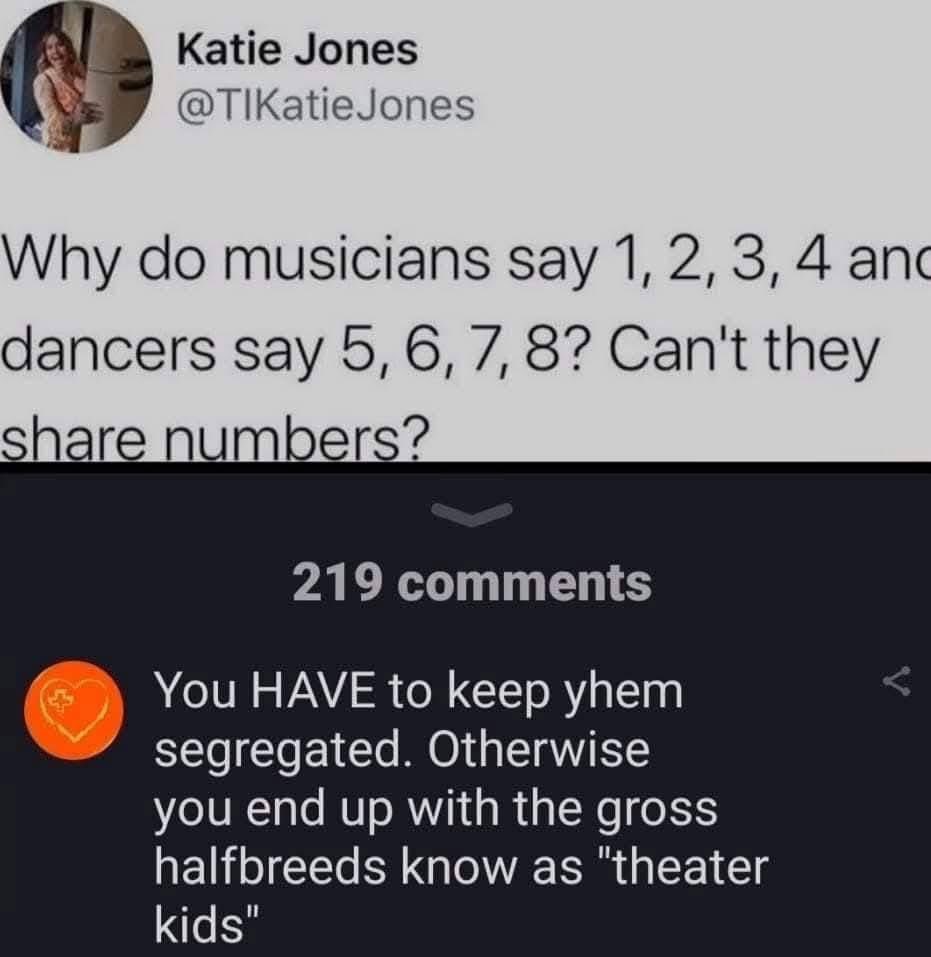
As a theater kid, I agree 😂😂😂
But seriously it's because of what comes after the counts. Musicians count in 4s so it's 1,2,3,4....1,2,3,4,1,2,3,4,1,2,3,4... while dancers count in 8s for movement so that's 5,6,7,8...1,2,3,4,5,6,7,8...so on and on. It's more to signal whether we count in 4s or 8s. Ha! Theater kid logic.
Let’s keep the debate focused on the data rather than personal assumptions. Let me set the record straight: I don't cook for a living. In fact, I no longer work. While the culinary arts are a deep passion of mine, my background actually includes three academic degrees and a history of building business ventures. Weaponizing a mischaracterization (or maybe a premature assumption) of my life to dismiss my economic literacy is a lazy evasion tactic. We both come to this with non-traditional backgrounds. Your degree is in Political Science, not economics, yet you’ve built a massive career in financial publishing. However, when we lean on personal authority and market expertise in a debate, credibility is key. A public record that includes a 2007 federal court ruling and a $1.5 million SEC penalty for defrauding investors makes it incredibly important that we rely on verifiable facts rather than just trusting authority and "expertise." I am genuinely looking for actual counterarguments grounded in municipal numbers, land-value capture metrics, or a mathematical rebuttal regarding the 1.4% vacancy rate. If you want to demonstrate your expertise, let’s move past the ad hominems and look at the actual data. I'd love to hear your mathematical breakdown of why taxing speculative vacancy would crash a market fundamentally built on artificial scarcity. Until we can look at those numbers, the condescension just distracts from the real issues. Clearly, you've got the time to talk to a "chef."
No, it’s just that I make my living understanding incentives. And you make yours cooking. I don’t think I am a superior person, I just know that folks like you with nothing to lose (nothing at risk from your assertions) make a lot of claims that don’t work in the market.
And I know that because while you’re cooking each day, I am risking lifetimes of capital. Millions each day.
And if you had even one day of my experience you would immediately laugh, out loud, at the arguments you’re making and the ‘facts’ you cite.
You sound like a child.
I am not being mean. You simply have no idea what you’re talking about. Much like a child.
Call back after you start a successful restaurant. I honestly hope you will!
That’s a great way to learn how the world actually works.
Making billions in the stock market doesn't automatically grant you a PhD in urban economics, and assuming a chef coat is my only credential is just ignorance on your end. Before you write me off as someone who only understands food, you might want to consider that the three degrees I hold (which you knew nothing about) actually taught me how to read municipal data and spot a fragile argument hiding behind a massive ego. If you're done throwing tantrums and want to actually debate the fiscal policies, land-value capture metrics, and taxation regimes of global hubs, drop your specific references and data points right here. I’d be more than happy to dismantle them with mine. Frankly, it is hilarious that someone claiming your level of prestige resorts to such intellectually lazy language. I'm still looking for actual substance in your argument instead of you just targeting the people raising points and calling them "stupid." The ad hominem fallacy speaks loudly, and if you truly are the master of the universe you claim to be, you are doing a spectacularly poor job of keeping your shit together the second someone challenges your narrative. Also, where do you get the time to be emotionally vulnerable? lol
You’re a chef. And you are comparing the tax / economic freedom regime of Singapore to NYC.
So, yeah, I have nothing left to say to you because you are so willfully stupid, it is a waste of time.
You know, if I was trying to make Peking duck, I would ask you. And I would listen— not my area of expertise.
I have made billions in the markets for 30 years. Maybe when you’re talking about economics you’d consider listening to someone who knows what he’s talking about.
The only way to create wealth and prosperity is strong property rights, fair and consistent tax policies, and small and efficient governments.
Keep dreaming that you can turn the government into a tool of exploitation and have a country / state / city worth living in.
And also, just fuck you for wanting to take shit from other people just because they succeeded and you’re a turd.
@porterstansb@JillFilipovic And there we have it. The intellectually subpar retreat to insults when a structured argument proves too taxing for their limited bandwidth.
John, you are cherry picking history to fit a narrative that the actual data immediately disproves. The legislature didn't reject taxing the ultra-wealthy in 2019. They pivoted under intense lobbying from the Real Estate Board of New York and instead passed a progressive Mansion Tax and supplemental transfer tax that hits high-end properties up to 4.15%. The recurring pied-à-terre bill wasn't shelved because it would destroy the city, it was shelved because lawmakers cited administrative hurdles in constantly auditing part-time residency, so they opted to front-load the tax at closing. And what was the result of that massive new tax on luxury buyers? The market didn't crash. In fact, Manhattan's ultra luxury sector absorbed the tax as the new cost of entry, and 2021 became the highest-grossing year on record for NYC luxury real estate, with sales over $10 million hitting historic volume. To claim the legislature concluded a tax would crash the market is factually FALSE. They implemented a massive tax on that exact same bracket, and the Veblen demand for Manhattan real estate proved that the "market crash" threat is nothing more than a real estate lobby bluff.
@CepheidV@JillFilipovic Yet when the legislature considered this in 2019 that wasn’t their conclusion and they rejected the bill. there was concern it might crash the market for luxury properties. But, hey, what do they know?
That logic works for consumer goods, but it fails completely when applied to Veblen goods like Manhattan real estate. Obviously, people don't buy a $20M penthouse for the low taxes. They buy it for the proximity to concentrated power, global talent, and the 3.8% of the world’s GDP that flows through the city. If taxes dictated residency, the number of high net worth individuals would have plummeted years ago, yet between 2010 and 2020, NYC's millionaire population actually increased despite having some of the highest top-tier rates in the U.S. Furthermore, ghost residents don't actually spend money in the city. That’s the whole point. If your prediction comes true and these owners leave, you get a market correction that restores the city's health. Those units won't sit empty, they will be snapped up by primary residents who have been sidelined by artificial scarcity. When a "ghost unit" becomes a primary home, the city trades a passive tax bill for a massive revenue explosion. Scenario would be a neighbor who actually pays local income tax, generates thousands in monthly sales tax at local restaurants, and hires local tradespeople. Taxing them isn't "discouraging spending". It’s encouraging habitation. If Singapore can thrive with a 60% stamp duty and London maintains its status with a 17% SDLT, NYC isn't going dark because the top 0.1% are finally being asked to pay the entry fee.
You want rich people to come to your city and spend money. This will discourage rich people from spending as much time & money in NYC.
Whatever you want less of, you tax it. NYC wants fewer "rich people * days in city". The question is how much will this influence rich people. We don't know but it probably will not be good. It is very unlikely that they will get as much revenue as they expect.