

Zach Rynes | CLG
83.3K posts

@ChainLinkGod
Community Liaison @Chainlink | Opinions are my own


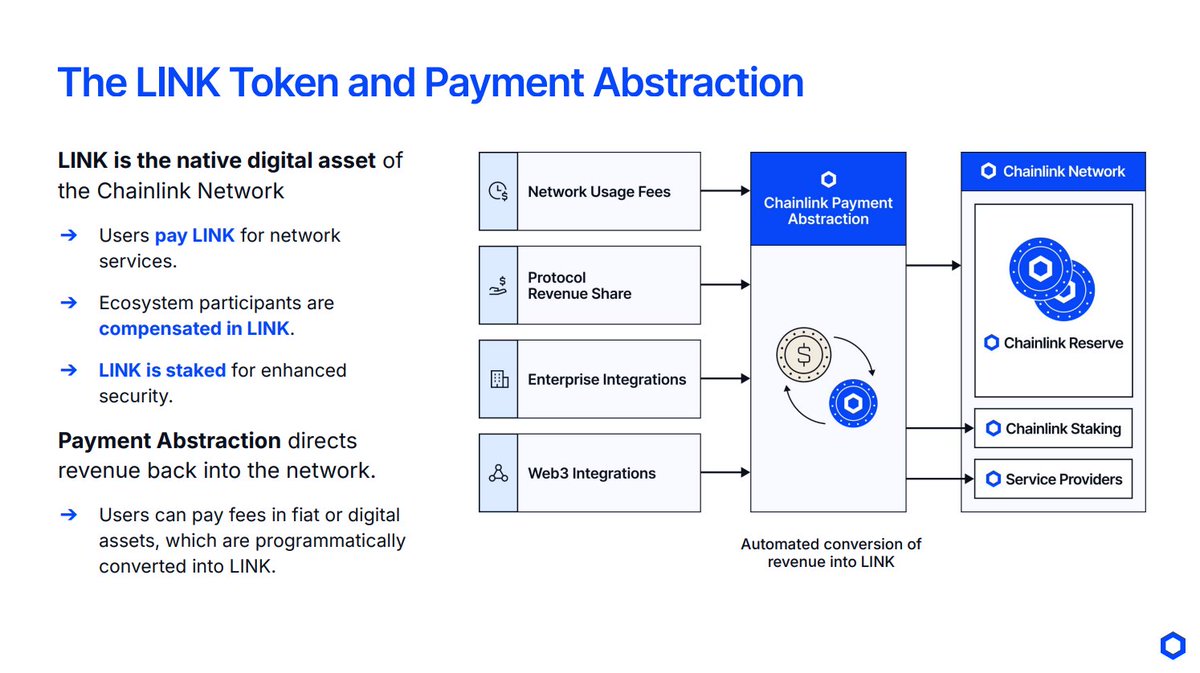
The second most asked token I get is $LINK. And it’s a tricky one. As a product, Chainlink is indispensable. RWAs don’t scale without reliable data, proof of reserves, and secure offchain → onchain infrastructure. A lot of this market will depend on them. However… I’m still not fully convinced on the token. Yes there are fees. Yes there’s staking.bBut it’s still not clear how much value actually flows back into $LINK itself. From my standpoint: The product = essential The token = still proving itself Bull case for $LINK would be : > Becomes the standard for RWA data + verification > Trillions in assets rely on Chainlink feeds + infra > Staking scales → large % of supply locked > CCIP becomes the default cross-chain settlement layer > LINK becomes economic security for the entire system If all of that plays out… Then LINK isn’t just a token, it “would” become the backbone collateral of onchain finance. Right now, I see one of the best products in crypto attached to a token still trying to find its final form. I feel it’s pretty hard to argue with that.


𝗟𝗜𝗩𝗘: Europe's largest asset manager Amundi (€2.3 trillion AUM) & Spiko launch new tokenized mutual fund (SAFO) powered by Chainlink. Chainlink is how the world's leading institutions & tokenization platforms are unlocking the issuance & distribution of tokenized funds.

It's going to be such a mindfuck when people realize that $LINK isn't just price feeds But is the foundational protocol that standardizes how the existing systems that store all of the world's data and value will integrate and interact with thousands of blockchain networks


"We got great guidance from the SEC yesterday that confirms unequivocally that LINK is a digital commodity." - Ben Sherwin, General Counsel @chainlinklabs

JUST IN: Taylor Lindman has been officially appointed as Chief Counsel of the @SECGov's Crypto Task Force. We thank Taylor for his great 5 years as a key part of the Chainlink Labs team in his role as Deputy General Counsel. We all look forward to modernizing the U.S. financial system together, taking it to the next level of its development and rapid growth.

𝗟𝗜𝗩𝗘: Europe's largest asset manager Amundi (€2.3 trillion AUM) & Spiko launch new tokenized mutual fund (SAFO) powered by Chainlink. Chainlink is how the world's leading institutions & tokenization platforms are unlocking the issuance & distribution of tokenized funds.

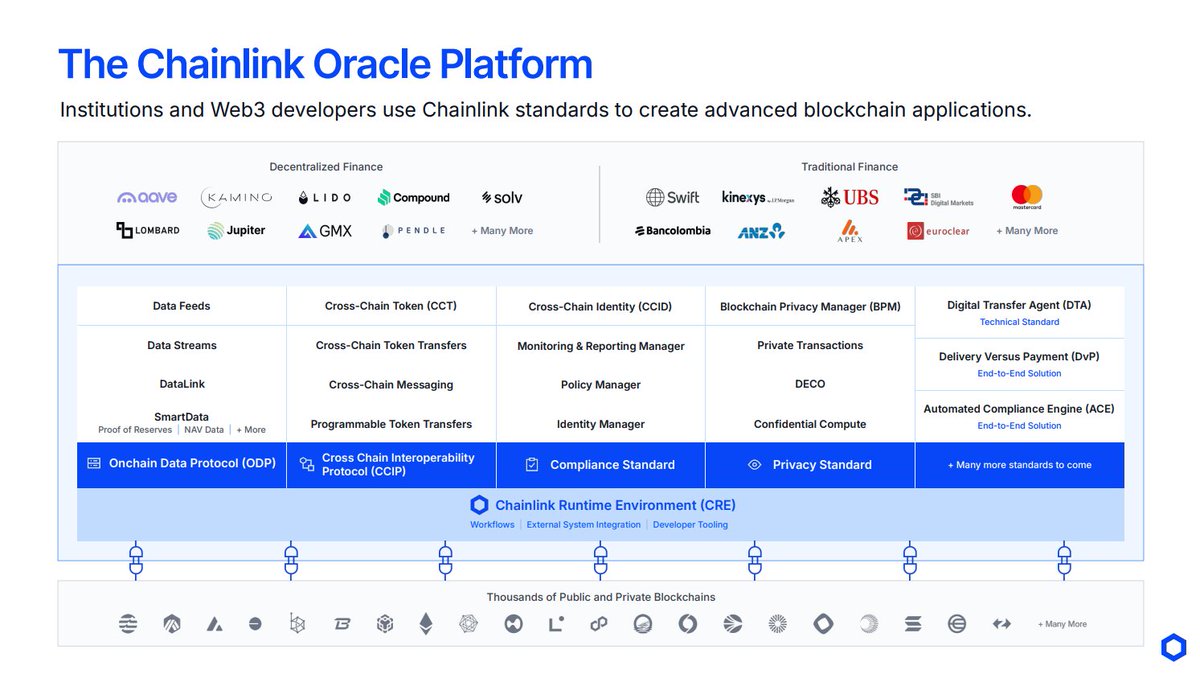
Most people's mental model of Chainlink $LINK is completely wrong Here's why👇 People often think of oracles as simple middleware bolted to the side of a blockchain, simply injecting price data In their mind, Chainlink is "just an oracle" so who cares right? A more complete mental model is that Chainlink is the global orchestration layer that sits above and across all blockchains and external systems A unified platform that enables organizations to create advanced business workflows spanning any number of blockchains, legacy systems, and oracle services, all powered by a decentralized runtime environment This matters now more than ever because we are entering a Cambrian explosion of blockchains of all kinds (public & private, L1 & L2, DeFi & TradFi, EVM & non-EVM) The cost and friction of launching a new blockchain network has never been lower And what we have seen historically is that in order for a blockchain to be successful, it needs critical oracle services: - Data oracles: DeFi needs market data to secure lending and derivatives, while TradFi needs NAV data for tokenized funds and corporate actions data for tokenized equities. Proof of Reserve provides public visibility into the reserves backing tokenized assets - Cross-chain oracles: Digital assets in both DeFi and TradFi need to be securely transferable across any public or private blockchain to access a greater pool of buyers, minimizing liquidity fragmentation and enabling advanced settlement workflows - Compliance oracles: Regulated tokenized assets need to comply with various regulations and internal business logic rules around identity verification and risk management to become adopted by institutions - Privacy oracles: Sensitive information needs to be made accessible to blockchain apps without revealing the underlying data, while private chains need to connect to public chains while only selectively revealing what is needed to complete transactions - Legacy-system oracles: Institutions want to access public and private blockchains using their existing infrastructure and messaging standards (Swift, FIX, DTCC) through a single integration gateway rather than manually integrating with thousands of chains individually - Orchestration oracles: Institutions need to be able to coordinate complex business workflows that span multiple blockchains, legacy systems, and oracle services through a simple API gateway Chainlink is the only unified platform that provides all of these solutions in a single offering, minimizing trust-assumptions and eliminating the complexity of using a patchwork of service providers This is how institutions adopt blockchains, not by betting on specific chains, but integrating with a unified platform that provides them access to any public or private chain While blockchains fiercely compete amongst each other to become the transactional database layer, Chainlink wins regardless of which chains are used For Chainlink, every new blockchain introduced to market is all the more justification for why organizations need a global orchestration layer to manage the complexity Financial market infrastructures like Swift, DTCC, and Euroclear understand this, which is why they have adopted Chainlink alongside J.P. Morgan, Mastercard, Central Bank of Brazil, UBS, SBI, Fidelity International, ANZ, and many others In addition to powering the DeFi economy (70%+ marketshare globally, 80%+ on Ethereum, and 90%+ on L2s), Chainlink directly monetizes the integration and deployment of its services on blockchains via the Scale program and enterprise deals Onchain revenue from the usage of Chainlink services, as well as offchain revenue from Scale and enterprise deals, directly fuel $LINK token buybacks which grow the Chainlink Reserve Chainlink services have already enabled $28+ trillion in transaction value across 77+ blockchain networks via 2,000+ oracle networks used by 500+ applications, with more public and private blockchains regularly integrated all the time Today, developers build on blockchains and plug into Chainlink In the future, developers will build on Chainlink and plug into blockchains The result is straight forward: More blockchains ↓ More Chainlink adoption ↓ More onchain & offchain revenue ↓ More $LINK token buybacks ↓ Chainlink's dominance compounds
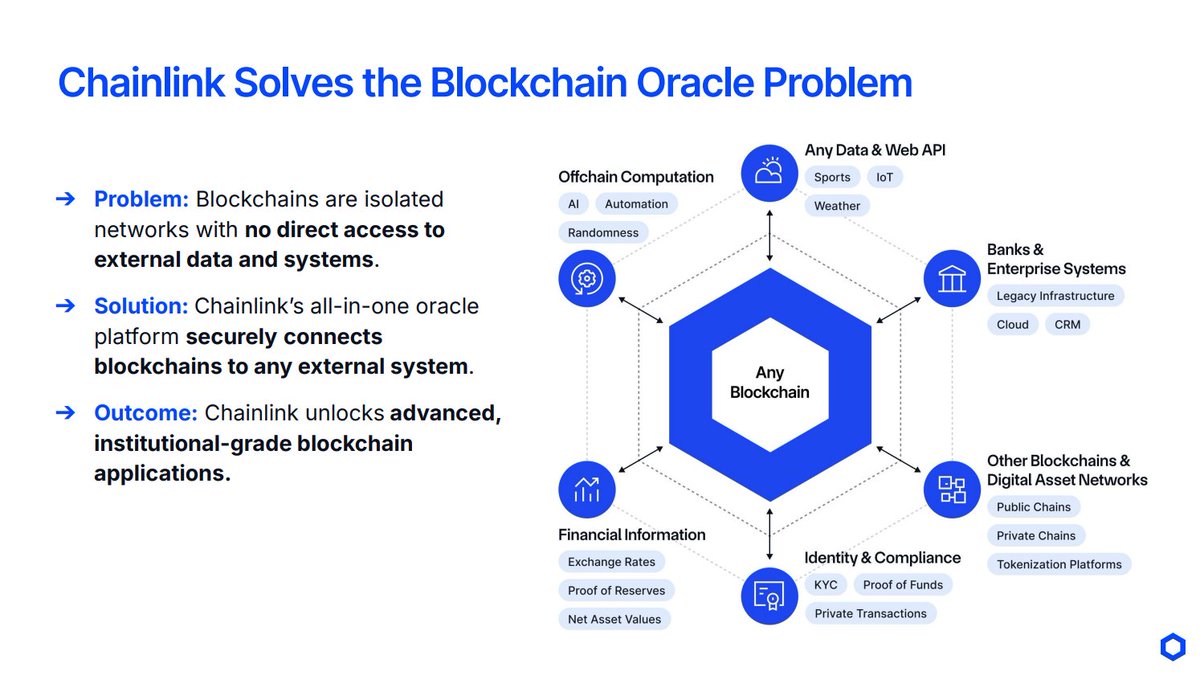


I believe the bull case for $LINK is straightforward, I would distill the thesis down to: 1. Chainlink continues to expand its dominant market share as the critical infra platform powering the most important crypto use cases (institutional DeFi, RWA tokenization, prediction markets, stablecoins, etc) 2. Growing demand for Chainlink's data, interop, privacy, compliance, & orchestration services leads to increasing demand for LINK tokens (native payments, programmatic buybacks, staking collateral, etc) 3. LINK is a digital commodity whose total supply is capped at 1 billion, meaning when growing demand combined with expanding supply sinks outpaces available on-market supply → buyers must raise their bids to find a willing seller 4. All 1 billion LINK tokens can only be acquired from someone who already owns it, no new units can be printed → demand-drive scarcity becomes an inherent property of the asset In short, the thesis is that $LINK becomes increasingly scarce as the value that the Chainlink platform generates is captured by the token Naturally, this story will need to prove itself over time, job's not done But the hardest part is not perfecting the economics today (this can always be fine-tuned), it's becoming the indispensable industry standard whose value is unquestionable. The economics will naturally flow from there As former Google CEO Eric Schmidt put it at Chainlink's SmartCon 2022: "Give me a hundred million users, and I will find a way to monetize them"


𝗟𝗜𝗩𝗘: Europe's largest asset manager Amundi (€2.3 trillion AUM) & Spiko launch new tokenized mutual fund (SAFO) powered by Chainlink. Chainlink is how the world's leading institutions & tokenization platforms are unlocking the issuance & distribution of tokenized funds.


𝗟𝗜𝗩𝗘: Europe's largest asset manager Amundi (€2.3 trillion AUM) & Spiko launch new tokenized mutual fund (SAFO) powered by Chainlink. Chainlink is how the world's leading institutions & tokenization platforms are unlocking the issuance & distribution of tokenized funds.