
Sabitlenmiş Tweet
CSL
3.4K posts


CSL
@CharlieStLouis
DeFi @ethereumfndn · Ex-MakerDAO, Element/DELV · Freedom tech
Canada Katılım Eylül 2011
469 Takip Edilen4.3K Takipçiler
CSL retweetledi

Mumbai is calling. 🇮🇳
Global tickets for Devcon 8 are now live.
This is the one to be in the room for.
November 3-6
English

There should be a better name for this:
“A company that builds an onchain product, then walks away once the smart contract ecosystem can function openly and permissionlessly.”
Sablier did it well. Thank you for your service. 🫡
Enjoy the time off. we tend to forget how valuable it is for the psyche.
Paul Razvan Berg@PaulRBerg
English
CSL retweetledi

Use @ArchivistStrg
Joshua Khane@JoshuaKhane
Microsoft DELETED my account AND OneDrive!!?? After ACKNOWLEDGING that I’m the owner of the account and that it was compromised??? 25 fucking years of data, thousands of euros spended on games?? My son’s baby pictures? GONE! All because MICROSOFT couldn’t bring back a compromised account?? One of the biggest companies ever coulnd’t do that so they just deleted that shit like it was nothing?? Fucking shame on you!! @microsoftnl @MicrosoftHelps @MicrosoftHelpt @Microsoft #microsoft #hacked
@PigiFinance We’re reviewing applications at the moment, will have more updates soon 👀
English

Update: applications now close June 25, 2026
Keep ’em coming 🫡
CSL@CharlieStLouis
5 more days to apply
English
CSL retweetledi

The Protocol Security Team has been pointing AI agents at Ethereum’s protocol code. Our core takeaway wasn't about finding bugs, it was about triage.
Here are field notes from the work.
blog.ethereum.org/2026/07/09/tri…
English


The @ethereumfndn staked ETH with @LidoFinance last week.
It also sells ETH regularly to fund operations.
Now there's a way to do both from one position: covered calls on wstETH, live on mainnet.
Keep the staking yield.
Earn income upfront, paid in stables.
Only sell if ETH hits a price you chose anyway.
live now: app.rysk.finance/earn/?chainId=…

English

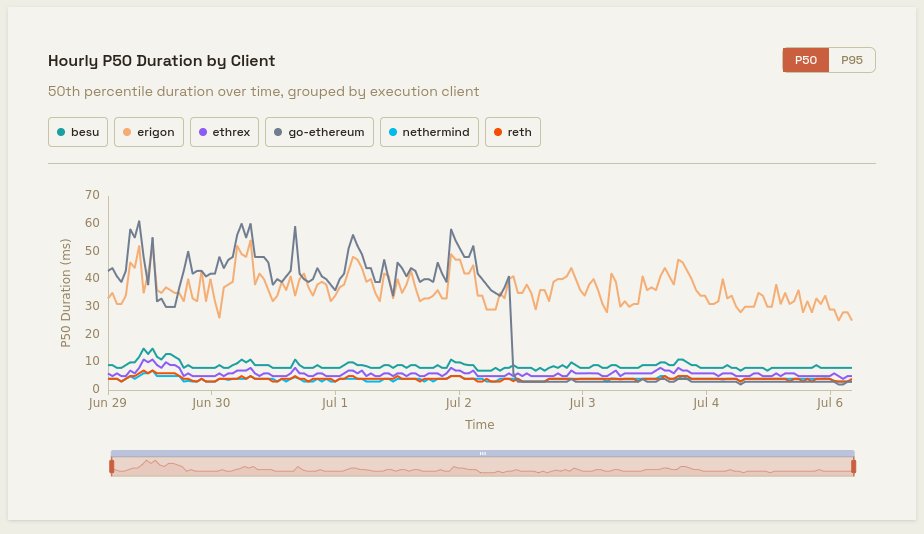
Big props to @JonnyRhea for getting our getBlobs performance to top all charts!
lab.ethpandaops.io/ethereum/execu…
English
Thanks, mate! Yeah, the boundary is blurrier than the framing suggests. I think the distinction is probably most obvious when you look at it from the protocol-enforced scarcity point of view: blockspace can't leave Ethereum, liquidity can (the same capital earns the same relative spread on another L1 or Nasdaq).
But what you're onto is that the organic part of staking yield is itself driven by said trading activity (at least until another big use case comes around), so there's circularity my three categories don't fully resolve. I think overal they are useful enough categories, but they indeed have imperfect boundaries.
English

@CharlieStLouis Amazing piece,
A small doubt: If ETH staking is native yield because users pay for blockspace security, why aren't DEX fees and lending interest native yield when users pay for liquidity and capital?
English
CSL retweetledi

When you deposit into a vault, you're exposed to more than the vault itself: oracles, bridges, collateral, the sequencer, holders of vault roles.
Introducing risk scenario planning on DefiLlama.
* Maps every dependency that touches your deposit
* Models your max loss from each failure point
* Live now across 20 Morpho vaults




English
CSL retweetledi

1/ Announcing Ethereum Institutional
An independent non-profit dedicated to accelerating the institutional adoption of Ethereum, its L2s, applications and overall ecosystem.
English

The best place for large trades is now Ethereum.
Introducing Turbine.
English
CSL retweetledi
Today, the EF is changing shape, concluding a months-long process of reorganization as part of the implementation of the Mandate and the Treasury Management Policy.
We come out of this process with the structure, activities, and people necessary for execution on the critical tasks ahead of us, but also with 54 fewer colleagues, roughly 20% of the EF, many of whom will be finding ways to contribute to Ethereum from outside the EF in the coming weeks.
Find a brief introduction to the new structure, and learn more about how we are supporting the people who are leaving in the full post below:
English

who's still in ef besides @aerugoettinea and @VitalikButerin 😂😂😂
English

My earlier take was unfairly reductionist.
The DeFi team (@CharlieStLouis, @ivangbi_), enterprise team, and folks like @binji_x and @jchaskin22 have done real work listening to Ethereum builders and helping teams like ours succeed.
Bullish on them staying in the EF and steering it in the right direction.
Odysseus | phylax.systems@odysseas_eth
funding secured honestly, very incentive aligned. if nobody did anything, ethereum would be dead in a few years, and they would go down as have done one of the worst trades in history they have the capital and are incentivized to push it to the right direction. there are ample people who left the EF (and therefore are not insane) and know where the ethereum protocol needs to go (as a product) very bullish for ETH
English
CSL retweetledi

1. Intro
Vitalik recently wrote about where the EF should go; Aya added a note to explain how we got here, and why. I’ll write about the execution.
We now have enough clarity to stop treating “what is the EF for?” as an open-ended question. Our mandate is clear: The EF exists to ensure Ethereum is, becomes, and remains real permissionless infrastructure for self-sovereignty: censorship (and capture) resistant, free and open source, private, and secure; and capable of supporting sovereignty-preserving coordination at scales where trusted institutions hitherto have been unavoidable.
The following are my thoughts on some of the points that follow from the mandate and how we are translating it to action. But first, a short reminder about
2. What the EF is not for
We are not here to optimize for EF importance, corpo/pol appeal, or ecosystem popularity. We are also not here to please short-term speculators, prop up TBTF neo-SIFIs, market every app on Ethereum, help anyone look good to their crypto or investor friends, or provide on-demand entertainment for dinner parties and private retreats.
3. What the EF is for: Eliminating weaknesses
We are here to defensively strengthen places where Ethereum is, or can still become, extractive, totalizing, or vulnerable to cartel or state capture, or authoritarian tools of surveillance or coercion.
We will base our actions on a full examination of what Ethereum is and can be at the protocol layer (what is actually running as “Ethereum”), the access layer (what users use to interact with the protocol), the user layer (the end-users who need and will need Ethereum), and the institutional layer (the intermediated paths that scale self-sovereign usage).
The EF exists to harden every surface of Ethereum, including those where Ethereum can remain formally permissionless while becoming practically captured. Some obvious surfaces are the transaction pipeline, staking and network security, access layer standards and interfaces, self-sovereignty norms, privacy expectations, institutional adoption patterns, and social layer governance processes. The primary concerns are similar across most of them: does the status quo and its future trajectory minimize trusted dependencies, minimize points of leverage and capture vectors, make user privacy the default, preserve exit, and make trust assumptions legible?
The work starts with the EF itself. We are moving compensation and major financial relationships toward ETH and mandate-compliant Ethereum-native stables, with exceptions where positive law or unavoidable operational constraints require exceptions. Rather than a purity ritual or instruction for people to take unmanaged personal risk, it is robustness, alignment, and product pressure. If the EF’s work is to make Ethereum usable as infrastructure for self-sovereignty, everyone at the EF will increasingly live inside the constraints of the system the EF exists to improve: wallet UX, volatility, accounting, privacy gaps, payment friction, stablecoin trust assumptions, recovery, dependency risk, etc. If we can’t use these tools ourselves, it is unrealistic to expect others to. Ethereum is already mature; those who do not depend on the user-facing stack have no business trying to shape its future, at any layer.
The transaction pipeline is next. Preventing toxic MEV capture is core EF work, not a peripheral market-structure concern. Transaction supply, ordering, inclusion, block construction, propagation, and settlement are part of Ethereum’s neutrality boundary. Some MEV may persist as an adversarial phenomenon the protocol contains, but it must be absolutely minimized and, for that to be possible, we must guard against the acquisition of unwarranted influence by its beneficiaries.
If credibly neutral execution is subverted by privileged orderflow, cartelized builders, trusted relays, opaque routing, or validators outsourcing into a narrow supply chain, Ethereum will look permissionless while users experience it as intermediated at the moment value moves. EF protocol work will therefore prioritize lower barriers to block building and validation, stronger inclusion guarantees, reduced extraction opacity, competitive transaction pipelines, user-facing legibility of trust assumptions, and more aggressively exploring the open orderflow solution space.
None of this is simple. A good solution in one place can aggravate problems elsewhere. FOCIL is good for censorship resistance, but it may introduce more cross-block MEV. While ePBS solves the relayer trust problem, we must make sure that its implementation does not inadvertently obstruct long-term solutions to even larger problems. It would be unacceptable, for example, if ePBS enshrining the builder economy ends up making it harder to reduce reliance on the private orderflow that has emptied out the public mempool. Encrypted mempools may not only reduce pre-execution transparency and pending orderflow visibility, but also shift competitive advantage to new privileged actors, including specialized hardware operators in some designs, while adding protocol complexity.
In order to avoid wasting time playing whack-a-mole, we must commit to solving the extraction problem at a whole system scale. Doing so will require creativity, courage, and the understanding that failure to solve this problem is unacceptable. If we fail, we will have left in place an unnecessary barrier to institutional adoption, but, more importantly, we will also have surrendered a core part of the promise of Ethereum - the replacement of extractive middlemen with permissionless, credibly neutral infrastructure and competitive markets. That must not happen.
MEV is likely to be the next major front in the cypherpunk war. We must set ourselves up to win here.
Privacy is just as fundamental. A public ledger without serious privacy defaults is a surveillance substrate with settlement guarantees. That is not an acceptable end state for the world computer. Unconditional privacy will be readily available across Ethereum, with programmability on top for selective disclosure, proofs, auditability, compliance logic, reputation, governance, identity, and other constraints chosen by users and their communities. The temporal order matters: unconditional privacy must exist first, opt-in constraints come second.
It is also important to avoid forcing users to assemble a fragile stack of special wallets, RPCs, bridges, apps, compliance providers, and operational habits to attain privacy. Deep privacy must be more secure than this. Privacy is a condition for Ethereum’s viability as freedom-respecting coordination infrastructure and as such must be robust.
Staking must be treated as protocol infrastructure risk. Staking is not merely a yield product, and liquid staking is not merely an app-layer market. If stake, liquidity, validator access, DeFi collateral, and governance influence concentrate around a small set of issuers or operators, Ethereum’s security layer becomes vulnerable to capture through capture of the economic layer around it. EF will support research, specifications, and designs that keep staking permissionless, private where possible, plural in operation, and resistant to intermediaries becoming permanent control points.
The access interfaces are where users access either the protocol directly or through intermediated defaults. The primary problem to solve here is not getting Ethereum into more rooms directly, but making its users, both end users and institutions, more self-sovereign and less susceptible to coercion, and avoiding normalization of soft coercion in exchange for reach. EF will not help Ethereum become more acceptable by sanding off the properties that make it uniquely valuable. Ethereum does not need to become another permissioned settlement backend with better branding. It needs to show, in production, that self-sovereign coordination at scale is possible.
Across Ethereum, the EF’s defensive work seeks to ensure that Ethereum is infrastructure people can still use when counterparties fail, platforms censor, governments overreach, intermediaries extract, and coordination problems become infeasible for trusted systems to handle. A core part of that is to make that infrastructure secure and robust against capture at every layer wherever capture opportunities can hide.
4. What the EF is also for: Seizing opportunities
Shoring up the fundamentals is not enough. Ethereum’s potential is still largely unrealized, but that does not mean that the path ahead is going to be straight. Opportunities must be seized when the time is right. At this moment in time, a number are visible, including:
* Ethereum becoming the first quantum-resistant global infrastructure. Ethereum researchers will lead the post-quantum cryptographic migration before the threat becomes urgent, not after it becomes a governance emergency. That means hardening Ethereum’s cryptographic foundations while there is still time to design carefully. The same applies to other long-horizon risks, where waiting for market demand means waiting until the window for principled design has already closed.
* Verifiably self-sovereign stack, from soup to nuts, whether local or remote, with no censorship or extraction openings: browsers, wallets, intents, broadcasts, orderflow, inclusion, block construction, proposal, proving, exit, and recovery. Minimal MEV, and zero toxic MEV entrenchment, either in or around the protocol. No execution layer that is formally permissionless but practically gatekept by privileged supply chains. If there’s a funnel towards an extractive private lane, there’s other options that keep the game live. The goal is not only to prevent extraction or capture, but to make credibly neutral execution competitive enough that serious users prefer it.
* Making ETH normal digital cash: a private, dignity-respecting, debasement-resistant and surveillance-resistant medium of exchange and store of value, as well as the native asset of private computation and private coordination for both humans and their agents. If Ethereum can make private economic life and private institutional life possible without routing users back through the friction and potential abuse of custodians, surveillance vendors, or permissioned ledgers with softer branding, as well as provide a venue for secure and competitive machine economics, the value unlocks will be immense.
* Personal wallets with personal AI agents that users can actually own and run on their own personal computers. Not your keys, not your coins; not your model, not your mind. As agents become interfaces for more economic and social action, the question of who owns the wallet, the model, the memory, the policy, and the signing authority becomes an existential question about sovereignty instead of UX details - we are all users above any other roles, and no one at EF will forget this.
* Institutional and enterprise use cases where Ethereum wins by not disappearing into an invisible backend, gatekept by intermediaries or terrible UX, and by not compromising into a compliant fintech rail with web3 branding. Rather, we will win through proving that credibly neutral infrastructure can handle disintermediated coordination so competitively that trusted intermediaries have to meet Ethereum users on Ethereum’s terms.
* Security-preserving scaling. L2s and related infrastructure will be able to meet institutional-level needs without accepting dependencies on closed operators, opaque sequencing, custodial UX, or upgrade committees that users cannot realistically exit. Scale is not throughput alone. Scale is the guaranteed availability of self-sovereignty under real load.
We are ensuring Ethereum remains the hardest bedrock for settlement, local and worldwide; and beyond that, a civilizational ledger and execution substrate to stand the test of time. When future civilizations speak of the infrastructure they inherited from the Antiquity of the Information Age, their first example should be Ethereum.
Ethereum will outlast all of us. More than enough people watching understand this. Many wondered why it needed saying at all, but it did. If you don't believe us or don't get it, we don't have time to try to convince you, sorry.
5. Addressing departures
There has been a lot of online speculation about departures from EF, both before and after the mandate. Some people resigned, others were terminated. Some departures were about strategy, some about role fit, some about normal institutional change, and some simply about people deciding that their best work for Ethereum should happen somewhere else. We will not litigate individual personnel matters on Twitter. That is the default because it is better for EF, better for the people involved, and better for Ethereum. People who contributed through EF deserve dignity on the way out. They do not deserve to have their employment history turned into factional content.
Where possible, we have let people describe their departures in their own words as a matter of courtesy, and not concession. If public claims materially mislead people about EF’s direction, decision-making, or mandate, we may correct the record at the level of policy, process, and institutional facts. We still will not turn personal files into public spectacle.
Ethereum is permissionless. People may disagree, criticize, compete, fork, and build elsewhere. We intend to keep exits dignified and expect others to do the same. It will suffice to say that we are thankful for what all contributors have built; we will continue to do work Ethereum needs.
6. Addressing EF spinouts
Some work should and will leave the EF in the months to come. We hope and expect this process to result in some excellent work being done in service of scaling self-sovereign adoption, but we also must take care lest it becomes an abdication of responsibility or an excuse for undisciplined spending. Some work is not mandate-compatible and should not be carried forward with EF funds or EF endorsement, either inside or outside the Foundation.
The efforts carried out by the spinouts will vary widely. Some efforts will leave EF because another org would be a better home for them; others will leave because markets should decide on their worth. Some will leave because they are not compatible with the direction set out in the mandate; others because they are useful but not EF work.
Just as a spinout is not automatically good because it reduces EF headcount, former EF affiliation is not a claim on EF funding. The question we ask when deciding on funding is not “did this come from the EF?” But, rather the questions that should be asked about all external funding:
“Is this work mandate-critical? Would the EF do this work internally if it had the organizational and financial capacity? Is there no better natural home? Can the external party execute without increasing capture risk, private extraction, opacity, or dependence? Does supporting it reduce Ethereum’s dependence on the EF over time, without prematurely transferring resources and legitimacy to new organizations and thereby risking operational failure or mission drift?”
EF funding for work being done externally can be appropriate when it is a capacity solution for mandate work - work the EF should responsibly want done; work that protects CROPS; work that advances self-sovereignty and scales it; essential work that no actor can or will reliably do without EF funding; and work that can be scoped, reviewed, and held accountable without creating a permanent dependency.
Such funding is not appropriate when it is a lazy continuity payment, a friendship payment, a reputational hedge, a way to avoid making a hard decision, or a way to support work that is not compatible with the mandate.
EF has finite funds, finite legitimacy, and a specific mandate. We will spend all three as if they matter. When we say “EF is one of many nodes”, we mean that we intend to be one of many nodes working to keep self-sovereignty and its scaling the North Star, and working to keep CROPS the undisplaceable first-class properties of the network. We don’t mean that we will support orgs or projects with different priorities. Diversity that leads to ecosystem resilience, coordination cost right-sizing, and better decision-making is good. Diversity that leads to mission drift is not.
We are not neutral on the direction Ethereum takes. CROPS are not just things we “believe in”, they are characteristics we understand must be thoughtfully prioritized at every fork for Ethereum to realize its potential. We are partisans for and builders of something of such incredible neutrality that it will fundamentally reshape the world we live in; we wish to work with everyone committed to this shared purpose.
English

Any Canadians in crypto? 🇨🇦
Let me know so I can follow you.
English
CSL retweetledi
1/ Today is the final day to support the quadratic funding round for Internet Freedom by @torproject and @FundingCommons.
Donations go to 10 organizations working across privacy, anti-censorship, and secure-journalism projects.
English
CSL retweetledi

Ethereum is for shipping.
Here are 25 things the Ethereum ecosystem launched, upgraded, and announced over the past month.
0/ @thedaofund Ethereum Security Quadratic Funding Round with @Giveth wrapped. The fund supported 134 security projects and had 3,934 unique donors.
1/ @Ronin_Network, one of the largest gaming blockchains, completed its migration to an Ethereum L2.
2/ Clear Signing went live. It is an open standard designed to help end blind signing and make transaction data human-readable before signing. Contributors include wallets and hardware, infrastructure, tooling, individual builders, and the Ethereum Foundation’s Trillion Dollar Security initiative, with the @ethereumfndn acting as a neutral steward.
3/ @SEAL_911 and @Wonderland_Fi introduced DARC, a Digital Asset Risk & Compliance standard for crypto teams, with continuous monitoring across GitHub, infrastructure, multisigs, DNS, and more.
4/ @arbitrum announced that LG Electronics' blockchain team is piloting an onchain advertising network on Arbitrum.
5/ @base activated Azul, its first standalone network upgrade, introducing multiproofs, new execution and consensus clients, CLZ opcode support, Osaka repricings, and performance upgrades up to 5,000 TPS.
6/ @Mastercard expanded stablecoin settlement support to include USDC, PYUSD, USDG, USDP, and SoFiUSD on Ethereum mainnet, @arbitrum, and @base.
7/ @EFDevcon 8 Mumbai early bird tickets went live. Tickets were available paid in ETH.
8/ Türkiye's Directorate of Communications (@Communications) registered cbiletisim.eth, making its first step in establishing an official onchain identity with @ensdomains.
9/ @CashApp launched stablecoin support, allowing nearly 60 million users to send and receive USDC with no wallet setup required, live on Ethereum mainnet and @Arbitrum.
10/ @torproject and @FundingCommons launched a web3-native crowdfunding initiative supporting 10 internet freedom projects.
11/ @JPMorgan launched a second tokenized money market fund on Ethereum.
11/ @lifiprotocol launched LIFI Intents, a full-stack intent execution engine built on the Open Intents Framework, an initiative for standardizing crosschain intents.
12/ @l2beat launched Token Frameworks, a dedicated place to explore interoperability solutions, token movement, volume, speed, chains, and framework adoption.
13/ @PrivacyEthereum launched a private transfers dashboard comparing 11 protocols across privacy, cost, UX, decentralization, compliance, verifiability, state, and composability.
14/ @Veildotcash launched Veil MCP 0.2.0, enabling agents to make private x402 payments on @base.
15/ @src_co_ introduced SLOW, reversible, self-custodial crypto payments on Ethereum.
16/ @ensdomains ecosystem builders launched ENS8004, a web app that converts an ENS name into an onchain AI agent other applications can find and verify.
17/ @OctantApp introduced properQF in Epoch 12, integrating quadratic funding into the funding round.
18/ @AragonProject launched onchain profiles, making governance participants readable across forums by resolving ENS names, avatars, bios, websites, and social links from Ethereum mainnet.
19/ The Ethereum Community Hub network expanded to Lisbon, hosted at the @gnosisDAO office.
20/ @SuccinctLabs introduced data confidentiality to OP Succinct, enabling institutions to keep transactions confidential while settling to Ethereum.
21/ @HardhatHQ 3 became stable, bringing Solidity tests, multichain support, a Rust-powered runtime, a revamped build system, and Hardhat Ignition for deployments.
22/ The inaugural @ethconf, in NYC, brought together thousands of founders, industry leaders, and builders to discuss building on top of Ethereum.
23/ @EthPrague brought Ethereum builders together in Prague to discuss protocol development, privacy, culture, and long- term societal impact.
24/ @ETHGlobal introduced a new format where, for the first time at an ETHGlobal hackathon, projects do not have to begin from zero.
English
4/ Experimenting at genesis is easy (ofc still worth doing), nothing's at stake yet. Futarchy DAOs launched with prediction markets running governance from day one. Now name one live, high-value DAO that migrated its core governance to anything like that. You can't, because making the jump isn't safe yet.
English
1/ Yes. Bring DAO governance experimentation back!
But don't forget the part nobody's solved: the DAOs already holding real value. They can't adapt or change how they're governed without risking it all, so they slowly decay.
Ali Yahya@alive_
DAOs were a failure in the last era of crypto. But it may have just been the wrong time for them. Two big things are different now: (1) regulatory clarity and (2) AI agents. We spent the last 10 years rediscovering the hard way that direct democracy is a bad idea. Turns out, nobody wakes up in the morning eager to adjudicate risk parameters or protocol updates. It didn't help that it was illegal to experiment with different DAO structures. The vicious hostility of Biden and Gensler toward the space killed all innovation. But it's a new day. It is once again legal to experiment. You could choose to play with forms of representative democracy, or multi-cameral systems, or hybrids of permissioned and permissionless participation. Not to mention, AI agents can now step into many kinds of roles that humans will never want to perform. They may help DAOs live up to their name by making them truly Autonomous. The design space for new DAOs is infinite, for they are just software. What new experiments are people running?
English