Sabitlenmiş Tweet
Chayan Sarda
251 posts

Chayan Sarda
@Chayan_Sarda
Delivering Accountable Solutions that make Your Money Work for You | Wealth Manager | Founder, Unity Capital Advisors
Gujarat, India Katılım Temmuz 2024
28 Takip Edilen27 Takipçiler

300 IPOs, that’s how many companies have gone public in India this year.
Which is worth around $16B (~₹1.33 lakh crore).
That’s more than all IPOs combined between 2010 and 2020.
And I was reading that another 2.7 lakh crore pipeline is already being lined up for late 2025 and 2026.
As someone who lives in this space, I find this moment quite fascinating.
Today, Lenskart hit the market, It was one of the most talked-about IPOs in recent times.
Despite all the chatter around valuation, it was subscribed 28 times.
Then there’s LG Electronics India fully booked in just 6.5 hours, the fastest oversubscription since Reliance Power in 2008.
Everywhere you look, there’s another roadshow.
Another debut.
But the most interesting part is,
It’s not foreign capital driving this wave, it’s us.
Domestic investors accounted for nearly 75% of IPO demand this year.
Households are putting more of their savings into equities than ever before.
It’s great for market depth but it also means the stakes are higher.
Because alongside enthusiasm, risk is quietly compounding too.
Valuations are stretched, smaller IPOs are seeing 100x subscriptions, and
-> Yet median listing gains have shrunk to 2.9% this year, down from 22% last year.
-> Almost 40% of new listings are already trading below their offer price.
Now, we’ve built incredible participation.
But the harder part is now staying selective, informed, and grounded.
If India does end 2025 with record IPOs, the real question will be:
Will we still chase listings, or will we start chasing value?
..
PS: At Unity Capital Advisors, we actively operate in the pre-IPO and PE space.
If you’re exploring opportunities in this segment, happy to connect and discuss what suits your risk profile.
Disclaimer: This is not investment or trading advice.

English

“For 60 overs they should feel hell out there”
Thank you for the iconic celebrations, the comebacks, and the legendary banter.
Test cricket will miss the King
Take a bow, Virat Kohli!
#bcci #testcricket #kingkohli

English

We often talk about threats. But how often do we talk about the systems that actually shielded us when 300–400 drones attempted infiltration at 36 locations?
India has built a strong range of weapon systems including S-400, Akash, L-70 guns, Spyder..
Most have heard that the S-400 saw its first combat deployment under Operation Sindoor.
But very few know that India’s preparedness for it began as far back as 2018.
In October 2018, India signed a $5.43 billion [~₹40,000 Cr.] deal to acquire five squadrons of the S-400.
And it did so despite the threat of US sanctions under CAATSA.
The response by then-Foreign Secretary S. Jaishankar was clear:
“We would not like any state to tell us what to buy or not to buy from Russia any more than we would like any state to tell us to buy or not buy from America. That freedom of choice is ours”,
So the first deliveries began in late 2021. And by the 2023 end, three S-400 squadrons were fully deployed.
👉 One covers Jammu & Kashmir and Punjab from Pathankot.
👉 Another is likely deployed along the LAC near Sikkim.
👉 The third protects Rajasthan and Gujarat.
Two more squadrons were originally scheduled for 2025, but those are now delayed due to the Russia–Ukraine war, as per IAF Chief AP Singh.
The Indian military gave it a fitting name: Sudarshan Chakra.
Though built by Russia, India’s timing and integration of the system have made it critical to our defence posture.
It can track targets up to 600 km away and intercept them at a range of 400 km even at altitudes of 30 km.
What sets the S-400 apart is its capacity to manage both volume and velocity.
It can track and engage 36 targets at once, From slow-moving UAVs and helicopters to cruise missiles flying fast and low.
Having followed this sector for years professionally and personally, reading about the S-400’s deployment was a reminder of what real preparedness looks like.
Some decisions don’t show their value on day one.
But when they do, they remind you why they were taken.
This is one of them.
We’ve rarely given enough credit to our defence systems and the people behind them.
#CeasefireViolation #sincetheoperations

English

- Coal India plans to invest ₹25,000 crore to enhance its renewable energy capacity.
- The initiative involves supplying 4,500 MW of solar and wind power to AM Green's green ammonia facilities.
- This move signifies Coal India's strategic pivot towards renewable energy, aligning with global sustainability trends.
English

As a service, everyone loved @BluSmartIndia .
It was on track to become a category-defining company.
I haven’t come across a single consumer who had a poor experience with them.
That itself says a lot, especially in an industry where most players get called out for poor service pretty early on.
Even the drivers I spoke with seemed genuinely content.
“Here, I don’t worry about EMI or fuel. There’s a fixed salary that’s what keeps me going,” one of them told me on my last trip to Delhi.
Of course, in India, even providing basic reliability can feel like a premium service.
And now, overnight, hundreds of those same drivers are left without income or security.
Because delivering at that quality, at scale, over the long run that’s when the real thing would have been tested.
And that’s where things started to break down.
The Jaggi brothers had a real shot at building something meaningful.
But that requires time, patience, and clean execution. Instead, they tried to shortcut the process.
I used to join the Gensol concalls regularly.
And the numbers they were projecting… they didn’t feel real. They were too optimistic.
Anyone tracking closely could sense the disconnect.
Even investors I know stayed away not because the sector wasn’t promising, but because the numbers projected for the business model didn’t feel sustainable.
In the end, everything comes down to the people running the show.
Some say it was Gensol, not BluSmart but the founder 's intent matters.
So do the people around them who choose to look away.
This isn’t a post about who got in and who didn’t.
It’s about how we create an ecosystem where early red flags are taken seriously.
Where due diligence doesn’t end with numbers, but starts with them.
Because consumer love matters but governance, founder’s intent, and long-term thinking matter even more.
BluSmart will be remembered for the lessons it leaves behind. Wish them the best if they can make a comeback.

English

RBI has cut the repo rate by 25 bps, bringing it down to 6.0%.
This is the second rate cut this year under the new RBI Governor Sanjay Malhotra. It also changed its stance from ‘neutral’ to ‘accommodative’
This simply means it’s now focusing on supporting growth and is open to more rate cuts if needed.
Alongside, India’s FY26 growth forecast has been reduced from 6.7% to 6.5%.
One reason for this move is the rising global risk, especially the new US tariffs on Indian goods, which are expected to hurt exports.
While Rate cut makes loans cheaper, EMIs lighter, and credit more accessible, it also signals stress in the economy.
Sectors like real estate and auto will benefit, but this isn’t a sign of strength.
Repeated cuts can weaken the rupee, push up import costs, and raise inflation risk.
It’s safe to say its a damage control for now
@RBI

English

Piyush Goyal ji didn’t just raise questions, he backed them with a substantial allocation from the ₹10,000 crore Fund of Funds,
Which is now being directed towards Deep Tech, AI, Robotics, Quantum Computing, ML, Biotech, and more.
But the volume of criticism over the last 24 hours shows how easily a two-minute clip can change the narrative.
If you listen to the full speech, the message was far more rooted in the current realities of our ecosystem.
His concern was, Is India okay having just 1,000 deep tech startups?
And It’s a valid question.
The truth is deep tech still remains massively underfunded.
The constraint in India isn’t just ambition, it’s infrastructure .
Even when founders have the ambition and the talent, that alone doesn’t build durable companies.
Innovation needs a support system which includes capital, time, and patience for R&D.
Expecting deeptech to thrive without that is like expecting a seed to grow in dry soil.
There are a few founders quietly building serious deep tech.
But they've struggled to raise at key stages despite solving for real innovation.
Real innovation is about solving hard problems, building for durability, and creating value that lasts.
But the ecosystem is still wired for speed.
That said, I also understand the structure most VC funds operate in,
Close-ended with 10–12 year horizons, raised from LPs expecting returns and liquidity on a schedule.
These funds need exits to deliver IRRs, earn carry, build a track record, and raise the next fund.
Which is why this allocation from the government was much needed at this point,
And equally, a reminder for investors to step in where we can, and ask better questions to founders.
So if you're a founder building in deeptech, let’s connect for a chat.
The Union Minister’s speech brought the direction and the conversation we needed.
But will things actually change? Or will that tiny brown box in the slide still stay the same?
P.S. The pic is from a TED talk by @AngadDaryani , and in the slide, there’s a tiny brown square in the left corner.
That was the proportion of Global VC funding going into moonshot climate tech and deeptech.
The talk is from a few years ago but I doubt if the numbers have changed much.

English

“The US should be very worried about the unintended consequences of its actions.”
These are the words of Uday Kotak ji about the tariffs,
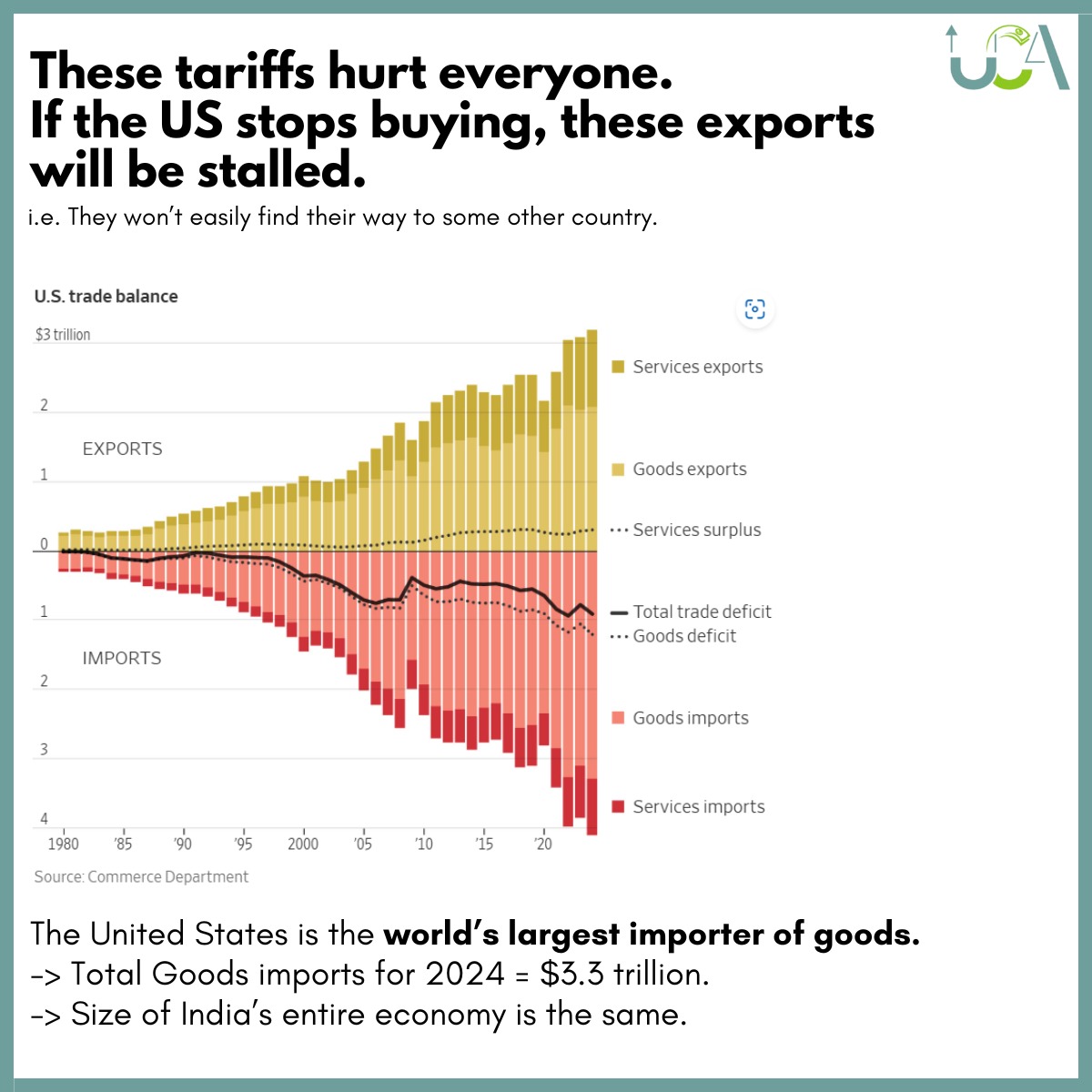
So, Donald Trump has slapped “reciprocal” tariffs on all countries
-> Starting tomorrow, a universal 10% tariff will apply on all imports into the US.
But that’s just the baseline.
-> From April 9, the US will roll out reciprocal tariffs, based not only on what other countries charge the US, but also on how big their trade deficit is with the US.
India’s new tariff under this is 26%.
That’s up from 3% earlier but still being labeled as “discounted” by US standards.
Because compared to China at 34%, Vietnam at 46%, Thailand at 36%, and Indonesia at 32%,
India’s 26% looks moderate.
The US says India charges 52% on average to American goods.
So, they’re just balancing the equation.
But that’s not true.
We don’t charge tariffs anywhere close to 52% on American goods.
According to the USTR, India’s effective tariff rate is 17%.
So where is that 52% figure coming from?
They’ve added currency manipulation (how India manages its currency to favor its exports)
Plus, non-tariff barriers (like strict rules or paperwork that make it hard to sell goods in India) to get the percentage.
Now, this is not the end of it.
Many believe the US is using an entirely different logic: Trade deficit ÷ exports to the US.
And this is confirmed by prominent economist James Surowiecki.
As in the case of Indonesia, $17.9B deficit / $28B exports = 64%.
That’s how they’re justifying it.
So tariffs charged to the US are calculated based on trade deficits.
The bigger the US deficit with a country, the higher the tariff.
This is no less than a trade war.
Tariffs make imports costlier, local sellers raise prices too, and inflation picks up.
That’s how recessions start.
So why isn’t the Indian market reacting?
Because most of the damage was already done.
The last 6 months have been priced in with most of the bad news, tariffs, global uncertainty.
Let me know your thoughts below.

English

It's unfortunate how common this has become, but every time I open LinkedIn, I see yet another post about broking platform glitches.
Imagine You're in a trade, markets are moving fast, and suddenly, the system crashes.
You can’t exit, adjust, or even see your position.
That’s the risk weak disaster recovery systems pose.
With NSE relocating its data centers and SEBI enforcing stricter disaster recovery rules, the chances of such failures drop significantly.
But a strong data center is only as good as the technology powering it.
This is where our portfolio company, Comtel, steps in.
To understand how, let’s go back to NSE turning its BKC headquarters into a full-fledged data center.
Right now, the facility has space for 1,400 racks.
But NSE is tripling its capacity to over 4,000 racks in the next three years.
This means NSE is increasing its capacity to host trading firms’ servers closer to the exchange’s matching engine.
Now, COMTEL provides rack colocation services, allowing brokers to place their servers inside NSE’s data center.
This ensures low-latency access, minimal downtime, and direct connectivity to the exchange
In simple words, it ensures that real-time backup systems function seamlessly.
For you, this means
- No unexpected disruptions during volatile market movements.
- Faster order execution with lower chances of delays or system failures.
- Operational resilience, safeguarding portfolios against technical failures.
And they are already trusted by 250+ brokers
Plus, this is just one part of their services, we are happy to be associated with them
@symphonyfintech

English


Tata Motors is down, but why aren’t other major automobile companies falling as much?
Trump just announced a 25% tariff on imported cars and light trucks, effective April 3.
And no company is more exposed to this than Tata Motors.
The reason is JLR, Jaguar Land Rover.
It relies heavily on exports to the US, making it particularly vulnerable to higher import tariffs.
-> Nearly 1/3rd of JLR’s total sales in 2024 came from North America.
-> All that matters because 40% of all new vehicles sold in the US last year were imported.
With tariffs raising costs, demand for these imports could take a hit.
Other Indian automobile companies are affected too, but not as much since they have local production and source more components domestically, reducing their exposure.
Some of them, however, supply parts to international automakers, and if demand drops, it could hit their revenue and margins.
What do you think about this?
Disclaimer: This content is for informational purposes only and should not be considered financial or investment advice.

English

Zomato and Jio Financial are replacing Britannia and BPCL in Nifty 50.
The change is happening on March 28, 2025.
Why?
Because @zomato and Jio Financial now have a bigger market cap.
- Zomato: ₹1.69 lakh crore
- Jio Financial: ₹1.04 lakh crore
And this shift is bringing in serious money.
- Zomato: $702M in passive inflows
- Jio Financial: $404M in passive inflows
With this Nifty’s valuation is getting more expensive, the index P/E will jump from 22.1x to 22.6x.
English
Chayan Sarda retweetledi

Where does the ₹10,000 crore of taxpayers’ money actually go?
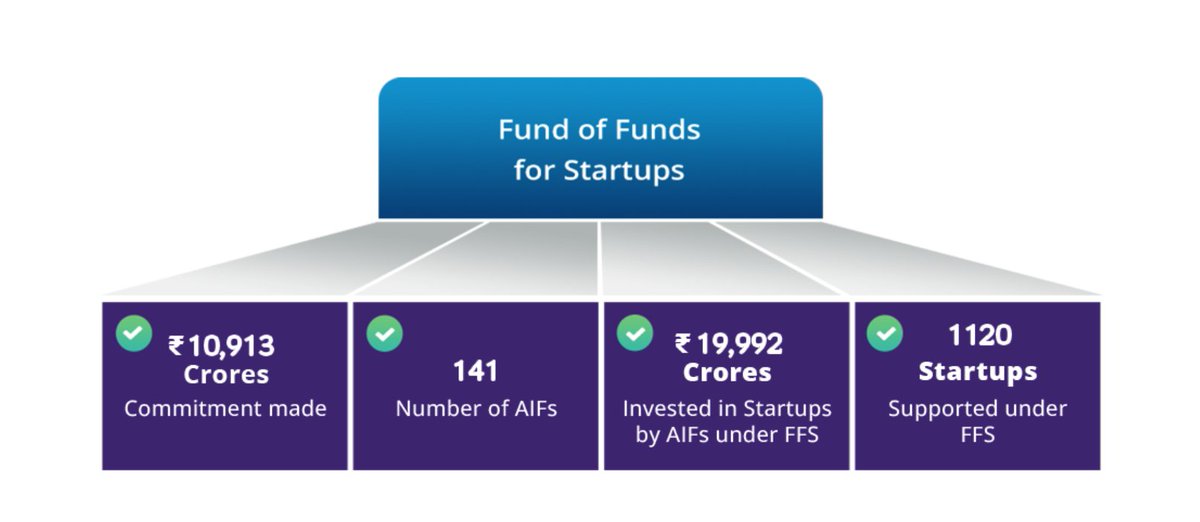
At the start of this month, the government launched a new Fund of Funds scheme with a ₹10,000 crore corpus to boost startup investments.
But this isn’t new.
The exact same scheme, with the exact same amount, was announced way back in January 2016.
Am sure, you might have heard this term way too many times, but how does a Fund of funds actually operate?
What have been the results from its last inception in Jan '16?
First, let’s break down how this fund actually works.
A Fund of Funds does not invest directly in startups.
It invests in VCs and AIFs, which in turn invest in startups.
But there are strict conditions on who gets this money.
Only Category I or II AIFs who have a total fund size of less than ₹1000 crore are eligible.
And these AIFs must strictly invest in DPIIT-registered startups.
The entire scheme is executed by SIDBI (Small Industries Development Bank of India), under the guidance of a 5-member expert committee.
So, after 8 years, what’s the impact?
Leading investment firms, IndiaQuotient, Blume Ventures, IvyCap Ventures Advisors Private Limited, WaterBridge Ventures, JM Financial Ltd, and others have raised capital through this initiative.
And as of October 31, 2024, FFS-backed AIFs have invested ₹20,572.14 crore into startups.
But does that mean the scheme is working?
That’s the real question.
The problem is that venture capital works on long horizons.
The true test of this scheme will only come in 2026 (after a 10 year horizon) when some of these investments start generating real returns.
Ideally, cash inflows from older funds should be enough to finance new ones, creating a self-sustaining system.
On the other hand, there’s a risk of it turning into a circular funding mechanism, where money moves around without generating real returns.
For now, it’s a step in the right direction.
But whether it truly multiplies taxpayer money or just recycles it remains to be seen.
P.S.: At UCA, we offer AIF Cat-II & III fund distribution as well. Feel free to reach out.

English