

Fuel Prices NI
1.2K posts

Fuel Prices NI
@CheHanvey26543
Find out the cheapest fuel options in Northern Ireland - https://t.co/UGgZn0cXbA
Katılım Şubat 2024
311 Takip Edilen58 Takipçiler

@CheHanvey26543 @afneil Except this 'Manuel' is far from well. 🤮
English

The official line remains that Mandelson’s failure to pass security vetting was overruled by Oliver Robbins off his own bat. But even if true, ‘mitigations’ would have been put in place to handle Mandelson’s failure — i.e. limits on what he could and couldn’t see. Are we expected to believe that Robbins did that on his own too? That he didn’t consult the cabinet secretary or the cabinet office? A question for Robbins tomorrow.
English
@ConsumerCouncil UPDATES DAILY:
fuelpricesni.com
⛽ NI fuel prices continuing to fall — 5th day in a row.
Avg petrol: 151.6p ▼
Avg diesel: 182.6p ▼
Cheapest petrol: 147.9p — Madigans Court, Belfast
#fuel #northernireland #petrol #diesel #armagh
English

We have updated this week’s average fuel prices across Northern Ireland ⛽
⬆️ 154.0p/ litre for petrol
⬆️ 188.1p/ litre for diesel
Interested in comparing the average fuel prices in each area? Visit: bit.ly/42j4kz4
English

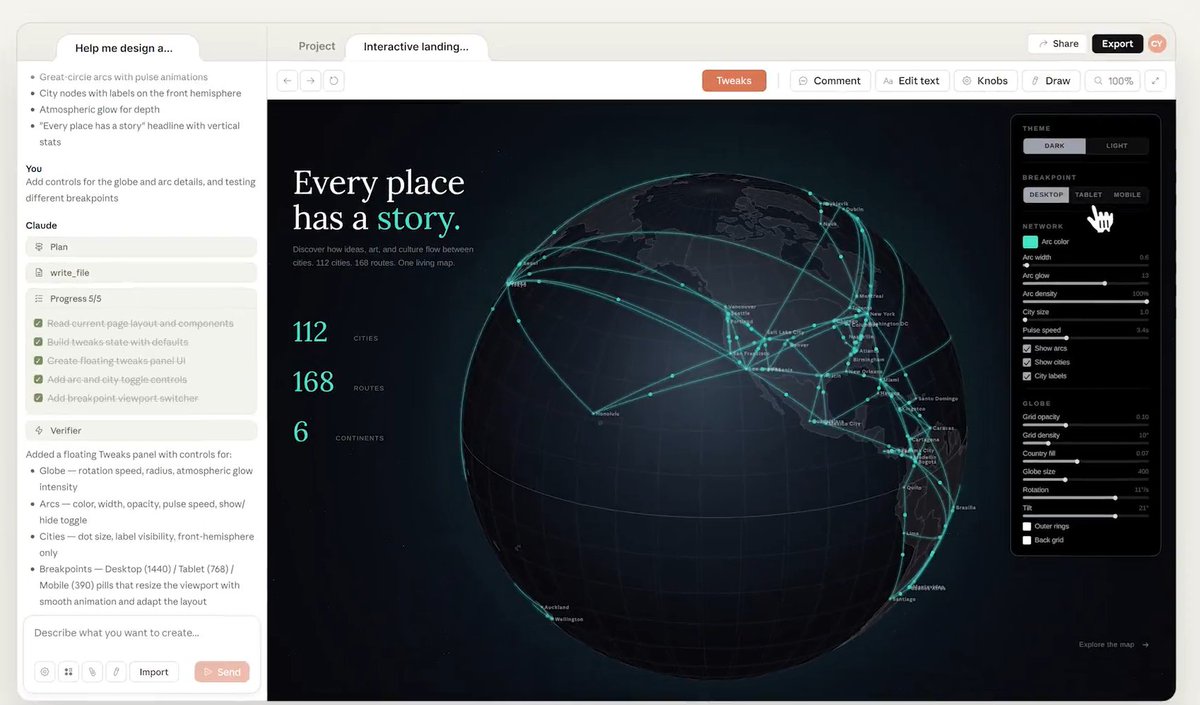
Claude Design launched this morning.
Here is how someone will use it to make $1,000,000 in 2026:
There are over 36 million small businesses in the United States. The vast majority of them have websites that look like they were built in 2014 because they were built in 2014.
They know the site is bad. They have not fixed it because a proper redesign costs $5,000 to $15,000 and takes weeks, and they do not have the budget or the patience for either one.
Claude Design just eliminated both problems.
You can now build a professional, polished website by talking to an AI. No designer. No developer. No Figma. No three-week timeline. A site that used to take a team two weeks to deliver can now be prototyped in an afternoon and refined in a day.
Step 1: Use Claude Design to build websites for local service businesses. Plumbers. Dentists. Roofers. Lawyers. Contractors. Med spas. The ones with 2014 websites and no time to fix them. Charge $2,000-$3,000 per site. You can deliver in days instead of weeks because you are building with Claude, not hiring a team. Your margins are enormous because your overhead is a $200/month AI subscription.
Step 2: (This is where the real money is.) A beautiful website that nobody finds is a billboard in a closet. Every one of those clients needs to know what AI search is saying about them. They need to show up when a customer asks ChatGPT or Google AI Overview "who is the best plumber in Austin" or "best dentist near me." That is not a website problem. That is a search problem.
Audit their AI search presence using SEO Stuff (it's free):
seo-stuff.com/free-audit
Show them exactly what ChatGPT and Google AI Overview currently return when a customer searches for their service. Show them the gaps. Show them the competitors who are showing up instead. Then offer to fix it.
The website is the door opener. The search optimization is the retainer. Charge $1,500 to $3,000 a month to manage their AI search presence alongside the site you built. Recurring revenue. Every month. For every client.
Step 3: At 20 clients paying $2,000 a month in retainer plus $3,000 per build, you are at $40,000 a month in recurring revenue and $60,000 in build fees in the first 90 days. Double it in the next 90. By day 180, 40 clients on retainer is $80,000 a month in recurring revenue alone. That is a million dollar annual run rate before the end of the year.
One person with Claude Design building the product and SEO Stuff identifying the gap is going to do this in the next 6 months.
seo-stuff.com
And they'll get rich from it.
Anthropic just gave everyone the ability to build. The question is whether you know how to make what you build findable.
That is the gap SEO Stuff (seo-stuff.com) was built to close.
Claude Design builds the site. SEO Stuff makes sure the right people find it.
The tools are here. The playbook is above. Someone is going to run this in the next six months and it is going to work.



Alex Groberman@alexgroberman
80% of Gen Alpha report increased AI chatbot use and more than half use chatbots daily. 3 in 4 say they verify chatbot responses, mostly by cross-checking with internet search. Traditional search still leads AI chatbots on trustworthiness (50% vs. 27%) and on accuracy (46% vs. 33%). What does this mean for how your brand is actually evaluated in an AI-first funnel? That is the question SEO Stuff answers for businesses daily. seo-stuff.com Gracenote's survey is one of the cleanest 2026 datasets on AI search behavior currently in market. The sample is AI chatbot users specifically, which removes the noise from respondents who do not use these tools. The age range runs 13 to 79, which captures every relevant generational cohort including Gen Alpha. Nielsen is the distribution partner, which puts the methodology through a credibility filter most vendor surveys do not clear. The headline finding is that chatbot adoption is not slowing. 66% of AI chatbot users are using them more than they were a year ago, and the Gen Alpha number is 80%. That is the growth story everyone expected. Here is the finding that reframes the commercial conversation: According to Gracenote, three in four AI chatbot users verify what the chatbot told them. And they verify it through internet search. This is not a skeptical fringe. This is 75% of the people using these tools, on a 4,003-person sample, reporting that they do not treat AI answers as final answers. They treat them as hypotheses that have to be confirmed somewhere else. According to the same study, traditional search still beats chatbots on the two dimensions that matter most for conversion: trustworthiness (50% vs. 27%) and accuracy (46% vs. 33%). The chatbot wins on convenience, follow-up dialogue, and comprehensive answers. Search wins on the question of whether the answer can be trusted when money, time, or reputation is on the line. (If you want to see where your brand stands across both AI platforms and traditional search, start here: seo-stuff.com/free-audit) Here is what this does to the funnel in practice: An AI-first user encounters your brand inside a chatbot response. That is the citation event. If you are not cited there, you do not exist in the first pass. Then, according to Gracenote's data, 3 out of 4 users open a search tab and verify. They type your brand name. They read the SERP. They look at who is covering you, what reviews exist, whether your expertise signals hold up, whether a competitor is running a comparison post that ranks for your branded terms, whether there is authority content that reinforces what the chatbot said. If the search result supports the chatbot answer, the user moves forward. If the search result contradicts it or is thin, the user abandons. This is why an AI-only content strategy loses to an AI + search content strategy at the point of actual decision. The AI citation gets you on the consideration list. The search result set is what closes or breaks the deal. Here is what AI citation plus search verification actually requires: Expert-attributed content that survives the trust check. According to Gracenote, the weak point of AI answers is trustworthiness. When the user cross-checks, they are not looking for more AI-summarized information. They are looking for named experts, documented experience, and credible authorship. Content with a real byline from someone with demonstrated category authority is what satisfies the verification search. Third-party authority signals on the domains that show up in verification SERPs. When a user types a brand name or a category claim into Google after the AI answer, the first page of results is effectively the trust jury. Editorial coverage from trusted publishers, citations from domains the user already recognizes, and high-DR backlinks all feed into whether that verification page supports the AI claim or undermines it. Consistent topical positioning between AI answers and search results. If the chatbot describes your brand one way and the first page of search results tells a different story, the user pattern-matches that inconsistency and moves on. Brands that win are the ones where AI citation and search ranking tell the same narrative about category authority, product positioning, and expert backing. Here is the structural implication most brands are missing: According to Gracenote, 75% of AI chatbot users are running a dual-funnel verification process whether you design for it or not. AI citation without search authority means users verify and walk away. Search authority without AI citation means users never get to verification in the first place because you are not on the shortlist. Winning requires both layers, and the two layers have to reinforce each other. This is why the brands pulling ahead in 2026 are not the ones choosing between AI and search. They are the ones building content and authority stacks that work in both. This is the system SEO Stuff (seo-stuff.com) was built around. Gold Plan seo-stuff.com/gold-plan-pack… Expert-attributed content backed by DR50+ backlinks that wins AI citation on the first pass and survives the 75% verification search that follows it Premium Content Bundle seo-stuff.com/premium-conten… 60 pages of expert-attributed content designed to be cited by AI chatbots and to hold up when users cross-check the answer in traditional search Premium Backlink Bundle seo-stuff.com/premium-backli… Authority signals from trusted editorial domains that make your brand the one users trust when they verify an AI claim through search According to Gracenote's 4,003-person study, AI is how buyers find brands. Search is how they confirm brands. The brands that understand both layers are the ones getting trusted. The brands operating in one layer are the ones getting filtered out at verification.
English

It’s good news that the Strait of Hormuz has now reopened.
This must be a long lasting and workable solution, without tolls or restrictions on routes.
Today we announced our joint plan with France and other international partners to protect freedom of navigation.
We need to see a return to peace and stability, and a permanent ceasefire.
English
CHEAPEST FUEL #northernireland
fuelpricesni.com
NI avg petrol: 151.9p ▼ down from 152.9p
NI avg diesel: 183.6p ▼ down from 186.0p
Cheapest verified petrol: 148.9p — Nicholl Antrim / Dungannon
Cheapest verified diesel: 173.9p — McGinleys GO, Derry
Heating oil: 115.11p
English
@afneil Starmers one of the most deceitful PMs in history - so much for "Setting standards"
English
We now have the Government response:
Neither the PM nor 10 Downing Street nor the Cabinet Office knew the Foreign Office had decided to ignore the fact Mandelson had failed his security vetting.
Call it the ‘know-nothing’ government.
But it leaves a major question unanswered: why would the FO take it on itself to make such a huge judgement call — and not inform/consult Downing Street?
What was in it for the FO? It hadn’t even necessarily wanted Mandy, unlike Starmer and the 10 Downing Street operation.
Doesn’t add up.
Andrew Neil@afneil
BREAKING NEWS (with the potential to be massive): The Guardian reveals Peter Mandelson failed advanced security vetting before becoming US ambassador. He was initially denied developed vetting clearance in January 2025 - weeks after Keir Starmer had officially announced his appointment. Foreign Office was ‘encouraged’ to deploy a rarely-used power to override the recommendation from security officials. The Government promised total transparency on the Mandelson affair after MPs forced it to release of a batch of documents about the process. But nothing it has released reveals this startling fact. Indeed, Starmer has always insisted Mandelson was subject to 'security vetting, carried out independently by the security services, which is an intensive exercise that gave him clearance for the role'. Developing …
English

Gordon Lyons is to propose a £100 heating oil payment for about 340,00 lower income households in Northern Ireland. bbc.in/3QeOuDN
English
16/04/26 — Verified data
NI Avg Petrol: 152.9p
NI Avg Diesel: 186.0p
Cheapest verified petrol: 148.9p — Nicholl Antrim / Circle K Ballymena / Dungannon
Cheapest verified diesel: 173.9p — McGinleys GO, Derry
Heating oil: 115.38p/L
fuelpricesni.com
##northernireland
English
NI FUEL PRICE UPDATE: 15 Apr 26
⛽ PETROL
🔹 NI Avg: 152.7p/L (vs last week: 🟢 -1.2p)
✅ Cheapest: 148.9p/L @ Nicholls, Antrim
🛢️ DIESEL
🔹 NI Avg: 186.6p/L (vs last week: 🔴 +0.5p)
✅ Cheapest: 179.9p/L @ Nicholls, Antrim
fuelpricesni.com
#Fuel #Belfast
HT
@williamcrawley @JP_Biz welcome to share this if it helps people. Ill be updating it daily. Thanks
English
Fuel protests across NI today.
So I built something.
fuelpricesni.com free tool showing
real-time petrol & diesel prices at 127 stations across Northern Ireland.
Cheapest petrol right now: 125.9p
NI average: 151.3p
Find the cheapest near you 👇
#fuel #northernireland
English
@williamcrawley Tribute to Moya Brennan today was good - but surprised you never mentioned her sister was Enya!
English

Help me out? What’s the best 3mins of radio you’ve heard on the BBC this week (including last weekend)?
GIF
English

This has gone down very badly with many of Trump’s biggest cheerleaders. He seems to be on a mission to piss off absolutely everyone, for reasons that are beyond my understanding given his current approval numbers.
Remarks@remarks
JUST IN: 🇺🇸 President Trump posts image portraying himself as Jesus Christ.
English
@Imaginary888 @McInnispicks Thought this myself. Strange thing to say
English

@McInnispicks You gotta be a extreme dork to have a problem with this. Seek help
English

I never really understood why some people didn't like Rory.
Now I kind of see it.
English

Suddenly, everyone is posting about $FET again.
Smart money never left!

English
@williamcrawley "Roughly $70 billion to $320 billion per year is the most widely cited range today — depending on how strictly you define “extreme poverty” and how you deliver the solution." (Source ChatGPT)
English
How much would it cost, annually, to eradicate “extreme poverty” globally?
English

@AmbJohnBolton You have no clue about what you are talking about. What a waste of 980 billion dollars a year protecting Europe and they are a bunch of ungrateful fools.🇺🇸
English

Trump’s war against Iran has caused a new crisis for NATO. Splitting the alliance was a key Soviet objective during the Cold War. Failure to achieve that objective was one reason among many the Kremlin lost that conflict. The last thing we need now is to serve Chinese and Russian interests by doing their work for them.
telegraph.co.uk/news/2026/04/0…
English

It is hard for me to see how far your views have changed. Offensive wars of choice is what NATO was never for. Eisenhower as example would have never done this. You are supporting a group that doesn’t understand who we are and are trying to change the country our grandparents fell in love with.
Ari Fleischer@AriFleischer
My message here clearly struck a nerve. A few friends from when I was press secretary, domestically and abroad, don’t like what I said. Instead of seeing how Western European nations must change, they just want to attack Trump. The reason it struck a nerve is because they recognize that this time NATO nations are being held to account. They know they’ve come up short for decades and by denying us overflight rights, they’ve gone too far. Americans are fed up, especially with France and Spain. Trump won’t stand for it and they know it. They now fear the consequences of their inaction. The UK, unlike its days under Thatcher or Blair, is wishy-washy. They’ve often been a good allie, but this time they want to sit it out and have it both ways. We can use their bases, but only for limited operations. At least the UK spends real money on defense. France, Spain, and Italy are another story. So too is Canada. None of these four contribute seriously to NATO. They’re laggards, trying to get away with it. Spain and France force our pilots to fly thousands of miles out of the way (I thought they didn’t like carbon footprints) en route to Iran. Eastern Europe is a different story. They spend more on defense and they understand power. They lived under Soviet domination and recognize weakness when they see it. They won’t be weak. Western European governments, especially France, are good at issuing communiques and statements. They enjoy hosting conferences. They love to ponder deeply. Getting them to act is another matter, unless it’s to purchase Russian LNG, which they still do. The world is changing. Out of this war will come a new group of younger nations that understand real power and the importance of strength. The UAE, Kuwait, Saudi Arabia, Israel and Eastern Europe will emerge stronger than ever. Western Europe will continue to fall behind. As for Trump, you don’t have to like him. He often says things none of his predecessors would say. But don’t underestimate the fact that US taxpayers are fed up with nations that don’t pull their weight, and then force our pilots to take risks and longer flights so we can rid the world from the menace that is Iran. Today’s Western European leaders would rather mollify Iran and pay them ransoms (trade) than support the US. Things are different today. We all know it. The UK, France, Spain and Italy (despite its Prime Minister) have earned the consequences that will unfold. They could have and should have supported us. Not as a NATO alliance. But as individual free nations. All we wanted was overflight rights and full access to airfields. They’ve made their choices. Soon, they’ll see the results.
English