
Kekwan

9.5K posts

Kekwan

Kekwan

@ChengKeki

Investor of PLTR, TSLA, MSTR, BTC, HBAR, SUI & XRP.

Katılım Kasım 2022
1.5K Takip Edilen450 Takipçiler
Kekwan retweetledi
M.A. Rothman
M.A. Rothman@MichaelARothman·
𝐁𝐑𝐀𝐈𝐍 𝐒𝐂𝐀𝐍𝐒: 𝐊𝐈𝐃𝐒 𝐎𝐍 𝐒𝐂𝐑𝐄𝐄𝐍𝐒 𝐀𝐑𝐄 𝐃𝐄𝐕𝐄𝐋𝐎𝐏𝐈𝐍𝐆 𝐄𝐀𝐑𝐋𝐘 𝐃𝐄𝐌𝐄𝐍𝐓𝐈𝐀. 60 Minutes Australia put up the brain scans of toddlers and teenagers and showed the country what every parent already suspected. 𝐓𝐡𝐞𝐫𝐞 𝐢𝐬 𝐚 𝐧𝐞𝐰 𝐭𝐞𝐫𝐦 𝐟𝐨𝐫 𝐢𝐭: 𝐝𝐢𝐠𝐢𝐭𝐚𝐥 𝐝𝐞𝐦𝐞𝐧𝐭𝐢𝐚. Two-year-olds on devices three hours a day already show abnormal white-matter development. Teens on screens six-to-eight hours a day show patterns that mirror early Alzheimer’s. “𝘖𝘶𝘳 𝘱𝘩𝘰𝘯𝘦𝘴 𝘢𝘳𝘦 𝘮𝘢𝘬𝘪𝘯𝘨 𝘶𝘴 𝘭𝘦𝘴𝘴 𝘪𝘯𝘵𝘦𝘭𝘭𝘪𝘨𝘦𝘯𝘵, 𝘮𝘢𝘬𝘪𝘯𝘨 𝘶𝘴 𝘥𝘶𝘮𝘣𝘦𝘳. 𝘛𝘩𝘦𝘳𝘦’𝘴 𝘢 𝘯𝘦𝘸 𝘵𝘦𝘳𝘮 𝘧𝘰𝘳 𝘪𝘵: 𝘥𝘪𝘨𝘪𝘵𝘢𝘭 𝘥𝘦𝘮𝘦𝘯𝘵𝘪𝘢. 𝘞𝘩𝘢𝘵’𝘴 𝘳𝘦𝘢𝘭𝘭𝘺 𝘧𝘳𝘪𝘨𝘩𝘵𝘦𝘯𝘪𝘯𝘨 𝘪𝘴 𝘵𝘩𝘢𝘵 𝘵𝘩𝘦 𝘦𝘷𝘪𝘥𝘦𝘯𝘤𝘦 𝘴𝘶𝘨𝘨𝘦𝘴𝘵𝘴 𝘣𝘳𝘢𝘪𝘯 𝘥𝘢𝘮𝘢𝘨𝘦 𝘪𝘴 𝘴𝘵𝘢𝘳𝘵𝘪𝘯𝘨 𝘵𝘰 𝘰𝘤𝘤𝘶𝘳 𝘪𝘯 𝘤𝘩𝘪𝘭𝘥𝘳𝘦𝘯 𝘢𝘴 𝘺𝘰𝘶𝘯𝘨 𝘢𝘴 𝘵𝘸𝘰. 𝘛𝘩𝘦 𝘴𝘤𝘢𝘯 𝘰𝘧 𝘵𝘩𝘪𝘴 𝘤𝘩𝘪𝘭𝘥, 𝘸𝘩𝘰 𝘴𝘱𝘦𝘯𝘵 𝘶𝘱 𝘵𝘰 𝘵𝘩𝘳𝘦𝘦 𝘩𝘰𝘶𝘳𝘴 𝘢 𝘥𝘢𝘺 𝘰𝘯 𝘢 𝘥𝘦𝘷𝘪𝘤𝘦, 𝘴𝘩𝘰𝘸𝘴 𝘴𝘪𝘨𝘯𝘪𝘧𝘪𝘤𝘢𝘯𝘵 𝘥𝘦𝘵𝘦𝘳𝘪𝘰𝘳𝘢𝘵𝘪𝘰𝘯.” The pediatric neurologist on screen narrating the scans: “𝘛𝘩𝘦 𝘮𝘰𝘳𝘦 𝘵𝘪𝘮𝘦 𝘢 𝘵𝘸𝘰-𝘵𝘰-𝘧𝘪𝘷𝘦-𝘺𝘦𝘢𝘳-𝘰𝘭𝘥 𝘪𝘴 𝘰𝘯 𝘢 𝘥𝘦𝘷𝘪𝘤𝘦, 𝘵𝘩𝘦 𝘮𝘰𝘳𝘦 𝘢𝘣𝘯𝘰𝘳𝘮𝘢𝘭 𝘵𝘩𝘰𝘴𝘦 𝘸𝘩𝘪𝘵𝘦-𝘮𝘢𝘵𝘵𝘦𝘳 𝘵𝘳𝘢𝘤𝘬𝘴 𝘢𝘳𝘦 𝘥𝘦𝘷𝘦𝘭𝘰𝘱𝘪𝘯𝘨 𝘪𝘯 𝘵𝘩𝘦𝘪𝘳 𝘣𝘳𝘢𝘪𝘯𝘴. 𝘗𝘢𝘳𝘵𝘴 𝘰𝘧 𝘵𝘩𝘦𝘪𝘳 𝘣𝘳𝘢𝘪𝘯 𝘢𝘵 𝘵𝘩𝘪𝘴 𝘺𝘰𝘶𝘯𝘨 𝘢𝘨𝘦 𝘢𝘳𝘦 𝘢𝘤𝘵𝘶𝘢𝘭𝘭𝘺 𝘴𝘩𝘳𝘪𝘯𝘬𝘪𝘯𝘨.” The teen scan was worse: “𝘛𝘩𝘦 𝘩𝘰𝘭𝘦𝘴, 𝘪𝘧 𝘺𝘰𝘶 𝘭𝘪𝘬𝘦, 𝘰𝘳 𝘵𝘩𝘦 𝘳𝘪𝘥𝘨𝘦𝘴 𝘵𝘩𝘢𝘵 𝘸𝘦 𝘢𝘤𝘵𝘶𝘢𝘭𝘭𝘺 𝘴𝘦𝘦, 𝘢𝘳𝘦 𝘴𝘭𝘪𝘨𝘩𝘵𝘭𝘺 𝘸𝘪𝘥𝘦𝘳 𝘪𝘯 𝘵𝘦𝘦𝘯𝘢𝘨𝘦𝘳𝘴. 𝘛𝘩𝘢𝘵’𝘴 𝘵𝘩𝘦 𝘴𝘢𝘮𝘦 𝘴𝘰𝘳𝘵 𝘰𝘧 𝘵𝘩𝘪𝘯𝘨 𝘸𝘦 𝘴𝘦𝘦 𝘪𝘯 𝘦𝘢𝘳𝘭𝘺-𝘰𝘯𝘴𝘦𝘵 𝘥𝘦𝘮𝘦𝘯𝘵𝘪𝘢.” 𝐀𝐬𝐤𝐞𝐝 𝐢𝐟 𝐬𝐡𝐞 𝐰𝐚𝐬 𝐫𝐞𝐚𝐥𝐥𝐲 𝐬𝐞𝐞𝐢𝐧𝐠 𝐝𝐞𝐦𝐞𝐧𝐭𝐢𝐚 𝐬𝐢𝐠𝐧𝐬 𝐢𝐧 𝐭𝐞𝐞𝐧𝐚𝐠𝐞𝐫𝐬, 𝐭𝐡𝐞 𝐚𝐧𝐬𝐰𝐞𝐫 𝐰𝐚𝐬 𝐲𝐞𝐬. Add the larger trend: 𝐭𝐡𝐞 𝐟𝐢𝐫𝐬𝐭 𝐈𝐐 𝐝𝐫𝐨𝐩𝐬 𝐢𝐧 𝐫𝐞𝐜𝐨𝐫𝐝𝐞𝐝 𝐡𝐮𝐦𝐚𝐧 𝐡𝐢𝐬𝐭𝐨𝐫𝐲 (the Flynn Effect reversed in 2019) and an estimated 𝟒𝟎𝟎% 𝐫𝐢𝐬𝐞 𝐢𝐧 𝐞𝐚𝐫𝐥𝐲-𝐨𝐧𝐬𝐞𝐭 𝐝𝐞𝐦𝐞𝐧𝐭𝐢𝐚 𝐚𝐦𝐨𝐧𝐠 𝟑𝟓-𝟒𝟒 𝐲𝐞𝐚𝐫 𝐨𝐥𝐝𝐬. Correlation, not proven causation. But the major new variable in this generation is the device. 𝐖𝐞 𝐚𝐫𝐞 𝐫𝐮𝐧𝐧𝐢𝐧𝐠 𝐚 𝐛𝐫𝐚𝐢𝐧 𝐞𝐱𝐩𝐞𝐫𝐢𝐦𝐞𝐧𝐭 𝐨𝐧 𝐭𝐡𝐞 𝐧𝐞𝐱𝐭 𝐠𝐞𝐧𝐞𝐫𝐚𝐭𝐢𝐨𝐧 𝐢𝐧 𝐫𝐞𝐚𝐥 𝐭𝐢𝐦𝐞. 𝐓𝐡𝐞 𝐬𝐜𝐚𝐧𝐬 𝐚𝐫𝐞 𝐚𝐛𝐧𝐨𝐫𝐦𝐚𝐥. 𝐓𝐡𝐞 𝐈𝐐 𝐝𝐚𝐭𝐚 𝐢𝐬 𝐜𝐨𝐥𝐥𝐚𝐩𝐬𝐢𝐧𝐠. 𝐓𝐡𝐞 𝐜𝐨𝐠𝐧𝐢𝐭𝐢𝐯𝐞 𝐦𝐚𝐫𝐤𝐞𝐫𝐬 𝐢𝐧 𝟑𝟓-𝐲𝐞𝐚𝐫-𝐨𝐥𝐝𝐬 𝐥𝐨𝐨𝐤 𝐥𝐢𝐤𝐞 𝐞𝐚𝐫𝐥𝐲 𝐀𝐥𝐳𝐡𝐞𝐢𝐦𝐞𝐫’𝐬. 𝐓𝐚𝐤𝐞 𝐭𝐡𝐞 𝐢𝐏𝐚𝐝 𝐚𝐰𝐚𝐲. 𝐇𝐚𝐧𝐝 𝐭𝐡𝐞 𝐤𝐢𝐝 𝐚 𝐛𝐨𝐨𝐤. 𝐓𝐡𝐞 𝐝𝐚𝐦𝐚𝐠𝐞 𝐰𝐞 𝐡𝐚𝐯𝐞 𝐚𝐥𝐫𝐞𝐚𝐝𝐲 𝐝𝐨𝐧𝐞 𝐰𝐢𝐥𝐥 𝐭𝐚𝐤𝐞 𝐚 𝐠𝐞𝐧𝐞𝐫𝐚𝐭𝐢𝐨𝐧 𝐭𝐨 𝐫𝐞𝐩𝐚𝐢𝐫. 𝘝𝘪𝘥𝘦𝘰 𝘧𝘳𝘰𝘮 @𝘯𝘦𝘸𝘴𝘵𝘢𝘳𝘵_2024 (60 𝘔𝘪𝘯𝘶𝘵𝘦𝘴 𝘈𝘶𝘴𝘵𝘳𝘢𝘭𝘪𝘢).
English
2
29
53
6.9K
Kekwan retweetledi
Milk Road AI
Milk Road AI@MilkRoadAI·
Chamath Palihapitiya just laid out the most important valuation question nobody on Wall Street wants to answer. For 20 years, the Mag 7 won because they had the greatest business model ever invented, asset- ight software. You write the code once, you sell it to a billion people, the marginal cost of the next customer is basically zero. There is essentially no factories, no raw materials, no union workers, no physical infrastructure, just pure leverage, scale the revenue, barely scale the costs. That's how you get 30x, 50x, 60x earnings multiples and the market was paying for compounding economics that had no natural ceiling. But AI just blew that model up. The hyperscalers, Amazon, Microsoft, Google, Meta are now projected to spend between $600 and $725 billion on capex in 2026 alone, up from $250 billion just two years ago. That number is climbing, not plateauing and it's not just the chips and the data centers, it's the energy contracts underneath all of it. When Microsoft re signed Three Mile Island, they locked in a 20 year forward purchase agreement at more than $100 per megawatt hour nearly double the prevailing spot rate of $60 for wind and solar in the same region. That's a long term liability commitment baked into operating cash flows for two decades. Here's where Chamath's math gets uncomfortable. These five or six companies are now collectively spending so much that their capex has exceeded their free cash flow meaning they can no longer self fund growth from operations alone. In 2025 alone, hyperscalers raised $108 billion in new debt and projections put the total debt issuance over the next few years at $1.5 trillion. These are companies that, for two decades, were net cash accumulators and now they're going to the debt markets like everyone else with term loans, revolvers, and structured credit facilities. That's Chamath's core point and it's a devastating one for anyone still modeling these companies the old way. When a company is asset light, investors pay a premium for that lightness and the multiple reflects the belief that returns on capital will stay high indefinitely, because there's no heavy physical plant dragging them down. But when Google starts looking like a utility locked into 20-year energy contracts, carrying hundreds of billions in debt, spending half its revenue on physical infrastructure, the rational multiple compresses. You don't price a utility at 30x earnings, you price it at 12x. His conclusion is that stop trying to value the hyperscalers themselves and follow the money instead. A trillion dollars a year is flowing out of these companies into power companies, data center operators, chip manufacturers, cooling systems, fiber networks, rare earth metals. The companies on the receiving end of that spending are already underpriced because the market is still staring at the senders while ignoring who's cashing the checks. The asset-light era minted the most valuable companies in human history and the asset heavy era that's replacing it might be the best argument yet for owning everything around them instead.
English
86
212
1.6K
263.3K
Kekwan
Kekwan@ChengKeki·
@iPaulCanada 只有個人化教育制度(eg用AI老師)才可做到
中文
0
0
0
731
iPaul
iPaul@iPaulCanada·
为什么孩子打游戏能连续6小时不动,写作业8分钟就开始发呆? 游戏设计师用了40年研究一件事:怎么让人心甘情愿做困难的事?!
中文
34
167
718
63.8K
Kekwan retweetledi
卢尔辰
卢尔辰@erchenlu1·
那些天天喊着“BTC 一枚一千万美元”的人,可能没有认真想过一个很疯狂的事实, 包括MSTR的老板本人。 他们愿意相信,未来全球会有无数人,把几百万亿美元的财富,押在一个由 C++ 写出来、需要长期维护、升级、修补漏洞的软件协议上。 黄金是一块静态的物理资产。它不需要开发者,不需要版本更新,不需要社区投票,不需要修 bug,也不会因为路线之争突然分叉。 但BTC不一样。 它背后有代码,有开发者,有矿池,有节点,有交易所,有托管机构,有 ETF 资金流,有基金会、捐赠方、利益集团和各种现实中的人。 只要是软件,就会有 bug。 只要需要升级,就会有路线分歧。 只要涉及利益,就一定有人性的复杂。 只要币价足够高,每一次技术争议、治理冲突、回滚讨论、分叉风险,都会被放大成巨大的金融冲击。 更关键的是,矿池并没有想象中那么分散,核心开发也不可能完全脱离现实利益网络。所谓“去中心化”,在很多具体环节上,其实仍然依赖一小群人、一批机构、一套基础设施继续运转。 所以我一直觉得,把 BTC 简单类比成“数字黄金”,其实忽略了最本质的差别: 黄金不需要维护; 比特币需要长期维护。 黄金没有版本路线之争; 比特币有。 黄金不会因为开发者意见不合而分叉; 比特币会。 当一个资产的估值被想象到几百万亿美元级别时,任何微小的治理裂缝、代码风险、利益冲突,都可能变成系统性风险。 所以问题来了: 一个长期依赖代码、开发者、矿池、社区共识和利益协调的软件协议,真的应该被赋予几百万亿美元的估值吗? 至少我觉得,这个问题远远没有那些喊单的人说得那么简单。
中文
197
25
287
173.6K
Mario Nawfal
Mario Nawfal@MarioNawfal·
Two Amazon robots got stuck in an aisle, spending what appears to be an eternity shuffling back and forth because neither one could figure out who should move first. This is what happens when you forget to teach a $200,000 robot to say "no, after you."
English
1.1K
2.5K
16.3K
3.1M
Kekwan retweetledi
宇峒
宇峒@xYsfknBXPT6M0jo·
世界上最危险的医疗手术正在你的口腔中发生。 每年,仅在美国,就有1500万例根管治疗手术。你被告知,这是一种安全、常规的程序,用来挽救一颗死亡的牙齿。 这是唯一一种将死亡器官留在人体内的医疗手术。 如果你的阑尾死亡,他们会切除它。如果你的胆囊死亡,他们会切除它。如果你的脚趾因冻伤而死亡,他们会截肢。因为如果你将死亡组织留在活体内部,它就会成为大规模系统性感染的温床。 但当一颗牙齿死亡时,牙科行业会钻开中心,用橡胶化合物填充,然后将死亡的骨头直接留在你的下颌中,与你的血液系统相连。 韦斯顿·A·普莱斯博士,美国牙科协会前研究主管,花了25年时间研究根管治疗的系统性影响。他进行了一项1000页的研究,证明了一个可怕的事实。 他从一名患有严重关节炎的患者那里取出一颗经过根管治疗的牙齿。他将这颗死亡的牙齿植入一只健康兔子的皮下。在48小时内,这只兔子就发展出了与患者完全相同的严重关节炎。 他重复了这个实验数千次。当他将来自心脏病患者的根管牙齿植入时,兔子得了心脏病。当他使用来自肾衰竭患者的牙齿时,兔子的肾脏衰竭了。 普莱斯博士证明,彻底消毒根管在物理上是不可行的。一颗牙齿包含超过3英里的微小管状结构。当血供被切断时,免疫系统就无法再到达那些管状结构。但厌氧细菌可以。 这些细菌在死亡的牙齿内部发生变异。它们产生了一些科学上已知的最毒物质——硫醚和硫醇。每次你咀嚼时,那些毒素就会直接泵入你的血液,并传播到你的心脏、大脑和关节。 美国牙科协会埋葬了普莱斯博士的研究。他们隐藏了25年的无可辩驳的证据,因为根管行业每年产生数十亿美元的收入。 一颗死亡的牙齿就是一个毒素工厂。如果一颗牙齿死亡了,就拔掉它。不要让他们在你的牙齿里留下一具尸体。
中文
40
145
569
199.5K
Unfiltered
Unfiltered@quotesdaily100·
THE WORLD GOES TO SCHOOL DIFFERENTLY: 1. Finland: No major exams until the final year of high school. Teachers are highly educated and respected. Consistently one of the best education systems in the world. 2. Japan: Students clean their own classrooms daily. Respect and responsibility are taught before academics. Character comes first. 3. South Korea: Students study until midnight. The university entrance exam is so critical that flights are rerouted on exam day. Burnout among young people is a serious national crisis. 4. United States: Standardized testing dominates everything. School quality depends on neighborhood wealth. Rich areas get better schools. Poor areas get what is left. 5. Germany: At age 10 students are placed into different school paths. Vocational training is taken as seriously as university. Youth unemployment stays low because of it. 6. India: The system runs on memorization and high-stakes exams. 1.5 million students compete for just 17,000 IIT seats. Pressure begins long before a child is ready. 7. Singapore: Ranked number one globally for math, science, and reading in 2022. Extremely competitive. Even the government admits student pressure has gone too far. 8. France: Philosophy is a required subject and counts toward the national exam. Students are trained to think critically and argue clearly from a young age. 9. Cuba: Education is completely free at every level. Literacy rate sits above 99 percent according to UNESCO. One of the most educated populations in Latin America. 10. Netherlands: Students are assessed at age 12 and placed into paths that suit their strengths. Academic and vocational routes are treated equally. No path is seen as lesser. 11. China: The Gaokao exam determines almost everything about a student's future. Pressure starts in early childhood and is carried by the entire family, not just the student. 12. Kenya: Primary school became free in 2003. Secondary school fees still push many families to breaking point. Dropout rates in rural areas remain high. 13. Russia: Historically strong in mathematics, science, and engineering. The system valued compliance over curiosity. That tension still shapes education today. 14. Brazil: Private schools are well funded and deliver strong results. Public schools are severely underfunded. Where you are born almost entirely determines the education you receive. 15. Denmark: University is free for Danish and EU citizens. Students also receive a monthly government stipend just for attending. Education is treated as a public good, not a personal expense. 16. Canada: Each province runs its own education system independently. Quality varies across the country. Indigenous history inclusion in the curriculum is real but still inconsistent. 17. Australia: Universities are strong and globally respected. Indigenous history is now formally part of the national curriculum. The debate over equal funding between public and private schools remains unresolved. 18. Sweden: No formal grades until age 12 or 13. Early pressure is believed to kill curiosity before it grows. Research consistently supports this approach. 19. New Zealand: Māori language and culture are officially part of the national curriculum. Legally protected but depth of teaching varies greatly between schools. 20. Switzerland: Two thirds of students enter vocational apprenticeships rather than university. Both paths are equally respected. Both lead to strong careers. 21. Norway: Public university is free for everyone including international students. Teachers must hold a master's degree. Teaching is one of the most respected professions in the country. 22. Israel: Schools emphasize critical thinking and entrepreneurship from an early age. Combined with technical military training, this directly feeds one of the most active startup ecosystems in the world.
English
91
1.2K
3K
325.5K
Kekwan
Kekwan@ChengKeki·
@rrtttrtret88199 @quotesdaily100 Maybe it is not related to education. It is related to hardworking of their citizens and the population of young generations that the countries have
English
0
0
0
71
rrtttrtret34
rrtttrtret34@rrtttrtret88199·
@quotesdaily100 I don’t get why it’s written as if European education is superior and Asian education is inferior. If Europe’s educational approach is really that great, then how did it end up being overtaken economically by Asia?
English
2
0
5
1.4K
Kekwan retweetledi
Crypto Fergani
Crypto Fergani@cryptofergani·
🚨 THIS IS YOUR WARNING: ONE GUY TURNED $225 MILLION INTO $5.5 BILLION IN 5 MONTHS HE’S ONLY 25 YEARS OLD I’M NOW TRACKING HIS EVERY MOVES WHAT IS HE BUYING NEXT? READ THE FULL TWEET BELOW, TRUST ME
Crypto Fergani tweet mediaCrypto Fergani tweet media
The Assembly@InTheAssembly

A 25 year old just turned $225 million into $5.5 billion in 12 months. Here’s exactly what he bought. Leopold Aschenbrenner got fired from OpenAI in April 2024. He spent the next few months writing a 165-page thesis predicting AGI by 2027. Then he launched a fund and put his money where his thesis was. He bought zero Nvidia. Zero Microsoft. Zero Google. Zero Amazon. He bought what AI actually runs on. Bloom Energy (BE), power infrastructure for data centers. Up 1,422% in one year. Lumentum (LITE), optical components that move data between chips. Up 1,331%. Sandisk (SNDK), storage. Up 3,130%. CoreWeave (CRWV), GPU cloud infrastructure. Up 166%. Iris Energy (IREN), AI computing and data centers. Up 583%. The thesis was simple: every AI company needs energy, bandwidth, storage, and compute. Nobody was buying those. Everyone was buying the AI companies themselves. He was right. His fund now manages $6 billion. Backed by Patrick and John Collison of Stripe and former GitHub CEO Nat Friedman. I’m adding this to my watchlist. Every time he files a new 13F, we will break it down here. Turn on notifications so you don’t miss the alert, this is VERY important. Many people will wish they followed us sooner.

English
53
135
1.7K
386.2K
Kekwan retweetledi
Jason Luongo
Jason Luongo@JasonL_Capital·
$NVDA just told you exactly where to invest your money. They just poured $4 billion dollars into photonics. Here are 10 of the most important photonics companies you need to be aware of: 1. $LITE - Lumentum (Lasers) The laser source that powers photonics interconnects. NVIDIA just invested $2B with a multibillion-dollar purchase commitment for advanced laser components. Building a new 240,000 sq ft InP laser fab in North Carolina. Added to the S&P 500. When NVIDIA writes a $2B check to secure your supply, the market is telling you something.
Jason Luongo tweet media
English
121
566
4.8K
903.8K
Kekwan retweetledi
CyrilXBT
CyrilXBT@cyrilXBT·
MIT just quietly dropped a free AI curriculum that puts $50,000 university courses to shame. 12 books. Zero tuition. From the same institution that produced the people building the models everyone is talking about. FOUNDATIONS 1. Foundations of Machine Learning — lnkd.in/gytjT5HC 2. Understanding Deep Learning — lnkd.in/dgcB68Qt 3. Machine Learning Systems — lnkd.in/dkiGZisg ADVANCED TECHNIQUES 4. Algorithms for ML — algorithmsbook.com 5. Deep Learning — lnkd.in/g2efT6DK REINFORCEMENT LEARNING 6. RL Basics (Sutton & Barto) — lnkd.in/guxqxcZZ 7. Distributional RL — lnkd.in/d4eNP-pe 8. Multi-Agent Systems — marl-book.com 9. Long Game AI — lnkd.in/g-WtzvwX ETHICS & PROBABILITY 10. Fairness in ML — fairmlbook.org 11. Probabilistic ML Part 1 — lnkd.in/g-isbdjj 12. Probabilistic ML Part 2 — lnkd.in/gJE9fy4w This is a complete MIT-level AI education. Not a YouTube playlist. Not a Twitter thread full of fluff. Textbooks written by the researchers who built the field. The people who actually study this will not just understand AI better than their peers. They will understand it better than most people currently getting paid to work in it. Most people will bookmark this and never open it. The ones who open it tonight are the ones who show up in 12 months having built something nobody around them understands yet. Bookmark this. Open the first one tonight. Follow @cyrilXBT for more resources that actually compound.
CyrilXBT tweet media
English
100
1.2K
4.3K
392.6K
Kekwan retweetledi
Roman Bystrianyk
Roman Bystrianyk@RBystrianyk·
The damage that is being done by giving children access to computers and phones because “it’s the future” or for “education” is massive. I’ve personally seen what computer time does to young minds—it destroys them. They aren’t interested in anything except the computer or phone (same thing). They find absolutely anything real boring and uninteresting. They hate to leave their devices for any length of time. They can’t really learn anything and just try to answer questions to “get through it.” Some have literal psychotic breakdowns if you take their device away. Keep children off screens. Read more here: romanbystrianyk.substack.com/p/the-great-du…
Roman Bystrianyk tweet media
Camus@newstart_2024

This MRI study on young kids just exposed something terrifying: They scanned the brains of 60 children aged 3–5 — including 5-year-old Rose — and found interactive screen time is causing measurable loss of white matter in their developing brains. Even just 2 hours a day is linked to impaired neural connectivity, language, and literacy development. Professor Mike Nagel (neuroscientist and father) said his first reaction was simply: “Wow… I was not anticipating seeing anything like that.” We’re physically changing children’s brains before they even start school — and the damage is visible on scans. This one actually unsettled me. I’ve always suspected too much screen time was bad, but seeing real white matter loss in toddlers hits different. Parents of little ones — has this kind of research changed how much screen time you allow?

English
22
199
457
19.1K
Rey|判断位 x 英语自由
Alpha School:每天学习2小时,全美统测前1% 双轨制:结构重组,腾出时间给判断和创造 大多数家长还在卷“多刷题、多补课”的时候, Alpha School 已经把孩子的学术学习 压缩到每天只要2小时。 剩下的时间呢? 做真实项目、掌握生活技能、玩游戏 ——真实世界的判断力 孩子爱上学——而且全国统测排进前1%。 这不是科幻。 这是刚刚爆火的美国Alpha School深度访谈: Patrick对 Joe Liemandt,学校校长, 本已归隐的亿万富豪创业者。 我之前看过校长的专访, 再刷完整期,核心就3句话, 每一条都砸中高认知家长: 1) AI不是工具,是个性化导师—— 每节课自动生成,真正做到“因材施教”。 2) 动机 > 一切——没有动机,再好的AI也白搭 乐趣引导 他们把“爱上学习”做成了系统。 3)下午才是真正的教育 上午是2小时核心学术, 整个下午的生命技能/项目/探索——真实世界, 这才是AI时代孩子该走的“双轨制” 当然不是建议大家把孩子送去美国读Alpha (成本+距离都不现实), 而是想问:在长三角/珠三角, 我们能不能把这种“2小时高效 + 下午高阶能力” 落地成周末/假期小班? 我从前年起,走的正是这条路: 英语真实输入 + AI实操工具判断结构训练 + 真实项目输出 → 让孩子在学校主路径之外, 提前建好AI时代的选项结构 想一起拆解这期访谈的家长, 评论区打“Alpha” 我下一条线程把最值得借鉴的 5个执行细节拆解出来
Rey|判断位 x 英语自由 tweet media
Patrick OShaughnessy@patrick_oshag

This is the definitive conversation on Alpha School with @jliemandt, who is the school’s principal and backer. What if kids could learn in two hours a day, test in the top 1% nationally, spend their afternoons mastering other great skills, AND love school more than vacation? What sounds impossible is already happening at Alpha. If you are a parent like me, it’s impossible not to wonder how to make sure your kids will benefit from this enormous innovation. We explore everything in exhaustive detail—the learning science, the role of software and AI, the central role of motivation, the challenges of scaling to ALL kids, and more. Joe is one of the most successful entrepreneurs in history, who has now decided to devote his next two decades to ushering in a new era of education. I hope this becomes a historically important episode. Timestamps: 0:00 Intro 0:54 What Is Alpha School? 4:02 The 200-Year Education Problem 8:06 Two-Hour Learning 16:41 Academic Results & Efficiency 23:51 AI-Generated Personalized Lessons 35:03 EdTech Fails Without Motivation 41:18 Life Skills & Afternoon Workshops 1:13:35 Gamification 1:29:09 Scaling Challenges 1:46:52 Video Games for Education 1:54:07 Joe's Background & Trilogy 2:14:22 Lessons from Mentors 2:32:29 The Kindest Thing

中文
3
3
9
2K
Kekwan retweetledi
Elias Al
Elias Al@iam_elias1·
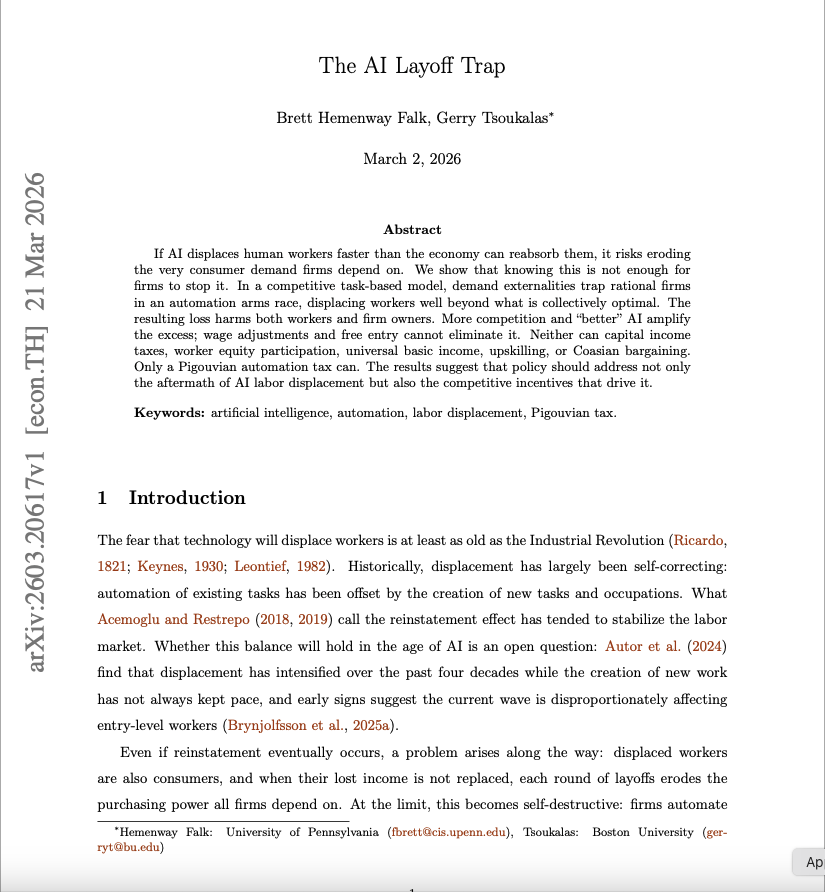
Two economists just published a mathematical proof that AI will destroy the economy. Not might. Not could. Will — if nothing changes. The paper is called "The AI Layoff Trap." Published March 2, 2026. Wharton School, University of Pennsylvania. Boston University. Peer reviewed. Mathematically modeled. The conclusion is one sentence. "At the limit, firms automate their way to boundless productivity and zero demand." An economy that produces everything. And sells it to nobody. Here is how you get there. A company fires 500 workers and replaces them with AI. A competitor fires 700 to keep up. Another fires 1,000. Every company is behaving rationally. Every company is following the incentives correctly. And every company is building a trap for itself. Because the workers who were fired were also customers. When they lose their jobs faster than the economy can absorb them, they stop spending. Consumer demand falls. Companies respond by cutting costs — which means automating more workers — which means less spending — which means more falling demand — which means more automation. The loop has no natural exit. The researchers tested every proposed solution. Universal basic income. Capital income taxes. Worker equity participation. Upskilling programs. Corporate coordination agreements. Every single one failed in the model. The only intervention that worked: a Pigouvian automation tax — a per-task levy charged every time a company replaces a human with AI, forcing them to price in the demand they are destroying before they pull the trigger. No government has implemented this. No major economy is seriously discussing it. Meanwhile the numbers are already tracking the curve. 100,000 tech workers laid off in 2025. 92,000 more in the first months of 2026. Jack Dorsey fired half of Block's workforce and said publicly: "Within the next year, the majority of companies will reach the same conclusion." Nobody is doing anything wrong. Companies are following their incentives perfectly. That is exactly the problem. Rational behavior. At scale. Simultaneously. With no mechanism to stop it. Two economists built the math. The math leads to one place. Source: Falk & Tsoukalas · Wharton School + Boston University · arxiv.org/pdf/2603.20617
Elias Al tweet media
English
1.1K
4K
9.9K
1.3M
Kekwan retweetledi
Camus
Camus@newstart_2024·
This MRI study on young kids just exposed something terrifying: They scanned the brains of 60 children aged 3–5 — including 5-year-old Rose — and found interactive screen time is causing measurable loss of white matter in their developing brains. Even just 2 hours a day is linked to impaired neural connectivity, language, and literacy development. Professor Mike Nagel (neuroscientist and father) said his first reaction was simply: “Wow… I was not anticipating seeing anything like that.” We’re physically changing children’s brains before they even start school — and the damage is visible on scans. This one actually unsettled me. I’ve always suspected too much screen time was bad, but seeing real white matter loss in toddlers hits different. Parents of little ones — has this kind of research changed how much screen time you allow?
English
588
9.6K
28.6K
10.1M
Kekwan retweetledi
Edison
Edison@CodeEdison·
Biggest Tech Layoffs in the Last 12 Months 1. Oracle Layoffs: 30,000 Reason: Took on $58B debt for AI data centers; cut jobs to free up cash flow. 2. Intel Layoffs: 25,000 Reason: Lost AI chip market to NVIDIA; new CEO restructured the company to become leaner. 3. Amazon Layoffs: 16,000 Reason: Removed corporate management layers and redirected resources toward AI. 4. Microsoft Layoffs: 9,000 Reason: Cut gaming and Xbox teams; realigned budget toward AI and cloud. 5. Block, Inc. Layoffs: 4,000 Reason: CEO Jack Dorsey said AI enables smaller teams; workforce reduced by nearly half. 6. ASML Layoffs: 1,700 Reason: Eliminated manager roles to reduce bureaucracy; engineers remained untouched. 7. Ericsson Layoffs: 1,600 Reason: Falling telecom demand after the 5G boom; ongoing cost reduction. 8. Atlassian Layoffs: 1,600 Reason: CEO cited AI reducing the number of roles needed; capital moved toward AI development. 9. Meta Layoffs: 1,500 Reason: Reduced focus on metaverse; redirected budgets toward AI after lagging behind OpenAI. 10. Salesforce Layoffs: 1,000 Reason: AI agents replaced about half of the support team; shift from human to AI support.
English
59
316
1.3K
197K
Kekwan retweetledi
Aakash Gupta
Aakash Gupta@aakashgupta·
OpenAI's CFO just told her own executives the company might not be able to pay its $1.4 trillion in compute bills. OpenAI makes $20 billion a year. That's a 70-to-1 ratio between committed spend and current revenue. To clear those obligations, OpenAI has to grow an order of magnitude in five years and hold it for a decade. Sam said last week the target is "hundreds of billions" by 2030. Friar has said three versions of this admission in three weeks. At WSJ Tech Live, she pitched a federal "backstop" for the financing, then walked it back when the backlash hit. With Cathie Wood, she reframed it as a compute shortage, saying OpenAI is "making tough trades" and turning down projects. Now WSJ has the internal version: she's worried they can't pay the bill. Same statement, three audiences, urgency turned up each time. The internal version is always the real one. The math underneath. Oracle: $300 billion over five years, $60 billion annually starting 2027. Microsoft: $250 billion. Nvidia: $100 billion in chip purchases, with Nvidia simultaneously investing $100 billion back into OpenAI to fund those purchases. AMD: 6 gigawatts of capacity, up to $300 billion. Broadcom: $350 billion. AWS: $38 billion. CoreWeave: $22 billion. Annual compute spend ramps from $6 billion this year to $173 billion in 2029 to $295 billion in 2030. Tom Tunguz modeled it straight from the public contracts. Microsoft took a $360 billion stock wipeout last week when investors learned 45% of its $625 billion commercial backlog, roughly $250 billion, is tied to OpenAI. Oracle has already borrowed against its deal, already started building, already committed years ahead of cash flow. HSBC estimates OpenAI has a $207 billion funding gap to meet what's already signed. The "Nvidia invests in OpenAI to buy Nvidia chips" loop is the same trade five different ways. Capital flows from one balance sheet to another and books revenue at every stop. If OpenAI's revenue ramp stalls, the loop stops, and every company holding the contract marks it down at the same time. Friar is the only person in the building with every contract on her desk at once. When she tells the room she's worried, the other three statements were warm-ups.
Aakash Gupta tweet mediaAakash Gupta tweet media
English
53
105
420
67K
Kekwan
Kekwan@ChengKeki·
@TRobinsonNewEra The dude trans from man to woman or woman to man. I can’t tell
English
0
1
1
27
Tommy Robinson 🇬🇧
Tommy Robinson 🇬🇧@TRobinsonNewEra·
Imagine paying £10,000 a year to send your children to Oxford University and this is their lecturer. Not even joking. This is an actual lecturer at Oxford University in "Modern England".
English
10.9K
20.7K
73.5K
5.6M