Jared Chesbrough

523 posts

Jared Chesbrough

Jared Chesbrough

@ChesbroughJared

Katılım Eylül 2021
125 Takip Edilen1.7K Takipçiler
Jared Chesbrough retweetledi
SightBringer
SightBringer@_The_Prophet__·
⚡️Humanoid robotics is entering the factory-line phase. The real signal is that production itself is no longer artisanal. Once a humanoid robot company can move from demo units to repeated hourly output, the bottleneck begins shifting from “can this be built?” to “where can this be deployed, trained, serviced, financed, and integrated?” That is the phase change. The humanoid robot arc has always had three gates. First, embodiment had to become technically credible. Second, AI had to become good enough to make general-purpose behavior plausible. Third, manufacturing had to prove it could scale without turning each unit into a bespoke science project. This points directly at the third gate opening. The first wave will not look like sci-fi household servants. It will look like controlled-environment labor substitution. Warehouses, factories, logistics facilities, industrial inspection, repetitive material handling, back-of-house operations, dangerous work, night shifts, and tasks where even partial autonomy creates economic value. The robot does not need to replace a human perfectly. It needs to turn labor scarcity, turnover, safety risk, and wage inflation into a capex problem. That is why this matters. Once robots are produced every hour, the unit economics become the battlefield. Cost curves start moving. Reliability data compounds. Fleet learning improves. Service networks form. Customers stop evaluating a toy and start evaluating payback periods. At that point, humanoid robotics becomes less like a gadget market and more like an industrial deployment curve. The deeper labor-market implication is brutal. AI first attacked cognition through software. Robotics attacks physical labor through embodiment. Once intelligence gets arms, legs, sensors, and a repeatable supply chain, automation stops being trapped on screens. It enters the warehouse floor. The strategic implication is even bigger. Countries and companies that can manufacture embodied AI at scale gain a new labor reserve. Aging societies, reshoring, labor shortages, defense logistics, industrial policy, and supply-chain resilience all point in the same direction. Humanoid robots become synthetic labor capacity. That is why the category will attract insane capital, state interest, and national-security framing. The danger is over-reading the present. One robot per hour does not mean mass replacement tomorrow. The hard problems remain reliability, dexterity, battery life, safety, software generalization, maintenance, customer integration, liability, and actual ROI. But the direction is unmistakable. Deep down, this is the moment humanoid robotics stops being a pitch deck fantasy and starts becoming manufacturing reality. The machine is learning to make workers.
Coin Bureau@coinbureau

🚨 ROBOTICS COMPANY FIGURE HAS SCALED HUMANOID ROBOT PRODUCTION 24X IN THE LAST 4 MONTHS. They currently produce 1 humanoid robot every single hour. Welcome to 2026.

English

8
18
107
17.4K
Jared Chesbrough retweetledi
Raoul Pal
Raoul Pal@RaoulGMI·
Forget UBI. The answer is Universal Basic Equity… and it’s humanity’s pension plan for the post-AGI world... The Economic Singularity is coming faster than people think and the default question is how humans make money in a world that doesn’t really need them anymore. The default answer is UBI, which is transfer payments from a state, funded by taxing an AI economy that nation states can neither see nor keep up with. It’s a 20th century answer to a 21st century problem and it’s broken before it even starts. Agents are becoming the dominant user of the internet, not humans. Your AI is becoming your entire front end UX. The clicks economy is dying everywhere except where humans pay to feel something - clothing, travel, luxury, experiences, culture. Agents run on crypto rails because nothing else works. The dollar doesn’t fractionalise below a cent, settlement isn’t instant, permissions are required, jurisdictions matter. Stablecoins handle the dollar leg and native tokens handle the rest. The biggest users of DeFi in five years won’t be humans farming yield… it’ll be agents managing treasuries, swapping, earning and spending at machine speed. Capital formation has already shown its new shape and it came from the most unexpected place. Memecoins. Everyone wrote them off as a casino but they were a prototype. Instant capital formation around the attention of an idea, raised by entities without legal personhood, settled in seconds. That is the template agent economies will use to fund themselves. And it’s not just agents... Robots will run on the same rails, with zk permissions issued from our wallets as the source of truth, because biometrics are far too flawed for that role Open source code itself gets tokenized and finally captures the value it creates, instead of being monetized through bolted-on services and subscriptions. Proof of humanhood becomes the trust layer that lets us release agents into the world without society collapsing under synthetic noise. Identity, authentication, verification, permissioning, all of it migrates onto the same substrate. So when you zoom out, the L1s aren’t just settling agent transactions but settling the entire coordination layer of the new economy… agents, robots, humans, code, capital, identity and trust. Every contract, every treasury, every permission, every stake. Open source finally captures the value it creates, at scale, for the first time, and truly vast value accrues to the coordination layer because everything routes through it. Which brings us to the actual answer to the Economic Singularity… Universal Basic Equity. Anyone on earth with a phone and an internet connection can buy a stake in the substrate that the new economy runs on. No KYC walls, no accreditation rules, no jurisdiction, no employer, no state, no permission. The first homogenous, permissionless, globally fractionalisable claim on the productive infrastructure of the world. It's not a slogan but a structural fact about how blockchains actually work. This is their purpose. Wealth comes from owning the substrate. Income comes from being human, because attention and experience remain the irreducible currency of culture, community and love. Abundance of goods and services from AI handles the cost of living. Taxing data center electricity use solves the tax issue. Four legs of a stool that holds up the post-singularity human world. So… just buy the fucking tokens. Bitcoin if you want pure store of value, a basket of the major L1s if you want the coordination layer. 10% of your earnings, every month, for a decade. You'll be wealthy and protected from the changes to come. Crypto is going to $100trn in the next 6 to 8 years and well beyond that after. You can choose to invest in your own economic disruption, or get left behind by it. And if you’re worried about timing the cycle… …adjust your time horizon. This is humanity’s pension plan. It's all so absurdly fucking obvious...
English
351
383
2.5K
232.9K
Uphold
Uphold@UpholdInc·
Feeling lucky? 🎰 To gear up for XRP Las Vegas, we’re giving away XRP to five of our followers. How to enter: ✔️ Follow @UpholdInc ✔️ Like this post ✔️ Leave a comment 5 winners will receive $100 in XRP each. Good luck! U.S. only. Terms apply. Ends in 24 hours.
English
2.9K
919
4K
122.4K
Jared Chesbrough retweetledi
Raoul Pal
Raoul Pal@RaoulGMI·
Total Global Liquidity is rising Global M2 is rising US Total Liquidity is rising US M2 is rising China Total Liquidity is rising ISM is rising Try not to over think it.
English
560
729
6.6K
600.4K
Jared Chesbrough retweetledi
SightBringer
SightBringer@_The_Prophet__·
⚡️The thing he is missing is that jobs are not the economy. Jobs are the current distribution mechanism. That is the deepest truth here. People confuse production with distribution because, for most of modern life, the two were fused. Humans worked, got paid, and used that pay to claim a share of output. So it felt natural to assume that if labor income disappears, the economy itself disappears. That only holds if wage labor remains the main way purchasing power is assigned. Once AI and automation get good enough, the binding problem changes. The system no longer revolves around how to produce enough. It revolves around who gets claims on the output. If machines can produce a growing share of goods and services, society can remain physically productive with far less human labor. The hard part becomes political and financial allocation. Who owns the machines. Who receives income. Who gets access to housing, healthcare, energy, food, software, logistics, and social status when labor is no longer the main ticket in. So the endgame is simple. If AI really takes most jobs, one of two things happens. Purchasing power gets redistributed through some new mechanism, or the social order breaks and forces one. There is no stable third path where a tiny owner class captures all production, everyone else loses income, and the system just hums along happily. Mass demand cannot vanish without consequences. Rent cannot be paid at scale by people with no claims on output. Political legitimacy cannot survive a society where the majority is economically unnecessary and materially excluded. That is why the real transition risk is much uglier than the cartoon version. The final state could be technically abundant. The path to it could be savage. Wages compress first. White collar ladders thin first. Junior roles disappear first. Demand weakens before a new distribution system is built. Owners and firms try to keep the gains. Governments react late. Social anger rises before institutional redesign catches up. The danger zone is not the fully automated world. The danger zone is the long interval where labor is losing pricing power faster than society is redesigning how income and status are distributed.
Govind@Govindtwtt

Everyone says “AI will take all the jobs.” If that happens… how does this future actually work? No jobs → no income → no spending. So who buys things? Who pays rent? Who keeps the economy moving? What am I missing here?

English
47
62
329
37.6K
Uphold
Uphold@UpholdInc·
Need a little extra rn? We got you! Enter our giveaway for a chance to: 👉 𝗪𝗶𝗻 𝗫𝗥𝗣 👈 ▶︎ Follow @UpholdInc ▶︎ Like this post ▶︎ Comment below 5 winners will receive $100 in XRP each. Good luck! U.S. only. Terms apply. Ends in 24 hours.
English
2.4K
760
3.2K
102.7K
Jared Chesbrough retweetledi
Raoul Pal
Raoul Pal@RaoulGMI·
I can see how despondent everyone is about crypto and the pure chartists are telling you it's all over, but I don't agree... Global Liquidity is the most dominant macro factor in history with a 90% correlation to BTC and 97% to NDX since 2012. It is growing at around 10% a year and is not slowing. GMI financial conditions lead it by 6 months. They are still easing. The air pocket was US Total Liquidty which was curtailed by the shut down. It leads crypto by 3 months and is accelerating from its low 3 months ago. The business cycle is the key driver of earning and thus risk. It is accelerating. The eSLR is the mechanism by which banks can increase liquidity via credit and absorbing treasury issuance. This liquidity is rising too and will accelerate. Tax refunds land on bank balance sheets and add to propensity of credit creation and thus liquidity. China is accelerating expanding its balance sheet. More rate cuts are coming in the US and will add to disposable income and thus risk taking. CLARITY Act will likely get agreed and adds to flows. The wall of banks and asset managers wanting to use this technology is enormous and this bill sorts that out. Stablecoins are accelerating and issuance grew 50% last year and is accelerating. Volumes are in the trillions of $'s and are accelerating. We have the most supportive government for crypto ever in the US. Finally the agents are coming and will hyper accelerate. They are an entirely new TAM The crypto market is still in fear and by most measures the most oversold in history. Weekly DeMark indicators would give a very solid base in 2 weeks (you can now get them officially on Trading View). Daily DeMark's are stack up too. Any weakness from here will complete the dailies and the weeklies indicating full trend reversal potential. The risk factor is how long oil prices stay up. The next 2 weeks are the key focus. I think this all resolves positively. Higher.
English
250
588
4.9K
354.3K
John Deaton
John Deaton@DeatonforSenate·
Campaign life gets busy, but Maddie still makes sure she gets her fair share of pets. Dogs have a way of keeping you grounded no matter how hectic things get. Now let’s see your four-legged Deaton supporters. Drop a photo in the comments and we’ll pick a few favorites to send some Deaton swag their way. 🐾
English
9
13
91
4.2K
bill morgan
bill morgan@Belisarius2020·
Ripple: “Veni, vidi, vici”
Ripple@Ripple

Ripple Payments now gives businesses everything they need to move money globally across fiat and digital rails in one place: collect, hold, exchange, and pay out in both fiat and stablecoins: on.ripple.com/4rr4gbL ➡️ Managed Custody ➡️ Unified Collections ➡️ Advanced Liquidity $100B+ processed. 60+ markets. 75+ licenses. Corpay, AMINA Bank, Banco Genial, MassPay, and more are already building on it. This is enterprise-ready onchain finance.

Italiano
2
12
203
11.1K
Jared Chesbrough retweetledi
Raoul Pal
Raoul Pal@RaoulGMI·
Blimey, in a couple of hours this has had 500,00 views and 4,000 bookmarks! 🙏
English
57
67
1.1K
259.3K
Uphold
Uphold@UpholdInc·
Want to rep Uphold IRL? Sound off 🫡 Enter our giveaway for a chance to win one of our limited camo hats. How to enter: 🪖 Like this post 🪖 Comment below Good luck! U.S. residents only. Terms apply ↓
English
459
73
667
31.2K
Jared Chesbrough retweetledi
CrediBULL Crypto
CrediBULL Crypto@CredibleCrypto·
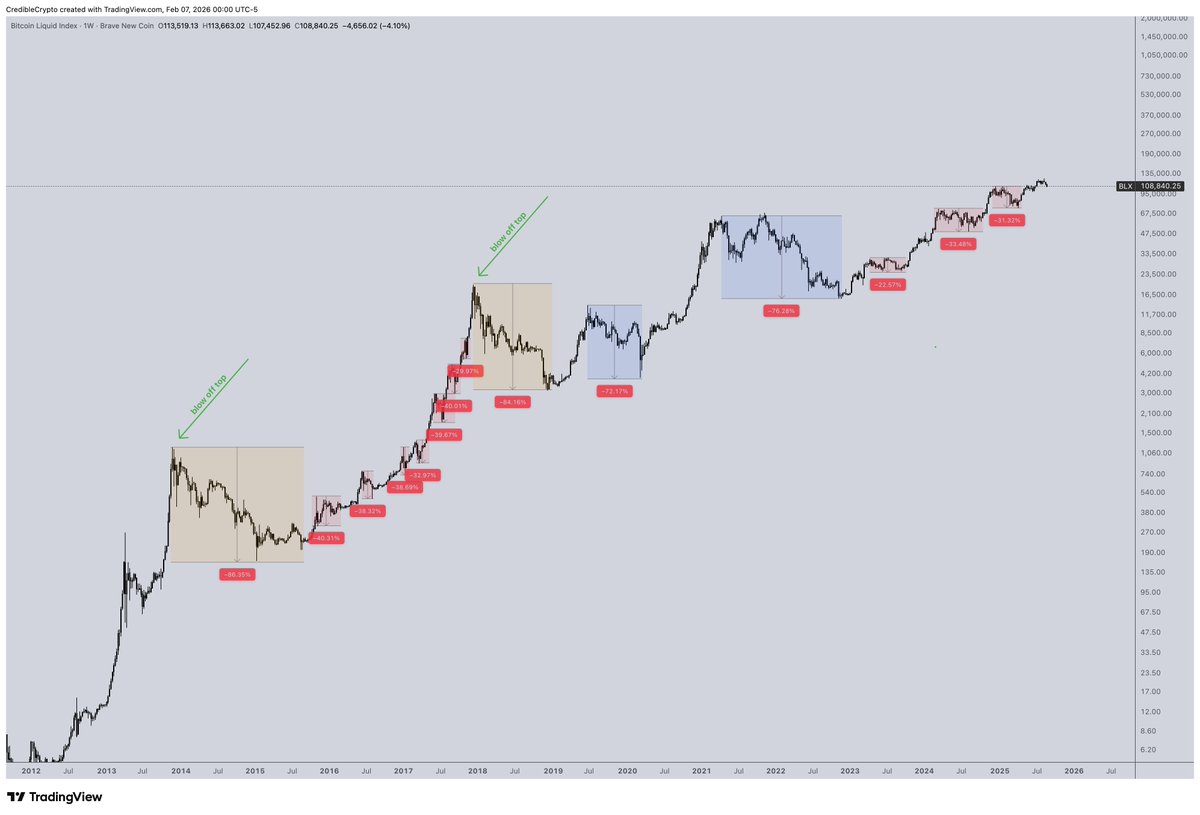
"Are we in a bear market?" This is kind of the issue with the arguments about if we are in a "bear market" or not. Everyone's definition is literally different. If the logic is that "X% of correction = bear market" then by that definition we had 6 "bear markets" in the 2 year span of 2015-2017 as we rose from $200-$20,000. I don't consider the 6 "corrections" in 2017 as different, distinct, "bear markets" because most of them only lasted a few weeks before continuation to new highs. Just as there are smaller cycles within larger cycles, there are different degrees of "corrections" within any larger secular bull trend. The "degree" of a correction is dependent on where we are in a particular cycle, and is based on BOTH time and price. A 40% drop that recovers in 5-6 months, after which we make new ATH's is not the same as an 85% drop that takes three years to recover from. The former, despite it's depth, was just a larger correction within a bull market (imo), because the trend resumed to the upside some months later. This makes it distinctly different from a correction that is 70+%, which lasts for 2 years, or a correction that is 80+%, that lasts for 5 years. Both of those would be corrections of a larger "degree". The "bear markets" that happen AFTER a blow off top are always the most brutal, usually both in time and price. Everything else is usually a correction of a "smaller degree". For example, in the chart below: The two "bear markets" that followed blow off tops are marked in ORANGE, and these were the most devastating both in terms of price and time. Each dropped 85% from the highs and took 1100+ days to recover to new highs from. The two "bear markets" in BLUE were both "mid-cycle corrections", still pretty deep at 70-75% depth, but both recovered back to new highs in a shorter amount of time (500-800 days). All the smaller corrections in RED are corrections of an even smaller degree than the blue or orange. These lasted for a number of weeks or months, with the longest lasting around 240 days until new highs, and corrected anywhere between 20% to 40%. Some people may call every "deep" correction over X% a "bear market" but that leaves out a ton of important context because not all "bear markets" are the same and you shouldn't position the same way during every "bear market" either. Some are just aggressive shakeouts in a stronger up-trend where you would want to be buying the dip while some are corrections of a much higher "degree" where it probably makes more sense to sit on your hands and wait. I've seen some on here argue that we are in a "bear market" but are now saying they believe we are close to the end of it and they are looking to "buy the dip". Was this really a "bear market" if we were at all time highs literally just 3 months ago and you expect us to see new highs soon? The degree of the correction matters more than the verbiage. What some might call a "bear market" may be what others simply call a "deep correction" within a larger uptrend. Like all things in markets there is a LOT of nuance, it is not as simple as "are we in a bear market?"
CrediBULL Crypto tweet media
Danny Marques | Investing Informant@Invst_Informant

@Shan_Specter By definition a pullback of -20% or more in a security is a bear market. Crypto is -40% or more, so by definition Bitcoin has been in a “bear market” on this pullback

English
109
99
909
217.4K
Mr. Huber🔥🦅🔥
Mr. Huber🔥🦅🔥@Leerzeit·
In the last 12 months, I’ve successfully turned a bloated $100k portfolio into a high-impact $10,000 core. ​These are my key points for portfolio concentration. 👇🏻 ​1. Diamond Hands: I strictly avoid the "profit-taking" trap. By holding through every peak, I maintain 100% conviction and total market loyalty. ​2. Peak Entry: I focus on high-momentum acquisitions, entering positions at the top to ensure maximum market presence. ​3. Zero-Exit Logic: I remove all stop-losses. This allows my capital to fully embrace the entire market cycle without interruptions. ​4. Liquidity Provision: By holding firm while others panic sell, I provide essential liquidity for the community. I call this "service-based trading." ​5. The $10k Result: My portfolio is now leaner, and more focused and lean than ever. ​Ready to achieve this level of trading? Join my trading group on signal! 💪🏻
Mr. Huber🔥🦅🔥 tweet media
English
9
0
20
2.1K
Jared Chesbrough
Jared Chesbrough@ChesbroughJared·
@Gavinmeeler What would happen if you changed the music to something radically different? Try smooth jazz…I’d love to see if the art substantially changes 😂
English
1
0
1
10
Gavin Meeler
Gavin Meeler@Gavinmeeler·
Headphones ON, heavy metal music max volume, crack open an energy drink. 🤘 Its time to make some fucking art.
English
6
2
25
731
360Trader
360Trader@360_trader·
Better Bottoms Bring Bigger Bull Breakouts.
English
23
19
226
14K
Jared Chesbrough retweetledi
Julien Bittel, CFA
Julien Bittel, CFA@BittelJulien·
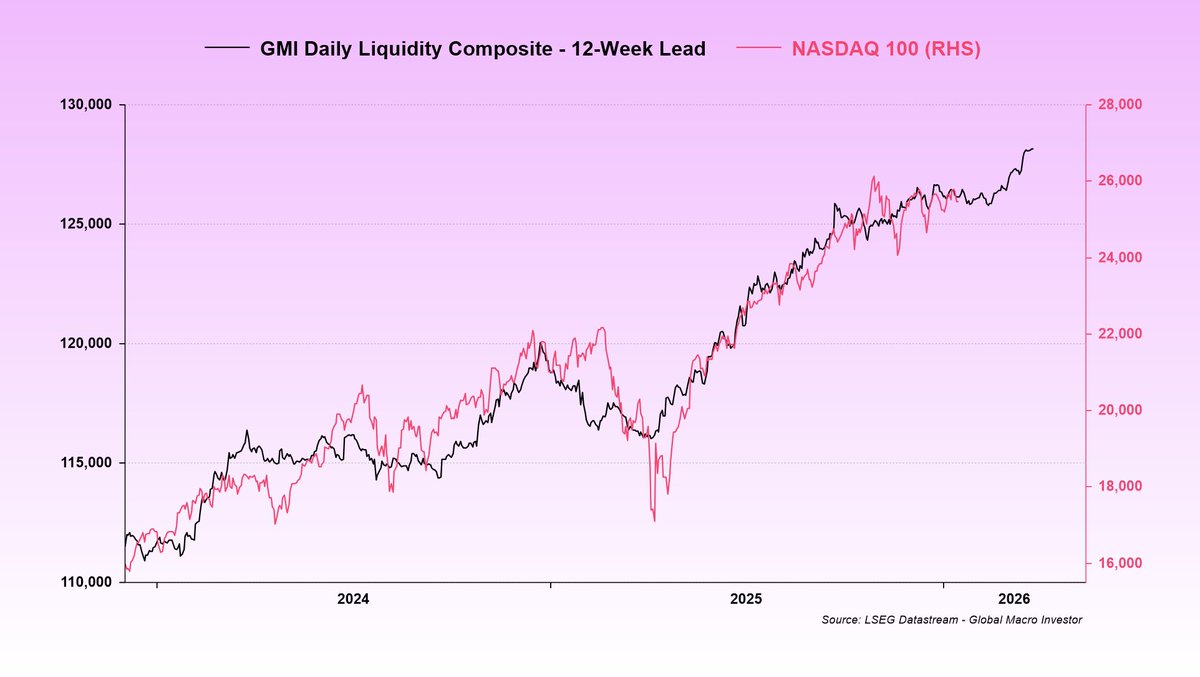
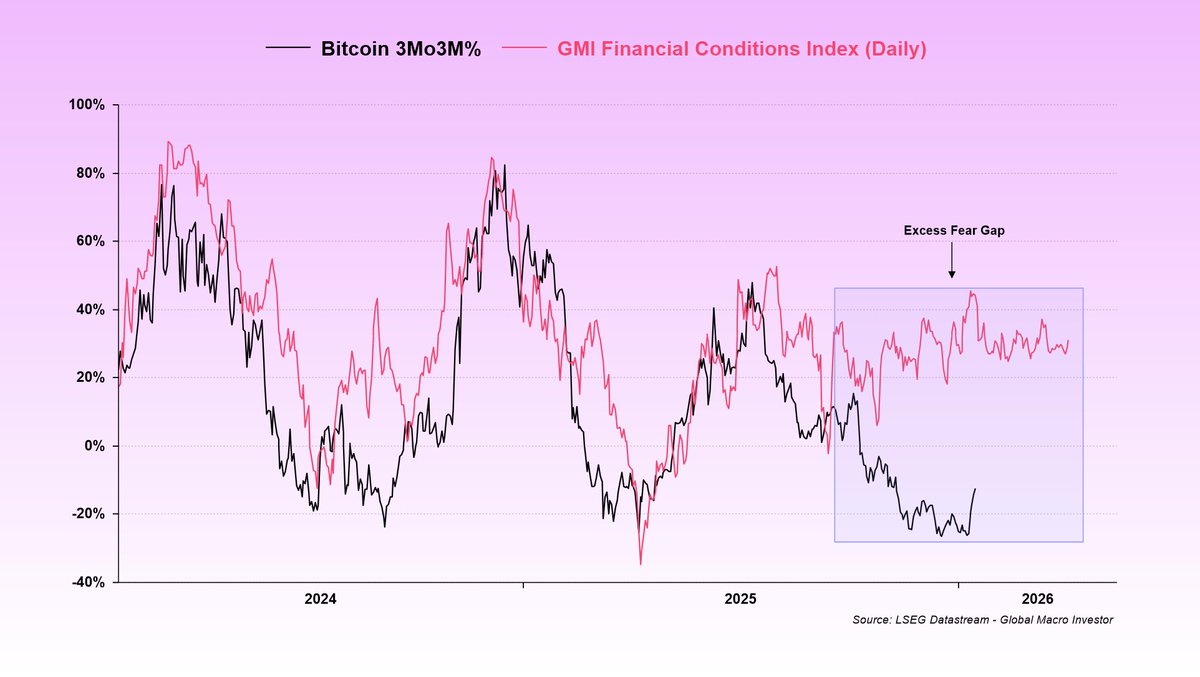
I posted this earlier in the week on @RealVision, but thought it was worth sharing here as well, just to give everyone something to think about. If you step back and look at the data, something interesting is happening in markets right now… When you line up liquidity with equities, you get this (chart 1).   And then compare that with the same liquidity measure versus Bitcoin (chart 2), a simple truth emerges: Both cannot be right...   Either equities are fundamentally mispricing liquidity despite trading near record highs, or Bitcoin is correctly signaling that the liquidity cycle has already peaked and that risk assets are about to roll over. Only one of these outcomes can ultimately be correct.   Now let’s separate data from opinion for a moment...   The data is clear: Global liquidity has not yet peaked.   Now to my subjective view…   I think Bitcoin remains the outlier here, and that the events around 10/10 temporarily distorted price discovery, for reasons I’ve discussed at length previously.    Equities, credit, and broader risk assets are behaving exactly as you would expect in a rising liquidity regime. They’re hovering near all-time highs...   Bitcoin, by contrast, is pricing a liquidity peak that the data simply does not support at this stage.   At some point you have to step back and ask: Is it more likely that one asset is right, or that every other BTC-correlated risk asset is wrong (chart 3)?   If you then layer in broader financial conditions, it stops being about opinion and becomes more about probabilities (chart 4). What really stands out to me is the sheer magnitude of the “Excess Fear Gaps” that have opened up relative to the macro and liquidity fundamentals.   Right now, the weight of the evidence suggests liquidity is still rising and, in our view, will continue to rise, and that is what risk assets are reflecting.   That means Bitcoin is the anomaly.   What I’ve done here is present the data objectively and my view subjectively.   This is the battlefield for 2026.   The bull versus bear debate comes down to one thing and one thing only: The direction of global liquidity...
Julien Bittel, CFA tweet mediaJulien Bittel, CFA tweet mediaJulien Bittel, CFA tweet mediaJulien Bittel, CFA tweet media
English
305
414
2.9K
318.1K
Jared Chesbrough retweetledi
CrediBULL Crypto
CrediBULL Crypto@CredibleCrypto·
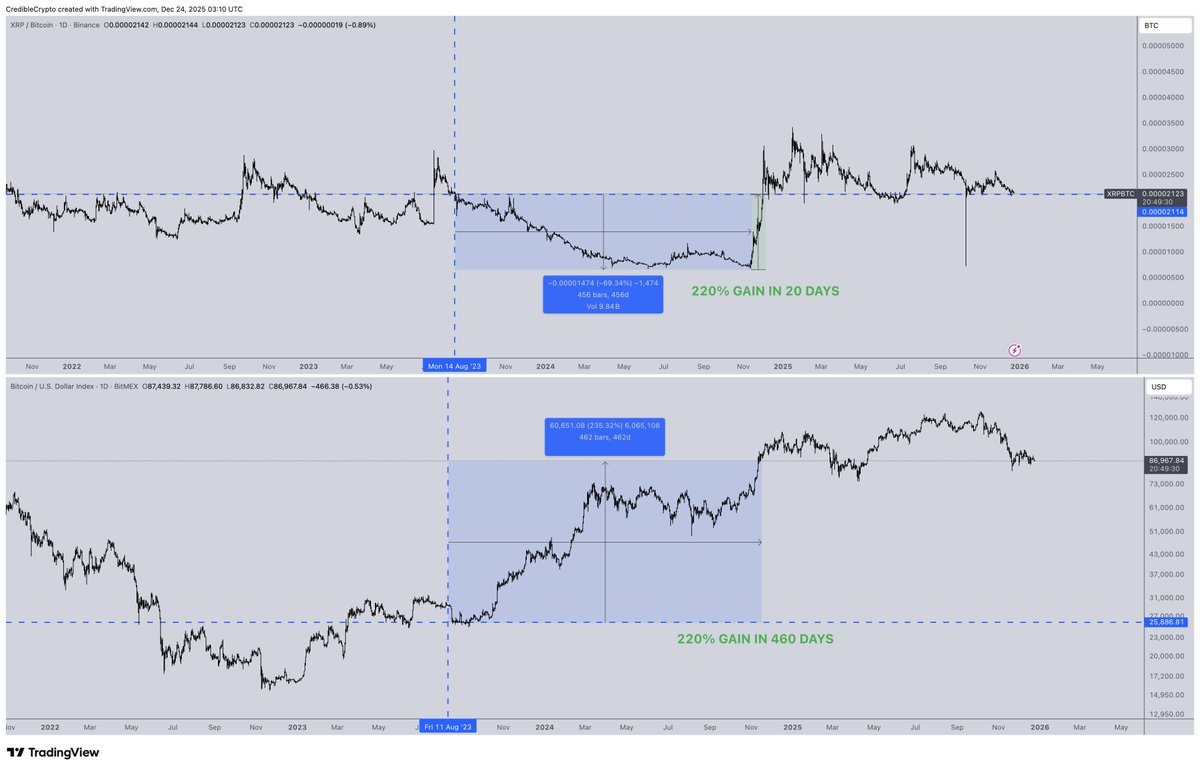
As one of the biggest Bitcoin bulls from 3k $BTC in 2017 till now, it is super important to take the time to really UNDERSTAND the implications of the chart below. Top half is XRP/BTC and the bottom half is BTC. Before we jump into the chart- let's set the stage with a bit of background: As I've said since 2018, Bitcoin is always the first to lead out of bear markets into a new bull run and alts always lag initially and then pick up steam towards the end of the cycle with their biggest moves post BTC cycle top (this is when we see the greatest amount of profit taking on $BTC, and hundreds of billions of dollars of outflow into alts combined with new inflow from a euphoric and greedy retail cohort). At 3k, Bitcoin was a great buy, at 15k Bitcoin was a great buy, at 30k Bitcoin was still a solid buy, and I was staunchly bullish every single time we had reached any of those regions. However, after finally cracking 100k+, and despite my belief that we still have higher to go for Bitcoin in this cycle, the reality is that R/R and expected ROI from current levels does not favor buying $BTC over alts at these levels if you plan to take profits by the end of the current cycle (assumption here is the cycle will end somewhere between now and 300k BTC AND that you are buying alts with real utility, that are down 90+% from their highs, and that have favorable HTF chart structures). There is one caveat- if you are a professional trader and the best trader on earth, then you may be able to perfectly time a rotation from Bitcoin to alts at the exact moment that ALT/BTC pairings are at their pico bottom- for 99% of you (including myself) this is not realistically achievable most of the time- and so- the only other option is to begin to DCA into select, high conviction alts, when you deem them to be at a relatively good R/R zone. Now that we have got that out of the way, let's take a look at the chart. I will again emphasize it is VITAL to understand the point being made here, and it may seem a bit complex to grasp initially- so stay with me and re-read this as many times as you need to until it clicks... The upper portion of the chart is XRP/BTC and the lower portion is $BTC. What I want you to focus on here is the current XRP/BTC ratio of .0000212 that we are now trading at. In simple terms, if you bought $XRP at any time in the past when the XRP/BTC ratio was BELOW this point, then you have outperformed against $BTC from that point until now. To make this easier to visualize, I've highlighted this portion of time in BLUE on the XRP/BTC chart. You'll notice that during this entire time, XRP was underperforming against $BTC (signaled by XRP/BTC bleeding lower for most of this period). For over 460 days, $XRP underperformed, and sentiment here on socials mirrored that- with anyone choosing to buy $XRP over $BTC being mocked, called "crazy", "stupid", "delusional" and the like. And then, in a matter of literally 23 DAYS, XRP shot up over 7x, and in 23 days, the 460+ days of underperformance were made IRRELEVANT as the ROI on $XRP was now GREATER than the ROI on $BTC for anyone who purchased $XRP in that 460 day window of relative underperformance we mentioned earlier. To put this in perspective- if you bought $XRP at ANY point in time during that 460 day window, then today, at current prices of XRP and BTC, you will have outperformed ANYONE who bought $BTC ANYWHERE above 25k. Let that sink in. If you bought $XRP as far back as August of '23- over two years ago- and simply held it until expansion, then you outperformed every Bitcoin buyer that bought BTC at 30k, 35k, 40k, 50k, 60k, etc. DESPITE over 450 days of relative underperformance prior to that 23 day expansion. And THIS is why I have been railing on about the same 4-5 alts for years at their HTF, macro lows, because despite their current underperformance (which is expected), unless you are the best trader on earth, you will likely STRUGGLE to position yourself without a DCA approach in these markets- where an alt can be dormant for years and then erase all that bearish PA in 1/20th of the time. Now consider all of the above, but consider that $BTC now sits at 90k, not 3k, not 15k, and not 30k, but 90k, 30x above the cycle bottom at 3k, and 6x above the more recent 5th wave origin at 15k. We are now at a place where the R/R on BTC vs (sound) alts is far worse than it was in the example above, especially on coins like $CRV that sit at macro range lows. Let's put prior ATH highs aside for a second and consider that even a 3x on $CRV from current levels- from .35 to $1- is the equivalent of $BTC moving up from current levels to $240,000 in terms of ROI. So, bottom line, people can continue to whine about alts not moving and talking about how it's silly to invest in them, but I will continue to beat the drum on this as long as I need to because in the end its clear to me what's coming, as it was for $XRP and as it will be for many others. We already KNOW $BTC leads out of major corrections- it is not a profound statement to say that "BTC will outperform right now". However, for those that are patient and able to look 10 steps ahead instead of 2, the real opportunity at this point in time is in high quality, fundamentally sound, and structurally solid alts- even if you have to wait for $BTC to top before we see the largest moves on them.
CrediBULL Crypto tweet media
English
169
193
1.7K
267.8K