ChipArndt retweetledi
ChipArndt
6.6K posts

ChipArndt
@ChipArndt
Believe in people not labels, evp @Flimp, entrepreneur, rational activist, golf, and a few other things
Boston Katılım Eylül 2008
791 Takip Edilen844 Takipçiler
ChipArndt retweetledi

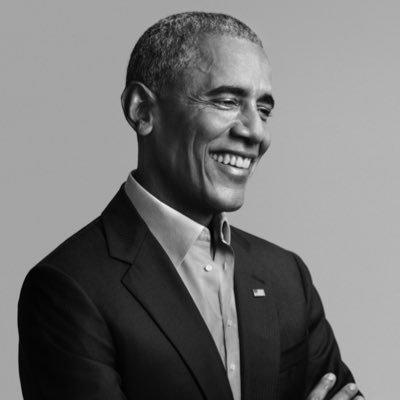
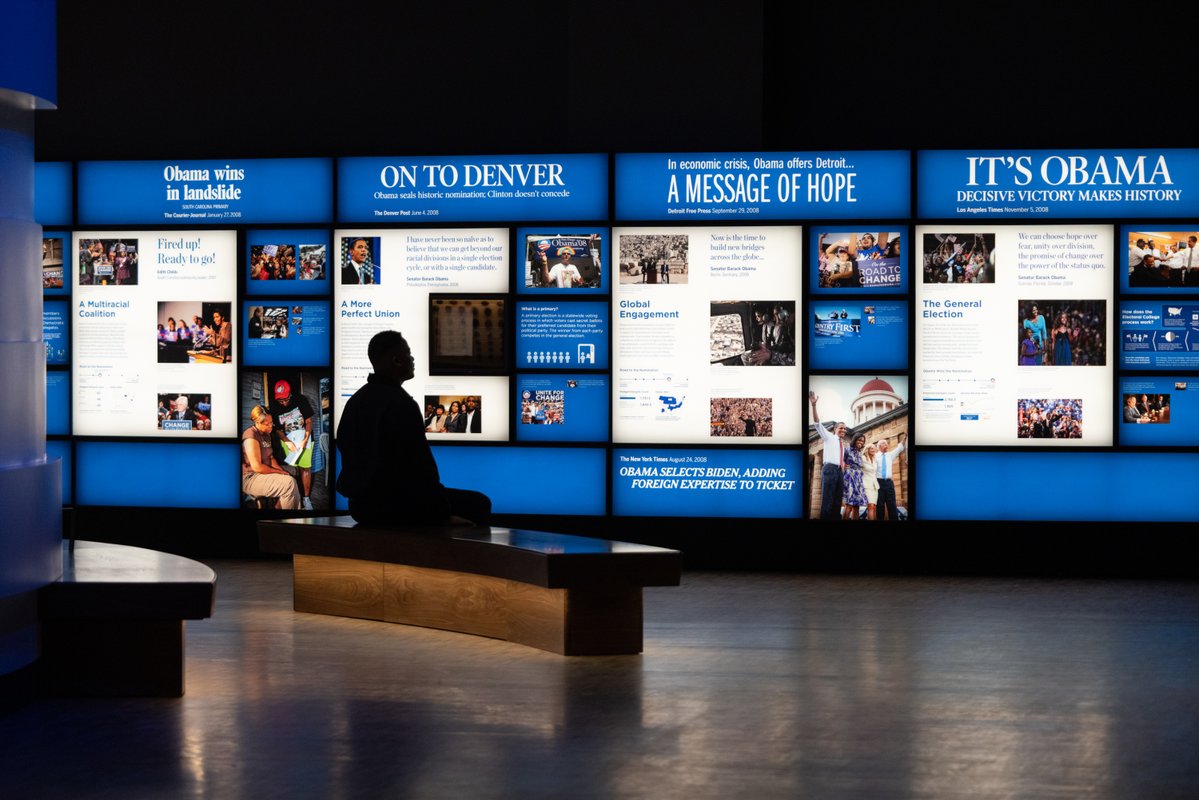
Michelle and I can’t wait for you to visit the Obama Presidential Center!
Starting on June 19, the Center will be open to the public, and you’ll be able to check out the Museum along with public spaces like a new branch of the Chicago Public Library with a reading room, a two-acre playground, a fruit and vegetable garden, and more.
Tickets available at tickets.obama.org.


English
ChipArndt retweetledi

Winston Churchill fought his depression with bricks. He'd lay them for hours at his country home in Kent. He joined the bricklayers' union. And in 1921 he wrote about why it worked. It took psychology another 75 years to catch up.
He called his depression the "Black Dog." It followed him for decades. His method for fighting it back was as basic as it sounds: laying brick after brick, hour after hour.
Churchill spelled out his theory in a long essay for The Strand Magazine. People who think for a living, he wrote, can't fix a tired brain just by resting it. They have to use a different part of themselves. The part that moves the eyes and the hands. Woodworking, chemistry, bookbinding, bricklaying, painting. Anything that drags the body into a problem the mind can't solve by itself.
Modern psychology now calls this behavioral activation. It's one of the most-studied depression treatments out there. Depression sets a behavior trap. You feel bad, so you stop doing things, and doing less means less to feel good about. Feeling worse makes you do even less. The loop tightens until you can't breathe inside it.
Behavioral activation breaks the loop from the action side. You schedule the activity first, even when every part of you doesn't want to. Doing it produces small rewards: a wall gets straighter, a painting fills in, a messy room gets clean. Those small rewards slowly rewire the brain. Action comes first, and the feeling follows.
Researchers at the University of Washington put this to the test in 2006. They studied 241 adults with major depression and compared three treatments: behavioral activation, regular talk therapy, and antidepressants. For the people who were most severely depressed, behavioral activation matched the drugs. It beat the talk therapy. A 2014 review of more than 1,500 patients across 26 trials backed up the result.
Physical work like bricklaying does something extra on top of this. It crowds out rumination, the looping bad thoughts that grind people down during the worst stretches of depression. Bricklaying needs both hands and gives feedback brick by brick: each one is straight or crooked. After an hour you can see exactly how much wall you built. No room left for the mental chewing.
The line George Mack used in his post, "depression hates a moving target," is good poetry. The science behind it is sharper. Depression hates a brain that has somewhere else to be.
George Mack@george__mack
Winston Churchill used to lay 200 bricks per day to keep his mind busy when feeling down. Depression hates a moving target.
English
ChipArndt retweetledi

This is perhaps the most remarkable interview I have ever seen.
Facing death, @BenSasse shares his views about life, faith, society, government, technology and the world we live in.
This is not about partisan politics or markets. Instead it is about something far more important - humanity and our lives.
I urge you to turn off all your devices, get to a quiet place and watch the entire conversation.
Judge Stephen Dillard@JudgeDillard
Every American should watch every second of this video. Thank you, @BenSasse.
English
ChipArndt retweetledi

“Sometimes the smallest things take up the most room in your heart.” – A. A. Milne
As we mark the 100th anniversary of the beloved Winnie-the-Pooh stories, The Queen has presented a very special gift to the New York Public Library, reuniting baby Roo with his friends from the 100 Acre Wood.
The Library is home to the original collection of toys owned by Christopher Robin Milne, son of A.A. Milne, which inspired the characters in the beloved Winnie-the-Pooh series. The collection is missing Roo, the baby kangaroo who was lost in an orchard in the 1930s.
The new addition of Roo was created by Shropshire-based company Merrythought, who also created the original toys.
👀 Watch Roo’s great adventure travelling from Buckingham Palace onboard Their Majesties’ flight to his new home in New York.
English
ChipArndt retweetledi

Celebrating America’s 250th birthday in Front Royal! 🇺🇸
It was a joy to join the town at their community block party – and to take part in the ‘potluck’. Their Majesties contribution was none other than… a Coronation Quiche! 🥧
‘America’s Potluck’ is a 250th celebration initiative, which aims to bring neighbours together across the country to share a communal meal and build a sense of connection in their community.
Thank you for having us! 👋
English
ChipArndt retweetledi

Parks and Rex! 🏕️ The King has spent time at Shenandoah National Park in Virginia’s Blue Ridge Mountains and Appalachian Highlands.
⛰️ The Blue Ridge Mountains are among the oldest in the worldand the Appalachian Highlands were, remarkably, once connected to the Scottish Highlands as part of a single mountain chain.
Conservation efforts at Shenandoah include those aimed at preserving the iconic bald eagle, which was at risk of extinction in the mid-1900s. 🦅
English
ChipArndt retweetledi

A MIT professor gave a 1-hour lecture in 2019 that has 18 million views.
He died 5 months after recording it.
It was his final gift to the world.
Patrick Winston taught at MIT for 50 years.
The smartest engineers on earth sat in his classroom.
And he spent his last lecture teaching them the one skill their degrees never covered.
How to speak.
15 lessons that will change how you communicate forever:
Never open with a joke. Your audience is not ready to laugh yet. Open with a promise of what they will know by the end.
Your ideas are like your children. You are too close to them. What is obvious to you is invisible to everyone else. Explain the obvious.
The 5-minute rule: the first 5 minutes of any talk determine whether people will listen for the next 55. Spend more time on your opening than anything else.
Repeat your most important idea 3 times in 3 different ways. Once is never enough.
Build a fence around your idea. Tell people what it is NOT before you tell them what it IS.
Verbal punctuation. Pause. Let the idea land before moving to the next one.
Ask questions nobody will answer. Then wait 7 seconds. The silence is not awkward. It is processing.
Never read your slides. Your audience can read. They cannot listen and read simultaneously.
Use the board not the slides. Writing forces you to slow down. Slowing down forces clarity.
Inspire before you inform. Nobody learns from someone they are not inspired by.
End with a contribution not a summary. Tell them what you gave them. Not what you said.
Never say thank you at the end. It is weak. End with something that lands.
Stories make ideas stick. Data makes ideas understood. You need both. In that order.
The quality of your communication determines the quality of your ideas in the eyes of the world. Not the ideas themselves.
Practice is not preparation. Practice IS the skill.
Patrick Winston understood something most people spend their entire careers missing.
Your ideas are only as powerful as your ability to transfer them into someone else's mind.
You can be the smartest person in the room and be completely invisible.
Or you can master communication and make average ideas feel like breakthroughs.
He chose to spend his last lecture teaching this.
Watch it tonight.
Bookmark this first.
Follow @cyrilXBT for more lessons from the people who built the future.
English
ChipArndt retweetledi

Profoundly Moving. Start to Finish. Thank You @BenSasse for Your Personal Courage and Showing What it Means to Love Your Family and Love God🙏🏻
60 Minutes@60Minutes
"There are no maverick molecules in the universe," says Ben Sasse. cbsn.ws/4e5LH9T
English
ChipArndt retweetledi

ChipArndt retweetledi