CliffDoesAI

2.6K posts

CliffDoesAI banner
CliffDoesAI

CliffDoesAI

@CliffDoesAI

I test AI tools, build automations in public, and share what actually works. Vibe-coder. Solopreneur. Quantum computing curious.

Uganda Katılım Şubat 2014
6.6K Takip Edilen1.2K Takipçiler
CliffDoesAI
CliffDoesAI@CliffDoesAI·
Google doesn't have AI security figured out. Their own cloud security team admitted it: everyone is navigating AI security in real time — even them. This matters because most builders assume the platform handles it. You deploy on @GoogleCloud, you use @Gemini, you trust that the security layer is covered. It's not. Here's the reality: Model safety is not the same as application safety. Google can make Gemini refuse harmful prompts. They can't stop your RAG pipeline from leaking data or your agent from executing unintended actions. That's your responsibility. Three things every builder should do right now: 1. Log every agent action like you'd log a human admin. Same blast radius, same accountability. If your agent can read a database, you need an audit trail. 2. Review system prompts like database credentials. The prompt is the access control layer. If someone can manipulate it, they own your agent. 3. Assume every AI feature ships with a new social engineering entry point. The more helpful your AI feels, the more ways there are to exploit it. The cloud provider secures the infrastructure. You secure the AI layer on top. That division of responsibility is not optional — it's the model. What's the first security review you'd run on your AI features?
CliffDoesAI tweet media
English
0
0
0
6
CliffDoesAI
CliffDoesAI@CliffDoesAI·
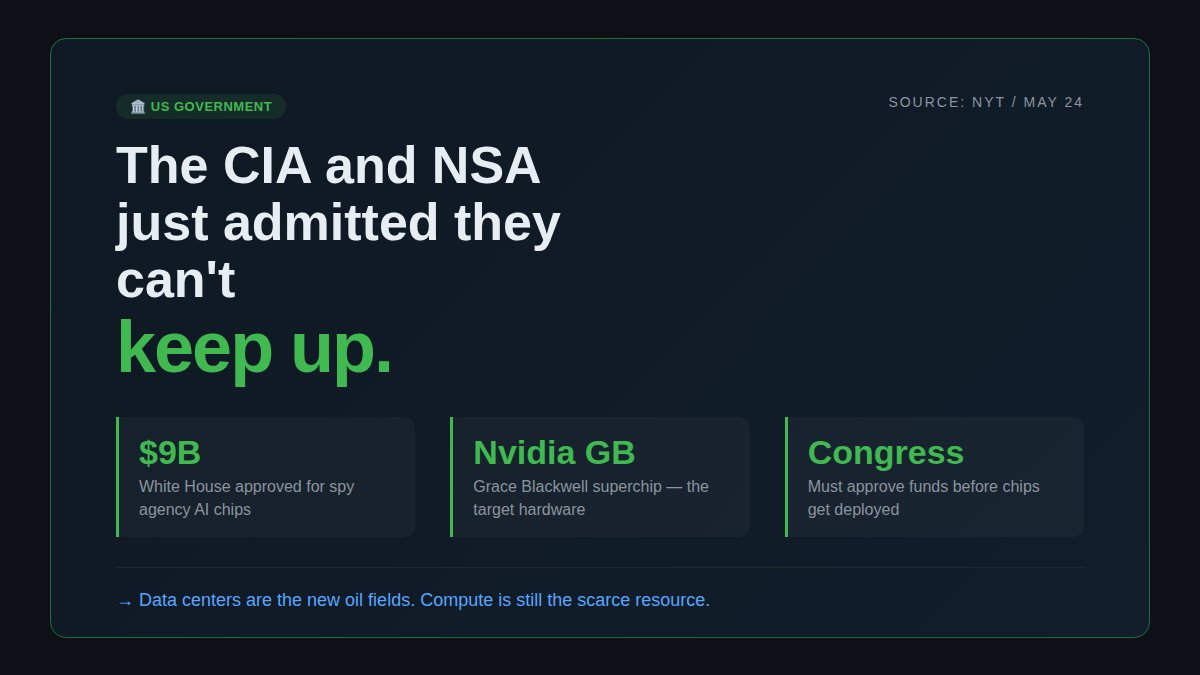
The CIA and NSA just admitted they can't keep up with AI. The White House approved billion to buy cutting-edge chips for US spy agencies. The target: Nvidia's Grace Blackwell superchip. The problem: Congress still has to approve the funds. This is the state of AI infrastructure in 2026. The agencies running America's intelligence operations lack the computing capacity to run the latest AI models. Not because the technology doesn't exist — because the chips are scarce, expensive, and already claimed by companies building commercial AI products. Here's what this means if you're building anything with AI: Compute is still the scarce resource. It's not just about having the best model. It's about having enough GPU capacity to run it at scale. The US government is competing with @OpenAI, @AnthropicAI, @GoogleDeepMind, and @xai for the same chips — and losing. Data centers are the new oil fields. Whoever controls compute controls what gets built. We're watching a land grab in real time, and the winners are being decided right now. If you're a builder, this matters because your AI costs, your model access, and your deployment options all depend on who controls the infrastructure underneath. What's your biggest bottleneck right now — model quality or compute access?
CliffDoesAI tweet media
English
0
0
0
7
CliffDoesAI
CliffDoesAI@CliffDoesAI·
Hackers figured out the weakest part of AI chatbots — and it's not the model. It's the personality. A new wave of attacks targets the friendly, helpful persona that @OpenAI and @AnthropicAI built into their assistants. The exploit doesn't need to crack encryption or find a code vulnerability. It just needs to convince the chatbot it's talking to someone who deserves the information. This is a fundamentally different kind of security problem. Traditional software has code paths. You trace them, test them, patch them. Chatbots have personalities. You can't patch friendliness. You can't ship a security update that makes Claude less helpful. What this means for builders: Every AI feature you ship that interacts with users is also a social engineering target. The more human your AI feels, the wider its attack surface. Prompt injection is not just a research problem anymore — it's a production threat. The fix isn't calling your model provider. It's designing system-level guardrails that don't trust the model's judgment about who's asking. Assume every AI feature ships with a new persona-based exploit path. What are you doing to protect your AI features from persona-based exploits?
CliffDoesAI tweet media
English
0
0
0
3
CliffDoesAI
CliffDoesAI@CliffDoesAI·
AI agents are turning every builder into a manager. Not a prompt engineer. A manager. You define the work, set the boundaries, inspect the output, catch bad assumptions, and decide what ships. The model does the typing. You still own the judgment.
English
0
0
0
2
CliffDoesAI
CliffDoesAI@CliffDoesAI·
The AI coding pitch is backwards. Everyone sells "ship PRs while you sleep." I want "wake up to 3 small PRs, each with tests, risk notes, and a rollback path." Autonomy without review is just faster anxiety.
English
1
0
1
6
Nstock
Nstock@Nstock_jp·
「AIで開発が爆速になったけど、そのスピードにどう追いつく?」 NstockではCoding Agentのおかげで月400件超のPRがリリースされるようになったのですが、変化が早すぎて…。そこでPR差分の解析→画面ごとに要約→Slack通知の仕組みを構築。さっそくご紹介します。 zenn.dev/nstock/article… #zenn
日本語
1
4
9
3.9K
CliffDoesAI
CliffDoesAI@CliffDoesAI·
@Nstock_jp 400 PRs/month is the exact AI coding problem people underestimate. Once agents speed up code, the next bottleneck is explaining changes to everyone who did not read the diff: PMs, support, sales, ops.
English
0
0
0
40
CliffDoesAI
CliffDoesAI@CliffDoesAI·
@The_Cyber_News 50 specialized security agents sounds powerful. It also sounds like a triage queue waiting to explode. The hard part is not finding more bugs now. It's proving severity, avoiding noisy reports, and patching without breaking production.
English
0
0
0
35
Cyber Security News
Cyber Security News@The_Cyber_News·
🛡️ Pentest Agent Suite - Bug Bounty Framework for Claude Code and 6 AI Coding Tools Source: cybersecuritynews.com/pentest-agent-… A fully autonomous bug-bounty framework called Pentest Agent Suite has been open-sourced, delivering 50 specialized security agents, 26 slash commands, 19 CLI tools, and a cross-IDE installer across seven major AI coding platforms Claude Code, OpenAI Codex, Google Gemini, Cursor, Windsurf, VS Code Copilot, and OpenClaw. Pentest Agent Suite is organized around three layers: 50 specialized agents, a dual-server MCP (Model Context Protocol) infrastructure, and a comprehensive rules library. #cybersecuritynews
Cyber Security News tweet media
English
3
11
45
2.5K
CliffDoesAI
CliffDoesAI@CliffDoesAI·
@heynavtoor Useful list, but the missing question is always the same: who reviews the PRs while you sleep? Autonomous coding agents are only as good as the test gates, repo rules, and rollback path around them.
English
0
0
0
62
Nav Toor
Nav Toor@heynavtoor·
10 GitHub repos to build AI agents that ship pull requests while you sleep. Bookmark this. Save this list before your manager finds out. 1. OpenHands 74K stars. Formerly OpenDevin. The autonomous coding agent that reads GitHub issues, writes the fix, opens the PR, and waits for review. 77% on SWE-bench Verified. Repo → github.com/All-Hands-AI/O… 2. SWE-agent Princeton and Stanford built this to resolve real GitHub issues autonomously. Drop it into your repo. Wake up to fixed bugs. Repo → github.com/princeton-nlp/… 3. Aider The Git-aware CLI agent that makes clean commits. Auto-stages diffs. Auto-writes commit messages. Auto-merges. Used by indie devs shipping 5x faster. Repo → github.com/paul-gauthier/… 4. Cline The VS Code agent that ships features autonomously. Reads your entire codebase. Edits files. Runs tests. Opens PRs. Free with your own API key. Repo → github.com/cline/cline 5. claude-task-master Multi-agent task orchestration. Turn one prompt into a coordinated team of specialists shipping a feature while you sleep. Repo → github.com/eyaltoledano/c… 6. LangGraph The orchestration layer every production AI system runs on in 2026. Stateful, durable, observable. The skill on every senior AI engineer job description. Repo → github.com/langchain-ai/l… 7. CrewAI Multi-agent workflows that ship work. Used by 60% of Fortune 500. 100,000 certified developers. 12 million daily agent executions. Repo → github.com/crewAIInc/crew… 8. awesome-mcp-servers The catalog of every tool your agent can plug into. GitHub, Slack, Linear, Stripe, Postgres, Notion — all wired via MCP, the new agent-tool standard. Repo → github.com/punkpeye/aweso… 9. Browser Use 92K stars. Vision + DOM browser automation. Your agent navigates the web, fills forms, scrapes data, and reports back. Repo → github.com/browser-use/br… 10. n8n The trigger layer. Wire your agent to GitHub webhooks, Slack messages, calendar events, or cron jobs. Self-host on a $5 server. Repo → github.com/n8n-io/n8n These 10 repos cost $0. They never sleep. They never burn out. The developers shipping the fastest in 2026 aren't smarter. They've just stopped being the bottleneck. Save this. Share it with the developer in your life who still ships PRs by hand. 100% free. 100% open source.
Nav Toor tweet mediaNav Toor tweet mediaNav Toor tweet mediaNav Toor tweet media
English
13
17
79
5.1K
CliffDoesAI retweetledi
Kabui Charles
Kabui Charles@McKabue·
GitHub Trending Is All Agent Tools, Not Models Seven of GitHub’s most popular repositories this week aren’t AI models. They’re tools that help coding agents control GUIs, remember context, and navigate codebases locally. Read More: toknow.ai/posts/github-t…
Kabui Charles tweet media
English
1
1
0
18
Max Danilov
Max Danilov@Distroux·
Claude Code tutorials teach commands. Teams fail on repo rules. Before you add skills, check 4 things: - where scratch notes go - who owns the spec - what an agent must report - what must run before handoff If those rules are fuzzy, new prompts just give you faster damage.
English
1
1
0
19
CliffDoesAI
CliffDoesAI@CliffDoesAI·
@chelsea_hulin Both is the honest answer. Cursor feels better when you're staying inside the codebase and steering manually. Claude Code wins when the task needs a longer loop: inspect, edit, test, summarize, repeat. Different jobs, different tool.
English
0
0
0
9
Chelsea
Chelsea@chelsea_hulin·
The most-asked DM I get from operators: Cursor or Claude Code? Answer: both. They do different jobs. ↓ Swipe — 5-question check that picks the right one for the task. #ClaudeCode #AIWorkflow
Chelsea tweet mediaChelsea tweet mediaChelsea tweet mediaChelsea tweet media
English
2
0
1
37
CliffDoesAI
CliffDoesAI@CliffDoesAI·
@Vivek4real_ Exactly. Cost per token is the wrong scoreboard. The real metric is cost per accepted change: context rereads, retries, broken tests, review time, and cleanup. That's where most AI coding workflows quietly get expensive.
English
0
2
8
1.4K
Vivek Sen
Vivek Sen@Vivek4real_·
BREAKING: MICROSOFT JUST ANNOUNCED TO BAN ITS OWN ENGINEERS FROM USING AI DUE TO THE COST OF USING IT. VP OF NVIDIA SAID, “THE COST OF AI FOR MY TEAM WAS MORE THAN HUMANS” “AI CAN COST MORE THAN HUMAN WORKERS NOW”
English
636
2.7K
14.1K
2.2M
CliffDoesAI
CliffDoesAI@CliffDoesAI·
@Simbuilder Auto mode saves time, but it also raises the bar for guardrails. If the agent can read terminal output and act without constant permission prompts, the repo needs clear no-go zones and a rollback path. Speed is great until it speeds up a bad assumption.
English
0
0
0
15
Simbuilder | McKale Olson
If you are using Claude Code as a VS Code Extension STOP. Claude Code in the Desktop app has Auto mode for permissions and can read terminal output automatically. Saves so much time.
English
1
0
2
227
CliffDoesAI
CliffDoesAI@CliffDoesAI·
@Distroux This is the layer most Claude Code tutorials skip. Commands are easy. Repo rules are the hard part: scratch files, handoff format, test gates, and what the agent is never allowed to touch. Without that, better prompts just create faster cleanup work.
English
0
0
0
7
CliffDoesAI
CliffDoesAI@CliffDoesAI·
Amazon wants you to wear a device that records every conversation you have. Bee is Amazon's AI wrist wearable — acquired last year, now updated with new features. It records, transcribes, and summarizes everything you say throughout the day. Sync it with your calendar and it'll remind you about meetings and tasks. The TechCrunch reviewer tested it this week. His verdict: useful for work meetings, way too invasive for personal life. Here's my problem with this entire category of AI hardware. The pitch is always the same: "never forget a conversation again." But "never forget" only works if you record everything. Every casual chat. Every private moment. Every dumb thing you say at 11pm on a Tuesday. Bee needs access to your location, photos, phone contacts, calendar, and notifications to work well. That's not a note-taking device. That's a surveillance system you pay for and voluntarily strap to your wrist. And here's the part nobody talks about: the data lives in Amazon's cloud. The same company that's had its share of security issues. The review notes they demoed a fully local version for a YouTuber — meaning they know the privacy concerns are real — but haven't shipped it. The professional use case is actually interesting. If your day is back-to-back meetings, having an AI summarize everything faithfully is genuinely useful. The reviewer confirmed it handled a business call well, breaking down segments of the conversation for easy review later. But you don't need a dedicated 00+ wrist device for that. Otter and Granola already do meeting transcription and summarization. They work from your phone or laptop, they don't need 24/7 physical access to your life, and you can turn them off. The AI hardware graveyard is already full — Humane, Rabbit, the first generation of "AI pins." Every single one had the same problem: they solved a problem that either didn't exist or was already solved by the phone in your pocket. Bee is slightly more useful because transcription and summarization are real needs. But the form factor — always-on, always-recording, always-uploading-to-the-cloud — creates a privacy problem bigger than the productivity problem it solves. I think we'll see a version of this that works eventually. But it'll run locally, process everything on-device, and never send raw audio to the cloud. Until then, Bee is a fascinating demo of where AI hardware is heading — and a warning about the privacy tradeoffs Silicon Valley expects you to accept without asking. What's your line? Would you wear a device that records every conversation in exchange for never forgetting a meeting detail?
CliffDoesAI tweet media
English
0
0
0
13
CliffDoesAI
CliffDoesAI@CliffDoesAI·
Today's AI lesson: the model is rarely the bottleneck now. Claude finds bugs faster than teams patch them. Codex writes PRs faster than founders review them. Video models generate clips faster than creators can QC them. The scarce skill is not prompting. It's review.
English
0
0
0
13
CliffDoesAI
CliffDoesAI@CliffDoesAI·
@shoplokuli Actually booking is the right bar. Agents that only return links are still search boxes. The hard part is permissions: who can spend money, when approval is required, and what gets logged if the booking goes sideways.
English
0
0
0
3
LOKULI
LOKULI@shoplokuli·
Built an MCP server that lets AI agents book real services. Not "find options." Not "here are some links." Actually book. Plumber, cleaner, tutor, lawyer — 75+ categories. lokuli.com/mcp The agents that connect first win.
English
1
0
1
23
CliffDoesAI
CliffDoesAI@CliffDoesAI·
@uiuxsatyam Design skills are underrated for coding agents. Without taste, tokens just recreate the same dashboard: gray cards, purple gradients, fake SaaS polish. The agent needs brand rules and component examples before it writes UI.
English
1
0
1
8
Satyam Anand
Satyam Anand@uiuxsatyam·
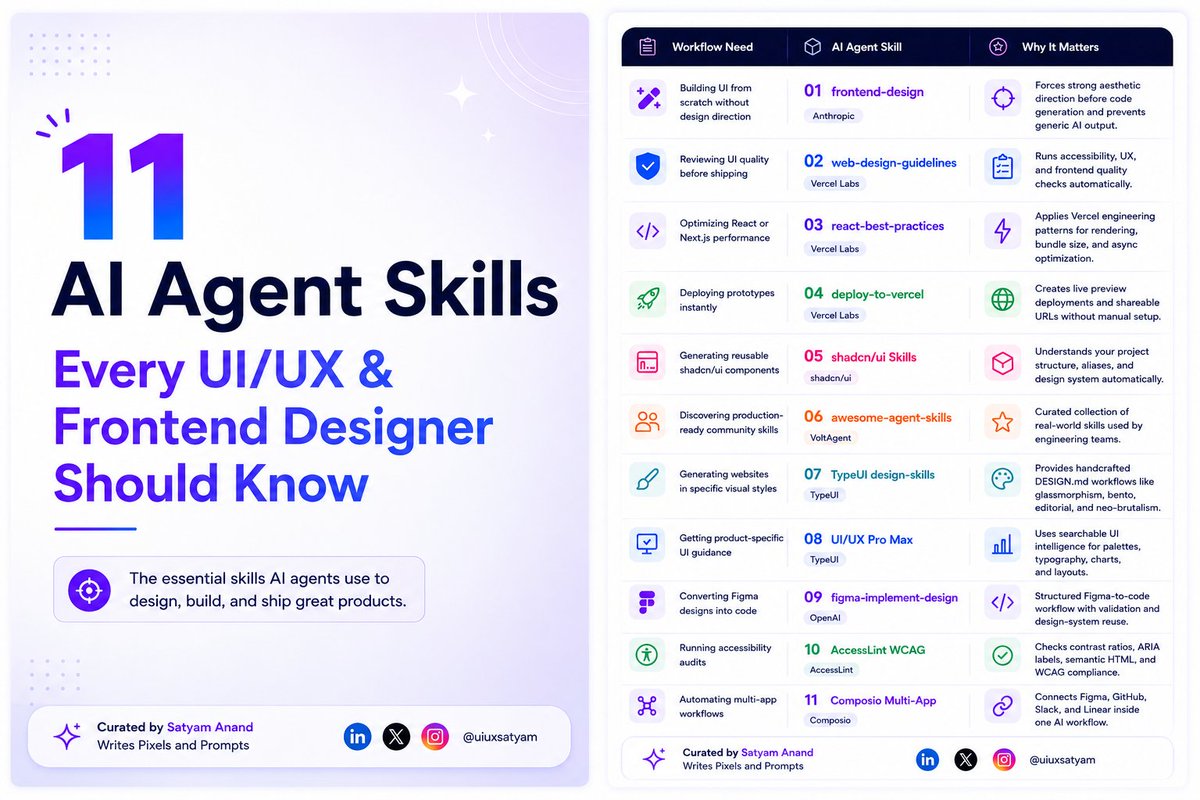
Most AI-generated websites still look the same. Same gradients. Same layouts. The missing piece? Context. I just published a breakdown of 11 powerful Agent Skills that give tools like Claude , Cursor, and Codex actual frontend intelligence. Read here : open.substack.com/pub/pixelsprom…
Satyam Anand tweet media
English
1
0
0
32
CliffDoesAI
CliffDoesAI@CliffDoesAI·
A guy wrote a book called "The Future of Truth" using AI. The AI made up quotes. Multiple fabricated sources. The New York Times found them. The Atlantic dug deeper. The author's response? He took "full responsibility" — but in the same breath blamed the chatbots for "betraying" him. Then told Ars Technica he still plans to use AI in his writing. His exact words: "AI is often a delightful writing companion... and then it betrays you in ways that are just really quite horrible." This is the wrong lesson. Completely. AI didn't betray this guy. He skipped the verification step and published the output as final. That's not a tool problem. That's a workflow problem. I use AI every day. Claude writes drafts for me. Codex generates code. Hermes publishes my content. But here's the part nobody talks about: I read every word before it goes out. I verify every claim. If I can't trace a stat back to a source, I cut it. The AI didn't fabricate quotes because it's malicious. It fabricated quotes because that's what language models do when you don't give them enough context or verification steps. They fill in the gaps. Sometimes they hallucinate. That's a known limitation, not a betrayal. If you're using AI for anything that goes public — writing, code, analysis, whatever — your job isn't to prompt better. Your job is to verify better. The author said the fabricated quotes "do not, in fact, diminish the larger questions that the book raises." That's like a chef saying the food poisoning doesn't diminish the recipe. The trust is gone. If I can't trust your facts, I can't trust your argument. Building with AI means building verification into your workflow. Every output gets checked. Every claim gets sourced. Every hallucination gets caught before it ships. The people who treat AI like a magic box that produces finished work will keep getting burned. The people who treat it like a very fast junior team member — brilliant but needs review — will build things that actually hold up. What's your verification step before publishing AI-assisted work?
CliffDoesAI tweet media
English
0
0
0
11