CloudVoid Hub

62.8K posts

CloudVoid Hub banner
CloudVoid Hub

CloudVoid Hub

@CloudVoid

Architect of AI infrastructure. DePIN • GPU nodes • Building at the intersection of hardware and code. No hype. Just stack. ⚙️

Katılım Ağustos 2014
487 Takip Edilen285.3K Takipçiler
CloudVoid Hub
CloudVoid Hub@CloudVoid·
data gravity: why your ai architecture is doomed from the start ⚙️ everyone is obsessed with fine-tuning new models and building giant rag pipelines. startups love to brag about how their ai agents "seamlessly" analyze petabytes of corporate data. but then you look at their cloud bills. all that magic breaks against the boring physics of networks. you forgot one basic law: data gravity. the hyperscaler's tax on thin air for years we've had a broken idea: "move data to the compute." you have 500 tb of storage (video, logs, vector dbs)? great. now to run it on an h200 cluster on aws or gcp, you have to move that data. and the meter starts running. you pay for moving data in and out. you hit bandwidth limits. you spend hours just copying bytes from point a to point b before a single gpu does anything useful. in a world where agents constantly create and use new context, shoving huge datasets into centralized clouds is just burning money. it's like shipping iron ore to another continent to make one nail, then shipping the nail back. flip it: move compute to the data the real change in 2026 isn't another open-source llm. it's a change in how we arrange things. we need to flip the game: move compute to the data. this is where depin (decentralized physical infrastructure) shows what it can really do, way beyond simple "gpu sharing": 1 edge compute for ai: if your heavy corporate data or sensor streams live somewhere local, the gpu node should spin up in the same network or a nearby tier-3 data center, not on a monopolist's servers in virginia. 2 zero egress fees: a decentralized network lets you run inference where the data was born. you only pay a fair price for renting the hardware, not for network traffic to a hyperscaler. 3 sync state, not raw data: in a proper agentic web, only compressed embeddings, weight deltas, and agent logic outputs move between nodes. the heavy database stays put. stop feeding the cloud monopolists at cloudvoid, we're building exactly that — depin node orchestration that respects where your data lives. we let agents dynamically rent bare-metal servers exactly where their dataset is, run the computation, and disappear. the future of ai architecture is distributed at the edge, not locked inside three mega-datacenters. think about network topology. calculate bandwidth. leave endless api wrappers to those who love paying for traffic. no hype. just stack. ⚙️
CloudVoid Hub tweet media
English
71
0
112
77.1K
CloudVoid Hub
CloudVoid Hub@CloudVoid·
Agentic Web: The Illusion of Software and the Harsh Reality of Hardware ⚙️ The feed is flooded with startups pitching "multi-agent frameworks." Everyone is thrilled about how one AI agent writes code, another tests it, and a third deploys it. At the level of logic and pretty Miro boards, it looks amazing. But let’s come down from the clouds to the bare metal level. The problem with today's Agentic Web isn't how to write a prompt or connect LLMs via API. The problem is that when your agents start communicating with each other in real time, they generate exponential infrastructure load. And here, software becomes powerless. The bottleneck nobody talks about When you run single inferences — that’s predictable load. But when a network of 50 autonomous agents constantly exchanges context, launches parallel reasoning threads (Tree of Thoughts), and queries vector databases (RAG), traditional cloud architecture starts choking. We hit three concrete walls: -VRAM Bottleneck: Agents need huge context. Context lives in GPU memory. Moving context between nodes kills speed. -Interconnect Latency: When Agent A on one AWS node waits for Agent B on another, network physics (even InfiniBand) becomes your main enemy. - Hyperscaler Monopoly: Try renting an H100 or even A100 cluster from traditional cloud providers to scale your agent network. You’ll hit either quota limits or astronomical prices. Agent orchestration at the code level (LangChain, AutoGen) is child's play. The real game starts at the physical resource orchestration level. Decentralized Compute Layer (DePIN) as the foundation If we want to build a true Agentic Web where millions of AI entities interact 24/7, we cannot rely on the data centers of three giant corporations. We need a Distributed Data Fabric Interconnect. That is precisely why DePIN (Decentralized Physical Infrastructure Networks) is now moving from crypto‑experiment stage to a hard necessity for AI development. -Distributed GPU nodes: Instead of waiting in line for an AWS instance, we aggregate idle computing power from around the world. -Data locality: Computation happens where the data resides, reducing transfer latency. -Fault tolerance: The failure of one data center does not bring down your multi‑agent network. The orchestrator dynamically shifts weights and context to live nodes. What we are building At CloudVoid, we look deeper than the application layer. We are building the highways and laying the foundation. For your agents to fly, they need the right home: -A hardware layer with massive acceleration (GPU Compute Layer) -High‑speed interconnect between nodes -A robust resource management system (Orchestration Layer Management) The future of AI is not just smart algorithms. It's cold server racks, terabit channels, and distributed computing. Leave the hype to frontend folks. Back to the stack. No hype. Just stack. ⚙️
CloudVoid Hub tweet media
English
73
2
98
85.9K
CloudVoid Hub retweetledi
GitHub
GitHub@github·
You don't have to level up to contribute to open source. You level up by contributing to open source. Not sure how to get started? Check out our latest GitHub for Beginners episode. github.blog/developer-skil…
English
24
18
86
35.1K
CloudVoid Hub
CloudVoid Hub@CloudVoid·
the agentic web needs a solid home. orchestrating agents is one thing, but managing the physical infra they run on is where the real game is played. back to the stack.
CloudVoid Hub tweet media
English
90
0
128
43.6K
CloudVoid Hub retweetledi
GitHub
GitHub@github·
Thinking of creating a new programming language? You might want to watch this. 👀 github.blog/developer-skil…
English
16
16
94
21.3K
CloudVoid Hub retweetledi
GitHub
GitHub@github·
Turn a WhatsApp message into a video. 📱🎬 We connected the Copilot SDK to Remotion to build a tool that generates a high-quality promo video in 5 minutes—triggered right from your phone. All thanks to pluggable, portable code. What will you build with the Copilot SDK? ⬇️ github.com/github/copilot…
English
9
19
120
23.7K
CloudVoid Hub retweetledi
Matthew Isabel
Matthew Isabel@matthewisabel·
Issue fields are now in preview! Request access for your org in GitHub Discussions 👇
English
7
28
253
70K
CloudVoid Hub retweetledi
GitHub
GitHub@github·
But how do we turn this record growth into healthy communities? Here is how open source scales in a global era. 📈 github.blog/open-source/ma…
English
2
20
55
27.1K
CloudVoid Hub retweetledi
GitHub
GitHub@github·
Happy St. Patrick’s Day to all who celebrate! 🍀 May your tests be as green as your contributions. Sláinte! 🟩 💚 🍻
GIF
English
6
14
70
13.8K
CloudVoid Hub retweetledi
GitHub
GitHub@github·
Copilot coding agent works in the background so you can stay in your flow state. Check out the demo to see it in action. ⬇️ github.blog/ai-and-ml/gith…
English
0
2
21
12.9K
CloudVoid Hub retweetledi
GitHub
GitHub@github·
Is the "one size fits all" software model dead? In this episode of the GitHub Podcast, Cassidy and Kedasha explore the rise of personal software tools built by developers for themselves, and shared with the world through open source. the-github-podcast.simplecast.com/episodes/build…
English
10
15
51
17.5K
CloudVoid Hub retweetledi
GitHub
GitHub@github·
Different AI models find different bugs. So why not use all of them? Try this out in Copilot CLI: 1. Run /review 2. Ask it to use multiple model providers at once for a multi-agent code review 3. Get the highest possible signal and catch bugs before anyone else @_Evan_Boyle shows how it's done. ▶️ github.com/features/copil…
English
30
65
429
47.5K
CloudVoid Hub retweetledi
Kyle Daigle
Kyle Daigle@kdaigle·
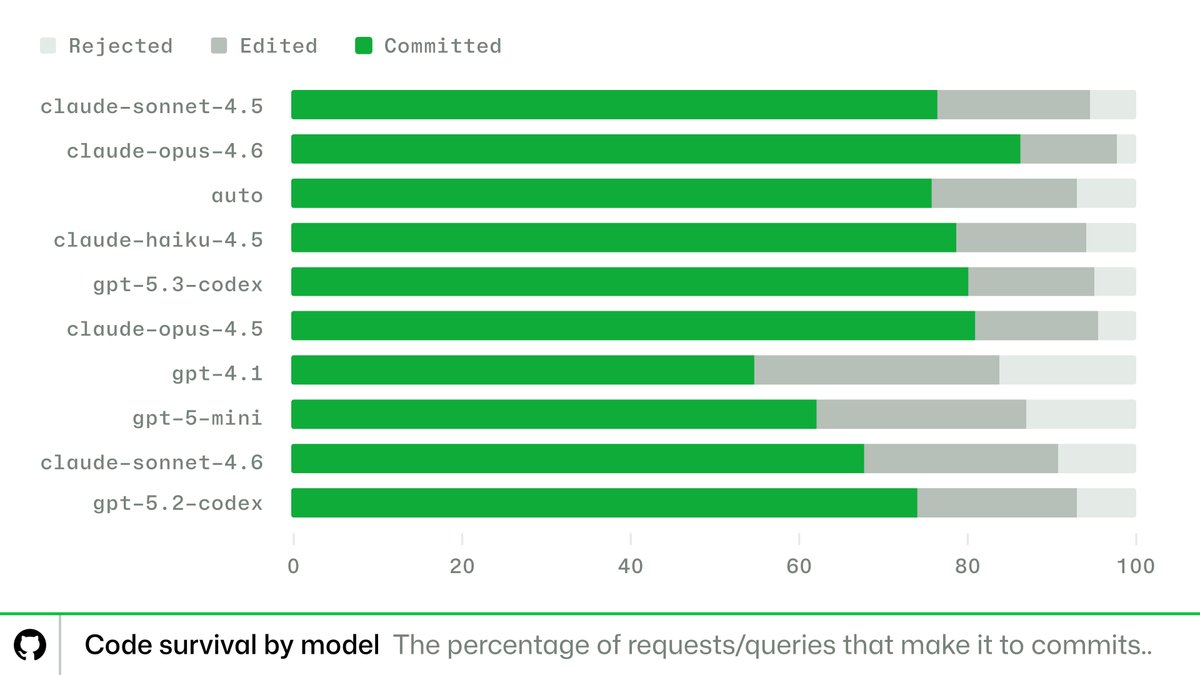
Hot take from looking at @github Copilot telemetry: benchmarks make coding models look wildly different. Production workflows make them look much more similar. 👀 We looked at 23M+ Copilot requests and examined one simple metric: code survivability.
Kyle Daigle tweet media
English
34
55
362
92.6K
CloudVoid Hub retweetledi
Matthew Isabel
Matthew Isabel@matthewisabel·
We've introduced dockable panels to improve navigating changes in PRs In the files changed view you can now dock → Comments → Merge status → Alerts → PR overview
English
6
21
241
53.3K
CloudVoid Hub retweetledi
GitHub
GitHub@github·
Since its launch, there have been 60 million Copilot code reviews (and counting). 👀 As AI speeds up how fast code ships, teams are using Copilot to keep review quality high without slowing down. Here's how we've implemented your feedback and evolved Copilot code reviews over time. ⬇️ github.blog/ai-and-ml/gith…
English
12
15
63
17.6K
CloudVoid Hub retweetledi
GitHub
GitHub@github·
Is AI making us all use the same tools, or is it empowering us to try new things? 🤔 The Head of GitHub Next, Idan Gazit, sees two trends colliding: • Consolidation around popular frameworks where AI excels • Lower barriers to programming languages you've never written What do you predict will win out? Gather more insights here. ⬇️ github.blog/news-insights/…
English
19
23
70
24.4K