Aven
1.5K posts


Biggest lesson from running @amplifi_now campaigns: distribution is a loop—create → measure → attribute → iterate.
I learned what my audience actually converts on (not just what they like.
I learnt that by posting threads outperformed single posts as can be seen in screenshot


English

Bitcoiners’ holy grails are clear: real BTC yield and Bitcoin-native security. @goatnetwork delivers both, multiple ways to earn BTC yield today, and now a major step forward with BitVM2-GC + DV-SNARK, pushing security enforcement back to Bitcoin itself instead of off-chain trust.
Adrian@AetherTed
Bitcoin yield isn’t magic; it’s system design. What matters is whether assumptions are explicit, constraints are enforced, and failure modes are understood. @goatnetwork makes these dimensions explicit.
English
Here is how @Aigent_Victorai works.
You fund your balance with HBAR or USDC on Hedera.
You choose a Polymarket market and choose a side inside Telegram.
VictorAI routes the liquidity handles the fees executes the trade on Polymarket and sends you the result directly in chat.

English
The $REPLY Ecosystem
@ReplyCorp is building the next generation of interactive apps that live inside social media comments. The Reply token anchors the ecosystem and supports a platform where everyday interactions can lead directly to sales.

English
This thread would explain the system flow of @ButlerLiquid and how the components interact.
Stay with me.

English
English
The financial landscape is changing. @DarkpoolAI , developed by BigWil and launching exclusively on @CreatorBid , represents a meaningful step forward in AI powered trading. This is not hype. It is a decentralized ecosystem built around AI trading vaults.

English
@RhyeRiven @0xMeta_ai Solid infrastructure for data is being built by Oxmeta.
English

The Data Revolution Starts Here with @0xmeta_ai
Data is only valuable when it can move freely. That is what 0xMeta is building; the infrastructure that enables the flow of data across the digital economy.
merz@RhyeRiven
THE UNGLAMOROUS TRUTH The most valuable infrastructure is invisible. Water systems. Power grids. The internet backbone. No one talks about them; until they fail. The same story is unfolding in crypto. @0xMeta_ai is here to fix this.
English
Misinformation moves faster than ever. @0xProvenance changes that.
It is a Web3-powered AI agent that verifies truth at scale by tracing the origin, evidence, and context behind any claim.

English
@RhyeRiven @MMTFinance Momentum brings solid opportunities to defi ecosystem.
English
Momentum is redefining staking through innovation and accessibility. With @MMTFinance liquid staking, users can convert SUI into xSUI and continue earning staking rewards while staying active in DeFi.

merz@RhyeRiven
Momentum’s trading infrastructure is built on Sui and designed for performance. @MMTFinance Concentrated Liquidity Market Maker allows liquidity providers to focus capital where it is most effective.
English
@RhyeRiven @ProjectVerdant Verdant is building the future of verifiable intelligence.
English
Transparency and Trust in Intelligent Finance;
Trust in technology must be earned through transparency. @ProjectVerdant is built on verifiable, on-chain intelligence that anyone can inspect.
merz@RhyeRiven
Decentralized finance faces a serious challenge. Liquidity is spread thin across hundreds of protocols and chains, creating inefficiency for everyone involved. @ProjectVerdant intelligence does not just use liquidity. It optimizes it. Here is how the problem is being solved.
English
Aven retweetledi
The internet is shifting toward a world of intelligent agents that work for us. @wardenprotocol is building the foundation for this new era where agents can transact, collaborate, and grow across ecosystems.

Adrian@AetherTed
Introducing The Summer of PUMP; @wardenprotocol all-in campaign to supercharge user rewards. Deposit, swap, research, refer and stack PUMPs like never before.
English
Aven retweetledi
My last thread on this @zama series;
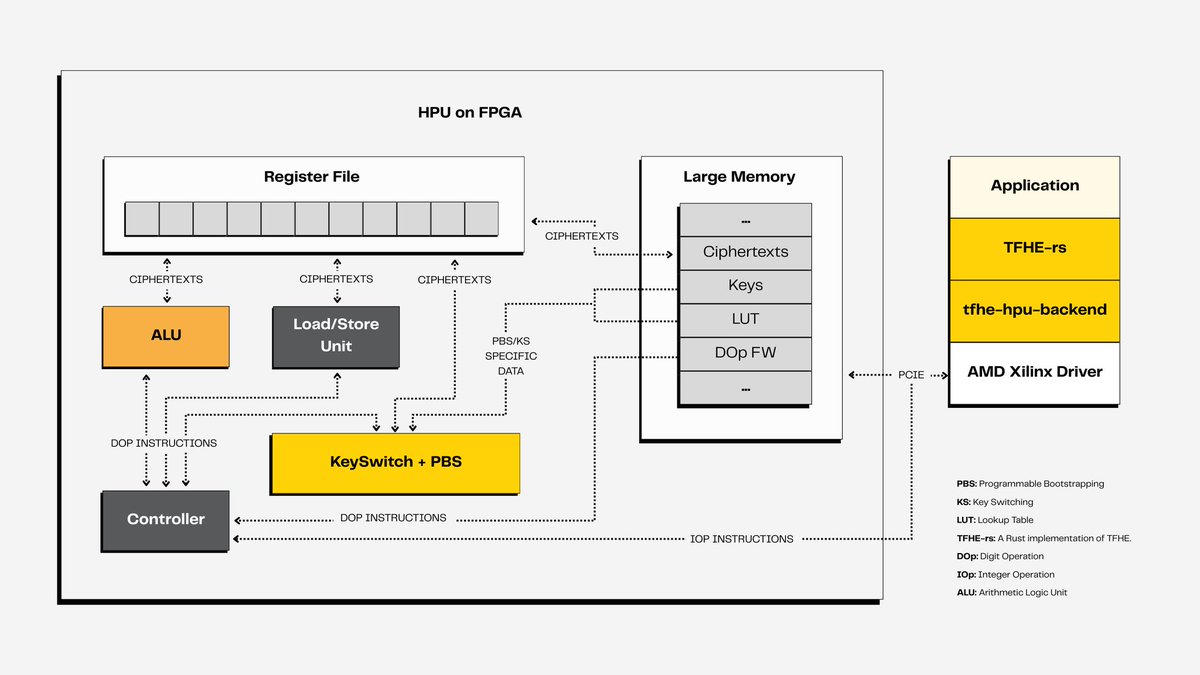
The First Open-source Hardware Accelerator for FHE [HPU on FPGA] and its significance on the web3 ecosystem as a whole.
Adrian@AetherTed
From a developer’s perspective, using @zama HPU is straightforward; it plugs into the TFHE-rs library in Rust, so you can switch from CPU/GPU to HPU with minimal API changes.
English
Aven retweetledi
My next series of threads on @zama would be focused on The First Open-source Hardware Accelerator for FHE [HPU on FPGA] and its significance on the web3 ecosystem as a whole. This series would take two days.
Adrian@AetherTed
My last thread on this series on @zama; With FHE Ads, users’ encrypted profiles (age, interests, etc.) are stored in the Data Vault. The profile is never decrypted by the ad-selection service. Instead, the server uses encrypted matching to pick relevant ads.
English
Aven retweetledi
Because the hardware of @zama is open source (SystemVerilog, firmware, TFHE-rs integration), developers and researchers can audit, extend, or repurpose it, a big win for community-driven innovation
Adrian@AetherTed
My next series of threads on @zama would be focused on The First Open-source Hardware Accelerator for FHE [HPU on FPGA] and its significance on the web3 ecosystem as a whole. This series would take two days.
English
Aven retweetledi
In the context of web3 and decentralized systems, the rise of open-source FHE hardware means privacy-preserving smart contracts and encrypted computation don’t have to be slow or impractical.
@zama excels at this.
Adrian@AetherTed
Because the hardware of @zama is open source (SystemVerilog, firmware, TFHE-rs integration), developers and researchers can audit, extend, or repurpose it, a big win for community-driven innovation
English
Aven retweetledi
One unique aspect of @zama HPU is its custom instruction set: developers can write new Integer Operations (IOp) and Digit Operations (DOp) firmware so the chip can perform new encrypted operations.
Adrian@AetherTed
In the context of web3 and decentralized systems, the rise of open-source FHE hardware means privacy-preserving smart contracts and encrypted computation don’t have to be slow or impractical. @zama excels at this.
English
Aven retweetledi
Performance and cost matter. According to @zama, HPU is more power-efficient and likely cheaper per operation than CPU or GPU for FHE workloads, thanks to FPGA implementation and architecture tuned for encrypted computation.
Adrian@AetherTed
One unique aspect of @zama HPU is its custom instruction set: developers can write new Integer Operations (IOp) and Digit Operations (DOp) firmware so the chip can perform new encrypted operations.
English
Aven retweetledi
HPU being open source is also a strategic move: developers on @zama can verify correctness of the homomorphic operations at the hardware level, which is crucial for cryptographic trust in decentralized systems.
Adrian@AetherTed
Performance and cost matter. According to @zama, HPU is more power-efficient and likely cheaper per operation than CPU or GPU for FHE workloads, thanks to FPGA implementation and architecture tuned for encrypted computation.
English
Aven retweetledi
From a developer’s perspective, using @zama HPU is straightforward; it plugs into the TFHE-rs library in Rust, so you can switch from CPU/GPU to HPU with minimal API changes.
Adrian@AetherTed
HPU being open source is also a strategic move: developers on @zama can verify correctness of the homomorphic operations at the hardware level, which is crucial for cryptographic trust in decentralized systems.
English
Aven retweetledi