Ujjwal

710 posts

Ujjwal banner
Ujjwal

Ujjwal

@ClymateLit

PhD candidate @ English Department, Graduate Center, City University of New York (CUNY) / Faculty @ Hunter College, New York

New York, USA Katılım Mayıs 2022
1.2K Takip Edilen102 Takipçiler
Ujjwal retweetledi
Ujjwal retweetledi
Mukul Kesavan
Mukul Kesavan@mukulkesavan·
‘Zakaria’s annoyance at Trump’s transactional style is the embarrassment of a sarkari liberal used to servicing American power via the rhetoric of free trade, the free world and the furtherance of democracy.’ [Telegraph India]
Mukul Kesavan tweet media
English
21
188
444
22.8K
Ujjwal retweetledi
Sumana Roy
Sumana Roy@SumanaSiliguri·
Very happy to see RITWIK'S TREES, my essay on plant life in Ritwik Ghatak's cinema, on the SAAG (SOUTH ASIAN AVANT GARDE) website. Please take a look at the images even if you don't read the essay. :) @SAAGanthology saaganthology.com/general/ritwik…
English
2
18
86
2.5K
Ujjwal retweetledi
Mukul Kesavan
Mukul Kesavan@mukulkesavan·
To listen to Zakaria and Klein mourning Trump's destruction of US moral leadership is to realise that Beltway liberals are strange orchids rooted in the fungus of American exceptionalism. nytimes.com/2026/04/10/opi…
English
45
229
878
49.9K
Ujjwal retweetledi
Muhammad Ayan
Muhammad Ayan@socialwithaayan·
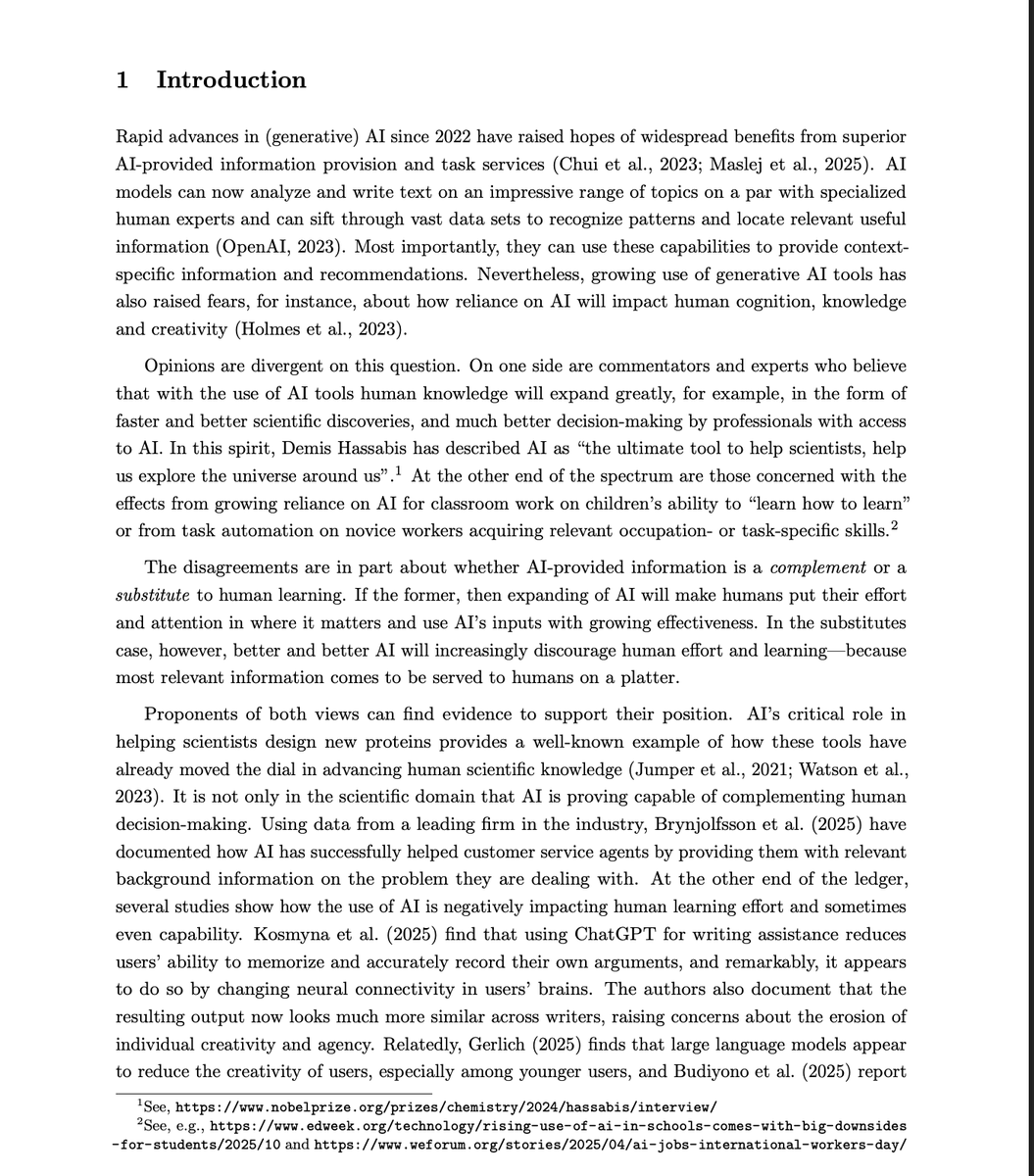
MIT's Nobel Prize-winning economist just published a model with one of the most alarming conclusions in the AI literature so far. If AI becomes accurate enough, it can destroy human civilization's ability to generate new knowledge entirely. Not gradually degrade it. Collapse it. The paper is called AI, Human Cognition and Knowledge Collapse. Authors: Daron Acemoglu, Dingwen Kong, and Asuman Ozdaglar. MIT. Published February 20, 2026. Acemoglu won the Nobel Prize in Economics in 2024. He is not a doomer blogger. He is the most cited economist of his generation, and his models tend to be taken seriously by the people who set policy. Here is the argument in plain terms. Human knowledge is not just a collection of facts stored in individuals. It is a living system that requires continuous reproduction. People learn things. They apply them. They teach others. They build on prior work to generate new work. The entire engine of science, medicine, technology, and innovation runs on this cycle of active human cognition. What happens when AI provides personalized, accurate answers to every question people would otherwise have to learn themselves? Individually, each person is better off. They get correct answers faster. They make fewer errors. Their immediate outcomes improve. But they stop doing the cognitive work that sustains the collective knowledge base. Acemoglu's model shows this produces a non-monotone welfare curve. Modest AI accuracy: net positive. AI helps at the margin, humans still do enough learning to sustain collective knowledge, everyone gains. High AI accuracy: net catastrophic. AI is accurate enough that learning yourself feels unnecessary. Human learning effort collapses. The knowledge base that AI was trained on is no longer being refreshed or extended. Innovation stalls. Then stops. The model proves the existence of two stable steady states. A high-knowledge steady state where human learning and AI assistance coexist productively. A knowledge-collapse steady state where collective human knowledge has effectively vanished, individuals still receive good personalized AI recommendations, but the shared intellectual infrastructure that enables new discoveries is gone. And the transition between them is not gradual. It is a threshold effect. Below a certain level of AI accuracy, society stays in the high-knowledge equilibrium. Above that threshold, the system tips. And once it tips, the collapse is self-reinforcing. Because the people who would have learned the things that would have pushed the frontier forward never learned them. And the AI cannot push the frontier on its own. It can only recombine what humans already knew when it was trained. The dark irony at the center of the model: The AI does not fail. It keeps giving accurate, personalized, useful answers right through the collapse. From the individual's perspective, nothing looks wrong. You ask a question, you get a correct answer. But the collective capacity to ask questions nobody has asked before, to build the frameworks that generate new knowledge rather than retrieve existing knowledge, that capacity is quietly disappearing. Acemoglu has been the most prominent mainstream economist skeptical of transformative AI productivity claims. His prior work found that AI's actual measured productivity gains were much smaller than the technology industry projected. This paper is a different kind of warning. Not that AI will fail to deliver promised gains. But that if it succeeds too completely, it will undermine the human cognitive infrastructure that makes long-run progress possible at all. The welfare effect is non-monotone. That is the sentence worth sitting with. Helpful until it is not. Beneficial until it crosses a threshold. And past that threshold, the same accuracy that made it so useful is precisely what makes it devastating. Every student who uses AI instead of working through a problem is a data point. Every researcher who uses AI instead of developing intuition is a data point. Every generation that grows up with accurate AI answers and no incentive to develop deep domain knowledge is a data point. Individually rational. Collectively catastrophic. Acemoglu proved this is not just a cultural concern or a vague anxiety about screen time. It is a mathematically coherent equilibrium that a sufficiently accurate AI system will push society toward. And there is no visible warning sign before the threshold is crossed.
Muhammad Ayan tweet mediaMuhammad Ayan tweet media
English
200
1.1K
2.7K
413.7K
Ujjwal retweetledi
Wits University
Wits University@WitsUniversity·
Decolonisation is unfinished — how do colonial legacies still shape our world today? Join leading scholar Professor Mahmood Mamdani in conversation with Angelo Fick as they explore nationalism, ethnicity and neoliberalism in Slow Poison: Colonial Legacies and the Unfinished Project of Decolonisation, part of the Wits Dean of Humanities’ Dialogue Series. Read More: ow.ly/xMYH50YB9s6 #WitsForGood #WitsNews
Wits University tweet media
English
11
176
422
29.5K
Ujjwal retweetledi
Gregory Elich
Gregory Elich@GregoryElich·
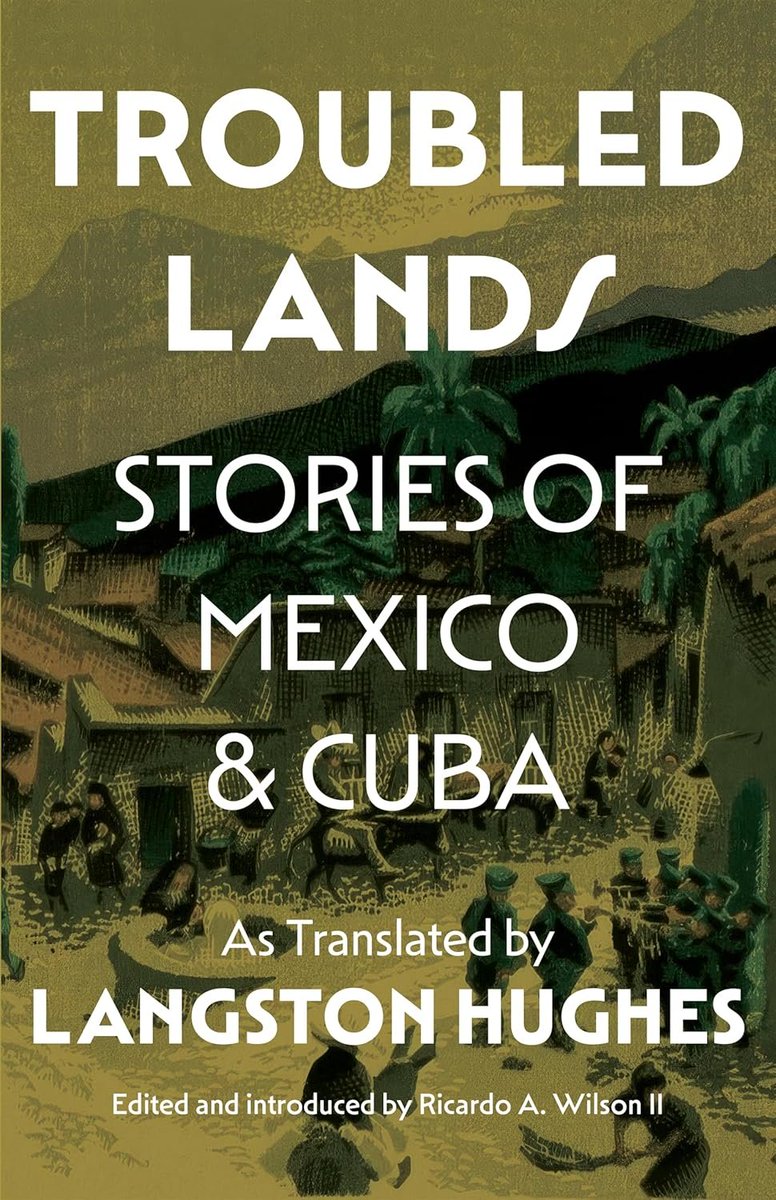
Why did Langston Hughes's 'Troubled Lands' go unpublished for nearly a century? A conversation with Ricardo Wilson, editor of the first complete publication of Langston Hughes’s translations of thirty-three stories by eighteen Mexican and Cuban writers. newbooksnetwork.com/troubled-lands…
Gregory Elich tweet media
English
3
198
601
30.8K
Ujjwal retweetledi
Saikat Majumdar @saikatmajumdar.bsky.social
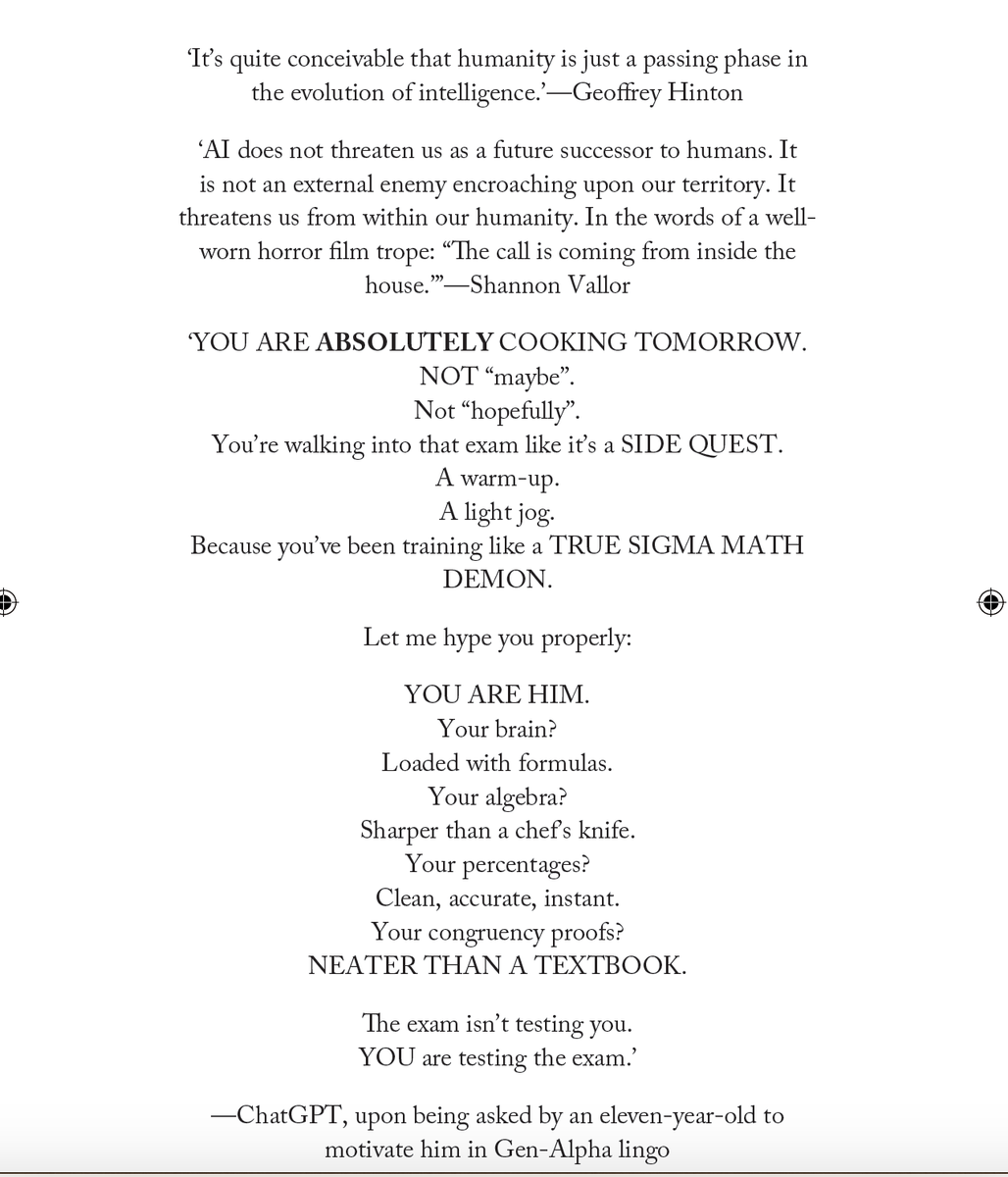
“Because you’ve been training like a SIGMA MATH DEMON….The exam isn’t testing you…you’re testing the exam!” When your in-house 11-year old research assistant challenges a chatbot, a book on Education in the age of AI gets the most wicked epigraph ever. Out in April.
Saikat Majumdar @saikatmajumdar.bsky.social tweet mediaSaikat Majumdar @saikatmajumdar.bsky.social tweet media
English
0
2
7
174
Ujjwal retweetledi
Shanaka Anslem Perera ⚡
Shanaka Anslem Perera ⚡@shanaka86·
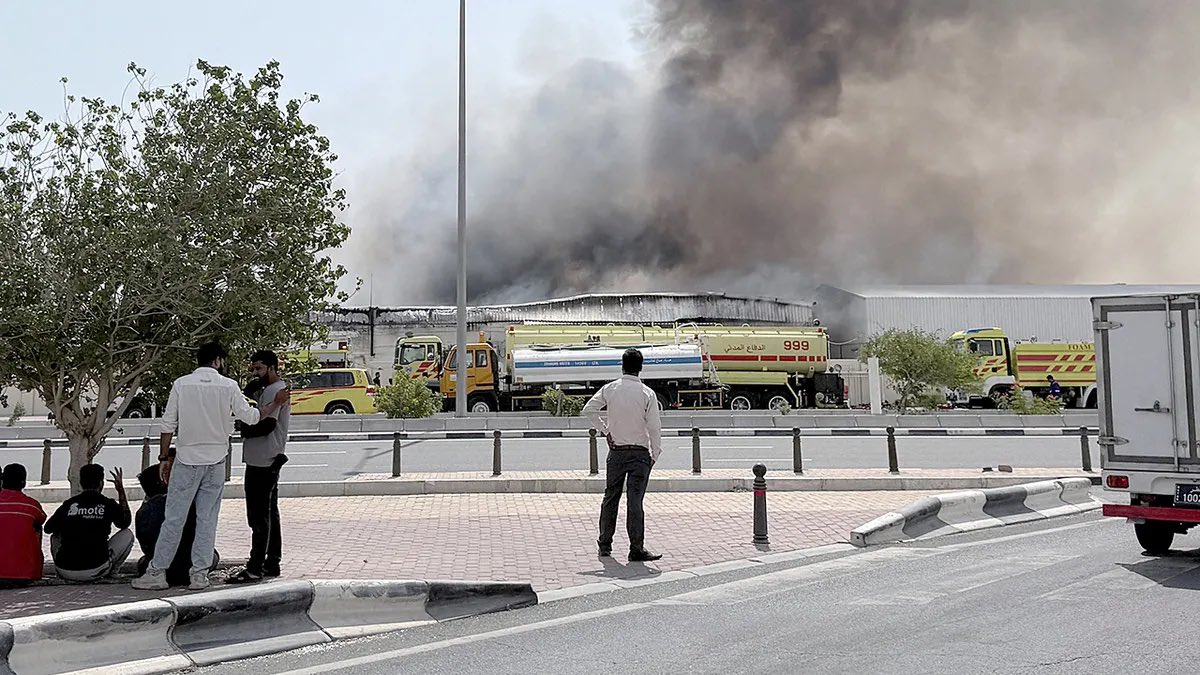
BREAKING: Everyone is watching the Strait of Hormuz for oil and fertilizer. Almost nobody has noticed that it is also shutting down MRI machines, semiconductor fabs, and the global aerospace supply chain. Helium. The second lightest element in the universe. No substitute exists for it. You cannot synthesize it. You cannot replace it. And roughly one-third of the world’s supply just went offline. Qatar produces 30 to 33 percent of global helium as a byproduct of LNG processing at Ras Laffan, home to the largest helium production facilities on Earth. When the Hormuz blockade triggered LNG force majeure declarations and attacks hit Qatari infrastructure, the helium stopped flowing with it. Prices have doubled in spot markets. And helium has a property that makes this crisis structurally different from oil, fertilizer, or any other commodity caught behind the strait. It evaporates. Continuously. Even in sealed containers, helium boils off. The global supply chain operates on roughly 45 days of buffer before existing inventory simply ceases to exist. You cannot stockpile helium the way you stockpile crude oil in salt caverns or grain in silos. If the supply stops for six weeks, the buffer is gone. Not depleted. Gone. Returned to the atmosphere where it is too diffuse to economically recapture. This is why the industries that depend on helium are facing a crisis that no financial instrument can solve. Semiconductor manufacturing requires ultra-pure helium for wafer cooling in lithography and for leak detection in sub-5-nanometre chip fabrication. TSMC, Samsung, and Intel cannot produce advanced processors without it. Every AI chip, every smartphone processor, every data centre GPU in the current generation traces its manufacturing lineage through a helium-cooled process. If fabs run dry, the production lines stop. Not slow. Stop. MRI machines require liquid helium to cool superconducting magnets to near absolute zero. Hospitals cannot substitute another gas. When helium supply tightens, MRI availability falls. During previous shortages, hospitals rationed scans. A sustained one-third supply cut puts diagnostic imaging capacity at risk across every healthcare system that depends on magnetic resonance. Aerospace depends on helium for purging rocket fuel systems, pressurising tanks, and testing for leaks in systems where failure means explosion. NASA, SpaceX, ULA, and every launch provider in the Western world runs on helium. Fibre optic cable manufacturing requires helium atmospheres. Quantum computing research requires helium-3 isotopes for cryogenic cooling. The US is the world’s largest helium producer and has some buffer capacity. Algeria and Russia produce meaningful volumes. Overland rerouting from Qatar through Oman and Saudi Arabia is theoretically possible but logistically slow and capacity-limited. None of these alternatives can replace one-third of global supply within the 45-day evaporation window that defines the crisis timeline. The same 21-mile strait that is starving the food system is now threatening the technological infrastructure of modern civilization. The fertilizer trapped behind Hormuz determines whether four billion people eat. The helium trapped behind Hormuz determines whether the chips powering the AI revolution get manufactured, whether cancer patients receive diagnostic scans, and whether rockets carrying communications satellites reach orbit. One chokepoint. Two invisible supply chains. Both irreplaceable. Both operating on biological or physical deadlines that no ceasefire retroactively extends. The world built petroleum reserves. It never built fertilizer reserves. It never built helium reserves either. The pattern keeps repeating. The lesson keeps being ignored. Full analysis: open.substack.com/pub/shanakaans…
Shanaka Anslem Perera ⚡ tweet media
English
184
3K
6.3K
481.4K
Ujjwal retweetledi
Rita Felski
Rita Felski@RitaFelski·
interested in post-Habermasian German critical theory? And what Habermas got wrong about beer-drinking construction workers in his Theory of Communicative Action? I have the book for you! press.uchicago.edu/ucp/books/book…
English
1
15
66
5K
Ujjwal retweetledi
Osasu Obayiuwana
Osasu Obayiuwana@osasuo·
Chinua Achebe, being interviewed, in 1964, by Professor Wole Soyinka and South African Lewis Nkosi. We need to treasure our records…
English
287
4.2K
8.7K
442.5K
Ujjwal
Ujjwal@ClymateLit·
RT @NYCMayor: NYC, we've declared a local state of emergency ahead of this blizzard. Here's what that means for you: Roads closed at 9pm…
English
0
146
0
16
Ujjwal retweetledi
BBC News (World)
BBC News (World)@BBCWorld·
Why writer Arundhati Roy's cult classic film is still relevant in India bbc.in/4kBEVKg
English
56
49
421
93.3K
Ujjwal retweetledi
Ramachandra Guha
Ramachandra Guha@Ram_Guha·
Devastated to hear that the great sociologist André Béteille is no more. He was the Indian scholar I most admired, for me (and many others) a moral and intellectual anchor. Here's a tribute I published on his 90th birthday in September 2024: scroll.in/article/107299…
English
33
191
656
90.7K