Derrick Beechum

19.1K posts

Derrick Beechum banner
Derrick Beechum

Derrick Beechum

@coachbeechum

OWU Insights & Analytics Founder Economist, Sports, Data, & Nutrition Scientist, Basketball Media , Director of Talent Identification & Quantitative Analysis

Des Moines, IA Katılım Mayıs 2009
6.3K Takip Edilen5.2K Takipçiler
Sabitlenmiş Tweet
Derrick Beechum
Derrick Beechum@coachbeechum·
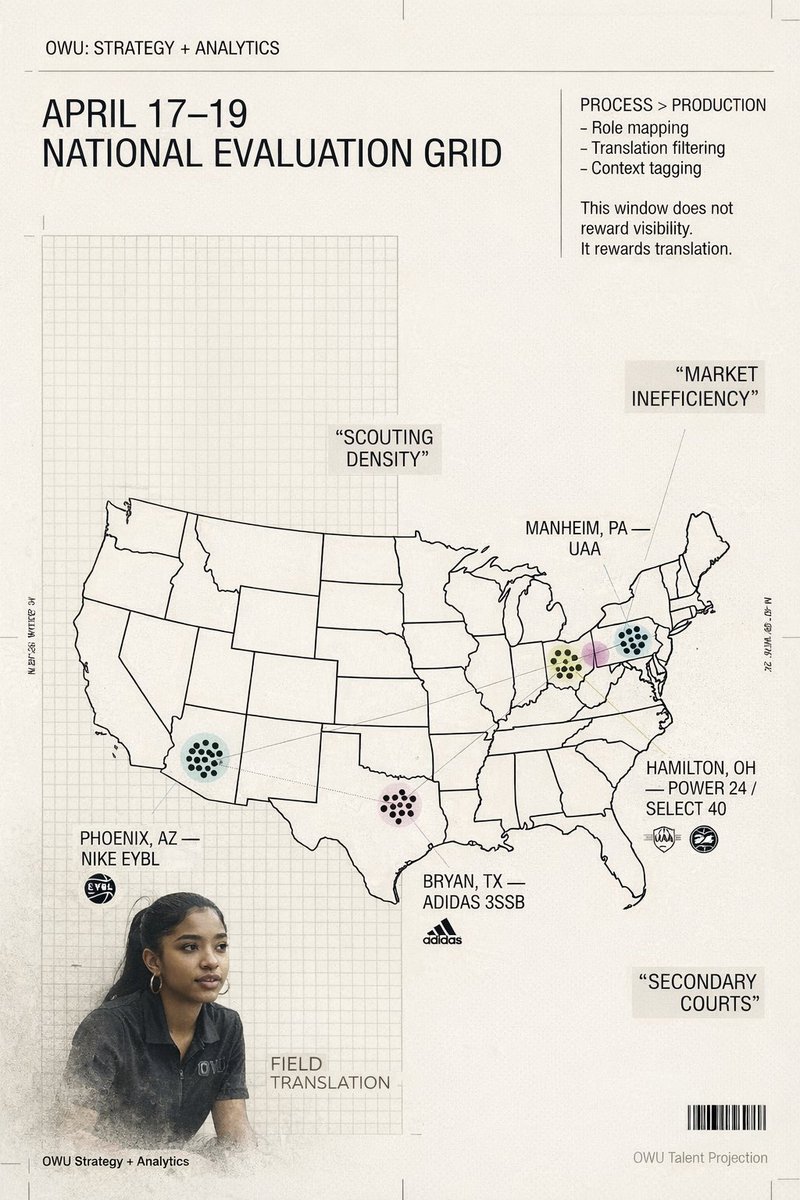
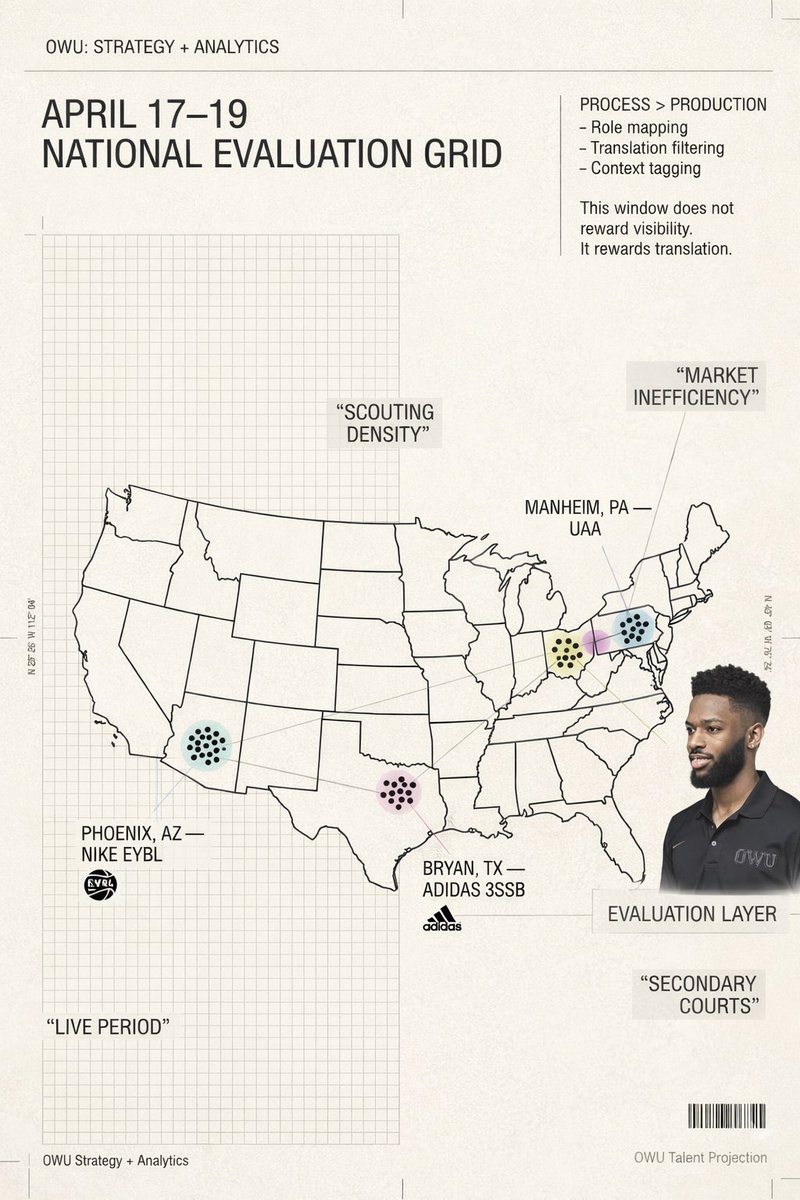
Drop That Schedule ‼️ OWU: Strategy and Analytics Institutional Coverage Expansion Brief The April 17–19 live period is the first full-scale convergence point of the 2026 scouting and evaluation ecosystem, with all four major circuits activating across distinct geographic nodes. Nike Girls EYBL opens with Session 1 in Phoenix, Arizona. Under Armour UAA Girls opens with Session I at Spooky Nook in Manheim, Pennsylvania. adidas Girls 3SSB opens with Session I at the Legends Event Center in Bryan, Texas. Power 24 and Select 40 open with The Clash / Session I East in Hamilton, Ohio. This distributed structure creates a national evaluation grid, forcing scouting operations to allocate attention with precision rather than volume. From an OWU lens, this is the opening inefficiency window of the scouting market. With Division I staffs still finalizing transfer portal boards, live evaluation coverage is present but fragmented. This creates a temporary gap between performance and recognition, particularly on secondary courts and within non-headline matchups. Our approach is structured around signal identification, not surface production. Early-session evaluations prioritize decision-making traits that translate: pace control, spatial awareness, defensive adaptability, and role clarity. These indicators remain stable across environments, while raw scoring output is highly sensitive to early-season volatility. Evaluation discipline centers on three layers. Role mapping to distinguish current usage from projected role. Translation filtering to separate system-driven output from independent creation. Context tagging to anchor every performance within competition level, lineup structure, and usage environment. This is where true scouting leverage is created. Who are we watching will not be defined by preloaded rankings alone. The focus is on players who demonstrate translatable traits under unstable conditions, particularly those operating in compressed roles or lower-visibility settings. These are the profiles most likely to be mispriced in the early cycle. Drop schedule will follow the structure of the live grid. Initial identification reports will release immediately following Session I, organized by circuit and tier. Secondary evaluation layers will track performance variance across subsequent sessions. Targeted deep dives will be triggered by role expansion, efficiency stability, or emergence against elevated competition. Each drop is designed to compound, not repeat. The objective is to build a clean, contextualized evaluation dataset ahead of market stabilization. As staffing normalizes and consensus forms, early signal identification becomes actionable intelligence. This weekend is not about who produces the most. It is about who translates first, and who is identified before the market corrects. #OWUEvalDay #ConceptuallyThinking #BuiltDifferent #PlayerTrustNetwork #ScoutingTruths [@PGHBrooks ] [@NXTPROG] [@JrAllStarBB] [] [@IGBRcoverage [@WorldExposureWB] [@_BlakeDerrick] [@WKGameBall] [@EconAdjunct] [@FiveStateHoops] [@OWUTALENT ][@PGHiowa ] [@JrAllStariowa ] @gemsinthegym
Derrick Beechum tweet mediaDerrick Beechum tweet mediaDerrick Beechum tweet media
English
1
0
1
252
Derrick Beechum
Derrick Beechum@coachbeechum·
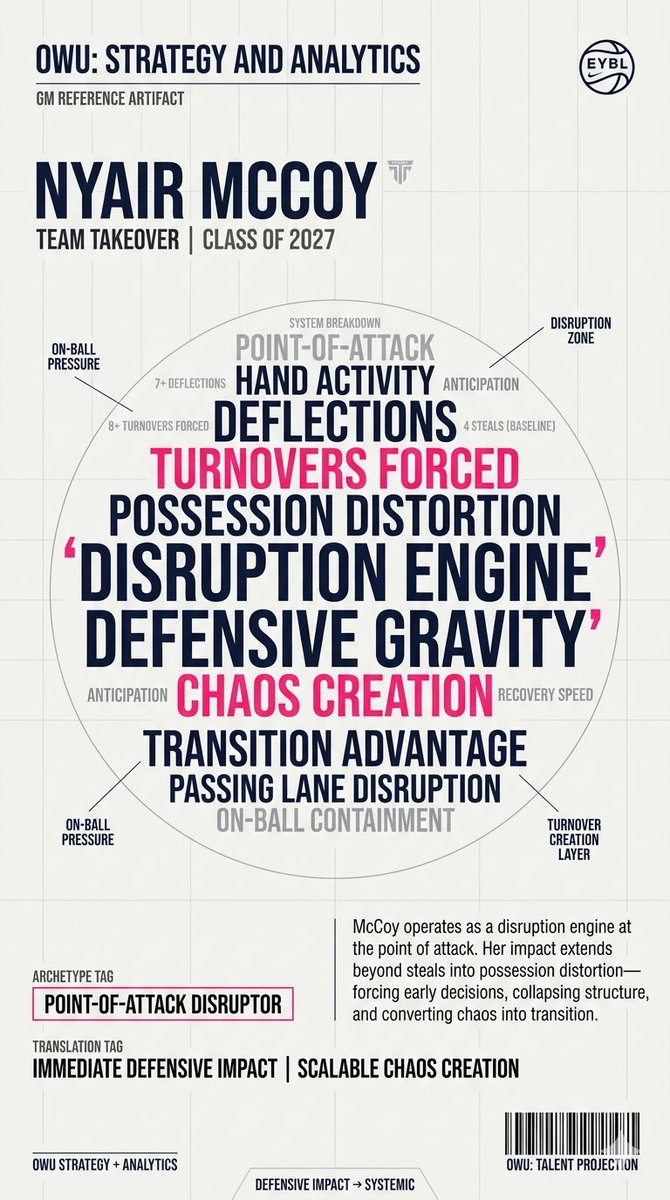
OWU: Strategy and Analytics GM Reference Artifact Nyair McCoy @TeamTakeoverGBB @Nyair_Mccoy McCoy is not simply a high-level point-of-attack defender—she is a disruption engine that collapses offensive structure at the initiation point. A four-steal baseline undersells her impact; the true value lies in the possession distortion she creates. With 7+ deflections and 8+ turnovers forced, her defensive profile extends beyond events into systemic breakdown. Her pressure operates across three layers. First, on-ball containment with elite lateral response forces early decision acceleration. Second, hand activity and anticipation generate deflection volume that interrupts passing windows before actions develop. Third, recovery speed allows her to convert chaos into transition advantage. This is defensive gravity. Offenses are not just guarded—they are redirected. McCoy projects as a high-leverage defensive catalyst at the next level, capable of shifting possession math without requiring scoring volume. In a system prioritizing turnover creation and tempo control, she becomes multiplicative. Archetype: Point-of-Attack Disruptor Translation: Immediate defensive impact with scalable chaos creation #OWUEvalDay #ConceptuallyThinking #BuiltDifferent #PlayerTrustNetwork #ScoutingTruths [@PGHBrooks ] [@NXTPROG] [@JrAllStarBB] [] [@IGBRcoverage [@WorldExposureWB] [@_BlakeDerrick] [@WKGameBall] [@EconAdjunct] [@FiveStateHoops] [@OWUTALENT ][@PGHiowa ] [@JrAllStariowa ] @gemsinthegym
Derrick Beechum tweet media
English
0
0
0
13
Derrick Beechum retweetledi
Seth Greenberg
Seth Greenberg@SethOnHoops·
What is the role of the General Manager in college basketball. I explain no BS just the facts.
English
32
50
455
151.7K
Derrick Beechum
Derrick Beechum@coachbeechum·
OWU: Conceptually Thinking Basketball STRATOS Model — Reference Grade Artifact Team Production Distribution Framework (WBB) Production has a distribution. It is not equal, and it is not random. It is structurally organized around possession control, decision authority, and role constraint within a team system. At the team level, scoring and impact follow a normal-like distribution with role-based skew. This is not a pure bell curve. It is a hierarchical curve where the top end is extended through usage concentration, and the lower tiers are compressed by limited opportunity. Teams are not flat systems. They are layered ecosystems. Three variables govern distribution: Possession control — who initiates and finishes actions Decision authority — who is trusted in high-leverage moments Role constraint — what actions each player is allowed to take Together, these determine how production concentrates. Tier 1 — Primary Engines The top one to two players control 35–45 percent of team scoring. Typical output ranges from 15–22 PPG for the lead and 10–16 PPG for the secondary. These players initiate offense, create advantages, and absorb defensive pressure. Their value is not just scoring, but control over the decision tree. They bend the defense. Tier 2 — Core Starters Three players typically account for another 35–45 percent of scoring, producing 8–14 PPG each. Their role is to stabilize the offense, convert secondary advantages, and maintain spacing and timing. They do not create the system, but they sustain it. They bridge star creation to team execution. Tier 3 — Rotation Connectors Three to five players generate 10–20 percent of scoring, typically 3–8 PPG each. Their value is efficiency within limited opportunities. They space the floor, defend, and make quick decisions. They punish mistakes. If these players require high usage to be effective, the system is misaligned. Tier 4 — Deep Bench Minimal offensive contribution, typically under 5 percent. This is structural, not a failure. These players provide depth and development value. Example: A 70-point team Tier 1: ~32 points Tier 2: ~27 points Tier 3: ~16 points Tier 4: minimal The structure holds even as individual games fluctuate. Key insight: production follows trust, not equality. Usage flows to players who can manage decisions under pressure. This creates an efficiency-volume tradeoff. Tier 1 carries volume and absorbs difficulty. Tier 3 must maintain efficiency in low-usage roles. In women’s basketball, this distribution becomes more top-heavy due to tighter rotations, compressed spacing, and guard-driven possession control. Geneva translation: You don’t have ten scorers. You have two creators, three stabilizers, and five connectors. Final principle: production organizes around possession control. Teams win when distribution aligns with role clarity. #OWUEvalDay #ConceptuallyThinking #BuiltDifferent #PlayerTrustNetwork #ScoutingTruths [@PGHBrooks ] [@NXTPROG] [@JrAllStarBB] [] [@IGBRcoverage [@WorldExposureWB] [@_BlakeDerrick] [@WKGameBall] [@EconAdjunct] [@FiveStateHoops] [@OWUTALENT ][@PGHiowa ] [@JrAllStariowa ] @gemsinthegym
Derrick Beechum tweet media
English
0
0
2
205
Derrick Beechum
Derrick Beechum@coachbeechum·
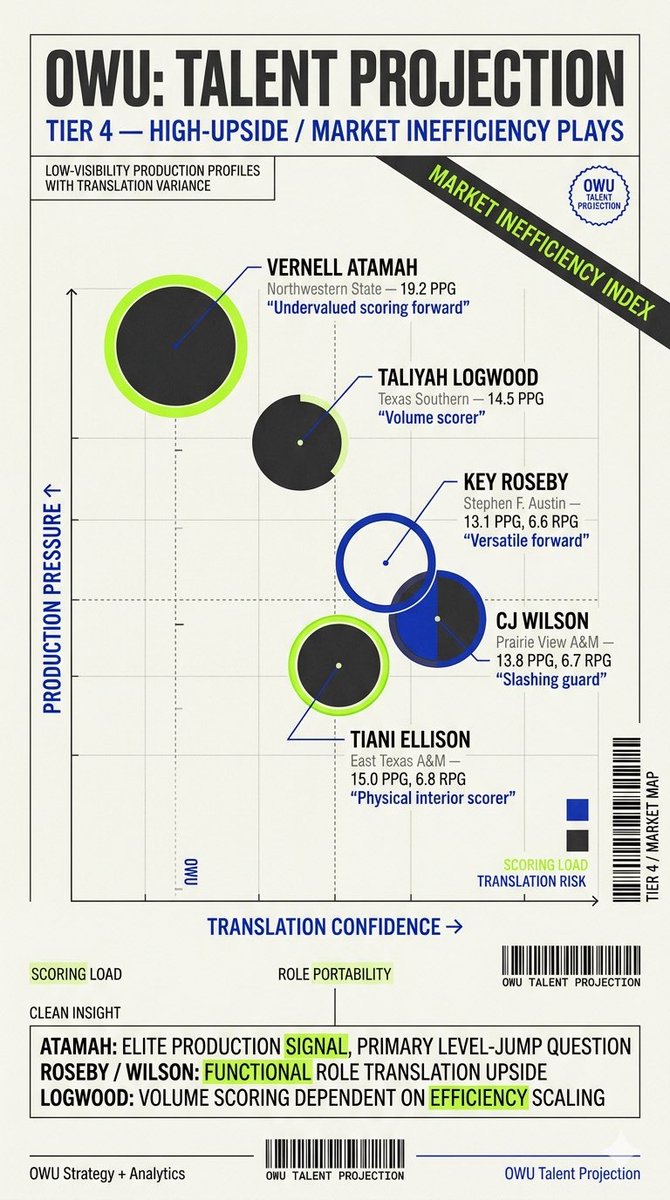
OWU: Conceptually Thinking Basketball Summit Reference Grade Artifact Tier 4 High-Upside and Market Inefficiency Plays represents the most mispriced segment of the offensive ecosystem. These players exist outside traditional valuation clarity, often producing in environments that distort true translation signals. Their value is defined by asymmetry—the gap between perceived output and actual potential. This tier is governed by three dynamics: market context distortion (competition level and visibility masking evaluation), skill signal ambiguity (incomplete efficiency or decision data), and asymmetric upside (disproportionate return relative to acquisition cost). These are not safe bets—they are calculated bets. Vernell Atamah (Northwestern State, 19.2 PPG) profiles as an undervalued scoring forward. Her production suggests real shot creation, but translation depends on whether it is driven by sustainable mechanics or favorable matchups. If her scoring holds under increased defensive length, she becomes a high-value inefficiency capture. Tiani Ellison (East Texas A&M, 15.0 PPG, 6.8 RPG) represents a physical interior scorer with rebounding stability. Paint production and possession control provide a strong baseline, with scalability tied to skill refinement against stronger interior defenders. Key Roseby (Stephen F. Austin, 13.1 PPG, 6.6 RPG) offers a versatile forward profile with untapped usage. Her current production may understate her potential, particularly if role expansion unlocks greater offensive responsibility. CJ Wilson (Prairie View A&M, 13.8 PPG, 6.7 RPG) operates as a slashing guard built on rim pressure. Her ability to collapse defenses creates value, with rebounding adding secondary impact. Perimeter development is the swing skill for scalability. Taliyah Logwood (Texas Southern, 14.5 PPG) represents a volume scorer with efficiency uncertainty. Her production indicates scoring capacity, but translation depends on shot quality and decision-making. Without efficiency stabilization, role compression risk remains. At the institutional level, Tier 4 players function as leverage points. Programs that correctly separate production from process can extract outsized value at minimal cost. Misreads lead to inefficiency. This tier rewards projection discipline. It requires identifying transferable skills within incomplete data environments and acting before market correction. Tier 4 is not about certainty—it is about probability. Organizations that manage that uncertainty effectively gain access to one of the strongest competitive advantages in modern basketball.
Derrick Beechum tweet media
English
0
0
0
200
Derrick Beechum
Derrick Beechum@coachbeechum·
OWU: Conceptually Thinking Basketball Summit Reference Grade Artifact Tier 3 Upside and Skill Translation represents the most development-sensitive segment of the offensive ecosystem. Unlike Tier 1 engines or Tier 2 scalable pieces, these players exist within a projection band where current production intersects with future role expansion. Their value is not fully realized—it is embedded in trajectory, skill indicators, and growth probability. This tier is governed by three variables: efficiency trajectory (is production trending toward sustainability), skill portability (do tools translate into higher-complexity systems), and role emergence (can the player expand into greater offensive responsibility). These players are evaluated as evolving systems, not finished outputs. Naomi White (Northern Arizona, 20.8 PPG) profiles as a high-upside freshman scorer. Early production signals strong creation instincts, but her true value lies in trajectory. If decision-making and shot discipline improve, she projects toward primary engine potential. JaQuoia Jones-Brown (Long Beach State, 17.6 PPG, 6.7 RPG) offers dual-impact production through scoring and rebounding. Her profile reflects usage capacity, but efficiency refinement will determine whether she evolves into a scalable offensive engine. Ryann Bennett (UC Davis, 15.3 PPG, 4.0 APG) provides one of the strongest portability profiles in this tier. Her efficiency and decision reliability create a high floor. If usage expands without efficiency loss, she transitions into a primary or secondary creator. Jailyn Banks (Belmont, 15.4 PPG) operates as a shot creator with mid-level scalability. Her value depends on whether shot-making efficiency holds against stronger defenses and whether playmaking layers develop. Doneelah Washington (Illinois State, 16.7 PPG, 8.6 RPG) anchors the interior translation profile. Her scoring and rebounding create stable baseline value, with scalability tied to mobility and adaptability against higher-level athletes. At the institutional level, Tier 3 represents investment in trajectory rather than immediate return. The risk is overvaluing current production. The opportunity is identifying directional growth before it materializes. This tier is not defined by uncertainty—it is defined by direction. Programs that correctly read efficiency trends, decision growth, and role expansion will consistently convert Tier 3 players into higher-tier contributors.
Derrick Beechum tweet media
English
0
0
1
150
Derrick Beechum
Derrick Beechum@coachbeechum·
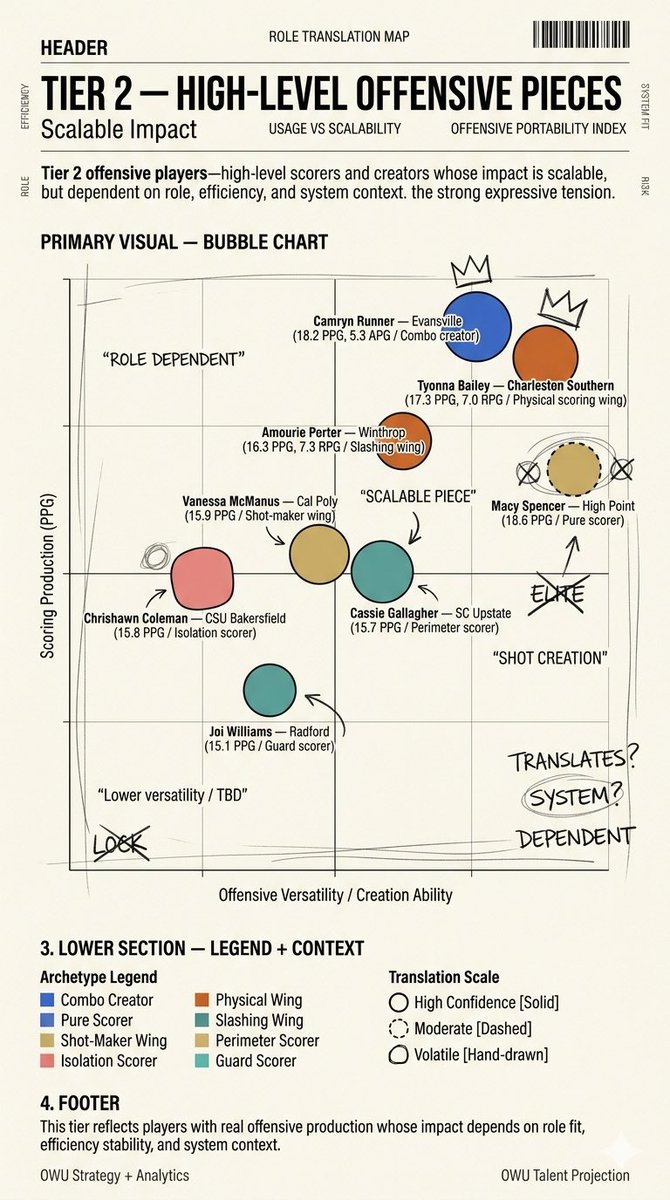
OWU: Conceptually Thinking Basketball Summit Reference Grade Artifact Tier 2 High-Level Offensive Pieces represent the most context-sensitive valuation group in modern women’s basketball ecosystems. Unlike Tier 1 engines, these players do not independently control offensive environments. Instead, they operate within a tension band between production and scalability, where impact is real but conditional on role, spacing, and defensive pressure. This tier is governed by three variables. First, offensive portability—the ability to maintain efficiency outside a primary usage role. Second, role elasticity—the capacity to shift between primary, secondary, and complementary responsibilities. Third, efficiency stability—whether production is sustainable or system-inflated. Camryn Runner (Evansville, 18.2 PPG, 5.3 APG) profiles as one of the strongest translation candidates. Her scoring-playmaking blend creates decision-layered value, allowing her to initiate, read, and convert. If her assist-to-turnover stability holds under increased pressure, she scales as a multi-role combo creator. Macy Spencer (High Point, 18.6 PPG) represents a pure scoring archetype. Her value is tied to shot creation and conversion, but without playmaking layers, translation hinges on efficiency. In structured systems with spacing, she retains value; in complex creation environments, her role may compress. Vanessa McManus (Cal Poly, 15.9 PPG) operates as a spacing wing. Her gravity stretches defenses without requiring high usage, making her one of the more portable archetypes. Translation depends on shooting consistency against length. Chrishawn Coleman (CSU Bakersfield, 15.8 PPG) embodies the isolation scorer profile. This archetype is volatile—valuable if efficiency holds, but sensitive to defensive upgrades. Her projection depends on whether her scoring is skill-driven or matchup-dependent. Tyonna Bailey (Charleston Southern, 17.3 PPG, 7.0 RPG) offers a balanced profile. Physical scoring and rebounding create dual-phase value, increasing translation stability. Continued skill refinement determines her ceiling as a two-way wing. Amourie Porter (Winthrop, 16.3 PPG, 7.3 RPG) generates value through rim pressure and activity. Her slashing translates when supported by spacing, with rebounding adding secondary impact. Perimeter development is the swing factor. Cassie Gallagher (SC Upstate, 15.7 PPG) is a shooting-dependent scorer. Her value is tightly linked to perimeter efficiency, making consistency the defining translation variable. Joi Williams (Radford, 15.1 PPG) represents a developmental scoring guard. Without clear playmaking or role flexibility indicators, her projection depends on skill expansion beyond scoring. At the institutional level, Tier 2 players require precise role alignment. Their value is not diminished—it is conditional. Programs that correctly map strengths to system design unlock efficiency gains; misalignment results in production drop-off. This tier is defined not by talent gaps, but by contextual sensitivity.
Derrick Beechum tweet media
English
0
0
1
246
Derrick Beechum
Derrick Beechum@coachbeechum·
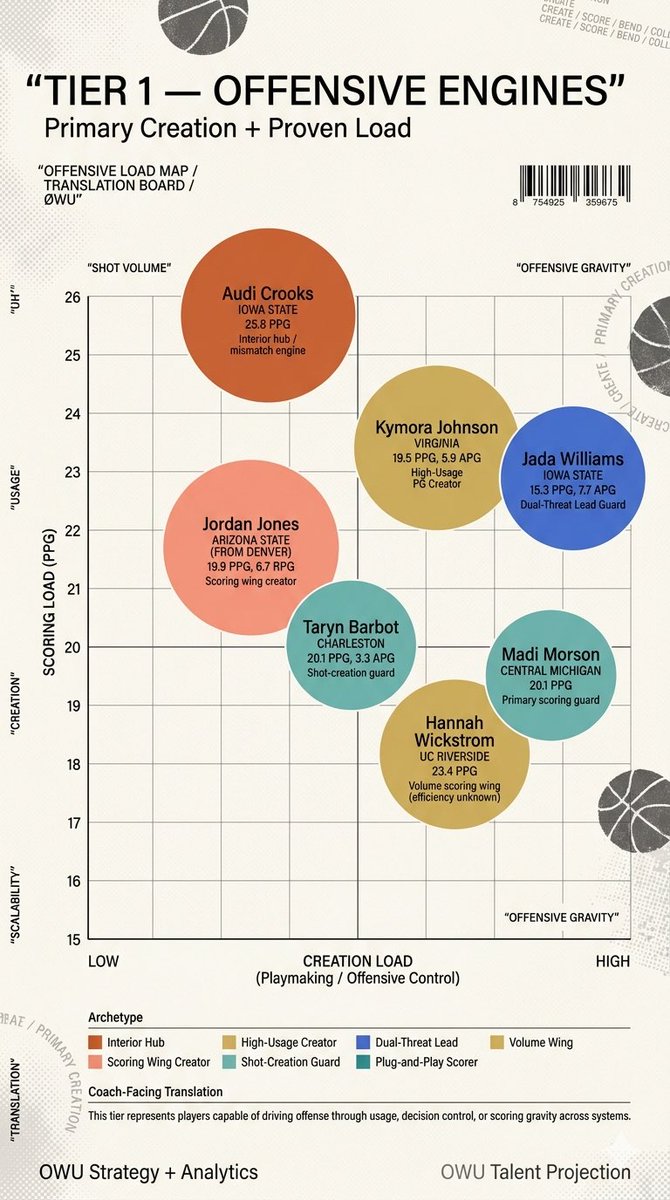
OWU: Conceptually Thinking Basketball Summit Reference Grade Artifact Tier 1 Offensive Engines represent the highest-value archetype in modern women’s basketball: players who sustain primary creation load while preserving efficiency under pressure. These are not just scorers—they are system drivers. They reshape defensive geometry, compress decision windows, and elevate possession-level expected value across entire offensive ecosystems. This tier is defined by three markers. First, usage resilience—the ability to maintain production as defensive attention scales. Second, decision gravity—the capacity to force help, rotations, and scheme distortion. Third, translation elasticity—skill sets that project upward without collapsing under increased speed, length, or physicality. Audi Crooks (Iowa State, 25.8 PPG) anchors the interior engine archetype. Her value lies in paint dominance through footwork, touch, and positional strength. Post gravity forces early help, destabilizing weakside coverage and creating indirect playmaking value. Her efficiency profile suggests strong translation, as her scoring is built on angles and timing rather than pure athleticism. She projects as an immediate half-court efficiency anchor. Kymora Johnson (Virginia, 19.5 PPG, 5.9 APG) represents the decision-control lead guard. Her production is an integrated outcome of pace manipulation, advantage creation, and conversion. She dictates tempo and consistently generates breakdown points. Her assist profile signals advanced read progression, suggesting strong scalability under pressure. She projects as a system-defining initiator. Jada Williams (Iowa State, 15.3 PPG, 7.7 APG) operates as a balanced dual-threat engine. Her value is rooted in decision equilibrium—optimizing outcomes between scoring and distribution. Her passing precision enhances teammate efficiency beyond raw assist totals. The key variable is scoring scalability; if it rises, she becomes a full-spectrum engine. Baseline projection remains high-impact lead guard. Jordan Jones (Arizona State, 19.9 PPG, 6.7 RPG) embodies the scoring wing creator. Her multi-level scoring and rebounding extend possession value and reduce predictability. Wings with this profile scale well if efficiency holds under length and athleticism. She projects as a high-upside usage absorber. Taryn Barbot (Charleston, 20.1 PPG, 3.3 APG) is a self-creation guard. Her scoring independence is highly portable, though efficiency becomes the key translation filter. Functional playmaking prevents overcommitment. With refined shot selection, her scoring translates cleanly. Hannah Wickstrom (UC Riverside, 23.4 PPG) profiles as a high-volume scoring wing with volatility. Her production implies real creation ability, but efficiency context remains incomplete. She represents a ceiling play—high impact if efficiency stabilizes, role compression if not. Madi Morson (Central Michigan, 20.1 PPG) offers scoring stability and portability. Her structured scoring habits suggest predictable translation. The question is ceiling expansion; she projects as an immediate contributor with potential for role growth. Collectively, Tier 1 engines define the offensive market. Interior anchors, lead guards, and scoring wings offer different pathways, but share one trait: sustained offensive control. At the institutional level, these players are not luxuries—they are structural necessities that stabilize systems and compound efficiency. #OWUEvalDay #ConceptuallyThinking #BuiltDifferent #PlayerTrustNetwork #ScoutingTruths [@PGHBrooks ] [@NXTPROG] [@JrAllStarBB] [] [@IGBRcoverage [@WorldExposureWB] [@_BlakeDerrick] [@WKGameBall] [@EconAdjunct] [@FiveStateHoops] [@OWUTALENT ][@PGHiowa ] [@JrAllStariowa ]
Derrick Beechum tweet media
English
0
0
1
221
Derrick Beechum
Derrick Beechum@coachbeechum·
OWU: Conceptually Thinking Basketball STRATOS Reference Grade Artifact Defensive Rating as a Performance System: Calculation, Distribution, and Strategic Value Defensive Rating is the most complete possession-based measure of defensive performance in modern basketball analytics. It captures points allowed per 100 possessions, eliminating pace distortion and enabling direct comparison across teams, lineups, and competitive environments. The core formula is: Defensive Rating = (Points Allowed / Possessions) × 100 Possessions are estimated using: FGA – ORB + TOV + 0.44 × FTA This transforms defense into a tempo-neutral efficiency signal grounded in possession control rather than raw totals. Within STRATOS, Defensive Rating is not treated as a static metric—it is interpreted through a distributional framework. Basketball performance naturally aggregates toward a normal curve, where most teams cluster between 95 and 100. This represents the equilibrium band of defensive performance, where outcomes are stable but not dominant. Movement along this curve defines competitive separation. Teams between 90 and 95 operate in the high-level band, capable of sustaining winning outcomes through consistent disruption. The elite tier exists between 85 and 90, where defenses suppress efficiency across all Four Factors simultaneously. Sub-85 represents the extreme left tail—typically the top 1–3% of teams—where defensive performance becomes structural rather than effort-based. At this level, success is driven by system alignment: communication, rotation timing, shot suppression, and rebounding cohesion. Every possession is controlled from initiation to completion. On the opposite end, teams above 105 occupy the right tail, reflecting systemic breakdown. These teams fail to control shot quality, turnover creation, or defensive rebounding, leading to unstable and high-variance outcomes. The value of Defensive Rating lies in its ability to capture full possession sequences rather than isolated defensive events. Box score metrics such as steals and blocks describe fragments of defense, but they do not measure whether a possession was successfully contained. STRATOS prioritizes outcomes over events, recognizing that elite defense is often invisible—defined by positioning, deterrence, and forced inefficiency. To identify causality, Defensive Rating is decomposed through the defensive Four Factors. Opponent effective field goal percentage is the primary driver, determining points per shot. Turnover rate reduces total opportunities. Defensive rebounding eliminates second-chance scoring. Free throw rate reflects discipline and vertical control. Elite defenses coordinate all four factors rather than relying on a single strength. At the player level, evaluation shifts to on/off Defensive Rating impact. High-value defenders lower team efficiency through positioning, communication, and rotational integrity—often without producing traditional statistics. STRATOS classifies defenders based on their ability to improve team-level outcomes rather than accumulate events. Development is defined by distributional movement. Improvement from 100 to 95 is incremental and attainable. Movement from 95 to 90 requires system cohesion. Progression from 90 to 85 represents a structural shift into the extreme tail, where marginal gains demand precision across every possession. Verdict expectations follow this structure. Teams above 100 are unstable. Teams between 95 and 100 are neutral. Teams between 90 and 95 are competitive. Sub-90 teams enter championship viability, with defense capable of controlling outcomes independent of offensive variance. Defensive Rating ultimately functions as a compressed signal of total defensive performance. When paired with distributional analysis and Four Factor decomposition, it becomes a complete framework for evaluating, projecting, and constructing elite defensive systems.
Derrick Beechum tweet media
English
0
0
0
132
Derrick Beechum
Derrick Beechum@coachbeechum·
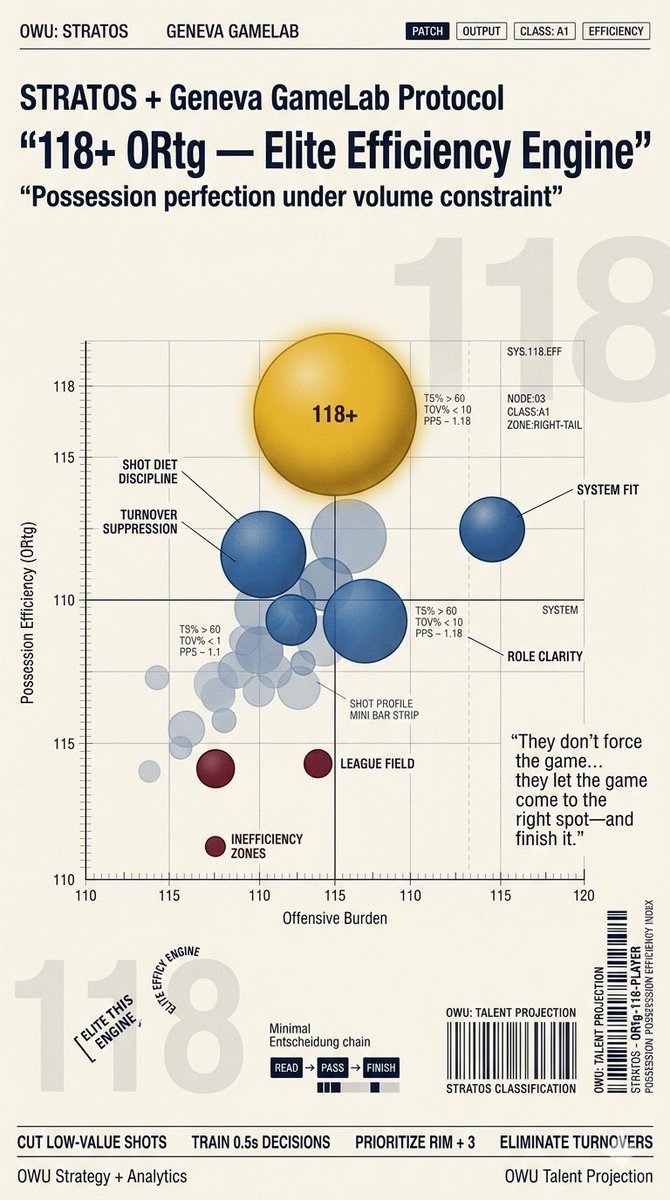
OWU Conceptually Thinking Basketball STRATOS Model Reference Grade Artifact Elite Offensive Player Evaluation Framework — 118+ ORtg Standard This framework defines the evaluation standards for elite offensive players operating at or above a 118 Offensive Rating. Within STRATOS architecture, a 118+ ORtg profile represents extreme right-tail efficiency, typically within the top one to two percent of performers. This level of output reflects possession-level precision rather than scoring volume. Definition and Context A 118 ORtg indicates a player produces approximately 1.18 points per possession. This level of efficiency signals consistent alignment between expected value and actual outcomes. The player is not outperforming the system temporarily; they are operating at a structurally optimized level. Calculation Structure ORtg = (Points Produced / Possessions Used) × 100 Points Produced includes scoring, assist value, and offensive rebound extension. Possessions Used includes field goal attempts, weighted free throw attempts, and turnovers. Sustainability requires a minimum of 300 possessions to ensure stability. True Performance Standards A 118+ ORtg player demonstrates four core traits. Shot Quality Discipline Shot selection is concentrated in high-value zones. Rim attempts and three-point shots dominate. Low-efficiency attempts are systematically eliminated. Decision Efficiency Turnovers are minimal. The player processes reads quickly and executes without delay. Each possession is protected as a high-value asset. Role Precision The player operates within defined efficiency zones. They do not expand into low-value actions. Usage is controlled and aligned with optimal output. System Amplification Their presence improves team-level efficiency. Spacing increases, passing lanes expand, and teammate performance benefits from their gravity. Archetype Profiles Low-Usage Finisher Produces efficient scoring with minimal touches. Excels in catch-and-shoot and immediate finishing situations. Connector Balances scoring and playmaking with elite assist-to-turnover ratios. Maintains offensive flow and continuity. Interior Finisher Operates near the rim with high conversion rates. Attempts are almost exclusively high-percentage opportunities. Comparison to Box Score Traditional metrics measure accumulation. ORtg measures conversion. A high-volume scorer with average efficiency may produce less value than a lower-volume player with elite efficiency. ORtg captures this distinction by embedding possession cost into evaluation. Evaluation Criteria To qualify as a 118+ player: Shot profile must reflect high expected value Turnover rate must be significantly below average Efficiency must sustain across game contexts Team offensive performance must improve with presence Verdict Expectation A 118+ ORtg player is a possession optimizer. They do not rely on volume to create impact. They maximize each possession, reduce offensive waste, and elevate system efficiency. Final STRATOS Statement Elite offense is defined by conversion, not accumulation. A 118+ ORtg player represents the highest standard of offensive performance, where decision-making, shot selection, and execution align to produce consistent, system-level advantage. #OWUEvalDay #ConceptuallyThinking #BuiltDifferent #PlayerTrustNetwork #ScoutingTruths [@PGHBrooks ] [@NXTPROG] [@JrAllStarBB] [] [@IGBRcoverage [@WorldExposureWB] [@_BlakeDerrick] [@WKGameBall] [@EconAdjunct] [@FiveStateHoops] [@OWUTALENT ][@PGHiowa ] [@JrAllStariowa ]
Derrick Beechum tweet media
English
0
0
0
131
Derrick Beechum
Derrick Beechum@coachbeechum·
OWU: Conceptually Thinking Basketball STRATOS Reference Grade Artifact Defensive Rating as a Performance System: Calculation, Distribution, and Strategic Value Defensive rating is the most complete possession-based measure of defensive performance in modern basketball analytics. It represents points allowed per 100 possessions, removing pace distortion and allowing true comparison across teams and contexts. The core formula is: Defensive Rating = (Points Allowed / Possessions) × 100 Possessions are estimated using: FGA – ORB + TOV + 0.44 × FTA This converts defense into a tempo-neutral efficiency metric grounded in possession control. Within STRATOS, defensive rating is interpreted through a distributional framework. Basketball performance aggregates into a normal curve, where most teams cluster between 95 and 100. This represents the equilibrium zone of defensive performance. Movement away from this center defines competitive separation. Teams between 90 and 95 operate in the high-level band, capable of consistent winning outcomes. The elite tier exists between 85 and 90, where defenses suppress efficiency across all Four Factors. Sub-85 represents the extreme left tail, typically reserved for the top one to three percent of teams. At this level, performance is not effort-driven. It is structural, requiring alignment of personnel, communication, and system execution. The right tail, above 105, reflects systemic breakdown. These teams fail to control shot quality, turnovers, or rebounding, resulting in unstable defensive outcomes. Defensive rating’s value lies in its ability to capture total possession outcomes rather than isolated events. Traditional box score metrics such as steals and blocks describe fragments of defense. They do not measure possession success. A player may accumulate defensive statistics while compromising system integrity, or record none while consistently forcing low-quality shots. STRATOS therefore prioritizes outcome over event. Defensive rating reflects the full sequence of defensive actions: containment, help positioning, contest, and rebound completion. It captures both visible and invisible impact, making it superior for evaluating team defense and lineup effectiveness. To identify causality, defensive rating is decomposed through the defensive Four Factors. Opponent effective field goal percentage is the primary driver, as it determines points per shot. Turnover rate reduces total opportunities. Defensive rebounding eliminates second-chance scoring. Free throw rate reflects discipline and vertical control. Elite defenses coordinate all four factors rather than relying on a single strength. At the player level, evaluation shifts to on/off defensive rating impact. High-value defenders lower team defensive rating through positioning, communication, and rotational timing. This impact often exceeds what is captured in the box score. STRATOS classifies defenders based on their ability to improve team-level efficiency rather than accumulate individual statistics. Distributional movement defines development. Improvement from 100 to 95 is achievable through incremental gains. Movement from 95 to 90 requires system cohesion. Progression from 90 to 85 represents a structural shift into the extreme tail, where marginal gains demand precision across every possession. Verdict expectations follow this structure. Teams above 100 are unstable. Teams in the 95–100 band are neutral. Teams in the 90–95 range are competitive. Sub-90 teams enter championship viability, with defense capable of controlling game outcomes independent of offensive variance. Defensive rating ultimately functions as a compressed signal of total defensive performance. When combined with distributional analysis and Four Factor decomposition, it provides a complete framework for evaluating, projecting, and building elite defensive systems.
Derrick Beechum tweet media
English
0
0
0
134
Derrick Beechum retweetledi
Coach Brad Bigler
Coach Brad Bigler@CoachBradBigler·
If I were a 2027 High School Recruit… AAU season means limited practices. Sometimes just 1–2 per week. That’s not enough to stay in a shooting rhythm. You’ve got to get extra work in on your own. Early in the week: high volume shooting. Less contact, lock in on form, build consistency, get reps. Later in the week: game speed, game like intensity. Create shots off movement, simulate real situations, and build a scoring routine from all spots. Chase efficiency. Move around the floor. Train with purpose.
English
5
34
184
25.7K