Coin Post
9.6K posts

Coin Post
@CoinPostMedia
Follow for market updates, stats, and alpha


OpenAI might have a new problem, and it's not Google or Anthropic. It’s open-weight AI models. Their fear? Cheap, powerful Chinese models like Moonshot’s Kimi K3 could eat into their margins by offering similar capabilities at lower cost. And triggeri a bigger debate: Should the US restrict them, or embrace them? 🤷♂️ The argument from frontier labs is simple: cheaper open models could pressure margins and reduce the incentive to spend billions training the next generation of AI. But there’s another side. Open-source software has historically accelerated innovation. Linux, Python, PyTorch, entire industries were built around open ecosystems. The AI race may not be only about who builds the best model. It might be about who builds the biggest developer ecosystem around it. If open models become “good enough” and run on cheaper infrastructure, the winners may be those who enable the most people to build. The real competition should be on talent and compute, not blocking access. What do you think, should the US restrict open-weight models or embrace them? 👀


OpenAI might have a new problem, and it's not Google or Anthropic. It’s open-weight AI models. Their fear? Cheap, powerful Chinese models like Moonshot’s Kimi K3 could eat into their margins by offering similar capabilities at lower cost. And triggeri a bigger debate: Should the US restrict them, or embrace them? 🤷♂️ The argument from frontier labs is simple: cheaper open models could pressure margins and reduce the incentive to spend billions training the next generation of AI. But there’s another side. Open-source software has historically accelerated innovation. Linux, Python, PyTorch, entire industries were built around open ecosystems. The AI race may not be only about who builds the best model. It might be about who builds the biggest developer ecosystem around it. If open models become “good enough” and run on cheaper infrastructure, the winners may be those who enable the most people to build. The real competition should be on talent and compute, not blocking access. What do you think, should the US restrict open-weight models or embrace them? 👀


For my first post, I’m sharing a letter @NVIDIA signed on why open models matter. AI will transform every industry, power every company, and be built by every country. Open models strengthen safety and cybersecurity, accelerate innovation and diffusion, and enable sovereignty. The world needs both frontier closed models and frontier open models. images.nvidia.com/pdf/Open-Weigh…

Wall Street doesn’t seem to be giving up on $SPCX 16 analysts cover SpaceX: - Average price target: $213.50 - Around +77% upside from current levels - Highest target: $800 - Lowest target: $130 Interesting setup: the stock is below every analyst target, yet sentiment has cooled significantly after the IPO hype faded. After the post-IPO volatility, it looks like analysts are still very bullish on the long-term story. Of course, targets are just models, the real test is still execution: Starlink growth, Starship progress and upcoming earnings. But the risk/reward looks very different at $122 than it did at $220.

Wall Street doesn’t seem to be giving up on $SPCX 16 analysts cover SpaceX: - Average price target: $213.50 - Around +77% upside from current levels - Highest target: $800 - Lowest target: $130 Interesting setup: the stock is below every analyst target, yet sentiment has cooled significantly after the IPO hype faded. After the post-IPO volatility, it looks like analysts are still very bullish on the long-term story. Of course, targets are just models, the real test is still execution: Starlink growth, Starship progress and upcoming earnings. But the risk/reward looks very different at $122 than it did at $220.

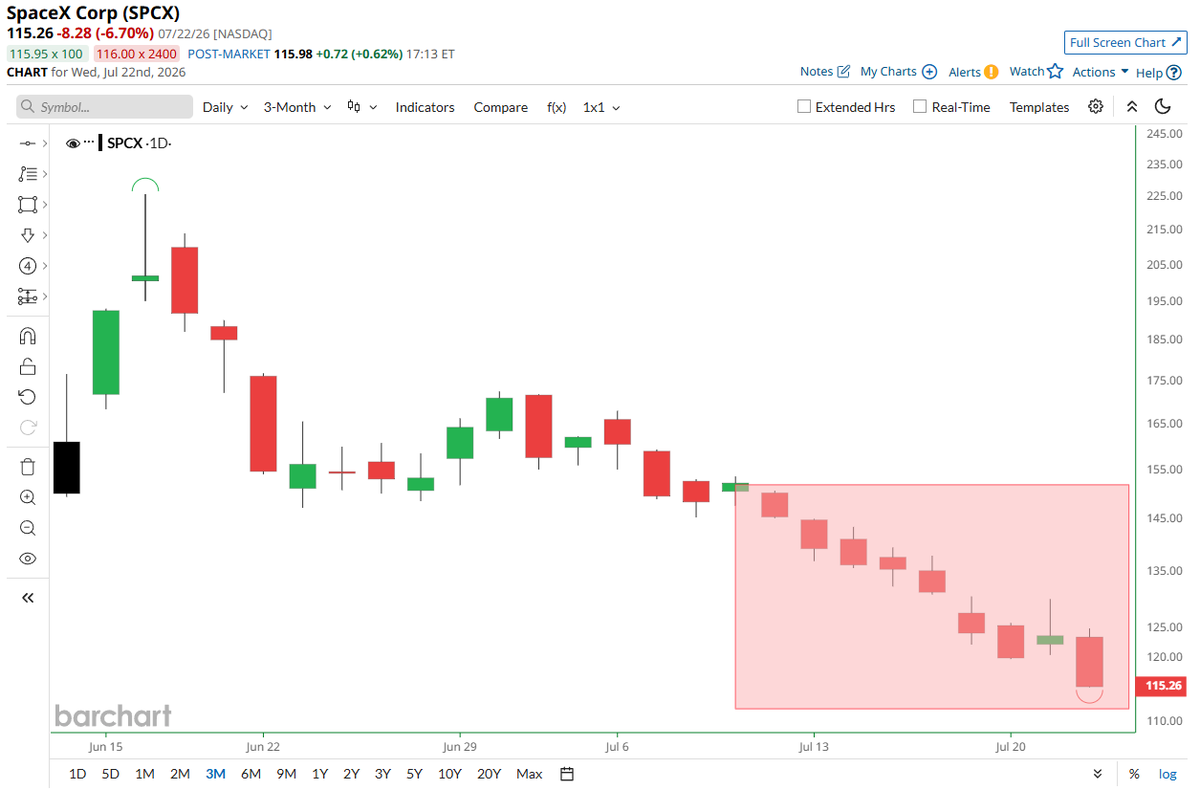
You bought SpaceX shares at the IPO price, and now you’re losing money. Is it safe to buy the dip? As I mentioned before, SpaceX shares dipped below their IPO price, so I’m starting to pay attention. After the insane hype and quick 45% drop, the stock is trading around $115. FUD in X, but it could be a potential contrarian setup. Cause nothing fundamental has really changed. Starlink keeps growing (10M+ customers and rising prices), and the long-term vision with Starship is still intact. Wall Street bulls like Deutsche Bank are already putting $255 targets. Of course, the valuation is still crazy high. I wouldn't call it "cheap." At ~$1.6T, the valuation still assumes a lot of future execution. it’s a high-conviction, high-volatility play. For me, this is the kind of moment where great businesses get interesting again, when the crowd loses interest. I’m adding it to my watchlist. Not rushing in, but definitely watching closely. What do you think, dip to buy or still too expensive? Also, check out the institutional targets in the post below 👇

Tesla + SpaceX merger is back on the table! During the earnings call he didn’t shut down the idea, and analysts are now saying the operational overlap (AI, manufacturing, Terafab, shared talent) is already huge. Market reaction: $SPCX 0% $TSLA -9% The logic behind a merger: Tesla brings manufacturing, batteries, robotics and AI ambitions. SpaceX brings Starlink, launch infrastructure, orbital computing and massive engineering capabilities. The overlap is already real. Tesla supplies technologies for SpaceX projects, both companies are connected through AI infrastructure, and they are working together on Terafab, a semiconductor manufacturing project. A combined company would basically become a bet on the future of AI, energy, robotics and space infrastructure under one umbrella. But there are huge questions too. Musk has much stronger control over SpaceX, meaning governance and shareholder approval would be complicated. Regulatory issues, especially around China, could become a major obstacle. Still, if it happens, it could be one of the most consequential corporate moves of the decade. What do you think - Tesla + SpaceX = unstoppable or too much risk in one basket?


JUST IN: SpaceX stock hits new low of $115

Tesla + SpaceX merger is back on the table! During the earnings call he didn’t shut down the idea, and analysts are now saying the operational overlap (AI, manufacturing, Terafab, shared talent) is already huge. Market reaction: $SPCX 0% $TSLA -9% The logic behind a merger: Tesla brings manufacturing, batteries, robotics and AI ambitions. SpaceX brings Starlink, launch infrastructure, orbital computing and massive engineering capabilities. The overlap is already real. Tesla supplies technologies for SpaceX projects, both companies are connected through AI infrastructure, and they are working together on Terafab, a semiconductor manufacturing project. A combined company would basically become a bet on the future of AI, energy, robotics and space infrastructure under one umbrella. But there are huge questions too. Musk has much stronger control over SpaceX, meaning governance and shareholder approval would be complicated. Regulatory issues, especially around China, could become a major obstacle. Still, if it happens, it could be one of the most consequential corporate moves of the decade. What do you think - Tesla + SpaceX = unstoppable or too much risk in one basket?

Wall Street doesn’t seem to be giving up on $SPCX 16 analysts cover SpaceX: - Average price target: $213.50 - Around +77% upside from current levels - Highest target: $800 - Lowest target: $130 Interesting setup: the stock is below every analyst target, yet sentiment has cooled significantly after the IPO hype faded. After the post-IPO volatility, it looks like analysts are still very bullish on the long-term story. Of course, targets are just models, the real test is still execution: Starlink growth, Starship progress and upcoming earnings. But the risk/reward looks very different at $122 than it did at $220.


Tesla + SpaceX merger is back on the table! During the earnings call he didn’t shut down the idea, and analysts are now saying the operational overlap (AI, manufacturing, Terafab, shared talent) is already huge. Market reaction: $SPCX 0% $TSLA -9% The logic behind a merger: Tesla brings manufacturing, batteries, robotics and AI ambitions. SpaceX brings Starlink, launch infrastructure, orbital computing and massive engineering capabilities. The overlap is already real. Tesla supplies technologies for SpaceX projects, both companies are connected through AI infrastructure, and they are working together on Terafab, a semiconductor manufacturing project. A combined company would basically become a bet on the future of AI, energy, robotics and space infrastructure under one umbrella. But there are huge questions too. Musk has much stronger control over SpaceX, meaning governance and shareholder approval would be complicated. Regulatory issues, especially around China, could become a major obstacle. Still, if it happens, it could be one of the most consequential corporate moves of the decade. What do you think - Tesla + SpaceX = unstoppable or too much risk in one basket?



Wall Street doesn’t seem to be giving up on $SPCX 16 analysts cover SpaceX: - Average price target: $213.50 - Around +77% upside from current levels - Highest target: $800 - Lowest target: $130 Interesting setup: the stock is below every analyst target, yet sentiment has cooled significantly after the IPO hype faded. After the post-IPO volatility, it looks like analysts are still very bullish on the long-term story. Of course, targets are just models, the real test is still execution: Starlink growth, Starship progress and upcoming earnings. But the risk/reward looks very different at $122 than it did at $220.