Common Futures

31.4K posts

Common Futures

Common Futures

@CommonFutrs

Community Ownership Explorer & Civic Engineer. MBE DU Essex (Hon). Polymath. Technophile. Rugby. Tweets my own/RTs not endorsements.

Katılım Nisan 2013
4.9K Takip Edilen2.7K Takipçiler
Common Futures retweetledi

Séb Krier
Séb Krier@sebkrier·
"Regulating AI" is about as meaningful as saying "regulate technology" and people use this to mean all sorts of things. I think it's important, but there are some hard Qs and I want to outline them here to make it more obvious why this isn't particularly easy in practice. The tl;dr is "AI governance should be threat-model-specific, layered, and allocated to the actors best placed to mitigate the relevant harm. Sometimes that will mean model-level duties, sometimes product or sectoral rules, sometimes user liability, and often a mix. Many laws already exist and apply; the case for new ones depend on the specific failure mode, the adequacy of existing law, and how much weight you put on the precautionary principle." Multiplicity of actors and artifacts 1. Models are the starting point, but they are distributed to millions of users and businesses who then subsequently fine-tune, adapt, 'scaffold' them in all sorts of ways. These then become different products, which labs or cloud companies have little visibility over (for commercial, IP, and privacy reasons, amongst others). 2. The reality is that 'capabilities' come from both the models (that keep improving over time), and the wider affordances they are connected to (coding environments, tools, multi-agent scaffolds, external API calls etc). 3. There is sometimes a temptation to focus 'upstream' on models; this assumes you can deal with whatever risk you have in mind at that layer, and not have to think about it afterwards. This seems questionable both practically and normatively. This does not mean upstream governance is irrelevant, but treating them as the only or final leverage point is mistaken. Threat/risk models matter 4. A specific governance/regulatory intervention for risk A will not necessarily be appropriate for risk B. The great majority I think are product/sector-specific. Financial risks of a high-frequency trading AI tool are better addressed by the SEC than by some generalist institution. 5. Other risks will entail a mix: e.g. some cyber-offense might be partly mitigated by model-level interventions (e.g. refusals), and partly by product-level ones (e.g. filters). More often than not, this changes over time, since much of this remains an R&D heavy area. 6. The right distribution of responsibilities is tricky and evolving a lot as the market takes shape. Generally my proxy is 'who is most proximate to the harm, and best placed to address it'. And for many risks, this depends on users too; if you ignore this, you're effectively creating a moral hazard. 7. In any case, a particular threat model needs to be agreed/defined, and there are a lot of disagreements between domain experts here (depending on the harm), sometimes due to differnt levels of risk tolerance, or sometimes due to how to design an externally valid evaluation. Existing laws and scoping 8. People love saying that AI operates in a wild west and this is plainly not true. Plenty of laws, regulations, tort liability, and legal precedent shape both how models and products are developed across the board. Lawyers will know this well, but generalists tend to have little visibility over this. Often this is completely ignored because it's a messy legal vortex and policymakers are incentivized to advocate for new laws. 9. Assuming you think the status quo is insufficient, the next challenge becomes scoping. Proxies like compute thresholds continue to be quite coarse and less predictive (epoch.ai/gradient-updat…). 10. Capabilities-based thresholds for models have the chicken and egg problem of 'how do you know which model to evaluate for these capabilities in the first place'. Hybrids are hard. 11. For products, you have the longstanding question of how to treat software, and not polluting the digital space with the same bureaucracy that prevents anything being built in the physical world. Evals, safeguards and mitigations 12. People often talk about evaluations as a 'mitigation' when really they are more information-surfacing mechanisms. Often I think this is very helpful and helps markets make informed choices. But they don't necessarily mitigate the underlying risk. 13. It's important to also note that mitigations (just like evals) are improving: the UK AISI notes that 'We've seen significant progress in the safeguards of certain Al systems, particularly in the biological misuse domain.' (aisi.gov.uk/frontier-ai-tr…) 14. However from a governance point of view, the items raised in bullets 1, 2, and 6 above matter here. Some capabilities diffuse quickly through open research, products, and scaffolding, even if the frontier itself remains concentrated for some period. This means that you will want safeguards to be applied by different actors, depending on risk and proximity. My own bias is to favour permissionless innovation, with some very narrow exceptions. Specificity, grey areas, and standards 15. Even if you codify high-level obligations in law, you now have the challenge of assessing whether or not a particular entity or model is compliant. Often this is determined by looking at legal tests (when litigated in court) or through standards (e.g. ISO, FMF etc). 16. But the standards for many risks don't exist. Few people seem invested in writing them clearly, and I don't blame them: it's hard, requires industry buy-in, and the technology evolves quickly since this is an R&D heavy field. 17. I think this remains a neglected/underrated area: even at the lab layer, there's no explicit standard specifying what a good 'frontier safety policy' is, or de minimis quality requirements for an evaluation. We are seeing some good progress in recent months though, e.g. CoT legibility/monitoring as a nascent norm. New mechanisms and institutions 18. There are interesting proposals a la 'regulatory markets for AI safety' and insurance mechanisms that I think are worth exploring and considering. I think there are promising directions but it's still early, and the devil is in the detail. I'm more unsure when this pertains to risks that are ill-defined/specified. For example there's a lot of disagreement on how to interpret 'misalignment'. 19. One thing I personally want to avoid is an ineffective rent-seeking middleware layer like the current European medical device rules which are notoriously slow, costly, unpredictable, and unnecessarily complex. There's a whole world of regulatory affairs consultancies, EU Authorized Representatives, clinical evaluation writers, QMS implementers etc that I think often produce little safety benefit relative to cost. 20. Ultimately there are different views and approaches here, I'm unsure about a lot of this, and the above isn't meant to discredit efforts on AI policy advocacy. I mostly want to unpack some of the cruxes/trade-offs for people who tend to read about 'AI governance' in more high-level and abstract pieces.
Séb Krier tweet media
English
11
25
124
17.8K
Stian Westlake
Stian Westlake@stianwestlake·
Ach, 14:30 BST not GMT, am an idiot. Thanks @paul_cal for spotting.
English
1
0
2
631
Stian Westlake
Stian Westlake@stianwestlake·
Over the weekend, we @ESRC made a big announcement about an investment that I hope will be of interest to anyone who cares about using evidence to make better public policy, or about harnessing AI for social science. I wanted to tell you a bit more about it, so here's a 🧵
English
10
71
200
199.1K
Common Futures retweetledi
Jeremy Nguyen ✍🏼 🚢
Jeremy Nguyen ✍🏼 🚢@JeremyNguyenPhD·
"LLMs Corrupt Your Documents When You Delegate". New research from researchers at Microsoft. Even recent models like Gemini 3.1 Pro, Opus 4.6, GPT-5.4 corrupt an average of 25% of document content by the end of long workflows. If you've ever noticed weird mistakes and divergences after long runs, turns out it's probably not just happening to you. Do you have a suite of tests that keep things on track?
Jeremy Nguyen ✍🏼 🚢 tweet media
English
5
7
24
1.7K
Common Futures retweetledi
Amit Paranjape
Amit Paranjape@aparanjape·
ArXiv, the open-access repository of preprint academic research, will ban authors of papers for a year if they submit obviously AI-generated work. 404media.co/new-arxiv-rule… "Late Thursday evening, Thomas Dietterich, chair of the computer science section of ArXiv, wrote on X: “If generative AI tools generate inappropriate language, plagiarized content, biased content, errors, mistakes, incorrect references, or misleading content, and that output is included in scientific works, it is the responsibility of the author(s). We have recently clarified our penalties for this. If a submission contains incontrovertible evidence that the authors did not check the results of LLM generation, this means we can't trust anything in the paper.” Examples of incontrovertible evidence, he wrote, include “hallucinated references, meta-comments from the LLM (‘here is a 200 word summary; would you like me to make any changes?’; ‘the data in this table is illustrative, fill it in with the real numbers from your experiments’.”"
English
2
1
5
850
Common Futures retweetledi
Rohan Paul
Rohan Paul@rohanpaul_ai·
Great usecase of Robots in healthcare. Aletta is a robot that fully automates blood draws. The patient sits down; the robot uses ultrasound to find a vein, helps position the arm, collects the sample, and applies a bandage—fully automated
English
13
24
87
13.2K
Common Futures retweetledi
Fraser Nelson
Fraser Nelson@FraserNelson·
Elon Musk has today updated the formula that decides if you see this tweet. Each tweet is scored. S=Σ (probability of reaction × value of reaction) A like = 0.5 points. A reply = 13.5. A full argument? 75+ That’s why outrage travels faster than facts. thetimes.com/comment/column…
English
185
1K
2.3K
146K
Common Futures retweetledi
Kelly Boesch🏳️‍🌈
‘Not Made For The Cage’ A strange and surreal trip. Images: #Midjourney Animation #VEO3 Lyrics by me. Guitar, synth, and mixing by Marshall Altman. Song made using #Suno This song goes out to all those who have always felt a little strange ❤️ #ai #aiart #surreal
English
110
369
1.7K
60.3K
Common Futures
Common Futures@CommonFutrs·
@Frencheconomics @labourlewis Now, please outline associated costs - and savings - over a 5, 10, 15 and 25 year period. Not only the cost of de facto nationalisation. But, the savings to individuals at different points in the life course. Because, multiple social contracts for an ageing demographic is needed
English
0
0
0
491
Simon French
Simon French@Frencheconomics·
Thanks for engaging Clive, what you talk about here - the ownership model for key factors of production/ staples is absolutely worthy of debate. And if that is the central argument - analogous to a repudiation of the Lawsonian (Mais 1984) arguments of greater efficiency of state-managed provision through exposure to market forces - then let’s have it. You must acknowledge though it would have been easier for Labour to have laid that platform out in opposition - design fiscal rules appropriate to enabling that ownership transition, and stand for election on that platform? Very hard to make that argument mid-Parliament without a mandate for such a radical change in economic model?
English
12
3
131
7.8K
Clive Lewis MP
Clive Lewis MP@labourlewis·
Simon, with respect, you’re diagnosing the wrong patient. Nobody serious is proposing tax & spend into a leaking bucket. The argument is about stopping the leak. Running a bath with the plug open doesn’t get fixed by turning down the tap. 40 yrs of outsourced energy, water, housing, transport & care extract rent from every household before a single unit of real economic activity happens. Your “80-year tax high” is partly the state compensating through welfare, housing benefit and NHS crisis spending for costs that privatised provision imposes but never internalises. This isn’t old Labour. It’s about ending rampant and inappropriate outsourcing. Public corporations borrowing against their own revenues, like the model that built the National Grid, don’t add to sovereign debt. The Dutch kept more of their economic foundations in public hands, built more of them, and generate higher productivity as a result. Britain sold the foundations off. The growth constraint you name, high energy, building and capital costs, is the privatisation settlement aka premium. You can’t solve a supply-side cost crisis by leaving the supply-side institutional structure intact.​​​​​​​​​​​​​​​​ That’s what we’re talking g about here.
Simon French@Frencheconomics

I would suggest this diagnosis from Rayner is for an economy some parts of the Labour Party believe exists - not the reality of one where the tax take is already at an 80 year high, concentration of tax on high earners & on assets is already high by international standards. The minimum wage has moved way higher than the international benchmark, and growth is clearly impaired by the frictions of the high cost of energy, building & capital. I would predict that if the Rayner statement became a detailed policy platform you would see the Gilt vs Other Sovereign spread widen, not narrow.

English
37
81
343
55.1K
Common Futures
Common Futures@CommonFutrs·
🤖🤖🤖
X Square Robot@XSquareRobot

X Square Robot Unveils New Embodied AI Model, Says Robots Will Arrive in Homes in 35 Days Backed by Alibaba, ByteDance, Xiaomi and Meituan, X Square Robot unveiled a next-generation embodied AI foundation model for home robots and said its first deployments in everyday households will begin within 35 days. X Square Robot on Tuesday unveiled WALL-B, a new embodied AI foundation model designed for deployment in real-world homes, marking what the company described as a major step toward bringing general-purpose robots into daily family life. At a launch event themed "Born to Bot, Bot to Family," the company also introduced its World Unified Model (WUM) architecture, a training framework that combines vision, language, action and physical prediction within a single system from the outset. X Square said the model is intended to help robots operate in the far more unpredictable setting of a home, where tasks, layouts and interactions vary from moment to moment. "Robots in factories and in homes are completely different. In factories, they repeat the same action 10,000 times without variation. In a home, however, they need to perform 10,000 different actions, each unique and non-repetitive. Therefore, the challenge of a truly intelligent robot lies not in repeating a single action, but in the ability to execute new, untrained movements within unstructured environments. Deploying robots in the home is one of the most significant technical hurdles of our time," said Qian Wang, founder and CEO of X Square Robot. WALL-B is the first real-world implementation of the World Unified Model architecture. Unlike modular systems that train perception, language and control separately, X Square Robot said World Unified Model optimizes those capabilities jointly from the very beginning. The company said that allows physical prediction — including force, friction and collision dynamics — to emerge as part of the model itself, rather than being layered on afterward. "We train all capabilities—vision, language, action, and prediction—within the same network from day one. Much like infants, who do not learn to see, move and speak in isolated, sequential stages, but instead see, move listen and act simultaneously while receiving feedback, we have integrated all these capabilities into a unified whole," said Wang Hao, CTO of X Square. X Square Robot said the development of WALL-B rests on two pillars. The first is a data strategy that prioritizes training on authentic, non-staged home environments to cover the “long-tail” distribution of real-world scenarios, such as misplaced objects and temporary occlusions. Unlike models primarily trained on synthetic data or laboratory datasets, this strategy exposes WALL-B to the natural clutter of lived-in spaces—misplaced items, unexpected obstacles, and spontaneous human activity—ensuring that the training data reflects real-world conditions rather than a simplified version. The second is a physics-aware predictive mechanism that anticipates physical outcomes before an action is taken, enabling the model to respond to contact dynamics instead of just reacting. The development of the self-developed WUM architecture on physical robotic platforms highlights the company’s accumlated experience in bridging sim-to-real gaps across varied operational contexts. Wang commented that the current AI model is still in an "intern" stage, subject to errors requiring remote assistance. For instance, it may mistakenly place slippers in the kitchen or pause while wiping a table to "think". However, the model operates nonstop 24 hours a day, becoming increasingly "intelligent" as each day of operation generates new data. In 35 days, on May 25, X Square Robot will officially bring its robots into everyday homes, underscoring the company’s long-term commitment to the home robotics sector.

ART
0
0
0
33
Common Futures retweetledi
X Square Robot
X Square Robot@XSquareRobot·
Yes — the Times Square billboard is ours! On April 21 in Beijing, we’re hosting our “Born to Bot, Bot to Family” themed Launch Event to unveil our next-generation embodied foundation model and share what comes next for embodied intelligence. This is more than a technology release for us. It marks our next step toward bringing embodied AI into the home and closer to everyday life. Stay tuned for the livestream on YouTube, with more updated and insight to come.
The Humanoid Hub@TheHumanoidHub

Some humanoid maker rented a billboard in Times Square. "It works around the house." "It has a real brain." "April 17th on X" Alongside a blurred-out humanoid! 🤔

English
1
6
17
4.4K
Common Futures retweetledi
Virtuals Protocol
Virtuals Protocol@virtuals_io·
Introducing Eastworlds We help robots leave the lab faster Discover More eastworlds.io
English
136
157
976
1.4M
Common Futures
Common Futures@CommonFutrs·
The librarians shall inherit the digital Earth 🌍 but, by all means, let’s prioritise the development of STEM skills 😉
Andrej Karpathy@karpathy

LLM Knowledge Bases Something I'm finding very useful recently: using LLMs to build personal knowledge bases for various topics of research interest. In this way, a large fraction of my recent token throughput is going less into manipulating code, and more into manipulating knowledge (stored as markdown and images). The latest LLMs are quite good at it. So: Data ingest: I index source documents (articles, papers, repos, datasets, images, etc.) into a raw/ directory, then I use an LLM to incrementally "compile" a wiki, which is just a collection of .md files in a directory structure. The wiki includes summaries of all the data in raw/, backlinks, and then it categorizes data into concepts, writes articles for them, and links them all. To convert web articles into .md files I like to use the Obsidian Web Clipper extension, and then I also use a hotkey to download all the related images to local so that my LLM can easily reference them. IDE: I use Obsidian as the IDE "frontend" where I can view the raw data, the the compiled wiki, and the derived visualizations. Important to note that the LLM writes and maintains all of the data of the wiki, I rarely touch it directly. I've played with a few Obsidian plugins to render and view data in other ways (e.g. Marp for slides). Q&A: Where things get interesting is that once your wiki is big enough (e.g. mine on some recent research is ~100 articles and ~400K words), you can ask your LLM agent all kinds of complex questions against the wiki, and it will go off, research the answers, etc. I thought I had to reach for fancy RAG, but the LLM has been pretty good about auto-maintaining index files and brief summaries of all the documents and it reads all the important related data fairly easily at this ~small scale. Output: Instead of getting answers in text/terminal, I like to have it render markdown files for me, or slide shows (Marp format), or matplotlib images, all of which I then view again in Obsidian. You can imagine many other visual output formats depending on the query. Often, I end up "filing" the outputs back into the wiki to enhance it for further queries. So my own explorations and queries always "add up" in the knowledge base. Linting: I've run some LLM "health checks" over the wiki to e.g. find inconsistent data, impute missing data (with web searchers), find interesting connections for new article candidates, etc., to incrementally clean up the wiki and enhance its overall data integrity. The LLMs are quite good at suggesting further questions to ask and look into. Extra tools: I find myself developing additional tools to process the data, e.g. I vibe coded a small and naive search engine over the wiki, which I both use directly (in a web ui), but more often I want to hand it off to an LLM via CLI as a tool for larger queries. Further explorations: As the repo grows, the natural desire is to also think about synthetic data generation + finetuning to have your LLM "know" the data in its weights instead of just context windows. TLDR: raw data from a given number of sources is collected, then compiled by an LLM into a .md wiki, then operated on by various CLIs by the LLM to do Q&A and to incrementally enhance the wiki, and all of it viewable in Obsidian. You rarely ever write or edit the wiki manually, it's the domain of the LLM. I think there is room here for an incredible new product instead of a hacky collection of scripts.

English
0
0
0
38
Common Futures retweetledi
David Miliband
David Miliband@DMiliband·
The window to avert a massive global hunger crisis is rapidly closing. Must-read from the @guardian on the food security timebomb that will go off if fertiliser cannot pass through the Strait of Hormuz: theguardian.com/world/2026/apr…
English
707
781
1.2K
900.3K
Common Futures retweetledi
The Humanoid Hub
The Humanoid Hub@TheHumanoidHub·
Amazon makes a big move in the humanoid game. Amazon has acquired Fauna Robotics, a New York-based humanoid robot startup. The transaction closed last week. Fauna Robotics developed Sprout, a compact and approachable humanoid robot designed for safe, everyday interaction in shared human spaces such as homes, offices, and schools. Standing about 3.5 feet tall, Sprout can walk, grasp objects, interact with people, and even dance. The robot was launched in January this year as a humanoid platform for developers, priced at $50,000. Following the acquisition, Fauna’s roughly 50 employees will join Amazon. The company will continue deploying Sprout to outside researchers, and the startup will retain its name while operating as “Fauna, an Amazon company.” $AMZN
English
63
178
1.3K
131.6K
Common Futures retweetledi
RoboHub🤖
RoboHub🤖@XRoboHub·
The future of home cleaning just landed in Shenzhen and it is walking right into your living room. 🤖🏠 @XSquareRobot and 58.com officially launched China’s first robot home service, moving embodied AI from the lab to your front door. When you book a cleaning on the 58.com app, a professional cleaner now shows up with an X Square robot partner to tag team the house. The human handles the tricky stuff that needs real judgment while the robot takes over repetitive tasks like wiping tables and tidying up surfaces. X Square is using an end to end foundation model which means the robot actually perceives and plans its own moves instead of just following a script. By testing in the messy reality of a real home, they are proving that if a robot can master a living room, it can handle almost any physical space. This pilot is part of a massive push to turn these machines into reliable partners that can actually assist in our daily lives.
English
13
47
146
102.7K
CyberRobo
CyberRobo@CyberRobooo·
Yeah. Another adorable new humanoid home robot🤖🏠 From Shenzhen-based robotics startup KNOWIN, a consumer-oriented humanoid home robot is being developed: Wheeled, it can chat, pour wine, do laundry, fold clothes, clean, play with children, and even learn in a messy real-life home environment. Driven by their self-developed next-generation embodied AI model architecture and synthetic data technology, this humanoid robot can operate autonomously. But the real goal is to achieve Level 3 autonomy (capable of independently completing long-chain tasks such as cleaning/laundry and being ready to respond at any time) within 1-1.5 years (<18 months). Skeptical? Yes, me too,need to see its complex autonomous capabilities for myself. It's worth mentioning that the founding members of the team are senior professionals from Huawei and DJI. Would you like a humanoid robot that can fold your clothes and chat with you while you relax? Share your thoughts…
English
16
33
204
39K
Common Futures
Common Futures@CommonFutrs·
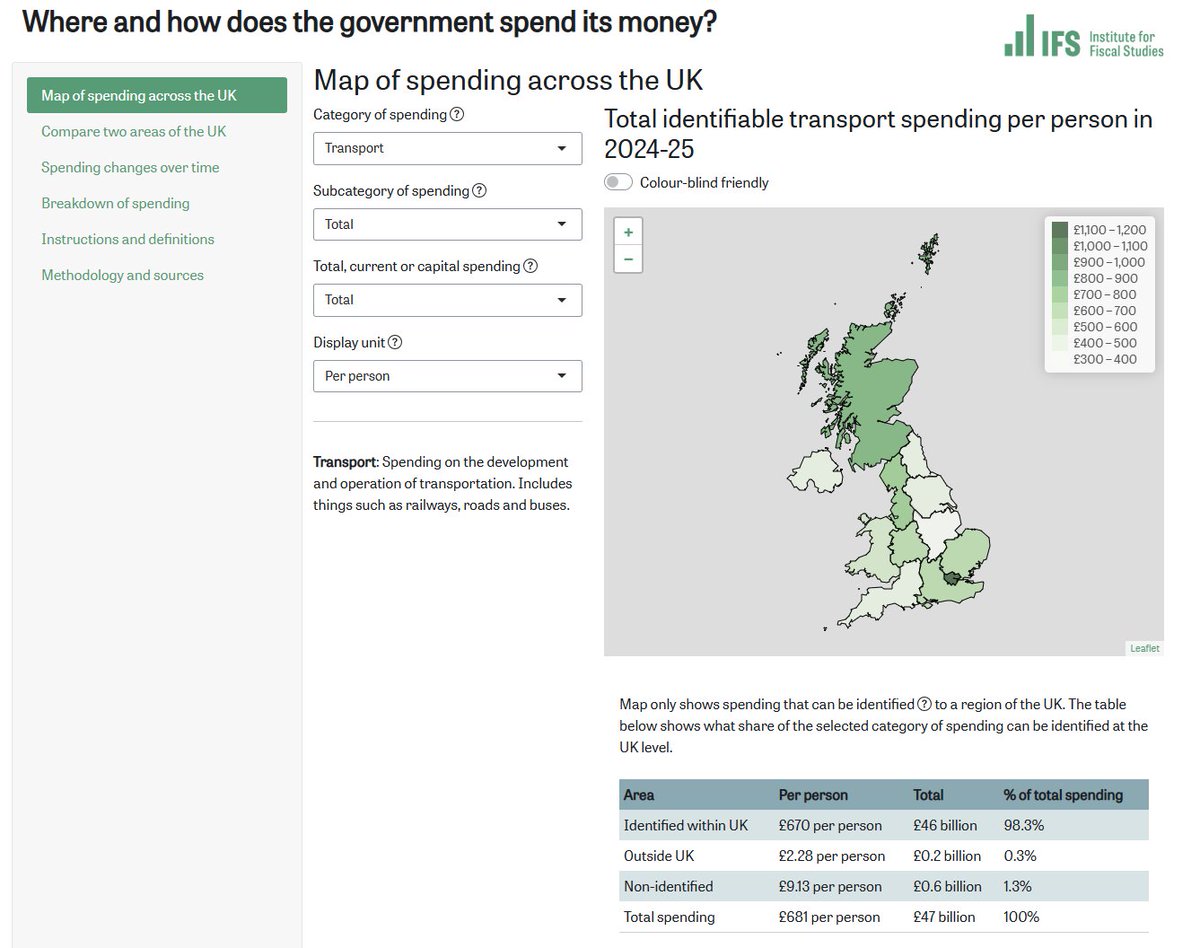
@MaxWarnerIFS @TheIFS If you could, also, overlay demographic data from ONS to make sense of local population makeup … users would be able to understand the most important component of local government spend.
English
0
0
0
42
Common Futures
Common Futures@CommonFutrs·
@MaxWarnerIFS @TheIFS Thanks 🙏 Given local elections will soon be upon us, it would be incredibly helpful to be able to compare spend on social care (with the scope to breakdown) at LA level (and the scope to group LAs where we have city regions) using your mapping tool.
English
1
0
0
36
Max Warner
Max Warner@MaxWarnerIFS·
We have just updated our @TheIFS public spending tool. It allows you to explore how and where the government spends its money in the UK, now up to 2024-25. You can check it out here: ifs.org.uk/calculators/wh…
Max Warner tweet media
English
4
7
26
12.4K