ComparativeSystemsBiologyGroup_unimi

103 posts

ComparativeSystemsBiologyGroup_unimi

ComparativeSystemsBiologyGroup_unimi

@CompSysBiolUnit

UNIMI research team is involved in inter-disciplinary projects, going from genomics, NGS and molecular evolution to machine learning and mathematical modelling

Katılım Haziran 2019
124 Takip Edilen62 Takipçiler
Martin Lercher
Martin Lercher@MartinJLercher·
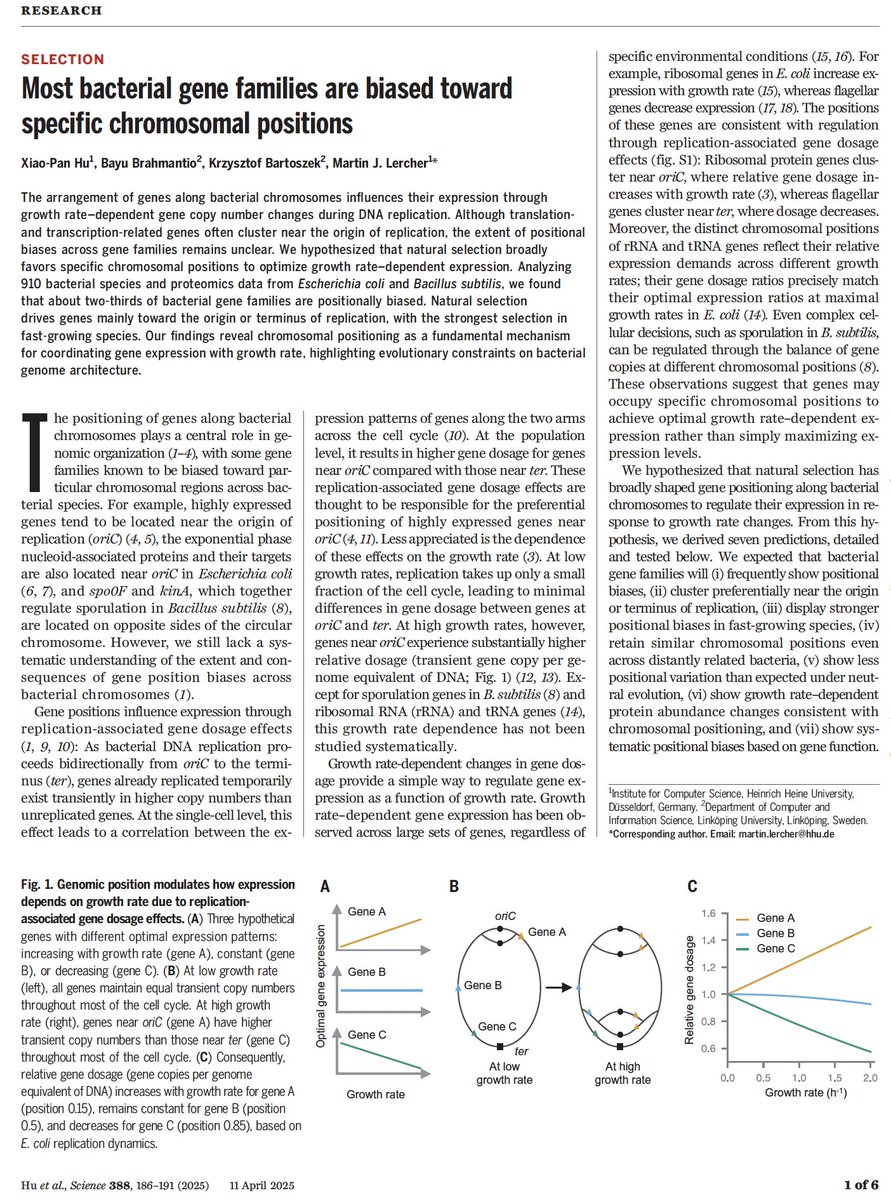
@67250Old @ItaiYanai @ScienceMagazine Why? The selection coefficients are small, which is also clear from the remaining variation in gene positions (our figure 3C). Such weak selection would be very difficult to detect experimentally.
English
1
0
0
18
Itai Yanai
Itai Yanai@ItaiYanai·
Is the genome just a bag of genes? A new paper in @ScienceMagazine now reports that for two thirds of an organisms' genes the position along the chromosome is actually very tightly constrained! Amazing work from my favorite night scientist @MartinJLercher and his team!
Itai Yanai tweet media
English
9
177
769
56.4K
ComparativeSystemsBiologyGroup_unimi retweetledi
Jeremy Wayne Tate
Jeremy Wayne Tate@JeremyTate41·
8th grade graduation exam from 1912. This wasn’t for affluent kids in New England. This was rural Kentucky.
Jeremy Wayne Tate tweet media
English
2K
12.1K
52.8K
4.2M
ComparativeSystemsBiologyGroup_unimi retweetledi
Physics In History
Physics In History@PhysInHistory·
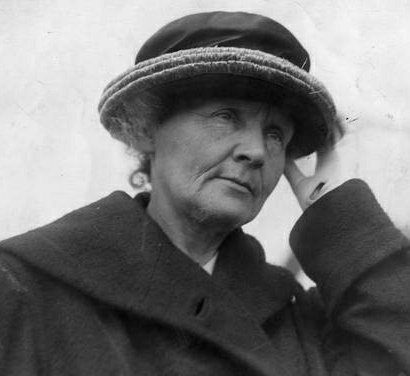
Be less curious about people and more curious about ideas. -- Marie Skłodowska Curie
Physics In History tweet media
English
40
404
1.9K
53K
ComparativeSystemsBiologyGroup_unimi
@schwabpa maybe you are right, in general you should not trust names, and use sequences, but this is normal to me. But, I am writing because the picture is really appalling and wrong. the generating AI does not even know that there are 10 bases per full turn, in DNA.
English
0
0
0
13
Patrick Schwab
Patrick Schwab@schwabpa·
A central mistake in biology was to name genes. This over-simplification made reconciling what is happening on the molecular level a mess - it's not rare to find reports of opposite mechanisms in different contexts, claimed involvement in dozens if not hundreds of different processes, sometimes inhibiting and sometimes amplifying and most of the time being oblivious to the potential for sequence-level variation. Nobody would be surprised about this diversity of findings if we instead recognized genes as (sometimes quite lengthy and complex) pieces of sequence that carry state and interact with and are interpreted by their environment - often producing dozens of gene products that are in turn themselves context-dependent and modulated. Naturally, such a highly amorphous composition of objects has many diverse effects, and masking this complexity behind a single name more often than not ends up being a harmful abstraction. The primary role of gene names then is to give us the false appearance of comfort in the face of enormous biological complexity. One under-appreciated potential of the emergence of AI tools in biology is to undo this mistake, and - instead of assuming it away - extend our ability to lean further into this complexity.
Patrick Schwab tweet media
English
81
226
1.2K
214K
ComparativeSystemsBiologyGroup_unimi retweetledi
Physics In History
Physics In History@PhysInHistory·
Paul Dirac explains the deep connection between mathematics and theoretical physics, highlighting how mathematical beauty often guides the discovery of new physical laws. ✍️
English
28
395
1.7K
70.9K
ComparativeSystemsBiologyGroup_unimi
ComparativeSystemsBiologyGroup_unimi@CompSysBiolUnit·
very easy to get fascinated by seeing things. I used to spend hours decorating my homology networks back in 2006-2008 but it is much more rewarding to exploit network theory to extract non trivial information about the biological system. So, go on!
Javier E. Fernandez @javif86.bsky.social@JaviF_86

Fascinated with graph theory and networks 😍🤯 Here a nice clustering of phages at the family level 👌 Planning to apply it to many more #genomics things 💪 #bioinformatics #microbialgenomics

English
1
0
3
106
ComparativeSystemsBiologyGroup_unimi retweetledi
Physics In History
Physics In History@PhysInHistory·
“Man is the most insane species. He worships an invisible God and destroys a visible Nature. Unaware that this Nature he’s destroying is this God he’s worshiping.” -- Hubert Reeves (1932 - 2023) He would have turned 92 today. He passed away last year in Paris.
Physics In History tweet media
English
170
1.6K
4.6K
163.3K
ComparativeSystemsBiologyGroup_unimi
ComparativeSystemsBiologyGroup_unimi@CompSysBiolUnit·
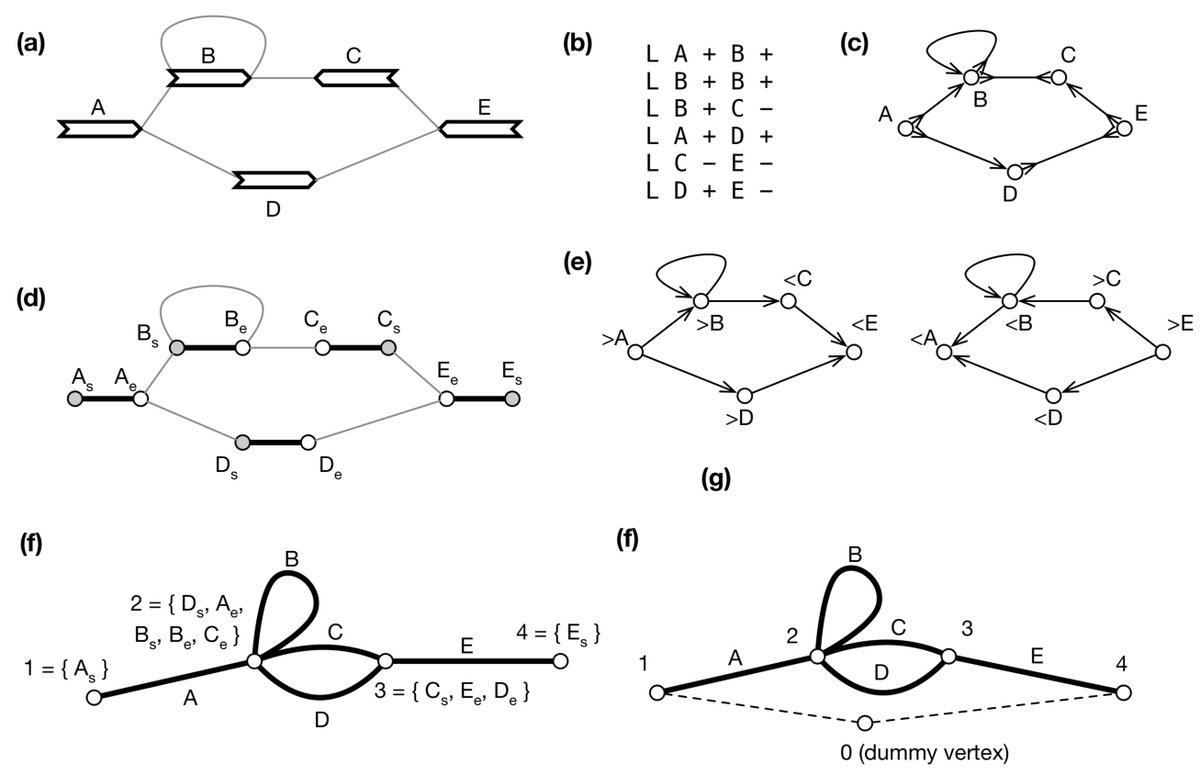
@razoralign I think you miss references to similar works. It is becoming increasingly common to realize that people nowadays do not pay attention to previous works. this is not entirely new. we worked on the same kind of graph in 2012. we called them gene neighborhood graphs
ComparativeSystemsBiologyGroup_unimi tweet media
English
0
0
3
70
ComparativeSystemsBiologyGroup_unimi retweetledi
Massimo
Massimo@Rainmaker1973·
76 years ago #Today, Claude Shannon published the article 'A Mathematical Theory of Communication', cited over 100,000 times, which is rare for a scientific article and gave rise to the field of information theory.
Massimo tweet media
English
18
338
1.3K
139.6K
ComparativeSystemsBiologyGroup_unimi retweetledi
Lior Pachter
Lior Pachter@lpachter·
In a blog post, she tells the story of the reaction she received when she pointed this out to her (tenured) professor at the time, and to others. She was basically told not to waste her time: "a lot of the scientific literature has problems". liorpachter.wordpress.com/2024/07/02/the… 7/
English
2
32
259
150.2K
ComparativeSystemsBiologyGroup_unimi retweetledi
Christoph Molnar 🦋 christophmolnar.bsky.social
My book Interpretable Machine Learning has been career-defining. Even though the book is available on the web for free, many have supported me by buying the ebook or paperback, which ultimately helped me become a full-time writer. I'm grateful for all your support 🙏
Christoph Molnar 🦋 christophmolnar.bsky.social tweet media
English
12
150
979
59.9K