compos mentis

56 posts

compos mentis

compos mentis

@ComposMentis_Be

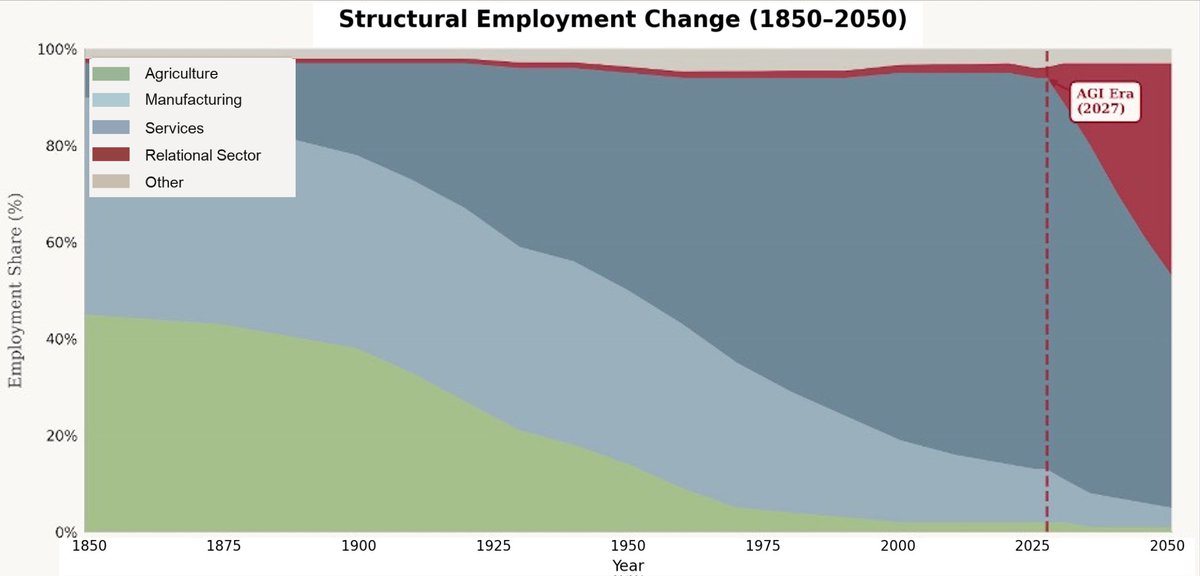
my Opinions. your Perceptions.

San Francisco, CA Katılım Ekim 2010
195 Takip Edilen34 Takipçiler
compos mentis retweetledi
Nyk 🌱
Nyk 🌱@nyk_builderz·
This a16z CLARITY breakdown is one of the best signal posts this week. My takeaway for builders is simple: This is not just “crypto policy news” - it’s infrastructure for where teams incorporate, ship, hire, and raise over the next 3–5 years. What stands out: 1) It moves the U.S. from patchwork enforcement toward explicit market structure. That reduces legal ambiguity tax, which has quietly been one of the biggest startup killers in crypto. 2) It recognizes a core truth many frameworks missed: Companies and decentralized networks are not the same thing. Trying to force network-native systems into pure company-era rules creates bad incentives and bad architecture. 3) It aligns innovation + consumer protection instead of pretending those are opposites. Good builders get clearer rails. Bad actors get less room to hide in gray zones. 4) It matters beyond “tokens.” If regulation improves, expect second-order effects in stablecoin rails, on-chain market infra, creator economies, machine-to-machine payments, and AI x crypto coordination systems. My addition: Policy clarity does not automatically create product-market fit. It creates permissionless focus. The winners from here are teams that can convert legal clarity into trustworthy UX, distribution, and real retained usage. So the play is: - build in public but compliantly - design for long-term user trust, not extraction loops - stay close to policy trajectory while shipping weekly - optimize for survivability + compounding, not narrative pumps If CLARITY progresses, this will be remembered as a major unlock moment for U.S.-based crypto building.
a16z crypto@a16zcrypto

x.com/i/article/2055…

English
14
33
203
200.9K
compos mentis retweetledi
Milk Road AI
Milk Road AI@MilkRoadAI·
This is WILD! MIT just solved one of the hardest unsolved problems in robotics (Save this). For decades, the fundamental problem with soft robots and wearable exoskeletons has not been compute or AI, it has been actuation. The moment you try to give a soft robot meaningful strength, you run into the same wall every engineer has hit since the field began, fluid-driven systems require external pumps, hydraulic reservoirs, and heavy infrastructure that makes the entire thing impractical to wear or embed into fabric. MIT's new Electrofluidic Fiber Muscles solve that problem by eliminating external infrastructure entirely. The key insight is electrohydrodynamic pumping using electric fields to generate pressure directly from electricity, with no moving parts, no motors, and no external fluid reservoir. The fibers are less than 2 millimeters thick, can be woven into fabric like ordinary textile, and operate in complete silence because nothing physically moves inside them, it is just ions propelling fluid through a closed circuit. The performance numbers published in Science Robotics are not conceptual, they are empirical results from actual hardware. These fibers achieve a power density of 50 watts per kilogram, matching skeletal muscle, with a contraction strain of 20% and a response time of 0.3 seconds. A single bundled configuration lifted 4 kilograms, 200 times its own weight while a separate configuration drove a robotic arm through a 40-degree bend compliant enough to safely complete a human handshake. Another configuration launched objects in under 100 milliseconds, which is faster than a human flinch reflex. The design mirrors biological muscle architecture in a way that prior artificial muscle approaches never achieved. The fibers are organized into antagonistic pairs, one contracts while the other extends, exactly like biceps and triceps and because the system runs in a closed loop, the relaxing fiber serves as the fluid reservoir for the contracting one, which is what allows the whole system to operate untethered with no external tank. The applications are not hypothetical but rather are the exact use cases the industry has been waiting years for the hardware to catch up to. Exoskeletons for physical labor, prosthetic limbs that move with the natural compliance of biological tissue, assistive garments for patients with motor disorders, and soft robots capable of safe physical contact with humans are all immediately unlocked by a muscle technology that is silent, lightweight, and weavable into clothing. The deeper significance is what this technology does when it meets the AI robotics wave that is already underway. Every major humanoid robot program, Figure, 1X, Boston Dynamics, Tesla Optimus is currently bottlenecked by the same hardware limitations these fibers address, actuators that are too rigid, too loud, too heavy, or too dependent on infrastructure to operate naturally alongside humans. Electrofluidic fiber muscles do not just solve a materials science problem but rather they remove one of the last physical barriers between robots that live in labs and robots that live in the world.
English
137
1K
5.2K
1.2M
compos mentis
compos mentis@ComposMentis_Be·
Humor is not a mood but a way of looking at the world. Ludwig
English
0
0
0
17
compos mentis
compos mentis@ComposMentis_Be·
The most selfish thing to do is be self-less
English
0
0
0
3
compos mentis retweetledi
Ryan Shea
Ryan Shea@ryaneshea·
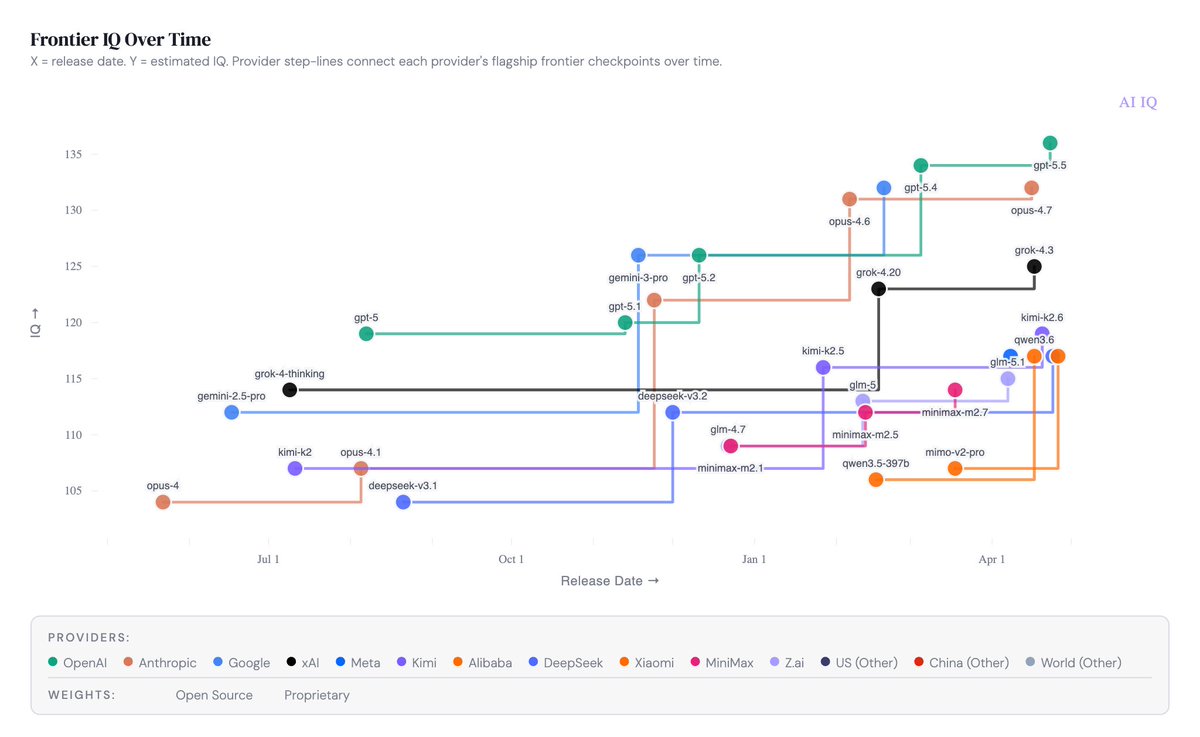
Today I’m launching AI IQ — frontier AI models, scored on the human IQ scale. Instead of endless leaderboard tables, AI IQ shows: • Where models land on the IQ bell curve • How frontier IQ is changing over time • How models compare on IQ and EQ • What intelligence costs in practice GPT-5.5, Claude Opus 4.7, Gemini 3.1, Grok 4.3, Kimi K2.6, Qwen3.6, DeepSeek V4, Muse Spark, and more. Link in the first reply. Curious which chart surprises you most.
Ryan Shea tweet mediaRyan Shea tweet mediaRyan Shea tweet mediaRyan Shea tweet media
English
153
230
1.4K
365.8K
compos mentis retweetledi
Vinod Khosla
Vinod Khosla@vkhosla·
We need awesome doctors who can help develop AI doctors to make AI scalable for all primary care, chronic disease care, and parts of specialty care we call "multi-specialty primary care"! AI allows for this oxymoron. Make a difference globally
Anitha Kannan@anithakan

We, at @curaiHQ, are hiring physician-builder, who are curious and execution-oriented, to help define the future of AI in healthcare. You will design patient and clinician facing solutions and also contribute to research Come join us! jobs.lever.co/curai/effcb328…

English
40
41
450
236.4K
compos mentis retweetledi
The AI Investor
The AI Investor@The_AI_Investor·
Brad Gerstner talked about the ridiculous valuation of memory stocks and said he will be on a podcast with the Micron CEO in a few weeks.
English
26
69
1.2K
368.3K
compos mentis
compos mentis@ComposMentis_Be·
@AnthropicAI When I reach my usage limit in Claude, can you process when the time is up? For example, go ahead and work on it automatically when the time resets- instead of waiting for me to come back and send go again.
English
0
0
0
25
Anthropic
Anthropic@AnthropicAI·
Last month, we published our look into what 81,000 people told us they want from AI. In new research, we’ve investigated the economic hopes and worries referenced in their responses. Read more: anthropic.com/research/81k-e…
Anthropic@AnthropicAI

We invited Claude users to share how they use AI, what they dream it could make possible, and what they fear it might do. Nearly 81,000 people responded in one week—the largest qualitative study of its kind. Read more: anthropic.com/features/81k-i…

English
252
228
2.3K
642.9K
compos mentis retweetledi
Alex Imas
Alex Imas@alexolegimas·
New essay on the economics of structural change and the post-commodity future of work. 1. Almost any question about the impact of advanced AI on the economy needs to start at the same place: what is still scarce? Answer that, and the analysis becomes pretty straightforward. This essay explores what becomes scarce if AI really can replicate most of what humans do in production, and what this mean for the future of jobs. 2. My conjecture, working through the economics: labor reallocates across sectors, and the sector it reallocates to has properties that keep labor a meaningful share of the economy. Ultimately this is about the structure of demand itself. For this, we have to go back to Girard, Augustine and Rousseau: once people's base needs are met, their preferences shift to comparative motives (e.g., status, exclusivity, social desirability). This motive is inherently non-satiated. 4. The key paper is Comin, Lashkari, and Mestieri (Econometrica 2021). As people get richer, they don't buy proportionally more of everything. They shift spending toward sectors with higher income elasticity. They estimate income effects account for 75%+ of observed structural change. 5. The ironic consequence: the sector that gets automated becomes a smaller share of the economy, not a larger one. Agriculture got massively more productive and its share of employment collapsed. Manufacturing too. The "stagnant" sectors absorb the spending and the jobs. 6. So the question is: which sectors have high income elasticity in a post-AGI world? I argue it's what I call the relational sector. Categories where the human isn't just an input into production, it is part of the value. 7. Why does the relational sector have high income elasticity? Because human desire has a mimetic, relational dimension. We don't just want things for their intrinsic properties. We want what others want, and we want it more when others can't have it. Girard, Rousseau, Augustine, and Hobbes all saw this. 8. In work with Kristóf Madarász, we showed this experimentally: WTP roughly doubles when a random subset of others is excluded from the good. And in new work with Graelin Mandel, AI involvement kills the premium. Human-made art gains 44% from exclusivity; AI-made art only 21%. 9. This all comes together for the core argument. The sector that absorbs spending as AI makes commodity production cheap is one where human provenance is part of the value, and demand for it grows faster than income. Exactly the profile that keeps labor meaningful. 10. To be clear about the claim: I'm NOT saying aggregate labor share must rise. It may fall. The claim is about sectoral composition, i.e., where expenditure and employment go once commodities get cheap, and the fact that the sector that will absorb reallocated labor maps to a substantial component of human preferences and desire. 11. If you're interested in the formal model, a linked companion technical note works out all the economics. Read the essay here: aleximas.substack.com/p/what-will-be…
Alex Imas tweet media
English
160
489
2.6K
944.2K
compos mentis
compos mentis@ComposMentis_Be·
@Strategy Inc. (MSTR) created 4 special income stocks: #STRF, #STRK, #STRD, @STRC_live . Think of them as "income tickets" backed by their ~780K Bitcoin (~$58B). They pay monthly/quarterly dividends — before regular MSTR shareholders get a cent. --- Imagine Strategy Inc. is an airline. The $50B Bitcoin pile = the planes and assets. In bankruptcy, the payout order is rigid: 🏦 Banks (secured debt) — first ✈️ STRF — business class 🪑 STRK — premium economy 💺 STRD — economy 🚶 STRC — standby 📉 MSTR shareholders — scraps, if anything --- STRF — "Strife" → 10% fixed yield (10.44% effective today) → Most senior preferred → Cumulative: missed payments pile up + 18% penalty interest → ~$96 price, trades near par → ~$1B+ invested Safest of the four. The business class seat. --- STRK — "Strike" → 8% fixed yield (11.05% effective at ~$72 price) → 2nd in seniority → Cumulative: missed payments pile up → Convertible to MSTR shares — upside if MSTR goes from $126 → $1,260+ → ~$1B+ invested Income + a Bitcoin lottery ticket. --- STRD — "Stride" → 10% fixed yield (~13.6% effective at ~$75 price) → 3rd in seniority → NOT cumulative: skipped payments are gone forever → Higher income today = more risk More yield. Less protection. Choose accordingly. --- STRC — "Stretch" → Variable ~11.5% yield, paid monthly → 4th (lowest) in seniority → NOT cumulative → Auto-resets to $100 → lower price volatility → ~$5B invested (by far the most popular) Liquid. Monthly income. Biggest crowd. Most junior. --- 7/10 How the money actually moves: 1. You buy preferred stock on the open market 2. Strategy keeps ~2 years of dividends in cash (~$2.25B today) 3. Rest goes to buy more Bitcoin 4. As Bitcoin appreciates, the treasury grows 5. Rising treasury + Bitcoin demand attracts more investors → repeat It's a flywheel. Bitcoin going up is the fuel. --- The honest risk: Strategy doesn't sell products. It raises capital → buys Bitcoin → pays dividends from that capital. If new investor appetite dries up, the dividend machine seizes. These are NOT bonds. NOT government-backed. NOT FDIC insured. The ~10% yield over T-bills (4%) exists for a reason. --- Current buffer check: → $50B Bitcoin vs. ~$8B in preferred stock obligations → $2.25B liquid = ~2 years of dividends covered → Average Bitcoin cost basis: ~$75K Short-term Bitcoin crash (even to $20K): holders probably fine. Multi-year bear market with no new capital: structure breaks. --- Bottom line: Regular Bitcoin-linked income without holding BTC or riding MSTR volatility. Tradeoffs are real — these are not T-bills. Most planners treat them as a 0–5% satellite position. "Play money" with a yield. Buy any of them in your regular brokerage (Fidelity, Schwab, etc.) by ticker. $STRF $STRK $STRD $STRC
English
0
0
0
106
compos mentis retweetledi
Aaron Levie
Aaron Levie@levie·
Another week on the road meeting with a couple dozen IT and AI leaders from large enterprises across banking, media, retail, healthcare, consulting, tech, and sports, to discuss agents in the enterprise. Some quick takeaways: * Clear that we’re moving from chat era of AI to agents that use tools, process data, and start to execute real work in the enterprise. Complementing this, enterprises are often evolving from “let a thousand flowers bloom” approach to adoption to targeted automation efforts applied to specific areas of work and workflow. * Change management still will remain one of the biggest topics for enterprises. Most workflows aren’t setup to just drop agents directly in, and enterprises will need a ton of help to drive these efforts (both internally and from partners). One company has a head of AI in every business unit that roles up to a central team, just to keep all the functions coordinated. * Tokenmaxxing! Most companies operate with very strict OpEx budgets get locked in for the year ahead, so they’re going through very real trade-off discussions right now on how to budget for tokens. One company recently had an idea for a “shark tank” style way of pitching for compute budget. Others are trying to figure out how to ration compute to the best use-cases internally through some hierarchy of needs (my words not theirs). * Fixing fragmented and legacy systems remain a huge priority right now. Most enterprises are dealing with decades of either on-prem systems or systems they moved to the cloud but that still haven’t been modernized in any meaningful way. This means agents can’t easily tap into these data sources in a unified way yet, so companies are focused on how they modernize these. * Most companies are *not* talking about replacing jobs due to agents. The major use-cases for agents are things that the company wasn’t able to do before or couldn’t prioritize. Software upgrades, automating back office processes that were constraining other workflows, processing large amounts of documents to get new business or client insights, and so on. More emphasis on ways to make money vs. cut costs. * Headless software dominated my conversations. Enterprises need to be able to ensure all of their software works across any set of agents they choose. They will kick out vendors that don’t make this technically or economically easy. * Clear sense that it can be hard to standardize on anything right now given how fast things are moving. Blessing and a curse of the innovation curve right now - no one wants to get stuck in a paradigm that locks them into the wrong architecture. One other result of this is that companies realize they’re in a multi-agent world, which means that interoperability becomes paramount across systems. * Unanimous sense that everyone is working more than ever before. AI is not causing anyone to do less work right now, and similar to Silicon Valley people feel their teams are the busiest they’ve ever been. One final meta observation not called out explicitly. It seems that despite Silicon Valley’s sense that AI has made hard things easy, the most powerful ways to use agents is more “technical” than prior eras of software. Skills, MCP, CLIs, etc. may be simple concepts for tech, but in the real world these are all esoteric concepts that will require technical people to help bring to life in the enterprise. This both means diffusion will take real work and time, but also everyone’s estimation of engineering jobs is totally off. Engineers may not be “writing” software, but they will certainly be the ones to setup and operate the systems that actually automate most work in the enterprise.
English
254
647
5.3K
1.8M
compos mentis
compos mentis@ComposMentis_Be·
@CrazyPolymath If you don’t have a destination in mind .... where you are is already the destination 😇
English
0
0
2
0
Kunal
Kunal@KunalBSarkar·
If you don't have a destination in mind, Every road is a right road, And every road is a wrong road.
English
2
11
108
0
Kpaxs
Kpaxs@Kpaxs·
The best things a man can have: * Friendship without expectations * Love without chains * Confidence without arrogance
English
5
90
460
0
compos mentis
compos mentis@ComposMentis_Be·
Game it to tame it
English
0
0
1
0
compos mentis
compos mentis@ComposMentis_Be·
W is the most important alphabet in the English dictionary .... as a prefix it changes the meaning of ‘hole (ignorance) to ‘Whole (knowledge)
English
0
0
0
0