
Computational Sciences & Engineering

14.8K posts

Computational Sciences & Engineering banner
Computational Sciences & Engineering

Computational Sciences & Engineering

@Computational_s

Magazine of #Computational Sciences • Engineering • Fluid Dynamics • #cfd | est. 2013 by @thepostdoctoral

California, USA Katılım Haziran 2013
4.5K Takip Edilen7.1K Takipçiler
Computational Sciences & Engineering retweetledi
Xiuyu Li
Xiuyu Li@sheriyuo·
AI research is already falling into a death cycle. If you do not get an internship at a top lab/company, you cannot access the core techniques or gain real frontier engineering experience. But without those experiences, it becomes almost impossible to pass the resume screening and multiple interview rounds for those same internships. People joke about using Macs for AI, but in reality they are often just better SSH terminals into remote GPU clusters. In frontier labs, the most important thing about an internship is not the payout. What really matters is which team (foundations/data/infra/ToC/...) you are on and how much GPU cluster (have you tried training on 64 GPUs?) access you get. That determines the actual value of the internship for your future research and career. The most advanced models, datasets, and compute resources are increasingly concentrated inside a handful of companies. That concentration is quietly reshaping the entire field.
紫云@dviolettchan

CS used to be a relatively less toxic field because the tools were open and cheap. You could do meaningful research with a laptop, or maybe a single GPU. Those good old days are probably never coming back. (1/3)

English

49
112
1.5K
124.2K
Computational Sciences & Engineering retweetledi
Tolga Birdal
Tolga Birdal@tolga_birdal·
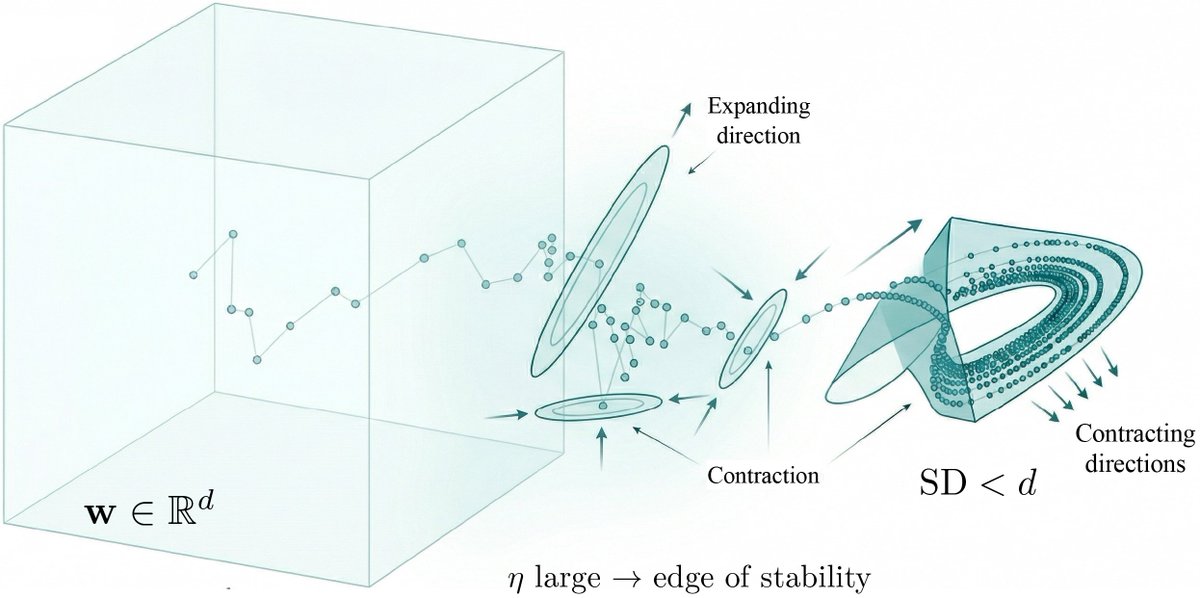
Modern deep networks are often trained at the #EdgeOfStability, a regime where dynamics are locally unstable, nearing chaos. Yet generalization improves, defying the wisdom of classical optimization. We now theoretically explain this central puzzle: arxiv.org/abs/2604.19740. 👇
Tolga Birdal tweet media
English
22
158
974
101.2K
Computational Sciences & Engineering retweetledi
Matt Dancho (Business Science)
Understanding regression models is essential in data science. In 4 minutes, I'll demolish your confusion. Let's go:
Matt Dancho (Business Science) tweet media
English
8
234
1.4K
119.2K
Computational Sciences & Engineering retweetledi
Jason Locasale
Jason Locasale@LocasaleLab·
The best science still comes from people who care more about truth than credit.
English
36
112
586
36.9K
Computational Sciences & Engineering retweetledi
Massimo
Massimo@Rainmaker1973·
Each sphere is moving in a straight line, but the final motion is circular
English
132
1.4K
12.5K
1.2M
Computational Sciences & Engineering retweetledi
Massimo
Massimo@Rainmaker1973·
Sums of sinusoidal functions visualized with epicycles. [🎞️ thebrainmaze]
English
5
141
662
66.4K
Computational Sciences & Engineering retweetledi
Antonio Orvieto
Antonio Orvieto@orvieto_antonio·
Looking for 2 strong applied ML/AI interns (6 months, Graduate/PhD level) to work on new efficient neural networks for event-based camera data (vision + sequential modeling). Apply here! docs.google.com/forms/d/e/1FAI…
English
10
51
496
42.8K
Computational Sciences & Engineering retweetledi
Nav Toor
Nav Toor@heynavtoor·
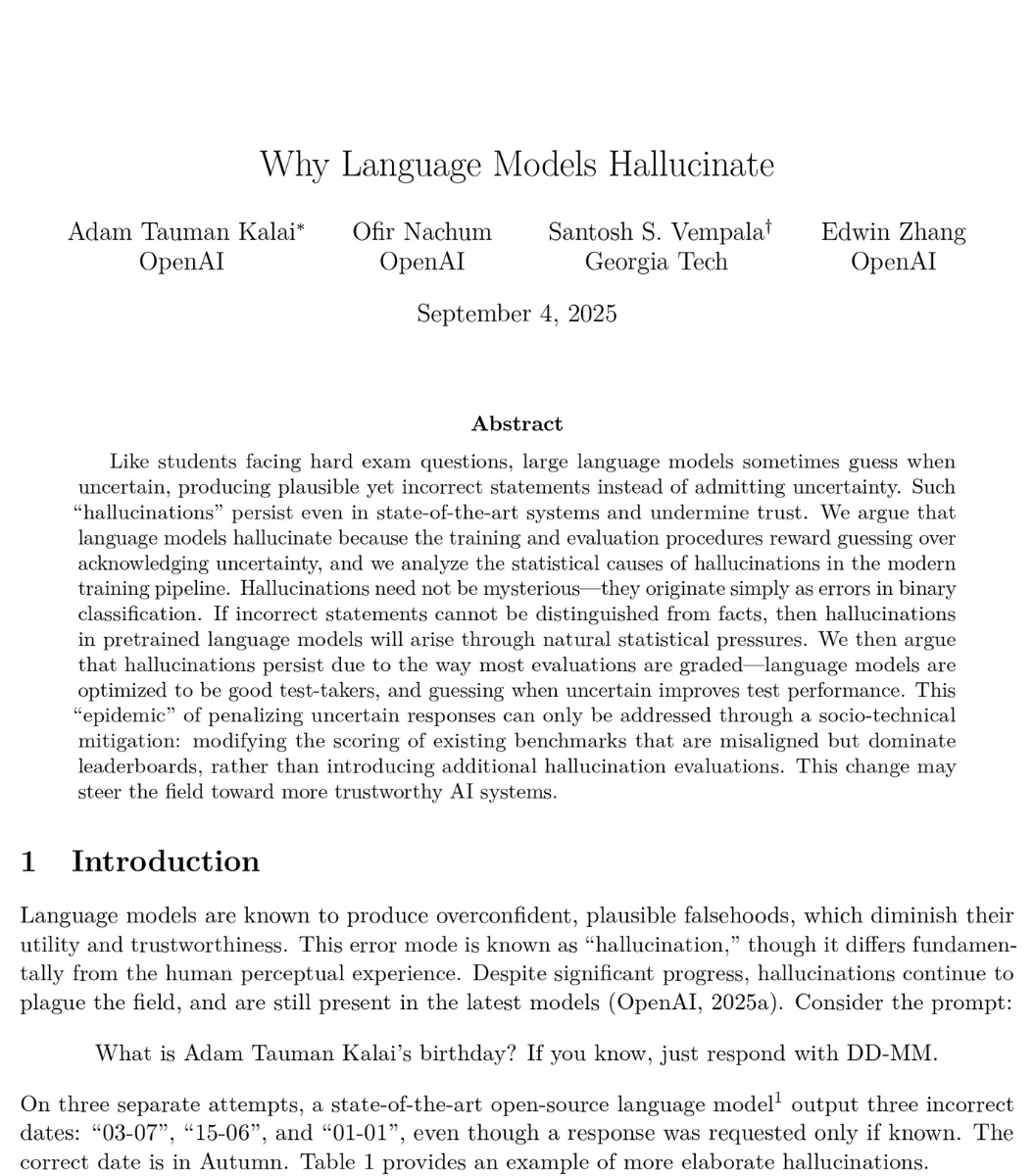
🚨BREAKING: OpenAI published a paper proving that ChatGPT will always make things up. Not sometimes. Not until the next update. Always. They proved it with math. Even with perfect training data and unlimited computing power, AI models will still confidently tell you things that are completely false. This isn't a bug they're working on. It's baked into how these systems work at a fundamental level. And their own numbers are brutal. OpenAI's o1 reasoning model hallucinates 16% of the time. Their newer o3 model? 33%. Their newest o4-mini? 48%. Nearly half of what their most recent model tells you could be fabricated. The "smarter" models are actually getting worse at telling the truth. Here's why it can't be fixed. Language models work by predicting the next word based on probability. When they hit something uncertain, they don't pause. They don't flag it. They guess. And they guess with complete confidence, because that's exactly what they were trained to do. The researchers looked at the 10 biggest AI benchmarks used to measure how good these models are. 9 out of 10 give the same score for saying "I don't know" as for giving a completely wrong answer: zero points. The entire testing system literally punishes honesty and rewards guessing. So the AI learned the optimal strategy: always guess. Never admit uncertainty. Sound confident even when you're making it up. OpenAI's proposed fix? Have ChatGPT say "I don't know" when it's unsure. Their own math shows this would mean roughly 30% of your questions get no answer. Imagine asking ChatGPT something three times out of ten and getting "I'm not confident enough to respond." Users would leave overnight. So the fix exists, but it would kill the product. This isn't just OpenAI's problem. DeepMind and Tsinghua University independently reached the same conclusion. Three of the world's top AI labs, working separately, all agree: this is permanent. Every time ChatGPT gives you an answer, ask yourself: is this real, or is it just a confident guess?
Nav Toor tweet media
English
1.3K
8.8K
33.5K
3.3M
Computational Sciences & Engineering retweetledi
Philosophy Of Physics
Philosophy Of Physics@PhilosophyOfPhy·
This is one of the best Visual Explanation of how LLMs actually work.
English
10
109
619
33.2K
Computational Sciences & Engineering retweetledi
Nikta Fakhri
Nikta Fakhri@FakhriLab·
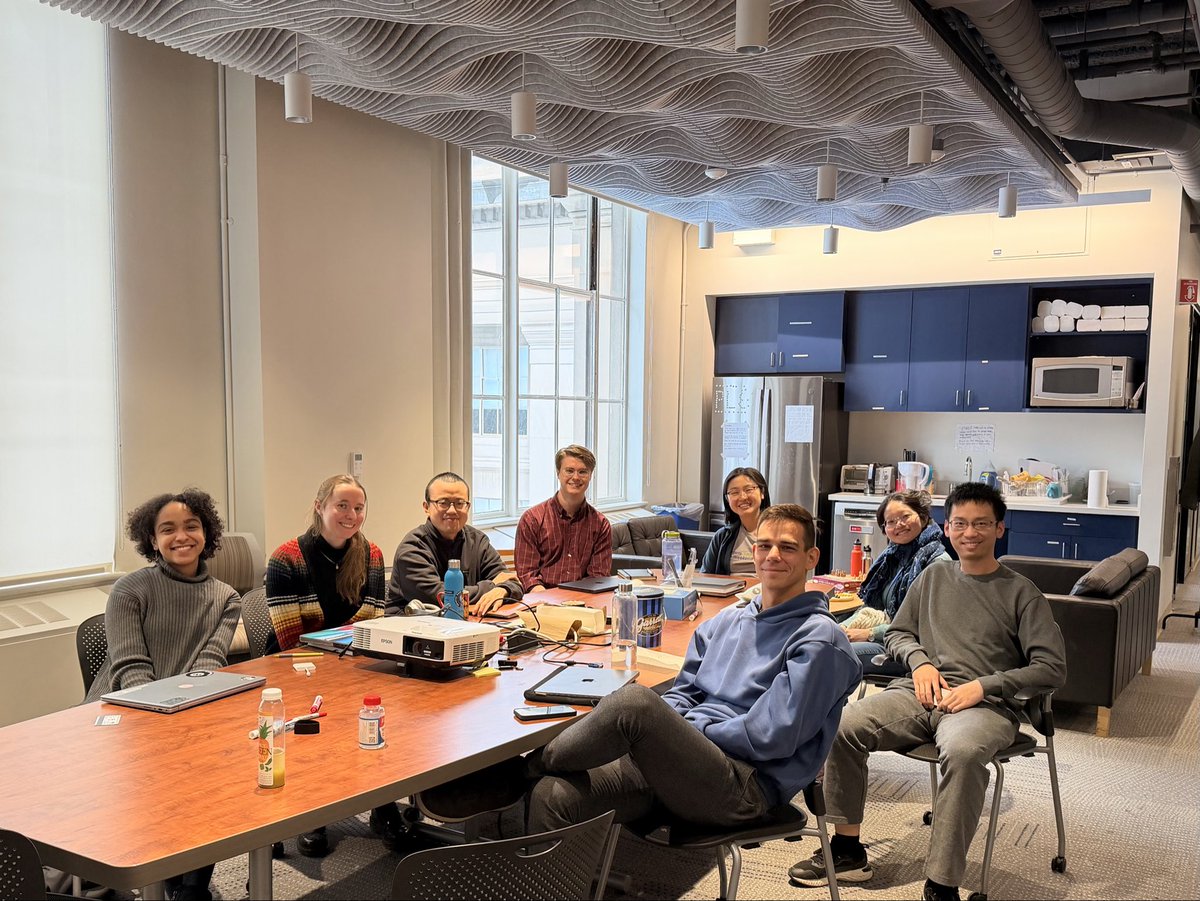
I’m excited to share that I’ve been promoted to Full Professor of Physics at @MIT. This milestone feels especially meaningful: I am the first Iranian woman to hold this position in physics at MIT. I carry my heritage with pride, especially in moments like this. I’m deeply grateful to my students, postdocs, colleagues and mentors. This achievement reflects the community that challenges me, supports me, and elevates the work every day. The work continues: ambitious questions, curiosity-driven science and much still to discover. Onward… to the questions we haven’t yet imagined! Picture: latest Fakhri group meeting
Nikta Fakhri tweet media
English
306
324
4.5K
116K
Computational Sciences & Engineering retweetledi
Next Science
Next Science@NextScience·
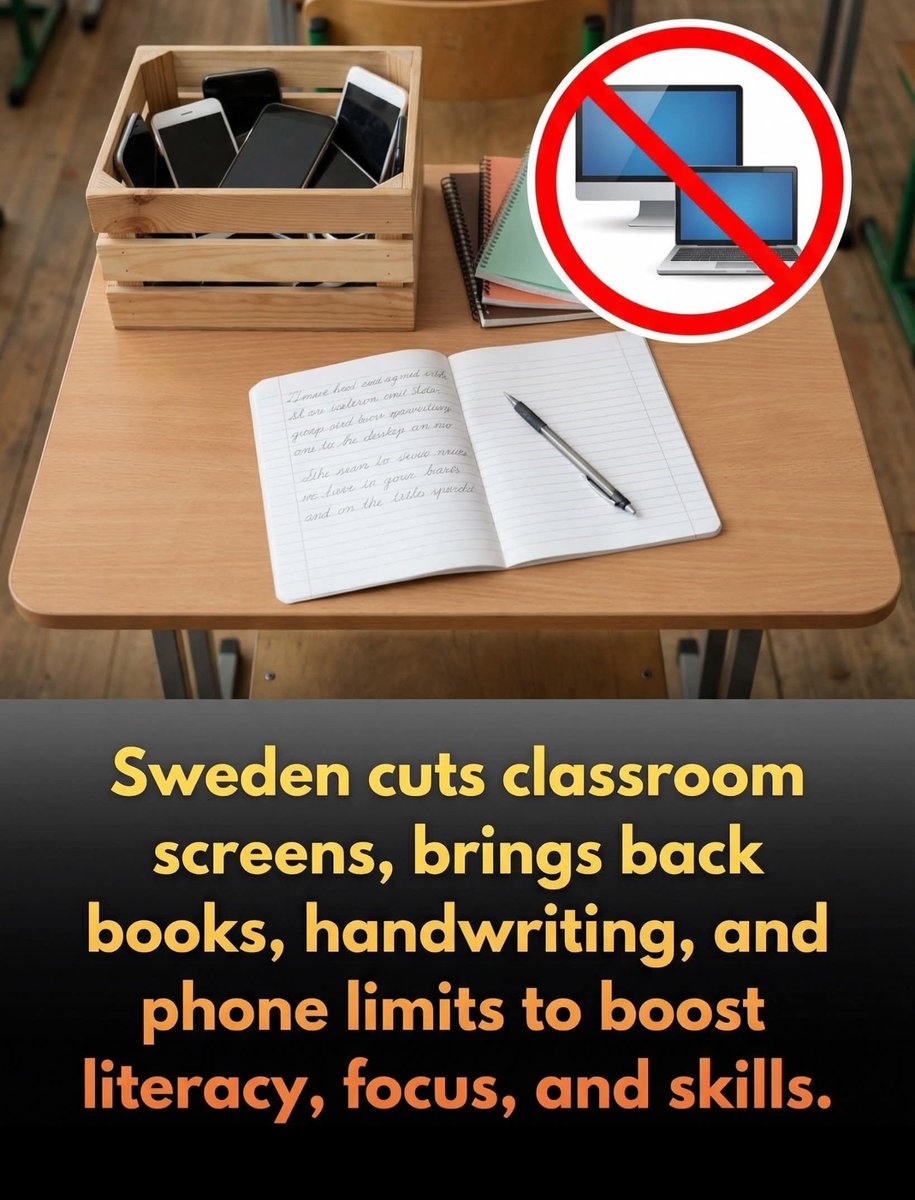
🚨 Sweden Ditches Classroom Tablets for Textbooks to Boost Student Focus In a surprising move, Sweden is spending over €100 million to bring real textbooks back into classrooms—and reduce the role of tablets and screens. After 15 years of digital-first learning, the country is hitting reset. Why? Because new evidence suggests that too much screen time has quietly harmed student focus, reading ability, and deep thinking. According to findings highlighted by the Ministry of Education, reading on glowing screens takes more mental effort, invites distractions, and weakens comprehension compared to reading on paper. Now, Sweden’s plan is simple but bold: every student will get a printed textbook for every subject. Digital tools won’t disappear—but they’ll move to the background instead of running the show. The goal is a calmer, distraction-free learning space where students can focus, remember more, and think better. This shift sends a powerful message to the world: technology is helpful, but it shouldn’t replace the magic of turning pages, underlining ideas, and truly getting lost in a book. By choosing paper over pixels, Sweden may be leading a global rethink of how we teach the next generation—and it might just change classrooms everywhere.
Next Science tweet media
English
14
85
214
6.9K
Computational Sciences & Engineering retweetledi
Prof Lennart Nacke, PhD
Prof Lennart Nacke, PhD@acagamic·
The classic hourglass structure of paper writing
Prof Lennart Nacke, PhD tweet media
English
6
263
2.3K
42.7K
Computational Sciences & Engineering retweetledi
critter
critter@BecomingCritter·
Is there a secret science that bridges all science?
critter tweet media
English
3.4K
1.2K
16.3K
12.8M
Computational Sciences & Engineering retweetledi
Science girl
Science girl@sciencegirl·
This drone can transform and switch between different movement styles
English
38
198
1.2K
42.5K
Computational Sciences & Engineering retweetledi
Joachim Schork
Joachim Schork@JoachimSchork·
Misuse of p-values is a prevalent issue in scientific research. P-values are often misunderstood and misapplied, leading to incorrect conclusions. A p-value measures the probability of obtaining results at least as extreme as the observed ones, assuming that the null hypothesis is true. Common problems with p-values include: ✅ Overemphasis on significance: Researchers often focus on whether p-values are below a threshold (e.g., 0.05), ignoring the effect size and practical significance. ✅ P-hacking: Manipulating data or experimental conditions to achieve statistically significant p-values. ✅ Misinterpretation: Believing that a low p-value proves the alternative hypothesis or that a high p-value confirms the null hypothesis. ✅ Ignoring context: Failing to consider the broader context of the study, including prior evidence and the research design. The graph shown in this post is a modified version of this Wikipedia image: es.wikipedia.org/wiki/Valor_p#/… Want to deepen your understanding of statistics with R? Sign up for my online course, "Statistical Methods in R." Learn more by visiting this link: statisticsglobe.com/online-course-… #datasciencetraining #Data #DataViz #Python #Statistical #pythoncode #datavis #database
Joachim Schork tweet media
English
10
127
649
31.9K
Computational Sciences & Engineering retweetledi
Ramon Bataller
Ramon Bataller@rabataller·
How do I write scientific papers, reviews, grants, and abstracts? Sharing 30 years of experience in one practical table. ⬇️
Ramon Bataller tweet media
English
12
245
909
49.7K