LucyInTheSky🇮🇳🇨🇦

22.8K posts

LucyInTheSky🇮🇳🇨🇦 banner
LucyInTheSky🇮🇳🇨🇦

LucyInTheSky🇮🇳🇨🇦

@Cosmo_CoCo21

I am just sunshine mixed with a little hurricane ! Instagram Account : @tulip_wind21

Planet Earth Katılım Nisan 2020
1.1K Takip Edilen279 Takipçiler
Amir
Amir@bloodyjatt·
@_Finance0 Please don’t post such disgusting things… mera sab khaya piya nekal jana tha 🤮
Filipino
1
0
0
26
Monika
Monika@_Finance0·
"An Indian Hindu is drinking cow's urine" The entire world is very different from these Indian Hindus & BJP supporters.
Monika tweet media
English
6
15
29
439
Voice Of Bangladeshi Muslims 🇧🇩
India last year carried out the Pahalgam false flag to present itself as a victim of terrorism and later attacked Pakistan. India got isolated; the world knows about it. India which tried to label itself a victim is a terrorist country that sponsors terrorism in Balochistan.
English
6
31
51
867
Jehad Zafar
Jehad Zafar@Jehad_Zafar·
Last year, the Indian govt labeled my channel, The Wide Side, a national security threat and banned it in India for simply reporting facts. We lost 40% of our dedicated audience, but we didn’t stop. Despite challenges, we’re still here, working, and still sharing Pak perspective.
English
55
13
143
13.1K
The Blank Page Official
The concept of India's Akhand Bharat theory is a virus, while Pakistan's two nation theory serves as its antidote; removing the Two nation theory from the equation would essentially result in a unchallenged Indian dominance in the region.
English
13
1
35
1.1K
Randeep Sisodia
Randeep Sisodia@Randeep_Sisodia·
Forget Ghar waapsi… First, many Hindus need to immediately convert to Hinduism!! Agree??
English
137
880
5.4K
33.5K
Voice Of Bangladeshi Muslims 🇧🇩
🚨🇮🇳 Iran has once again stopped an Indian-flagged ship in the Strait of Hormuz after previously stopping and firing against other Indian vessels. Iran is allowing Pakistani ships but not Indian ships due to betrayal.
English
2
9
35
672
LucyInTheSky🇮🇳🇨🇦
@VOBMUSLIMs Claim regarding 🇮🇳 India - is misleading and largely false. Claim regarding Pakistan 🇵🇰- There is no verified report from credible international media supporting this claim. Illiterate Bangladeshi read news paper Articles— Gandu
English
0
0
1
13
Pakistani
Pakistani@FactCheckAsia·
Indians should accept the fact that Urdu is better than Hindi.
English
316
81
1.2K
23.2K
Kris Nair
Kris Nair@KrisNair1·
I am a Hindu and I want my Nation to remain SECULAR and not a Hindurashtra. How about you guys ?
English
843
180
1.4K
27.1K
Akshit Singh 🇮🇳
Akshit Singh 🇮🇳@IndianSinghh·
National refinery site in Pakistan has been attacked by Unknown men. The refinery has been set under fire 🔥😎🇮🇳
English
39
348
2.9K
31.8K
Revolt
Revolt@revolt_71·
ভারতের ক্ষমতাসীন ভারতীয় জনতা পার্টি (বিজেপি) বাংলাদেশের সীমান্তবর্তী রাজ্যগুলোতে তাদের নির্বাচনী প্রচারণায় ‘বাংলাদেশ’ প্রসঙ্গটিকে একটি নিয়মিত বিষয়ে পরিণত করেছে। বিভিন্ন জনসভা, প্রচারণামূলক ভিডিও এবং দলীয় বার্তায় বিজেপির শীর্ষ নেতারা বাংলাদেশকে অবৈধ অভিবাসন, সীমান্ত অনিরাপত্তা, জনতাত্ত্বিক পরিবর্তন এবং কথিত ভোটার জালিয়াতির সঙ্গে যুক্ত করেছেন। thedissent.news/current-affair…
Revolt tweet media
বাংলা
6
4
46
863
Revolt
Revolt@revolt_71·
Pakistan’s Real Power Is Not Noise, But Position Much of the conventional commentary on Pakistan still sounds trapped in an outdated vocabulary: crisis, dependency, instability, bailout, fragility. None of those labels is entirely false. But none of them, on its own, explains Pakistan’s actual place in the emerging geopolitical order. That is the more important story. The international system is shifting away from a simple unipolar framework. American dominance is more contested, China is more assertive, and many regional powers are no longer choosing one camp so much as learning how to work several at once. In that environment, Pakistan is not merely surviving. It is positioning itself. Its recent diplomatic behavior suggests not chaos, but a deliberate attempt to turn geography, strategic relevance, and great-power competition into leverage. That interpretation is strengthened by the record: the IMF approved a new 37-month Extended Fund Facility for Pakistan worth about $7 billion in September 2024, while Islamabad also hosted the SCO Council of Heads of Government meeting in October 2024 and continued to deepen CPEC cooperation with China. This is why Pakistan should no longer be read simply as a “problem state.” It is increasingly acting like a swing state in Eurasia: a country that matters not because it dominates the system, but because too many major actors need it at once. Washington wants stability in South Asia. Beijing wants overland and maritime connectivity, especially through CPEC. Moscow wants room to widen its energy relationships. The Gulf states want a secure regional partner with military and political relevance. Pakistan sits at the meeting point of all four calculations. That is not weakness. That is strategic centrality. CPEC remains an official long-term framework, and Pakistan and China publicly reaffirmed in July 2024 their commitment to an upgraded Phase II. The most important point is this: Pakistan’s influence does not come from having the largest economy in Asia or the strongest industrial base in the region. It comes from being difficult to bypass. Geography still matters in world politics, and Pakistan occupies one of the most consequential locations in Eurasia. It links South Asia, Central Asia, the Arabian Sea, and the western edge of China’s strategic corridor-building. It is also close to one of the most sensitive maritime zones in the world, the wider Hormuz energy theatre. In a century defined by supply chains, corridors, choke points, and energy insecurity, that location is not incidental. It is power. What makes Pakistan especially important is that it is trying to convert that geographic inheritance into diplomatic room for maneuver. Islamabad’s role in regional mediation efforts, including attempts to encourage de-escalation around Iran-related tensions, reflects this broader ambition to be seen not only as a security consumer, but as a political broker. That posture fits a wider reality: Pakistan is attempting to stay relevant to both China and the United States, rather than becoming the exclusive instrument of either. Reuters reported as recently as April 2026 that Pakistan was adjusting its energy procurement strategy amid Iran-war-related disruption while still preferring government-to-government arrangements and seeking to protect domestic supply. This is also where the India question becomes unavoidable. For years, much of the regional narrative assumed that India’s rise would automatically reduce Pakistan’s strategic significance. But geopolitics is rarely that linear. India’s growing value to the United States and its broader role in balancing China have not erased Pakistan’s utility; in some ways, they have preserved it. A state sitting on India’s western flank, tied into China’s strategic planning, engaged with Gulf powers, and still relevant to Western financial diplomacy cannot simply be wished away. That does not mean Pakistan is “winning” some grand civilizational contest. It means the balance of power in South Asia remains more contested than triumphalist narratives on either side often admit. To say this clearly: Pakistan’s future relevance will depend less on rhetorical nationalism than on whether it can translate external leverage into internal strength. A country cannot indefinitely rely on geography while neglecting governance, exports, energy reform, institutional credibility, and social stability. The real test of Pakistani statecraft is not whether it can alarm India or irritate the West. The real test is whether it can use its strategic position to build durable national capacity. Still, the direction is hard to miss. Pakistan is no longer best understood as a passive recipient of global pressure. It is learning how to exploit the fractures of a multipolar world. It is using China without fully abandoning the West. It is taking IMF support without surrendering all strategic flexibility. It is keeping channels open across rival blocs. That is not the behavior of a collapsing state. It is the behavior of a state trying to turn permanent vulnerability into permanent leverage. The IMF itself described the 2024 program as aimed at restoring external viability and supporting sustainable growth, while Pakistan’s foreign ministry highlighted the October 2024 SCO summit in Islamabad as a major multilateral gathering under its chairmanship. Pakistan may still be fragile. But fragility and importance are not opposites in modern geopolitics. Sometimes, in a fractured international order, they coexist. And that may be the uncomfortable truth many analysts still resist: Pakistan is not on the margins of the new Eurasian contest. It is increasingly one of the states through which that contest will be negotiated.
Revolt tweet media
English
1
0
20
389
Rishi Bagree
Rishi Bagree@rishibagree·
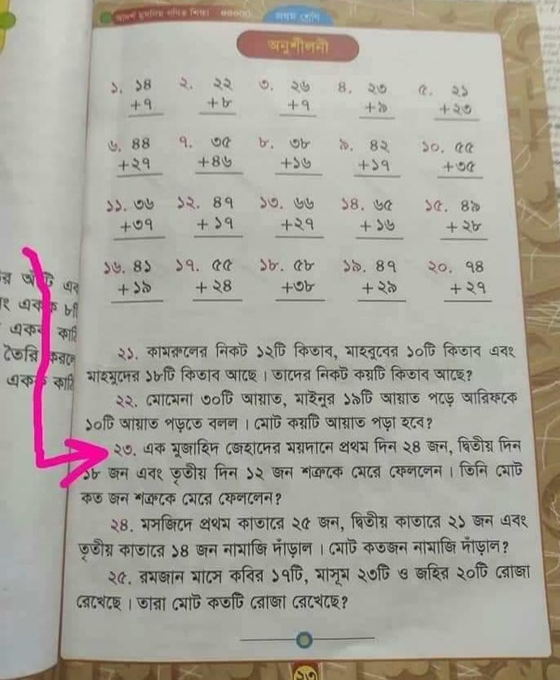
MATHS QUESTION THIRD STANDARD? Question no. 23 - A Mujahid Jihadi kills 28 enemies on the first day, 18 on the second day and 12 on the third day. How many enemies has he killed in all?
Rishi Bagree tweet media
English
137
1.9K
3.7K
103.4K
Baba Banaras™
Baba Banaras™@RealBababanaras·
Which of these women is the most beautiful? I nominate this photography for World Press Photo Award.
English
56
55
203
11.5K