K Crary

40K posts

K Crary

K Crary

@Crary76

Green/grocer/XY

Katılım Mart 2012
393 Takip Edilen172 Takipçiler
K Crary
K Crary@Crary76·
@RantyAmyCurtis It’s much more interesting to think about the message Obama is trying to send here.
English
0
0
0
27
K Crary
K Crary@Crary76·
@jared_shult This is Obama’s memo to progressives, telling them to knock it off.
English
0
0
0
4
Jared Shult
Jared Shult@jared_shult·
Republicans really tried to claim Caitlin Clark as one of theirs lmao
Jared Shult tweet media
English
1.4K
316
5.4K
609.2K
K Crary retweetledi
Matt Devitt
Matt Devitt@MattDevittWX·
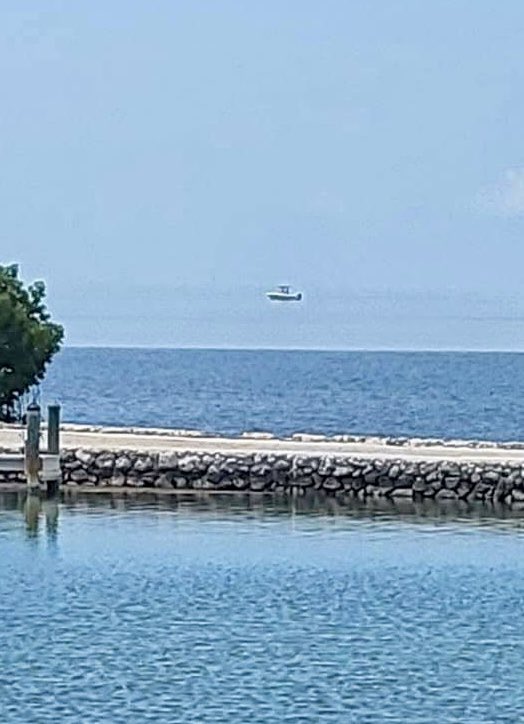
HOW COOL IS THIS?! 🤯 It’s a floating boat in the Florida Keys! Well, not really (and also not AI). It’s called a Fata Morgana, which is a mirage that forms when warm air sits above cooler air near the water. The changing temperature and density bend the light, distorting the view and making a distant boat appear to float above the horizon. Pretty awesome! Credit: Heather E Watson
Matt Devitt tweet media
English
28
134
975
37.3K
K Crary retweetledi
Krzysztof Szczawinski 🇵🇱
The gun is the most misunderstood object in Western civilization. Not a weapon. A technology. The technology that made the idea of equality physically real. 1. The longbow democratized warfare – a peasant could kill a knight with a stick and a string, and Agincourt proved it. The gun completed the process. The armored warrior class whose claim to social dominance rested on physical superiority became obsolete. The aristocratic monopoly on violence ended not with a philosophy but with a mechanism. The gun is the physical enforcement of the idea that all men are created equal. Which is why the American founders put it in the second amendment – not as an afterthought, but as the guarantee of everything else. 2. The Roman citizen had the right to bear arms. The Greek citizen had it. The English yeoman had it. The Swiss canton built its entire civilization on it. The disarming of the population has always been, in every civilization, in every century, the first act of the government that intends to stop being answerable to that population. Show me a disarmed population and I will show you a population that lost something else shortly after. 3. The Second Amendment is not about hunting. It is not about sport. It is about the relationship between the armed citizen and the state – the explicit constitutional acknowledgment that the citizen’s right to defend himself, his family, and his civilization against any threat, including the government itself, is not granted by the state and cannot be revoked by it. Power flows upward from the armed citizen, not downward from the armed state. 4. The gun defends the family. The woman alone with her children. The farmer on the edge of civilization. The shopkeeper in the neighborhood the police no longer patrol. The gun is the equalizer – the technology that makes the physical difference between a large man and a small woman irrelevant. Every argument for disarmament is, at its core, an argument that the state will protect you better than you can protect yourself. The evidence for this proposition is not encouraging. 5. In Europe, the disarmament is now nearly complete – and it happened precisely as the state’s ability and willingness to protect its citizens began to decline. The timing is not coincidental. A population that cannot defend itself must trust the state to defend it – which is a population that cannot effectively question whether the state is doing so. The dependency is the design. 6. The gun is a civilizational technology in the deepest sense: it requires responsibility, judgment, and the willingness to accept the consequences of your decisions. You cannot outsource it. You cannot have a committee fire it. It is the most anti-bureaucratic object ever invented – a direct, personal, consequential instrument that puts the full weight of the decision on the individual holding it. Which is precisely why the administrative state finds it intolerable. Not because it is dangerous. Because it is sovereign. 7. The family that can defend itself does not depend on the state for its most fundamental security. The civilization that can defend itself has not yet outsourced its survival to an institution that will negotiate the terms of that survival on its own behalf. The gun determines who controls violence – and therefore who controls everything that violence can threaten. Which is everything. The Sobieski who rode down the hill had a sword and sixty thousand horsemen. The equivalent today is the armed citizen who understands what he is defending and why. Every civilization that forgot this discovered it the hard way. The ones that remembered it are still here.
Krzysztof Szczawinski 🇵🇱 tweet media
Krzysztof Szczawinski 🇵🇱@Kristof_Poland

The French knights at Crécy and Agincourt were full of honor and panache. Beautiful horses, beautiful armor, beautiful feathers – formidable. Magnificent. The English were efficient. Guess who won? The longbowman was a peasant. No noble blood, no chivalric code, no magnificent plumes. He trained every Sunday by royal decree until he could put an arrow through armor at two hundred yards. He was not impressive to look at. He was devastating to face. The French knights found it offensive. To be killed by a commoner with a stick and a string – it violated the entire aesthetic of war. They charged anyway, because the code demanded it, because the horses were magnificent, because retreating was unthinkable for a man of honor. The arrows didn’t care about the code. This is the oldest story in Western civilization, told every century in a different costume. The beautiful system versus the efficient one. The one that looks right versus the one that works. The French had the better uniforms at Crécy, at Agincourt, at Waterloo, and in 1940. The pattern is not a coincidence. It is a civilizational tendency – the preference for the magnificent gesture over the effective one, for the noble form over the brutal function. The market is the longbow. Unglamorous, democratic, slightly disreputable in polite company – and devastating to any system that faces it while still believing that looking correct is the same as being right. The arrow doesn’t care about your panache. It never did.

English
183
1.4K
5K
209K
K Crary
K Crary@Crary76·
@asymmetricinfo It’s a mistake to treat conservative criticism as an exogenous variable anyway. That criticism is a result of academia’s failure.
English
0
0
0
47
Megan McArdle
Megan McArdle@asymmetricinfo·
One of the most frequent responses to me about the loss of public trust in academia is that it's not their fault, it's the result of a decades-long conservative campaign. Why don't I talk about that? Well, because you can't explain a change with a level.
English
37
23
358
64K
Annie Dufour
Annie Dufour@anniedufour99·
Yes. A country that is beloved and respected around the world for its commitment to democratic ideals. A country- that was your best ally, your best friend- who hid your countrymen in its Embassy in Iran, got them out, and stayed behind, at great risk to itself, in 1979. A smaller country you are shamelessly attacking. Bigger in every way, Trump' s USA, you are, except where it matters: honour, courage and loyalty.
English
103
4
14
54K
Stephen L. Miller
Stephen L. Miller@redsteeze·
"From Canada"
Annie Dufour@anniedufour99

@Acosta From Canada : this is painful to watch as a journalist. American Media has fallen short of its role as a pillar of democracy. Complacent. Coy. Accommodating. A Vichy Press, almost. When it should have been unyielding, brave, and bold. You reap what you sow. #uspoli

English
15
15
401
28.1K
K Crary retweetledi
Spencer A. Klavan
Spencer A. Klavan@SpencerKlavan·
Odysseus is a character defined throughout Homer’s original by the open question of who he is. His name is left unspoken for the first 20 lines of the poem. He’s famously “polytropos”—a man of many ways. Homer sets up in the first word of the first line that his subject is “anēr,” a man, then gives us four books in which Odysseus is pretty much *not* present, establishing that the central character begins his own story as an absence, a void. That’s why—with respect to @MattWalshBlog—it’s important that it’s not Nolan who came up with the idea to tell the events of the story out of order. Homer did. Odysseus in the original tells much of his own story in retrospect, as in the movie, and many other characters in the poem also have a version of his story. Each new retelling adds another layer to his character. He’s known the world over for his cunning and trickery, but that means it’s very hard to know the core of the real him. He calls himself “nobody” to trick the Cyclops, and the resonance is clear: to survive he has to efface and reinvent himself, to hide. But to restore his place at home in Ithaca, he has to tell his own story and integrate all the layers of who he is—trickster, warrior, father, husband, king. It’s true that he’s full of righteous anger and hungry for glory. It’s also true that he weeps, in Homer’s original, to hear the story of his own Trojan horse. Homer says he weeps like a woman whose husband is killed at the walls of his city. The implication is very strong that he’s identifying with the enemy widows of his own war. None of this makes him less of a solider or means he regrets the war. It means Homer’s character contains multitudes and is one of literature’s most enormous, complex personalities. He’s like Hamlet in this way. It’s impossible to capture all of him in any telling except that of the original poem. That’s what makes the Odyssey itself a work of insurmountable genius. Many great artists have portrayed a version of Odysseus: Sophocles, Virgil, Dante, Tennyson. Each one drew out and emphasized different aspects of the original. Sometimes he’s a deceitful louse. Sometimes he’s a wistful and restless adventurer. Every retelling refracts the white light of the original character through the prism of a new age’s concerns—Dante’s Christian condemnation of fraud, for example, or Tennyson’s sense that the age of heroes is fading from the world (Nolan, as has been said many times now, obviously has Tennyson in mind with the ending of his movie). And here’s the beautiful thing: the idea that different people would see and judge this guy different ways *is there at the center of the poem to begin with.* It’s like Homer already knew there would be many versions, and built that in. Have I mentioned he was a great artist? Nolan’s no Dante, and I agree that his retelling introduces a degree of guilt over the war itself—and war in general—that makes the character less rich and more modern than in Homer. But the problem’s not that his version of Odysseus is different from the original, or from others. In a way, that’s one of the things about the movie that places it right in line with the Western tradition. “There are as many Hamlets as there are melancholies,” wrote Oscar Wilde. There are as many Odysseuses as there are homecomings. That’s why the poem never dies.
Andrew Klavan@andrewklavan

Hey Matt. If you listen to the Klavans on the Culture show I did with @SpencerKlavan, you'll see I partly agree wtih you. I (and just about everyone else in America apparently) found the movie very entertaining, but it misses being a great film because Nolan's take on Odysseus doesn't fit his own portrayal of Odysseus. The character he wrote wouldn't feel the things he makes him feel. In other words, it's an aesthetic failing. BUT... Nolan has no responsibility at all to make Homer's story as Homer would have. Odysseus is a difficult character to pin down even in the original, and artists have been rewriting, changing, wrong-footing and criticizing both the story and the hero since ancient times. That's how western culture actually works. It's what makes it endlessly creative and challenging. That said, yes, the woke casting was clearly another aesthetic mistake. It's not a big deal onscreen, but as both Spencer and I agree on KOC, it's easy to see why it pisses people off.

English
30
58
451
44.8K
K Crary
K Crary@Crary76·
Entirely apart from the issues at stake here, what is up with the all-caps bold in which “YOU” was always written in Biden’s memos? Was that unique to Biden, or do they do that with every president? It makes him (or them) look incapable of elementary reading comprehension.
Senator Eric Schmitt@SenEricSchmitt

BREAKING: I am releasing a newly obtained internal Presidential memorandum from the Biden White House. It details how Biden was advised to block President Trump's deportation of 3.1 MILLION noncitizens—including Tren de Aragua members—through “Temporary” Protected Status.

English
0
0
0
20
K Crary retweetledi
The Babylon Bee
The Babylon Bee@TheBabylonBee·
"I'm thankful that he's going after the real threat to citizens." buff.ly/ciNdiEs
The Babylon Bee tweet media
English
72
1.5K
14.5K
165.3K
K Crary retweetledi
AG
AG@AGHamilton29·
This obvious lie was made up by The Quincy Institute and a lobby closely tied to the Islamic Republic. Now it’s been widely adopted by a ton of fringe figures and some politicians. I explained it back in May: x.com/aghamilton29/s…
Greg Price@greg_price11

Who the hell made this crap up that the NDAA "merged" our military with Israel's? All it does is expand the already existing research and technology agreements that exist between the U.S. and Israel, which we have with basically all of our allies. It's like saying that NORAD is a "merger" of our military with Canada's.

English
19
228
1.2K
60.9K
K Crary
K Crary@Crary76·
@janecoaston Both of them were freed, but regrettably, both were later returned to their oppressors. Eternal vigilance is the price of liberty.
English
2
0
0
170