CryptoCompliant
3.9K posts

CryptoCompliant
@Crypt0Compliant
Bringing the drudgery of compliance to web3. All opinions expressed are personal. Former Global Head of Conduct OKX
San Francisco, CA Katılım Kasım 2021
1.2K Takip Edilen1.5K Takipçiler

No complexity. No accident.
10/10 was caused by irresponsible marketing campaigns by certain companies.
On October 10, tens of billions of dollars were liquidated. As CEO of OKX, we observed clearly that the crypto market’s microstructure fundamentally changed after that day.
Many industry participants believe the damage was more severe than the FTX collapse. Since then, there has been extensive discussion about why it happened and how to prevent a recurrence. The root causes are not difficult to identify.
⸻
What actually happened
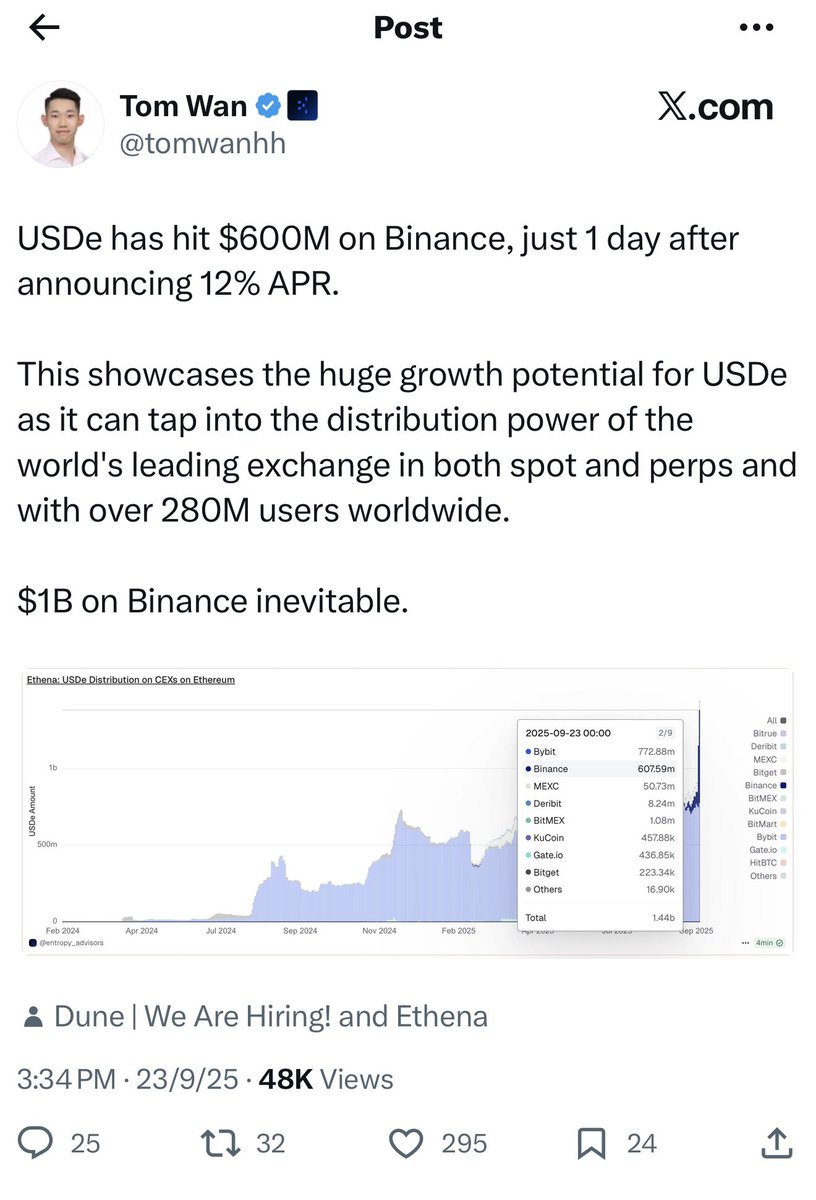
1.Binance launched a temporary user-acquisition campaign offering 12% APY on USDe, while allowing USDe to be used as collateral with the same treatment as USDT and USDC, and without effective limits.
2.USDe is a tokenized hedge fund product.
Ethena raises capital via a so-called “stablecoin,” deploys it into index arbitrage and algorithmic trading strategies, and tokenizes the resulting fund. The token can then be deposited on exchanges to earn yield.
3.USDe is fundamentally different from products such as
BlackRock BUIDL and Franklin Templeton BENJI, which are tokenized money market funds with low-risk profiles.
USDe, by contrast, embeds hedge-fund-level risk. This difference is structural, not cosmetic.
4.Binance users were encouraged to convert USDT and USDC into USDe to earn attractive yields, without sufficient emphasis on the underlying risks. From a user’s perspective, trading with USDe appeared no different from trading with traditional stablecoins—while the actual risk profile was materially higher.
5.Risk escalated further as users:
•converted USDT/USDC into USDe,
•used USDe as collateral to borrow USDT,
•converted the borrowed USDT back into USDe,
•and repeated the cycle.
This leverage loop produced artificial APYs of 24%, 36%, and even 70%+, widely perceived as “low risk” simply because they were offered by a major platform. Systemic risk accumulated rapidly across the global crypto market.
6.At that point, even a small market shock was sufficient to trigger a collapse.
When volatility hit, USDe depegged quickly. Cascading liquidations followed, and weaknesses in risk management around assets such as WETH and BNSOL further amplified the crash. Some tokens briefly traded near zero.
The damage to global users and companies—including OKX customers—was severe, and recovery will take time.
⸻
Why this matters
I am discussing the root cause, not assigning blame or launching an attack on Binance. Speaking openly about systemic risks is sometimes uncomfortable, but it is necessary if the industry is to mature responsibly.
I expect there may be significant misinformation and coordinated FUD directed at OKX in the near future. Even so, speaking honestly about systemic risk is the right thing to do—and we will continue to do so.
As the largest global platform, Binance has outsized influence—and corresponding responsibility—as an industry leader. Long-term trust in crypto cannot be built on short-term yield games, excessive leverage, or marketing practices that obscure risk.
The industry needs leaders who prioritize market stability, transparency, and responsible innovation—not a winner-take-all mentality where criticism is treated as hostility.
Crypto is still early.
What we choose to normalize today will determine whether this industry earns lasting trust—or repeats the same mistakes again.

English

trade setup at $3.3k
upside was $3.6-4k, downside was $3.2k
we sitting at $3.2k now - if we break down, i'm out
GIF
Mando@rektmando
I'm the most long ETH I've been in 6 months
English



I unlocked my OKX rewind in #OKX2025.
Join me to discover yours: app.okx.com/ul/okx2025?cha….
English



OMFG ….. it turns out that I’am actually a catch .. LFG🦾😁 😳
Elma@oelma__
He doesn’t smoke He doesn’t drink He doesn’t Womanise He doesn’t party He stays at home He doesn’t bet Where can I find him??
English
Shout out to the @RealVision community.
Reading through the comments and discussions lately the RV hive mind has genuinely reshaped how I think about how markets move. Not just what moved, but why it was even allowed to move in the first place.
That’s the real power of @RealVision.
It’s not just the content.
It’s the feedback loop between ideas, practitioners, and people actually thinking in public.
The new platform has made that even clearer. The signal isn’t just in the videos, it’s in the conversations underneath them.
One of the biggest shifts for me came from that collective thinking.
Liquidity doesn’t explain every move in BTC.
Liquidity explains the environment BTC is moving in.
BTC can rally, dump, chop, or squeeze inside the same liquidity regime. Those moves can be loud, violent, and convincing.
But whether those moves persist or fade depends on the environment liquidity, credit, and volatility create.
Liquidity is not the steering wheel.
It’s the road.
Price action is the car.
That distinction is subtle, but once you see it, you can’t unsee it.
And honestly, that click came from the combination of @RealVision research plus the hive mind stress-testing ideas in real time.
Content plus community is the edge.
And not forgetting @goldmembrrr and @money_penny that work tirelessly making sure the community is real comfy and snugg
English
CryptoCompliant retweetledi

In a volatile world where hacks and scams rule, one platform refuses to play by the old script: OKX.
CEX, DEX, and CeDeFi powered by infrastructure that shuts out chaos and unlocks possibility.
Welcome to the Mild Mild West, where the wild gets mild. x.com/i/broadcasts/1…
English

🫧 Last day to claim bubbles!
Huge thank you to everyone who has claimed so far 🙏
Shape@shape
bubbles.art 18+. void where prohibited. no purch necess. odds approx 1/10,000,000. see rules: bubbles.art/terms
English

Invadi o escritório da @OKXBrasil hoje e do nada esse moletom estava no meu carro! Alô time de compliance, foi um acidente!

Português

@Cointelegraph Why did you use an AI-generated image of me lmao?
English

🚨 INSIGHT: Sassano says Ethereum tripling its gas limit is just the floor and it can go even higher.


English

Thankful for @CatTownBase giving me an opportunity to build with them.
…for @Crypt0Compliant my tpb bff
…for my family.
…for the ethereum virtual machine that will liberate us all from the status quo.
…for wine.
Have a great day, CT. Thankful for you.
English
English
@Crypt0Compliant @arbitrum @OKXBrasil @GSacamone @arbitrum_pt @arbitrumdao_gov Hey bro, long time no see! We build long term, strong and consistent. LFG
English
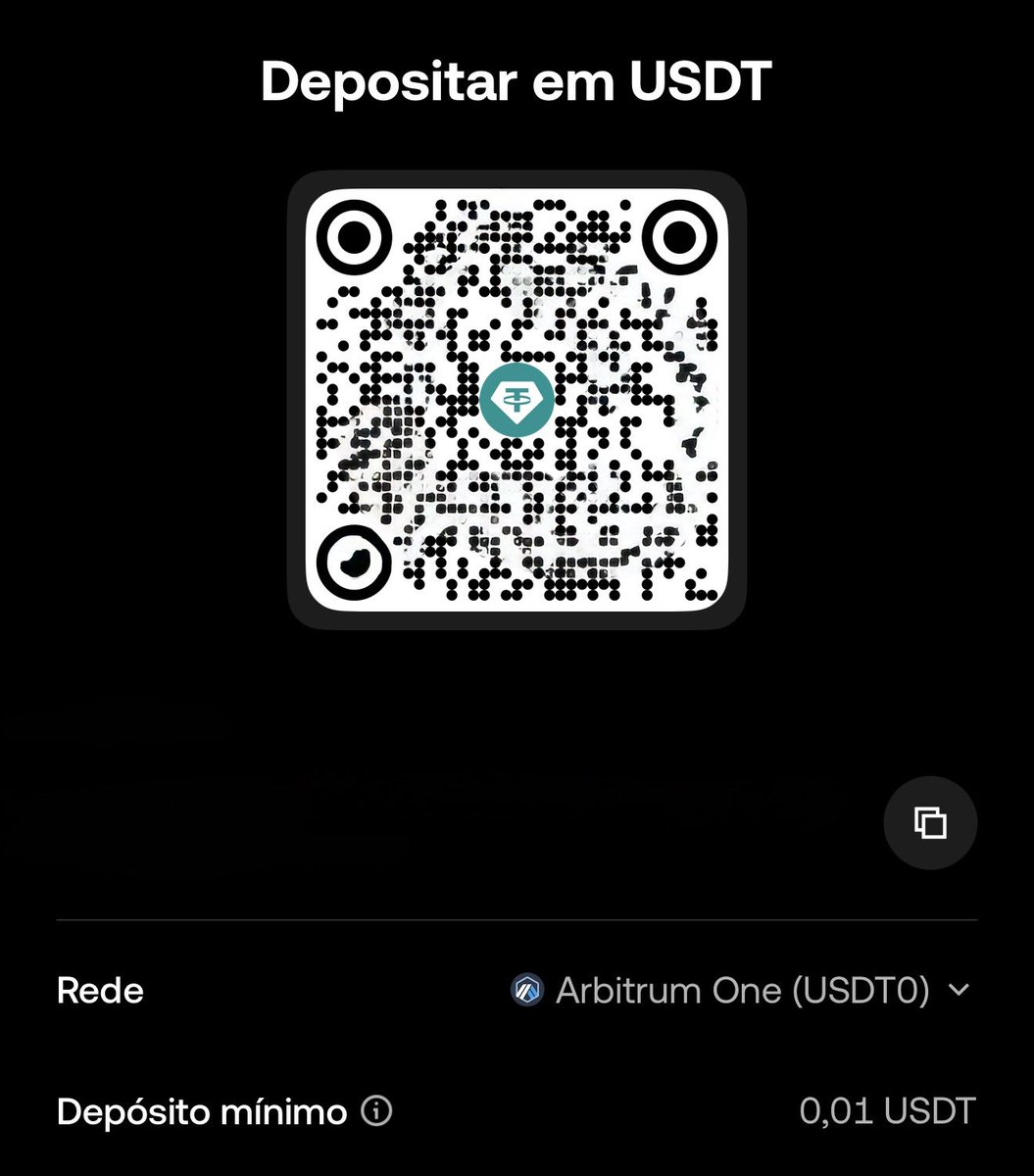
É OFICIAL E É DO BRASIL 🇧🇷
OKX Pay agora aceita depósitos via @arbitrum
Um agradecimento especial ao time da @OKXBrasil, especialmente ao @GSacamone, por aguentar minhas DMs diárias pedindo Arbitrum 💙🖤
Português
@chooserich I remember proposing this to my quant last year, glad he’s finally pulling his finger out!

English


I wanted to give everyone something meaningful, a gift…
This comes from Global Macro Investor (GMI) and a deep, long-running body of research developed by @RaoulGMI and myself.
Many of you already know The Everything Code, which is our framework for understanding the macro landscape and why major central banks are debasing their currencies to manage aging demographics and overwhelming debt loads.
I call this a gift because these four charts, while only scratching the surface of The Everything Code, give you the big-picture context you actually need in moments like this.
They stop you from getting lost in every Bitcoin pullback and explain why Raoul and I never panic, even when, to borrow one of his expressions, everyone’s acting like monkeys throwing poo at each other.
Once you understand The Everything Code, you stop trading short-term noise and expand your time horizon. You cannot unsee it.
The starting point is what we call The Magic Formula:
GDP growth = population growth + productivity growth + debt growth.
Population growth and productivity growth have been falling for decades. Debt growth is the only thing filling the gap.
The private sector has been deleveraging since 2008, mainly households, but debt levels are still around 120% of GDP. The public sector sits at roughly the same level.
Here’s the problem…
If the government is running debt at 100% of GDP and the private sector is sitting on another 100%, and for simple math we call rates 2% even though they are really closer to 4%, then the entire 2% trend growth of the economy is being consumed by servicing private-sector debts. That is a completely unproductive use of GDP. And then there’s the issue of public-sector debts. There’s just not enough organic growth to service the existing debt load.
To understand why this dynamic persists, you need demographics.
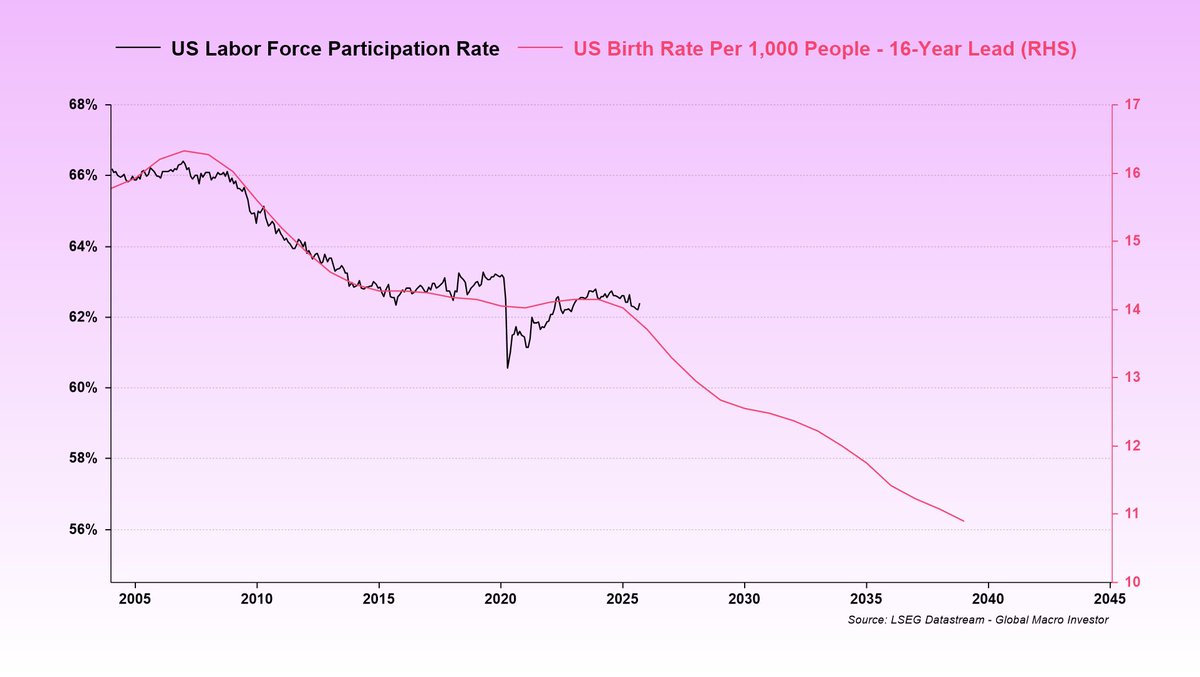
Birth rates peaked in the late 1950s and have been declining ever since. This shows up about sixteen years later in the labor force participation rate as each generation enters the workforce (chart 1).
That means the labor force participation rate is not going to rise any time soon. It is set to keep drifting lower. This is a structural problem.
Aging populations, falling birth rates, and rapidly expanding automation make the backdrop even more deflationary. AI and robotics are replacing humans at scale, and we are only at the beginning. This reinforces the need for ongoing stimulus to keep the system functioning.
With weak population growth and sluggish productivity, the only way to keep GDP expanding is through debt.
Now here’s where it gets interesting…
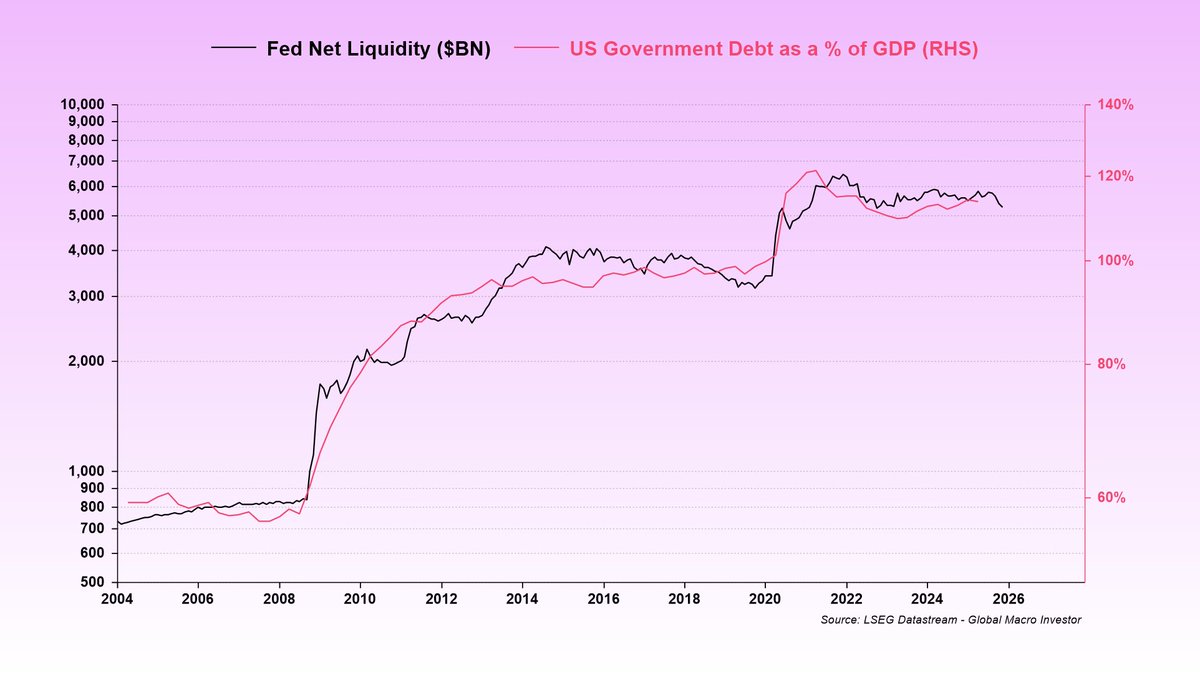
Government debt growth is completely offsetting the demographic decline and policymakers know exactly what they are doing (chart 2).
And what happens next?
All debt growth in excess of GDP gets monetized (chart 3).
Basically, since 2008, magic money has effectively been paying the interest. Governments issue new debt to cover old interest, and once rates fall enough, central banks absorb it onto their balance sheets.
So to wrap this up, demographics drive the decline in the labor force. Governments offset that decline with more debt. That debt eventually gets monetized through quantitative easing (QE) style operations, not always directly by the Fed, but through the coordinated ecosystem of the Fed, the Treasury, and the banking system. And the bottom line is that there’s still a massive wall of interest that needs to be monetized, far more than GDP can ever cover. Liquidity is literally the only game in town.
And what thrives in a world of perpetual debasement? Bitcoin (chart 4).
I know this correction has been painful, but it’s all part of the journey. These periods feel brutal in the moment, then they fade and the trend resumes. This too shall pass…
To quote Walter White from Breaking Bad, later echoed by @LynAldenContact, nothing stops this train.
MOAR COWBELL (liquidity) = number go up over time. Zoom out and be more bullish…


English

I wanted to put the current sell off in perspective...
BTC corrected in 2024 -32%, 2025 -32% and right now is around -28%. This is normal. You've lived it before.
SOL corrected -47%, -67% and currently -48%.
Sui corrected -69% in 2023, -79% in 2024, -68% in 2025 and -64% currently.
Technicals are flamboyantly over sold. Sentiment is in the shitter too... worst I've seen it this cycle.
English