Sabitlenmiş Tweet

hek
4.6K posts

@CryptoWilliamG
Not a KOL or a teacher Trying to become a real independent trader 二级|流动性Alpha|思考迭代 For people who truly love the market





Some of my perspective on where the @ethereumfndn is going. First of all, this is only my own view. The board is not just me, and I have no extra special powers on the board that the other board members do not. @aerugoettinea is the one executing much of this transition. My input has been largely on technical questions. The board is in the process of expanding, and my own power within the org will continue to decrease, which is honestly what I want. The 2025 era brought many important improvements to EF and its ability to execute. Many issues were resolved, and EF continues to benefit from its improved efficiency and greater focus on concrete goals to this day. And so with those problems resolved, early this year, the largest remaining hole that I perceived was something different nagging at me: I would regularly spot people saying things like "vitalik says these beautiful things about ethereum needing to be decentralized, and have privacy, and be a sanctuary technology, but why do the EF's actions not reflect that?" Now, you may have been hearing something different. You may not have been sensing a feeling of crisis at all, and maybe were hearing people saying that finally we were taking execution and BD seriously and the main task for us is to keep going that way and be even better and faster. Then probably there is genuine difference between you and me, in what kinds of criticism I take most seriously, and what kinds of critics through their criticism are most able to make me feel pain. As an analogy, let's briefly switch over to a different domain. One belief you can have about Google is that it is a success story, and has brought a lot of good to humanity in organizing the world's information. Another belief you can have about Google is that they had a beautiful idealistic beginning, but at some point the corruption of mainstream corporate attitudes seeped in, and they slowly bit by bit completely abandoned the "don't be evil" slogan. My belief on Google specifically is probably somewhere between the two. BUT, if you had taken me back in time to ~2008, and offered me a button to press to make Google one or two standard deviations more "dogmatic", eg. give Richard Stallman permanent veto power over some key policies, I would immediately press it. Why? Because a choice for one company is not a choice for the world, or even one country. Google existed and exists in the context of a technology industry generally drifting away from early idealistic don't-be-evil roots and toward greed for financial gain, totalizing visions of accelerated superintelligence, infiltration by sociopaths, and craven capitulation to (or worse, active participation in) government pressure for ideological control, surveillance and war. And so *one company* doing something different, positioning itself to be what George Bernard Shaw calls the Unreasonable Man, resisting the trend of the times, would have been better for freedom, balance of power and stability of society as a whole, than *all* large companies bending to dominant trends. This is a part of my version of pluralism. This line of thinking is not just mine, but I also is not too far off from what Aya and others had in mind with the Mandate. Now how does this all get to the role of the EF? EF is not a "center of Ethereum", rather EF is "one node, with a defined purpose, alongside other nodes". We've always said that the EF should be the latter, but many in the Ethereum ecosystem (and even within the EF) wanted us to be the former. Now, we are taking action to ensure that we will be the latter. This is particularly important because EF is a limited organization, with limited resources and limited organizational capacity. The EF has only ~0.16% of all ETH (less than many other individual ETH holders), whereas among other blockchains it's common for "the central foundation" to have 10-50%. Fiscally, the EF was originally designed to fulfill a limited work scope defined in the token sale docs and other pre-launch materials (building the chain software; getting through Frontier, Homestead, Metropolis, Serenity), which was fully completed in 2022; it was not designed to be an eternal steward. And so today, the EF is choosing to use its remaining resources to pursue longevity over breadth (yes, this means we sell less ETH). The EF focuses *specifically* on those activities critical to the success of ethereum as a censorship/capture-resistant, open, private and secure system, that would not happen otherwise. This means making hard choices, and in some cases even activities that we highly approve of and people that we highly respect becoming outside of the EF. People of great technical talent, public respect and even alignment with the mission and CROPS being outside of the EF is in fact necessary if we want important tasks to be able to attract outside capital. This also means the EF taking opinionated stands culturally. This is all intended in cooperation with all other parts of ethereum. We recognize that many other parts of the ethereum world highly respect CROPS and related values. But highly respecting is not the same as choosing to specialize and totally dedicate to a domain (Compare in a different domain: I think reducing animal cruelty is important, and I like vegan food, but am not full unconditional vegan myself) EF is still in a transition period, and we expect its new long-term form to stabilize over the next few months. What are the guiding principles of this new form? Again, I am only one person, but I can give my answer from a technical perspective (there are also critical non-technical aspects). At the core, *Ethereum must be impressive*. We are living in an age of highly intelligent AI and all kinds of other technological acceleration. "Status quo EVM, with a hard fork or two a year to optimize for short-term needs of users" is not interesting. To some, "impressive" means: 250ms latency and 1M TPS. I think Ethereum trying to go that route is a mistake. Being as fast and as scalable as possible, and only a small epsilon more decentralized than the others, is a route to mediocrity, and if we try it we will lose. I think Ethereum should scale. But I think Ethereum should strive the hardest to be deeply impressive in a different dimension: the CROPS dimension. This means things like: * Provably bug-free Ethereum. This is a goal that all cybersecurity researchers would have thought is absurd and impossible, up until roughly 6 months ago. Now, it's on the cusp of being possible, thanks to AI-assisted formal verification. So we should be frontrunners in doing this. * Available chain consensus. Ethereum is, and with lean consensus will cotninue to be, the ONLY chain that has both (i) traditional-BFT style properties that it's safe under asynchrony up to a high level of fault tolerance, and (ii) the bitcoin PoW-style property that under synchrony it's safe up to 49% attackers. As far as I can tell, literally no other chain has this or is planning for it; bitcoin goes for (ii) only and most other chains go for (i) only. Some will remember I fought hard for this, Unreasonably insisting that it is not OK for ethereum to rely on social consensus and hard forks to rescue ethereum from 34% of nodes going offline. It's OK for chains like hyperledger, bnb, solana, tempo, etc. It's not OK for bitcoin or ethereum or eg. zcash. * Intermediary minimization. The fact that smart contract wallets, protocols like railgun, etc have to send transactions through intermediaries to get included onchain is honestly embarrassing, and it's a constant point of fragility. Hence the work on FOCIL and EIP-8141 (and 7701 and years of work before) to make transaction sending intermediary-minimized with public mempool and strong inclusion properties, in a truly general-purpose way, that covers not just eg. secp256r1, but also privacy protocols and much more. Kohaku is pushing intermediary minimization at the user layer, pulling Ethereum away from the dystopian status quo world where our wallets don't even verify the chain, send our private data out to a dozen third-party servers, and toward a brighter CROPS future. Some of these goals are Unreasonable - maybe Ethereum would be "fine" getting only 50% of the way - what if we depend on intermediaries, but make it easy to switch? But going 50% of the way would not make Ethereum Deeply Impressive in the CROPS way. So we push for 100%. Fortunately all these goals are compatible with high TPS, this is a major focus of research (esp. on scaling the state). Well-designed L2s can also help, especially L2s optimized for specific applications (eg. high-volume trading, privacy...). These goals are even compatible with significantly lower slot times, thanks to Raul's work on erasure-coded P2P, and many other optimizations. The most high-value "product" of the ethereum blockchain, financially speaking, is ETH the asset. Ethereum secures $250 billion of ETH. The types of properties of Ethereum that I mentioned above are very good for ETH the asset. Nearly 90% of my net worth is in ETH, and most of the remainder is ~$40m of onchain fiat of which every dollar has already been allocated for some open-source biotech or software or hardware initiative. That said, there are aspects of supporting ETH the asset - *necessary* aspects even - that are outside the scope of the EF. This is where we need other heroes (some of whom hold more ETH than the EF does) to step in and help. EF has been recently thinking more about how it will relate to other such organizations, and give them needed initial support. EF will be a smaller ship than in previous years, a more opinionated one - in some cases more opinionated in ways that might be difficult to comprehend - but a longer-lasting one, and one suited to making sure that ethereum brings something meaningful to the world. We are grateful to all those inside and outside the EF who are helping to make this happen.

很多人都让我去写点我很多年前小资金如何赌到大资金的经历,其实交易除了努力还是要看天赋,看你敢不敢赌,挣到钱以后敢不敢收手不赌,我称之为赌商吧。 我18年5月在bitmex玩比特币合约,一周就可以把1个比特币到21个比特币,后面各个交易所出了usdt合约,我一个月就可以一万刀到五十万刀。 有些东西就是天赋,只要我看过的k线,我可以清晰的记得长啥样发生啥事,所以一旦我遇到什么k线,什么事件,我的金融直觉会反应的特别快。 你觉得我的交易能力和天赋很牛逼了对吧,我玩贵金属,大行情出现的情况下,一个月十万刀到一百五十万刀。 你去看看枯木逢春,不需要大行情一两周就可以一百多万刀,我觉得没啥行情,人家照样赚的起飞,有些东西是降维打击。 你觉得老恶魔很牛逼,两年一千万刀,矿工只需要一天一个单子。 这个世界永远是人外有人,天外有天,你不需要羡慕别人的,做好自己的就可以了,学会知足。 我也很想写一点小资金如何做大,杠杆合约,美股期权也好,这些高倍赌法我太熟悉了,只是没办法写,写出来就是引导你们去赌。 这是幸存者偏差,我曾经高杠杆赢下来了,如果我没有提现盈利,持续高杠杆必死。 就算我写出来小资金如何赌,不是每个人都有这个能力的,90%人看完依旧是亏,能有一个跑出来都不错了。 后面我有钱以后为了保持良好的睡眠,让自己不是一个只会赌的机器,多享受生活,已经放弃了很多短线的机会了,但是如果你们处于小资金,你觉得你性格适合高杠杆,你还是要尝试去赌的,只是这东西我教不了,有些需要你自己去悟,拿钱亏出来的,这条路每个人的性格不一样,走出来的路也不一样。 你想要挣多少钱就要承受多大的风险,根据你的性格,去选择适合自己的方法。

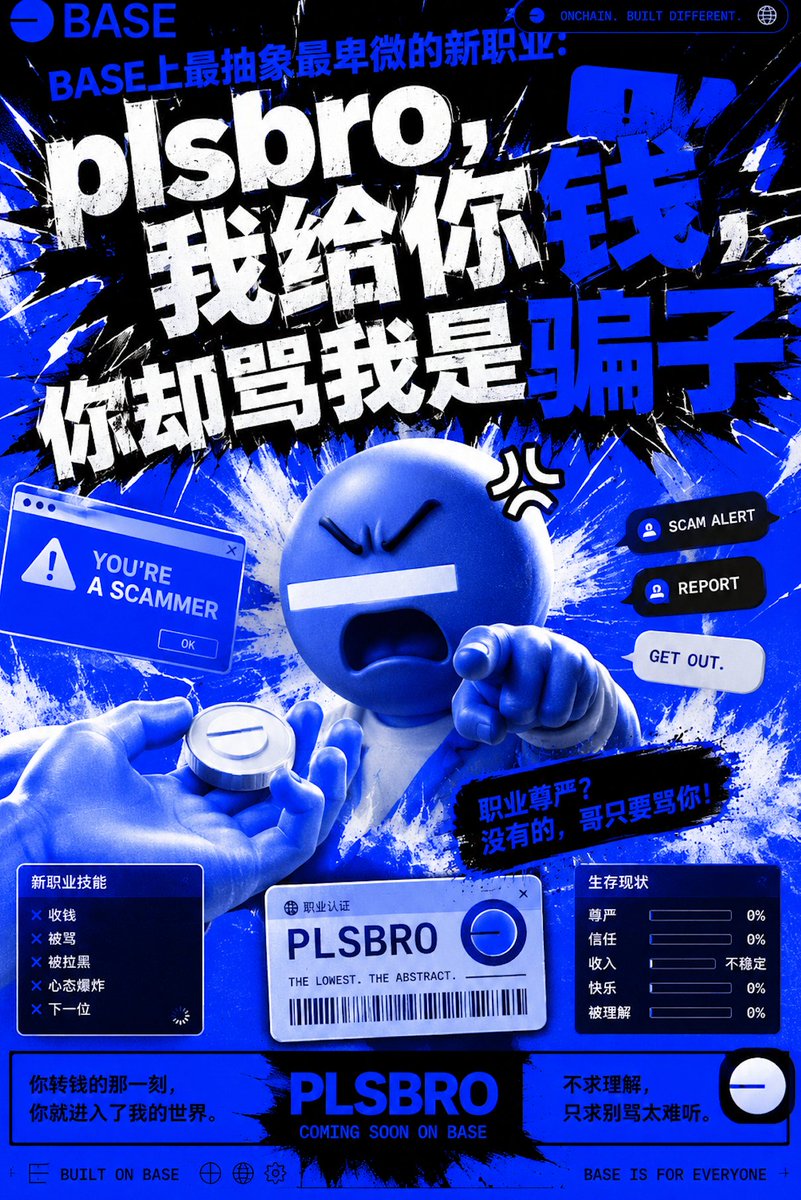
Base上最抽象最卑微的新职业:plsbro,我给你钱,你骂我是骗子 世界上只有三种赚钱模式:妓女、骗子、强盗。 妓女出卖时间和精力赚钱,骗子赚信息差和认知差,强盗是游戏规则制定者,靠掠夺他人赚钱。 现在加密又发明了第四种:plsbro。跪着求别人收你的钱,这可能是人类金融史上最卑微的一种风投。 🥷🥷plsbro,我不是骗子,请收下我的膝盖吧 Base链上的真实现象:一个 Web2 产品、AI 工具、开源项目、Agent 应用刚冒出来,dev本人可能还在改 bug,甚至根本没想过发币。 加密选手们就已经冲上去了,先用 Clanker、Zora、Base App、Bankr发一个 token,再买一堆早期仓位,然后全网开始喊: pls bro, claim your fees bro just claim, we believe in you plsssssss bro 翻译成人话就是,求求你了大哥,收下这笔钱吧,这是我孝敬您的。 一群陌生人,自掏腰包给你的产品发币,买好仓位,然后跪下求你认领手续费,好让币价拉起来,他们出货赚钱。 结果大致分三种: 1⃣第一种:dev积极认领,LFGGGG Dev把token集成到产品里,发几条"社区太疯狂了"的推文,用嘴build,token应声拉升。老鼠仓嗷嗷赚钱,dev白捡几万刀手续费。皆大欢喜,这叫web3和web2的双向奔赴。 2⃣第二种:dev半推半就,当婊子立牌坊 沉默几天,架不住社区狂轰滥炸,勉强领了手续费,然后发条声明:"This is a community effort, I have nothing to do with this token." 钱我收了,锅我不背,然后 token 慢慢归零。 3⃣第三种:dev生气了,加密就是骗局 "你们这群骗子,加密就是一坨狗屎,不要来沾边!" 不仅不领钱,还要骂你。token光速归零,老鼠仓变老鼠shi。 好笑吧?这就是 plsbro 的精髓: 一群人上赶着给dev送钱,还要被dev骂。加密就是这样一个不被主流社会认可的平行宇宙。 你辛辛苦苦写的BP,VC看都不看一眼。但只要你把产品部署到Base链上,第二天就有人帮你发币,哭着喊着让你收手续费。 这世界疯了吗?是的,疯了。而且疯得很合理。 🥷🥷穷 dev 富 dev,meme 才是最好的风投 一个素人产品设计师,想在传统世界拿到融资,其实很难。 你要有 pitch deck,要讲市场规模,要找 FA,要约投资人,要证明团队背景,要算 TAM/SAM/SOM,要解释商业模式,要回答增长路径,要谈估值,要签条款,要接受尽调。 传统融资的本质是【证明你不需要钱,才能拿到钱】。如果你只是一个单兵 dev,一个周末做了个有意思的 AI 小工具,大概率没人理你。 在Base链上,一切都颠倒了。你不需要认识任何人。你只需要把产品做出来,部署上去,然后——等着。 自然会有人帮你发币,链上资金帮你的产品定价,几千刀、几万刀手续费,真的可能帮助 dev 继续做产品。对于那些有野心、有能力、但没资源的人来说,这不是一件小事。 比如 OpenClaw、Moltbook、Clanker,迅速被 Base 市场包装成 Agent 经济的一部分。 VC给你开50万估值的term sheet,还要你签对赌协议。链上赌徒直接给你打50万美元手续费,连合同都不要。 这件事荒谬到了极致。我给你送钱,还要跪下来求你收? 🥷 🥷plsbro,求求你们赏我点手续费吧 吐槽了这么多,回归Base链本身,它最大的价值是什么? 它用一条公链,汇聚了大量闲散资金和流动性,而这些流动性,正在以最魔幻的方式赋能个体创作者。 这其实是web3对web2最根本的撬动。 在web2,创作者变现靠广告分成、付费订阅、品牌赞助。这些模式有一个共同点:平台拿走大头。YouTube拿走45%,抖音拿走更多,Patreon拿走5-12%。创作者永远是食物链的底端。 在web3呢?一个dev做了一款产品,社区主动帮你发币。你认领一下,手续费直接打到你钱包里。 零平台抽成。零中间商。当然,前提是你得是一个"欧美创作者"。 这也是一个吊诡到让人不舒服的事实:全球最强码农在中国。GitHub上贡献量最高的开发者群体是中国人,华人开发者在AI领域的论文数量全球第一。 但在Base链上,几乎没有国人产品的发币风投。 希望未来不是链上散户跪着求 dev 收钱,而是优秀创作者、独立开发者、Agent builder,舔着脸来求链上玩家: 能不能给我发个币? 能不能让我拿一点手续费? 能不能让我用市场的钱,继续把产品做下去? 这样加密才有意思,才有价值。 🥷🥷回到开头。 世界上曾经只有三种赚钱模式:妓女、骗子、强盗。 加密创造了第四种:plsbro,但不应该只有plsbro。 让plsbro不再是单向的求dev领钱,而是双向的我投你,你build,我们一起赚钱。 让链上的流动性,真正流向那些值得被支持的人。 到那一天,plsbro这个词的含义也许会变。 从"please bro, claim"变成"please bro, build"。 从跪着送钱,变成站着合作。 那才是区块链真正杀死风投的那一天。 @base @0xDeployer @jessepollak


今天梳理了一下持仓---华人之光套餐 @sign 0.01% $SIGN @aspecta_ai 0.01% $ASP @KaitoAI 0.001% $KAITO @Sidekick_Labs 0.0000% $K 大概持仓占比 70% $SIGN :年华10%,每月领生活费! 20% $ASP :每期打新,拿点盘前筹码! 10% $KAITO :领空投打新,赚点小毛! 0% $K :打游戏直播,薅点币!




Thank you for your service.