

CHETAN
3.6K posts

CHETAN
@CryptoWithCK
Crypto enthusiastic | Content creator | Web3 contributer at: @Prismaxai, @get_optimum
Katılım Kasım 2024
938 Takip Edilen1.2K Takipçiler

Community growth starts with people who truly believe in the vision and I do.
After almost 5 months of actively contributing to @PrismaXai , I've seen how supportive and impactful this community can be.
For me, becoming an ambassador is not only about helping users or onboarding new members.
It is also about growing PrismaX presence on social media, creating content that helps people understand the project better, and building positive sentiment around the community
My goal is to help more people see PrismaX potential, trust the community, and feel excited to be part of what PrismaX is building.
Becoming a PrismaX Ambassador isn't a decision I took lightly.
After careful thought, my reason is simple -
I want to work with the community, contribute consistently, and help PrismaX grow in my region.
As for my contributions,
I’ve been actively contributing to @PrismaXai by
- creating quality content,
- hosting regional events,
- and building tools for the community.
One of my best contributions was building a Memory Wall web app,
x.com/dexi269/status…
x.com/dexi269/status…
as of my region
India’s tech, AI, and robotics ecosystem is growing fast and I believe PrismaX has strong potential to become part of that growth.
That’s why I want to represent PrismaX as an India Ambassador and help build a strong community
@MaxC16134 @vivianrobotics

PrismaX@PrismaXai
Introducing the PrismaX Regional Ambassador Program. A select cohort of regional leaders building local PrismaX communities in their language, region, and time zone. Applications open today 👉 forms.gle/3Hfo8yEEKsGLeo…
English

⚡ OPTIMUM ARCHITECTURE ⚡
Most blockchain projects mainly focus on TPS and execution speed.
But Optimum is focused on something happening underneath all of that:
How data actually moves across decentralized networks.
As blockchain ecosystems grow, nodes constantly exchange blocks, transactions, attestations, and network data with each other. Over time, this creates propagation delays, redundant traffic, bandwidth inefficiency, and communication bottlenecks.
⚡ Optimum’s architecture is designed to solve these network-level problems.
Some parts of the architecture I found interesting:
🌐 mump2p:-
An optimized propagation layer built on top of libp2p, designed to improve communication efficiency between nodes.
🧠 RLNC (Random Linear Network Coding):-
Used to optimize data transmission by reducing unnecessary packet redundancy while improving propagation reliability.
📡 Efficient Data Movement:-
Focused on improving how quickly and efficiently data spreads across distributed systems.
💾 DeRAM:-
A decentralized read/write memory layer being developed for scalable Web3 infrastructure and distributed applications.
What stands out to me is that Optimum is not trying to replace existing blockchains.
Instead, it’s focused on strengthening the networking and memory infrastructure behind decentralized ecosystems.
Feels like the future of Web3 scalability may depend not only on faster computation, but also on faster and smarter communication between nodes.
@get_optimum
@TheBl0ckBoy

English

I’ve been supporting PrismaX long before the Ambassador Program started .🦾
Now I’m applying for the PrismaX Regional Ambassador Program 🇧🇩
I’ve been creating educational content about teleoperation and physical AI, helping new members understand the project, and staying active in the community consistently.
I believe @PrismaXai is building something important for the future of real-world AI.
The idea of connecting humans, robots, and AI into one learning system is something I truly believe in.
As a contributor from Bangladesh, I want to help grow a strong local PrismaX community through content, discussions, onboarding, and continuous support.
My goal is simple:
Help more people understand what PrismaX is building and why human-guided robotics learning matters.
Ready to keep building and contributing for the long term.🦾
@shayebackus | @vivianrobotics | @MaxC16134

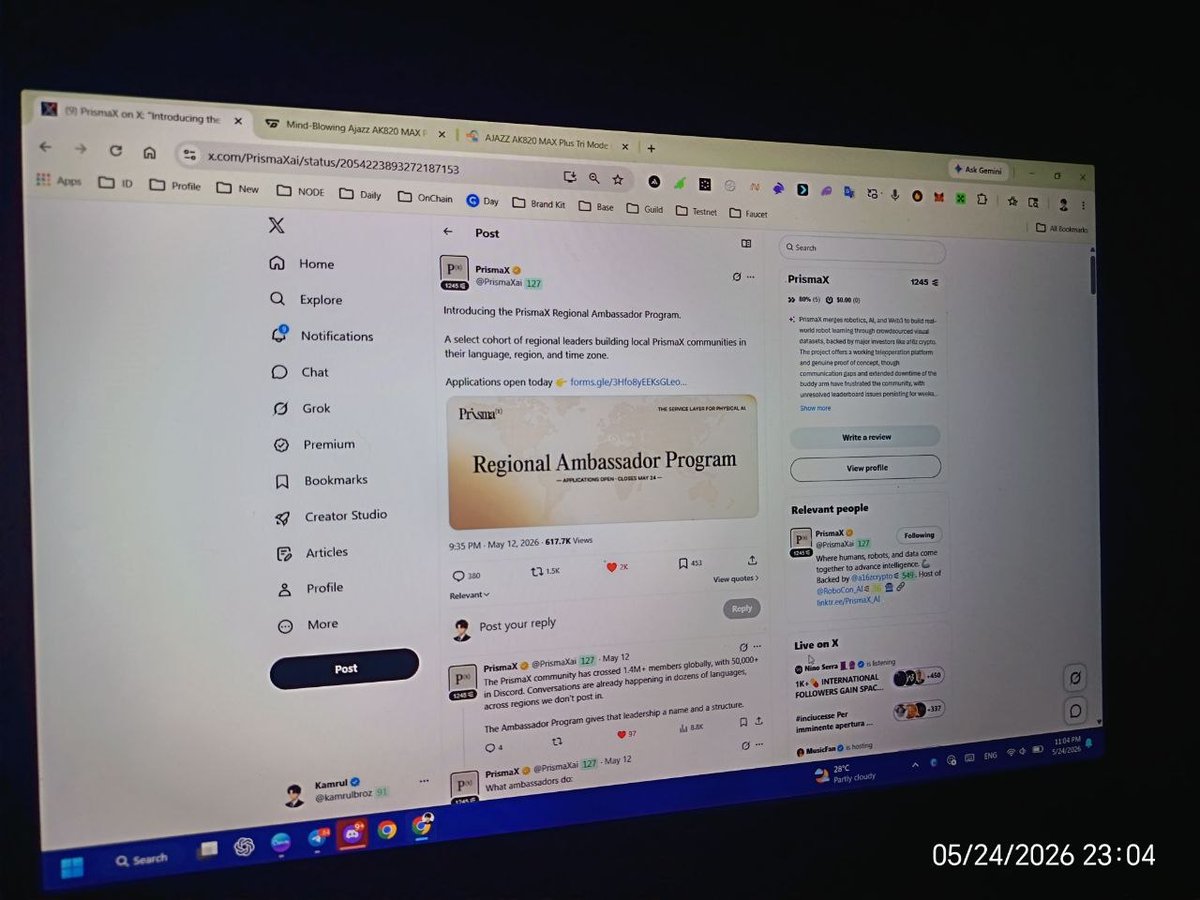
PrismaX@PrismaXai
Introducing the PrismaX Regional Ambassador Program. A select cohort of regional leaders building local PrismaX communities in their language, region, and time zone. Applications open today 👉 forms.gle/3Hfo8yEEKsGLeo…
English

Gprisma everyone!
This is your 𝐚𝐥𝐭𝐦𝐚𝐗 here. I’m really happy to let you all know that today I’m applying for the prestigious @PrismaXai Regional Ambassador Program for India. This is a decision I took after thinking deeply, and I truly believe it’s one of the best decisions I’ve made this year.
𝐖𝐡𝐲 𝐈 𝐖𝐚𝐧𝐭 𝐭𝐨 𝐁𝐞𝐜𝐨𝐦𝐞 𝐚 𝐏𝐫𝐢𝐬𝐦𝐚𝐗 𝐑𝐞𝐠𝐢𝐨𝐧𝐚𝐥 𝐀𝐦𝐛𝐚𝐬𝐬𝐚𝐝𝐨𝐫
As an early believer and contributor to PrismaX, this journey has been truly special for me. I started as an unknown person back in June 2025, but the PrismaX community gave me the opportunity to grow, guide people, help them understand the project, and build a strong culture of teamwork and support.
My dedication and initiative were recognized by the 𝐜𝐨𝐦𝐦𝐮𝐧𝐢𝐭𝐲 𝐭𝐞𝐚𝐦, which later gave me the opportunity to become a moderator. I always tried to give my best to both the community and PrismaX, and I strongly believe I can contribute even more through this new Ambassador Program and help PrismaX reach a much wider audience globally.
𝐖𝐡𝐚𝐭 𝐈 𝐇𝐚𝐯𝐞 𝐂𝐨𝐧𝐭𝐫𝐢𝐛𝐮𝐭𝐞𝐝 𝐭𝐨 𝐭𝐡𝐞 𝐏𝐫𝐢𝐬𝐦𝐚𝐗 𝐂𝐨𝐦𝐦𝐮𝐧𝐢𝐭𝐲
• Spearheaded and took the initiative to build the first regional foundation for the 𝐈𝐧𝐝𝐢𝐚, 𝐏𝐚𝐤𝐢𝐬𝐭𝐚𝐧, 𝐚𝐧𝐝 𝐁𝐚𝐧𝐠𝐥𝐚𝐝𝐞𝐬𝐡 𝐜𝐨𝐦𝐦𝐮𝐧𝐢𝐭𝐢𝐞𝐬
• Helped create a strong culture of helping, learning, and growing together among members
• Initiated the “𝐖𝐞 𝐁𝐞𝐥𝐢𝐞𝐯𝐞 𝐢𝐧 𝐏𝐫𝐢𝐬𝐦𝐚𝐗” social campaign across communities to fight negativity and organized FUD from certain groups
• Guided creators toward higher quality teleoperation focused content instead of generic AI slop content
• Personally onboarded thousands of people through my network and community driven campaigns
• Consistently supported newcomers, answered questions, and kept the community active and aligned
𝐇𝐨𝐰 𝐈 𝐖𝐨𝐮𝐥𝐝 𝐆𝐫𝐨𝐰 𝐭𝐡𝐞 𝐋𝐨𝐜𝐚𝐥 𝐏𝐫𝐢𝐬𝐦𝐚𝐗 𝐂𝐨𝐦𝐦𝐮𝐧𝐢𝐭𝐲
My idea of growing a community starts with understanding people individually and giving attention to every member’s voice, ideas, and thoughts.
The first thing I would focus on is creating an environment where every single person feels valued and heard. Strong communities are built when people feel involved, not ignored.
𝐈 𝐰𝐨𝐮𝐥𝐝 𝐚𝐥𝐬𝐨:
• Organize weekly X campaigns to keep the local community active and aligned
• Encourage educational and high quality content creation around PrismaX
• Create onboarding initiatives for newcomers so they can easily understand the vision of PrismaX
• Build stronger connections between regional communities and the global ecosystem
• Host discussions, spaces, and community activities to increase engagement and visibility
• Focus on long term culture building instead of temporary hype
I truly believe PrismaX has the potential to become something massive, and I want to dedicate my time, energy, and experience to helping expand that vision across India and beyond.
Thank you PrismaX and everyone who has supported me on this journey so far. Regardless of the results, we’ll continue working together to make PrismaX greater. ❤️
Cc @shayebackus || @vivianrobotics

PrismaX@PrismaXai
Introducing the PrismaX Regional Ambassador Program. A select cohort of regional leaders building local PrismaX communities in their language, region, and time zone. Applications open today 👉 forms.gle/3Hfo8yEEKsGLeo…
English
Most people still think blockchain scaling is only about faster execution and higher TPS.
That is surface-level thinking.
The deeper bottleneck has always been how blockchain data physically moves across networks.
─────────────────────────
➥ Why Current Blockchain Propagation Still Breaks at Scale
Most blockchain systems today still depend on packet forwarding logic inherited from the early internet.
A node receives data.
Forwards it.
Another node receives the exact same packet.
Forwards it again.
If packets go missing, retransmission requests begin and the cycle repeats across thousands of machines simultaneously.
The system works.
But it was never designed for globally distributed blockchain coordination at this scale.
And as networks expand, the inefficiency compounds quietly underneath everything.
─────────────────────────
➥ What This Actually Causes
→ Identical packets get forwarded repeatedly across nodes
→ Packet loss creates retransmission delays
→ Validators struggle to maintain synchronization
→ Bandwidth gets consumed by unnecessary overhead
→ Propagation slows during network stress
Execution layers keep improving.
The communication layer underneath remains inefficient.
And eventually every system built above it inherits that limitation.
─────────────────────────
➥ Why @get_optimum Is Approaching This Differently
Instead of optimizing around the same transmission model, Optimum changes the logic itself.
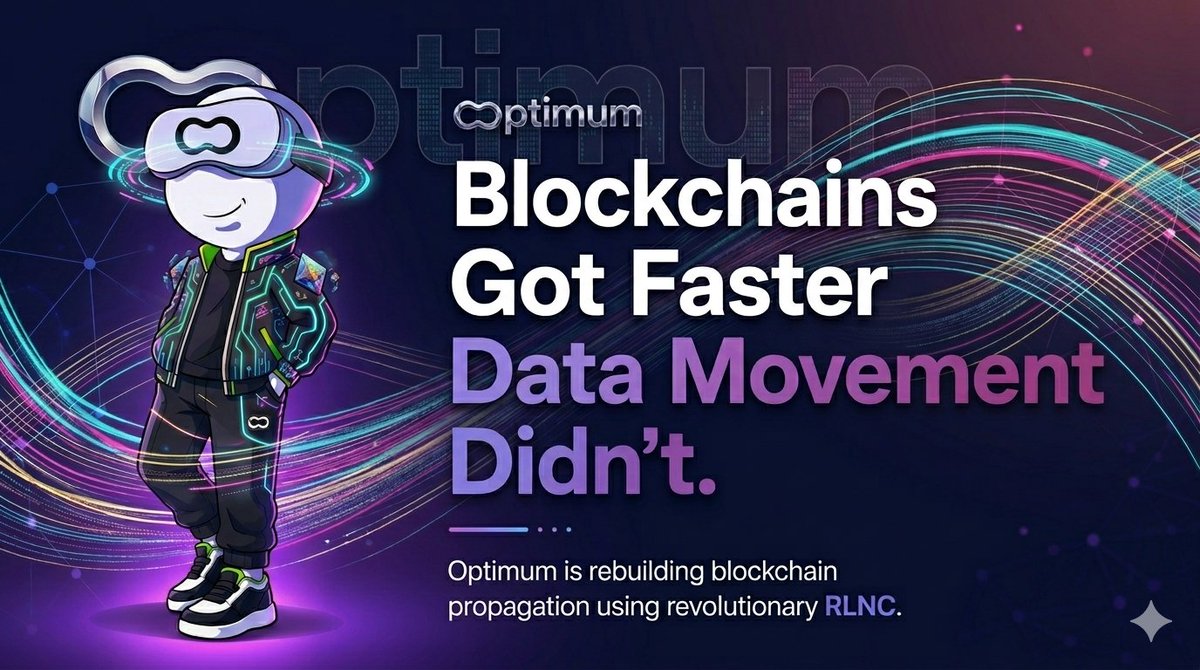
The core technology is called RLNC — Random Linear Network Coding.
Traditional propagation depends on recovering the exact missing packet after packet loss.
RLNC removes that dependency.
Nodes no longer wait for one specific missing packet to arrive again.
They can reconstruct the original data from any sufficient combination of encoded packets received across the network.
That changes the entire coordination model.
No repeated waiting.
No retransmission bottlenecks.
No single missing packet stalling propagation.
─────────────────────────
➥ What RLNC Improves For Blockchain Networks
→ Faster validator synchronization
→ Lower retransmission overhead
→ More resilience against packet loss
→ Better bandwidth efficiency
→ Smoother decentralized coordination at scale
─────────────────────────
➥ The Bigger Picture
Most infrastructure projects focus on making execution faster.
@get_optimum is working on the layer that determines how blockchain information travels between machines in the first place.
That layer rarely becomes the center of attention.
But it silently shapes the performance ceiling of everything above it.
And historically, the teams solving invisible infrastructure problems before the market notices are usually the ones building the foundations of the next cycle.
@get_optimum
English
High-throughput blockchains need more than fast execution.
Optimum focuses on the networking layer that moves data between nodes.
When a chain processes many transactions, every block needs to spread quickly across validators.
If that data moves slowly, the network starts waiting.
Some validators receive updates early. Others receive them late.
That delay can reduce real throughput, even if the execution layer is fast.
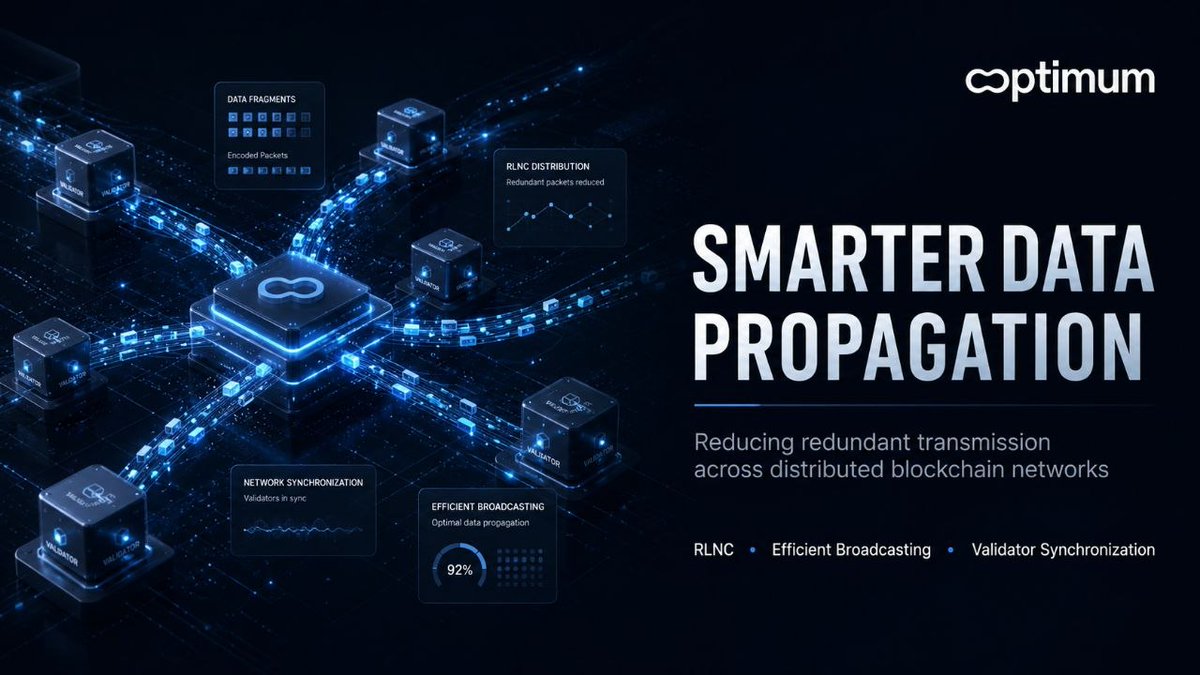
@get_optimum could help by making data propagation more efficient.
Instead of sending the same data again and again, the network can distribute useful encoded pieces.
Validators only need enough useful pieces to rebuild the full data.
This reduces duplicate traffic, lowers waiting time, and helps nodes stay aligned.
Think of it like sharing a large file with a group.
Sending the same full file repeatedly wastes time.
Sharing useful parts from different places lets everyone rebuild the file faster.
For high-throughput blockchains, this kind of networking layer becomes very important.
More transactions only matter if the network can move data fast enough to support them.
That is where Optimum approach becomes interesting.
English

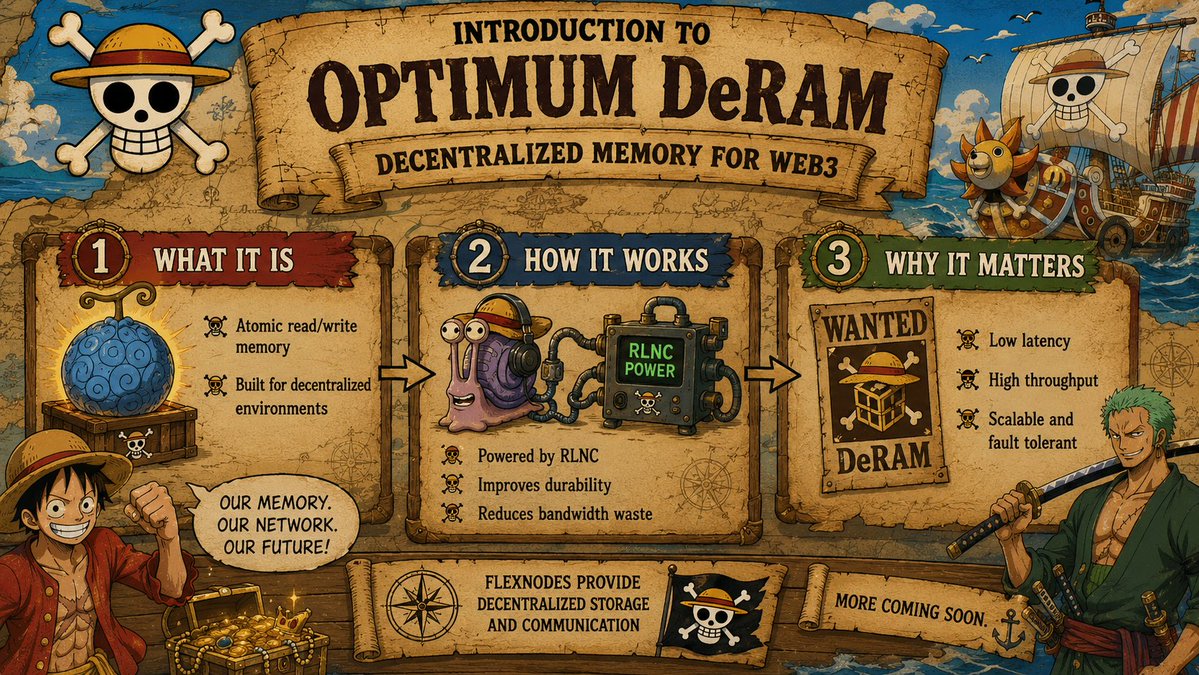
Introduction to Optimum DeRAM: Next-Gen Memory for Web3 Infrastructure
Decentralized networks face a major bottleneck: data doesn't move through a central system. Instead, it constantly shuffles between multiple nodes, causing latency, bandwidth waste, storage strain, and unreliable communication.
Optimum DeRAM solves this by introducing a decentralized memory layer designed for ultra-fast read/write operations across @get_optimum.
By optimizing how external clients interact with Flexnodes, DeRAM makes shared memory reliable, scalable, and efficient. It moves beyond simple transaction speed to solve the real challenge of modern Web3: node coordination.
Key Features & Architecture:
Powered by RLNC:
Optimum uses Random Linear Network Coding (RLNC) to eliminate heavy synchronization and redundant data transfers. Information is distributed intelligently, maximizing durability and fault tolerance even if some nodes are unstable or malicious.
High Performance:
Built specifically for real-time Web3 systems, DeRAM focuses on low latency, high throughput, and high availability.
Resource Efficiency:
Significantly reduces bandwidth waste and storage pressure across the network.
English
Today I want to break down how @PrismaXai connects humans, robots, and AI in one learning system ?
The idea is simple, but it explains a lot about where real-world AI is heading.
Most AI systems look strong when everything is already prepared for them.
PrismaX looks at what happens when AI has to deal with the real world.
That is where things become harder. A robot does not learn from clean text only.
> It has to see objects.
> Move around them.
> Make decisions.
> Handle small changes.
Sometimes the object is in the wrong place. Sometimes the lighting changes.
Sometimes the robot is not sure what to do next. This is where humans become part of the system.
A human can watch what the robot sees. Guide the action. Correct the mistake.
And help the system understand the better path. That correction is not just control.
It becomes useful data. The system can learn from what happened:
> what the robot saw,
> where it struggled,
> how the human fixed it,
> and what result came after.
Over time, AI starts to understand real situations better.
The loop becomes simple:
> Robot brings real-world experience.
> Human brings judgment.
> AI turns both into better behavior.
It is similar to how people learn during practice. Reading helps, but real improvement comes when someone corrects you while you are doing the task.
@PrismaXai applies that idea to physical AI. Not just remote control. Not just data collection.
A system where human guidance helps robots learn from the real world.

English

Gmum 🔥
@get_optimum is addressing a challenge that becomes unavoidable as decentralized systems move toward real world scale
Communication overhead grows with every additional participant in the network
More validators more applications and more onchain activity all increase the amount of information that must constantly move across the system
• Larger networks creating heavier data traffic
• More synchronization requirements between nodes
• Greater pressure on bandwidth and latency
At a certain point scalability is no longer limited by computation alone
It becomes limited by how efficiently data can circulate through decentralized infrastructure
Optimum focuses on optimizing this communication layer so networks can continue expanding without creating excessive coordination costs
• More efficient propagation across distributed systems
• Lower communication friction between participants
• Stronger performance during large scale activity
This becomes increasingly valuable in ecosystems powered by modular architectures autonomous services and continuous machine driven interactions
As Web3 evolves the ability to move information efficiently may become just as important as processing transactions themselves
That is the infrastructure layer @get_optimum is working to strengthen

English
@blipped258 @PrismaXai I hope you will get selected bro gPrisma 🫶❤️
English

January 3, 2026
I was just another wanderer, scrolling my X feed until I saw a shiny post etched in stylish font, backed from a market giant, a project, having actual utility and use case, which would fuel the robot economy for not years, but decades ahead - @PrismaXai

PrismaX@PrismaXai
Introducing the PrismaX Regional Ambassador Program. A select cohort of regional leaders building local PrismaX communities in their language, region, and time zone. Applications open today 👉 forms.gle/3Hfo8yEEKsGLeo…
English
vibecoded a game on @base
STARCADE — arcade survival, fully onchain
play here starcade-dun.vercel.app
about game -
wave survival gameplay in the browser
daily check in
onchain leaderboard
scores submitted on-chain
wallet connect to play
drop your feedback , i will improve
English

Most crypto products are still built from the inside out.
Start with blockchain capability.
Then force users to adapt.
That approach has always been the bottleneck.
KAST flips the direction.
It starts with the user experience and works backward.
The focus is not “what can we build onchain,” but “what should money feel like for the end user.”
And that difference is bigger than it sounds.
Because finance is already solved in theory.
We can send value globally, store it digitally, and settle transactions instantly.
The real problem is fragmentation.
Different chains.
Different wallets.
Different interfaces.
Different rules depending on where you are.
That fragmentation kills mainstream adoption more than any technical limitation.
KAST positions itself in the middle of that gap.
A layer that abstracts complexity and pushes stablecoin-based finance toward something closer to a unified consumer product.
Not a toolkit.
Not a protocol dashboard.
A usable financial interface.
What matters here is direction.
The industry is slowly moving from speculation-driven apps to utility-driven systems.
Payments.
Savings.
Cross-border movement.
Everyday spending.
None of that requires users to understand crypto mechanics. It requires reliability, speed, and trust.
If KAST executes well, it is not competing with “crypto apps.”
It is competing with modern fintech.
And that is a very different scale of opportunity.
The long-term winners in this space will not be the most complex systems.
They will be the ones that disappear into the background while quietly moving money better than everything else.
That is the real benchmark.
@KASTxyz

English

gOptimum everyone !
Nobody really talks about how decentralization can actually make a network faster.
Most people instantly blame consensus whenever a blockchain slows down.
But the bigger issue usually starts before consensus even begins.
→ propagation.
The part where data moves between nodes across the network.
━━━━━━━━━━
For years, almost every network handled this the same way.
One node receives data.
Copies it.
Sends the same copy again.
Then every other node repeats that process.
Works fine at small scale.
Starts breaking once thousands of globally distributed nodes are involved.
━━━━━━━━━━
→ More validators slowly creates:
• more duplicate traffic
• more congestion
• longer propagation time
• bigger advantage for expensive infrastructure
That’s why decentralization often ends up hurting performance in traditional systems.
━━━━━━━━━━
Optimum is approaching this differently with mump2p.
Instead of forwarding raw copies everywhere, nodes send coded shards built from the original message.
Every shard is mathematically different.
You don’t need every single one.
→ You just need enough independent shards to rebuild the full data.
That’s RLNC.
Random Linear Network Coding.
Research that came out of MIT and now being used live on Ethereum.
━━━━━━━━━━
The interesting part is what happens as the network grows.
Normally more nodes means more congestion.
With RLNC, more nodes actually help distribute more unique shards across the network.
→ More regions = shorter routes
→ More nodes = faster reconstruction
→ More decentralization = better propagation
The relationship flips completely.
━━━━━━━━━━
And honestly this matters more than people realize.
A smaller validator running from Southeast Asia shouldn’t automatically lose to enterprise infrastructure sitting next to major European data centers.
Most networks quietly reward geography.
Propagation design is a big reason why.
Optimum is trying to remove that disadvantage directly at the protocol layer instead of hiding it behind marketing language.
━━━━━━━━━━
Real infrastructure equality isn’t a slogan.
It’s whether the network architecture stops punishing people for where they operate from.

Optimum@get_optimum
For blockchains, decentralization has always been the differentiator. Now it's also the accelerator.
English


Everyone talks about scaling blockchains
almost nobody talks about the part that actually breaks first:
the network itself
that is why @get_optimum caught my attention
most projects are competing to become the next chain
optimum is trying to improve the layer underneath all of them
and honestly
that feels way bigger long term
➥ faster data movement
➥ lower network congestion
➥ better validator communication
➥ more efficient infrastructure
simple idea:
if blockchains can move information faster and cheaper between nodes, everything on top improves too
apps feel smoother
validators work better
networks scale easier
the deeper i looked into optimum, the more it felt like real infrastructure instead of narrative farming
what stands out to me:
➥ builders actually explaining the tech clearly
➥ strong research background instead of empty hype
➥ active community discussions
➥ people contributing early before mainstream attention
➥ consistent progress without forcing noise every day
and the community still feels EARLY early
not the fake early people spam after a project already exploded
i am seeing more people:
-> running nodes
-> joining discussions
-> exploring the docs
-> applying for contributor roles
-> paying attention to the ecosystem before the crowd arrives
that is usually the stage i like most
before timelines become saturated
before everyone suddenly pretends they always knew
feels like one of those projects that could quietly become critical infrastructure over time
watching this closely
@kentlinyy

English
The biggest reason blockchain still hasn’t fully entered enterprise systems?
Not speed.
Not adoption.
Trust.
Most companies still look at blockchain and see volatility, security concerns, compliance headaches, and public systems that don’t fit real business operations.
DAC is trying to close that gap.
And that’s a far more important problem than launching another fast chain nobody uses.
🧵
Right now, most enterprise infrastructure is painfully inefficient behind the scenes.
Records live across disconnected databases.
Verification takes days.
Audits require middlemen.
Ownership trails are messy.
Internal workflows rely on manual approvals.
Even massive organizations still operate on systems held together by spreadsheets, emails, and outdated software.
That creates friction everywhere.
DAC’s vision seems built around making blockchain useful where trust and verification actually matter.
Not just in trading apps.
In real operational systems.
The key idea is simple:
turn critical business processes into verifiable digital workflows.
That changes a lot.
Imagine supply chains where every movement of goods is permanently verifiable.
Or financial systems where settlements and approvals happen automatically through smart contracts.
Or identity systems where credentials can be verified instantly without exposing unnecessary private data.
That’s where blockchain stops being a narrative and starts becoming infrastructure.
DAC also leans into tokenization in a more practical way.
Most people still associate tokenization with hype cycles.
But the real value is operational efficiency.
Assets, invoices, licenses, contracts, memberships, and ownership rights can all become programmable digital records.
Once that happens:
• transfers become faster
• verification becomes easier
• auditing becomes cleaner
• automation becomes possible
And automation is the part people underestimate most.
Businesses spend enormous amounts of money handling repetitive trust-based processes manually.
Approvals.
Validation.
Compliance checks.
Record updates.
Reconciliation.
Smart contracts can remove huge chunks of that operational waste.
Not because it sounds futuristic.
Because it’s more efficient.
Another thing DAC seems to understand is that enterprises don’t want fully public systems for everything.
This matters.
A lot of blockchain projects still act like maximum transparency solves every problem.
It doesn’t.
Real organizations need selective privacy, permissioned access, and protected workflows.
Especially in sectors like healthcare, finance, identity, and government operations.
That balance between verifiability and privacy is where enterprise blockchain either succeeds or completely fails.
And then there’s the long-term security angle.
Honestly, this might become DAC’s strongest positioning later.
Most chains today are still built around cryptographic assumptions that may face pressure as quantum computing evolves.
Few projects seriously address this.
DAC is.
That’s important because enterprises adopting blockchain infrastructure are thinking in decades, not hype cycles.
If critical systems move on-chain, security longevity becomes non-negotiable.
No serious institution wants to migrate into infrastructure that may become vulnerable later.
What stands out to me is that DAC feels focused on operational durability instead of short-term attention.
That usually gets less engagement than meme narratives.
But real infrastructure almost always looks “boring” before people realize how important it is.
And if blockchain ever becomes deeply integrated into enterprise systems, the winners probably won’t be the loudest chains.
They’ll be the ones businesses can actually trust.
@dac_chain

English