
Sabitlenmiş Tweet
CryptoHao
902 posts

CryptoHao
@Crypto_Hao
Crypto Trading & Research at @SuDoResearch
Katılım Haziran 2017
1.7K Takip Edilen1K Takipçiler


CryptoHao retweetledi

A glimpse of tokenized stock #tokenization
-
#RWA has become a popular sector in the crypto world, and tokenized stocks are one of the most eye-catching applications. This thread will bring you into the core concepts, current solutions, and the challenges of tokenized stocks at the current stage.
◼️ What is tokenized stock and why do we need it?
Tokenized stocks are the on-chain representations of real-world stocks. Stock tokens are all (supposedly) 1:1 backed by real stocks. For example, when 1 #MSTR stock token is minted, 1 share of #MSTR stock is in custody. It ensures that the stock tokens are not arbitrarily minted without collateral, and also closely track the price of underlying assets.
In the real world, stocks trading typically faces barriers such as limit market time, geographic limitations, high trading fees, and lengthy withdrawal/deposit process. With stock tokens, users can trade beyond market hours, combine stocks with various DeFi strategies, and lower the threshold of the entry for stock market investment.
As the world's largest capital market, US stocks naturally become the first market to be tokenized.
Curious about current main players? See the intro of FOUR tokenized stock projects below.
◼️ Four projects in tokenized stock sector
1/ @RobinhoodApp
As a popular stock trading platform, Robinhood also wants to expand its business on blockchain. Robinhood now tokenizes US stocks based on @arbitrum and opens the commission-free market to EU users with only 0.1% FX fees. Although the token holders don't actually own the underlying stocks, Robinhood still share the dividend with them by rebasing the token amount. Notably, in current stage, Robinhood is more like embedding blockchain technology into their centralized platform, users can only trade and hold these tokens within Robinhood, not allowed to transfer to other platform or self-custody wallet.
It's not the end of Robinhood's road to tokenization world. It plans to first extend the trading hours from 24/5 to 24/7 (by utilizing the exchange Bitstamp they acquired on June 2, 2025) in Phase 2, then enables self-custody wallets and onchain interoperability in Phase 3.
However, there are some controversies around Robinhood, including the unauthorized tokenizations of private equities OpenAI and SpaceX, and a "rugged" event where Robinhood created OpenAI and SpaceX token pools on Uniswap, then burned the pools and renamed the tokens as demo1 and demo2 without prior notice.
Overall, Robinhood's model remains heavily centralized. It's closer to tradfi wrapper than a true on-chain asset. @eToro also announced its plan of tokenization US stocks on Jul 29, targeting the EU clients. Upon launch, the trading hours will be 24/5 with 100 popular US listing stocks, and soon to be 24/7. Would eToro become the strongest competitor of Robinhood? Let's wait and see.
2/ @xStocksFi
xStocks is backed by @BackedFi and @krakenfx , primarily launched on Solana. It is the first solution to extend regular U.S. stock trading hours to 24/7 with DeFi composability.
Backed Finance is the main service provider of xStocks tokenization, process as follow: the tokens are pre-create and stored in the tokenizer Backed Finance AG's wallet (on behalf of the issuer Backed Assets JE Limited). The qualified investors (or Authorized Participants) who have done the proper KYC procedures can send token issuance order to the issuer. Once the payment is received, the issuer will deduct the fees & taxes, kick off the stock buying process in accordance with the amount, and instruct tokenizer to activate the stock tokens. In this way, retail users don't need to mint the tokens directly but can still enjoy US stock exposure with no KYC needed. Currently, xStocks tokens have mint/redeem fees up to 0.5%, and probably a management fee of 0.25% in the future. Although users sacrifice the shareholder rights of the underlying stocks, the good news is, xStocks will still share the dividend by rebasing the quantity of stock tokens.
There are 2 channels that users can access to xStocks tokens: CEX and onchain DeFi. Different marketplace, different order matching mechanism. Those tokens on CEXs rely on orderbook and market maker on CEXs. The others onchain are traded on AMMs. Some of the tokens can now be found on Kamino, the largest lending protocol on Solana, but not yet open to borrow. Having said that, xStocks is still closest solution for crypto-native users.
3/ @MyStonks_Org
MyStonks tokenized 166 US stocks to tokens on Base, but users can connect wallets from Solana, BSC, Ethereum, and Base to access the token. It uses a similar way as CEXs to achieve this. After passing a simple KYC, users deposit their USDT/USDC to addresses that the platform assigned to them, then users can use the deposit to trade the stock tokens, with 0.3% trading fees. MyStonks is also the only solution that pays out the dividend in terms of USDT, rather than rebase the tokens. The pre-market and after-hours trading have also been opened on MyStonks.
The stocks on MyStonks is now over-collateral with the reverse rate of 118.56%, according to the Prove of Reserve page on the website. With the newly-added Merkle Tree function (proved by zk-SNARKs solutions), users can even verify their personal asset records and platform assets on their own. These information and functions make MyStonks' a better platform when it comes to transparency and verifiability.
Fun fact: it was a meme coin that was promoted by hacked Nasdaq X account. After CTO, it aimed to be the true "Nasdaq" onchain.
4/ @OndoFinance
Ondo's tokenized stock solution Ondo Global Markets is still under development. It aims to provide accesses to 24/7 services of DeFi and RWA, primarily on Ondo Chain with interoperability with other chains.
According to its document, Ondo GM uses a similar way as xStocks to do tokenization. The primary purchasers have to pass necessary KYC in order to mint/redeem tokens, the underlying stocks will be held by US licensed broker-dealer. To address concerns around centralization, Ondo promises to review and provide reserve reports every working day by independent 3rd-party Verification Agent. If the tokens encounter events such as backing fails, or the issuer cannot finish redemption requests, the Collateral Agent has priority to liquidate the collaterals and distribute the proceeds to tokenholders.
Given that Ondo has strong relationship with some tradfi giants and also onchain partners, it may quickly become the main market player in tokenized stock sector.
◼️ The challenges of tokenized stock
While these solutions unlock the potential of buying and using stocks as on-chain collaterals, this sector still has a long way to go.
Everyone should note, the "tokenized stocks" people trade are more like stock derivatives than real stocks. Stock token holders will not have any shareholder rights of the underlying stocks nor the right to redeem the real stocks. The transparency of current solutions is also a main issue. Users can barely track whether the underlying shares truly back their tokens, or they are actually nothing.
Liquidity is another problem to be solved. The projects mentioned above have limited liquidity, which may lead to high slippage and transaction delay. As @JupiterExchange co-founder @sssionggg said, stock tokens need to have new AMM to accommodate higher liquidity requirements.
There are no clear regulatory framework for tokenized stock, but SEC commissioner Hester Peirce emphasized that traders still need to consider the federal securities laws when making transactions of stock tokens. SEC chairman Paul Atskins also said they're considering to proceed an "innovative exception" for tokenizations.
Overall, the current generation of tokenized stocks still faces structural limitations - legal ambiguity, limited liquidity, centralized custody, and lack of real shareholder rights - that must be addressed before mass adoption can occur.
-
That's a wrap for this thread - open to any discussions! Follow @SuDoResearch to learn more market news.
English
CryptoHao retweetledi
KAITO: An in-depth overview
There are tons of AI search tools and even more info platforms, but Kaito is the first to turn attention into an asset, directly financialize the entire CT info. Its success has already inspired many projects trying to copy that. If you haven’t tried @KaitoAI yet, this thread will provide you with a concise overview.
Kaito quietly launched during the 2022 bear market. While most attention was on ChatGPT, Kaito chose to focus on AI-driven integration of crypto-related information. It began as a research-oriented AI search platform and data dashboard (Kaito Pro), but later went viral thanks to a system called Yap to Earn. This shift from ”finding information to earning from information“ was a turning point.
The core of Kaito is the concept of #InfoFi, which is the financialization of information. Using a proprietary algorithm, Kaito scores content on X based on factors like relevance, influence, and engagement quality. Creators earn Yaps: the greater their impact, the more Yaps they receive. These Yaps function as both a reputation metric and a ticket to airdrops, while also powering public leaderboards. In the end, every post you publish becomes a measurable unit of influence and attention.
This is not only valuable for creators. Projects benefit from it as well. For the first time, they can quantitatively identify the right KOLs to collaborate with and determine whose content truly drives exposure for their project. Traditional marketing focuses on broad exposure. Kaito enables each unit of attention to be priced, valued, and distributed with precision. Marketing budgets can now be allocated more effectively, directly rewarding KOLs who generate meaningful exposure. A single post becomes a measurable and monetizable economic action.
To date, Kaito has delivered 13 airdrops which include renowned projects in this cycle. The total value of airdrops distributed to the community has exceeded USD 74mn.
According to public data, Kaito generates over 32 million USD in annual revenue. Its main income sources are:
-Subscription services from over 700 teams (Kaito Pro / API)
-Listing fees from projects aiming to appear on the rankings
-Data services for extracting and analyzing community metrics
Since 2025/3/6, Kaito has allocated a portion of its revenue to buy back USD 5.4mn KAITO tokens. Additionally, token holders can stake their tokens to earn airdrops from other partnered projects.
Beyond Pro and Yaps, Kaito has launched several interesting experiments. One example is the Yapper Leaderboard, a public ranking system that transparently displays the informational contributions of each creator. Another is the Launchpad system, which allows token holders to vote for projects they support to be featured on the leaderboard. (Note: This feature was temporarily suspended in April.)
Of course, this kind of innovative system also comes with risks. The algorithm is a black box (and even if made public, it could be easily manipulated). There are concerns about CT KOLs forming cliques to dominate rankings, marginalization of ordinary users’ voices, and the platform’s heavy dependence on X as a data source. Still, in a world where attention is already capitalized by default, Kaito is at least trying to create a fairer set of rules for the game.
We believe Kaito is worth paying attention to because it seems to achieve Product-Market Fit at the current stage.
-Creators can earn
-Projects are willing to pay
-Users can discover genuinely valuable information
At the same time, the community is highly active, and the ecosystem continues to grow. Each participant — whether creator, builder, or user — can find a meaningful role to participate. Kaito’s true value may not only lie solely in its current business model, but also in its attempt to address two structural problems in the crypto space: information overload and wasted attention.
Finally, if you’d like to explore further:
Official website: kaito.ai/https://www.ka…
Dashboard: dune.com/kaitoai/kaito
Leaderboard: yaps.kaito.ai
$KAITO #KAITO #YAP #YAPS #YAPPER #YAPPERS #YAPPING
English
CryptoHao retweetledi

CryptoHao retweetledi
With @BlackRock 's BUIDL @Securitize having been launched for 6 months now, let's look at where we are in the #RWA space and what to look forward to.
On-chain RWA for KYC'd entities has been easy: products like BUIDL, @Ondofinance , USYC, and @FTI_US BENJI offer on-chain US treasury products to eligible investors who can successfully KYC.
The hassle has always been for non-KYC'd entities and DAOs. @MakerDAO (aka Sky) has in the past used DAO-controlled real-world SPVs to earn treasury yields through intermediaries like BlockTower and Monetalis. But these structures are complicated and less efficient than what's now available for properly KYC'd entities.
They require extensive legal review, customization, and carry risk from less reputable intermediaries. For example, some in MakerDAO were dissatisfied with the less-than-expected yields with the custom structure provided by Monetalis.
BUIDL seems to be the best-in-class RWA at the moment. Its key advantage is its exclusive partnership with @circle , allowing BUIDL to offer 24/7, practically unlimited USDC swap liquidity. Others have slower or size-constrained swaps.
Not to worry, though: BUIDL has submitted proposals to provide stablecoin management for various DeFi protocols, including Sky and @ethena . This suggests BUIDL believes there is a path for DeFi protocols to use SPV structures or other workarounds to access their KYC product.
The legality of such structures is yet to be determined. With these structures, users or entities could generate yield from US treasuries even if they are sanctioned, unqualified, or do not pay applicable taxes.
With the Corporate Transparency Act coming into effect this year and explicitly covering DAOs, regulatory agencies may have something to say in the future about such structures earning yield for unknowable beneficiaries.
Regulations aside, overall we like BUIDL to continue to build their assets and market share moving forward. Projects like Ondo that have shifted to investing their assets into BUIDL begin to look like BUIDL distributors and undoubtedly are working on new products and features to add further value to the RWA space.
We expect BUIDL to be used as collateral for institutional traders and if "permissioned DeFi" becomes a thing, it will be a prime choice as a stablecoin. Though as it is still limited to KYC'd and whitelisted addresses, it won't become an everyday permissionless stablecoin any time soon.
Lastly, as we enter a rate cutting cycle, many believe it is directionally bearish for RWA projects. However, with adoption only in the early stages, we expect large waves of adoption on the horizon, and with RWA still expected to pay 3-4 % long-term, it still beats holding stablecoins paying no yield. Indeed, we are still in the very early stages of RWA.

English
CryptoHao retweetledi
The @MtGox coins will start to be repaid any day now. How many coins could be coming? It depends
#mtgox #bitcoin #btc #crypto
Most of the coins repaid this year will be for those who selected the “Early” lump sum payment. These creditors took a 10% haircut on their claims to be able to get paid earlier. Those who chose the hodl-for-me “Final” option will need to wait longer, perhaps years longer.
The reason for the delay is the ongoing dispute between creditor CoinLab (CL) and the Gox estate. In order to get to the point where we could have early distributions before the dispute was resolved, an agreement between MGIF (a large creditor fund) and CL was reached.
CL agreed to subordinate their claim, and MGIF agreed to subordinate their claim behind CL’s. But MGIF would receive significant upside if there were leftover assets (generated from Early repayment 10% haircuts and/or a favorable dispute outcome with CL).
So the more creditors who chose Early repayment, the higher the surplus to MGIF. Given the CL dispute on their full claim amount is shaky, MGIF also stands to benefit from settlement of this dispute. (Though MGIF did pay $11 million to CL to make this agreement possible.)
MGIF’s upside is capped; there are thresholds where assets would flow to Final, and then Early creditors. MGIF was also given the Early repayment option if they deposited fiat collateral with the estate to cover possible insufficient funds when the dispute ends.
However, the collateral was denominated in yen and applied to their crypto distribution at 2018 prices (BTC $5K), meaning the fiat collateral was very little compared to their crypto distribution this year! (MGIF still gets any surplus payment at the end of the dispute)
Thus, it can be helpful to think about the Gox distributions in two waves: Early and Final, across our known creditor groups: Individuals, credit funds, Bitcoinica, unclaimed “zombie claims” which will end up with the Japanese govt, CL and MGIF.
For some creditors, we can guess their claim amount and if they’re Early/Final based on news reports, research estimates, and court documents.
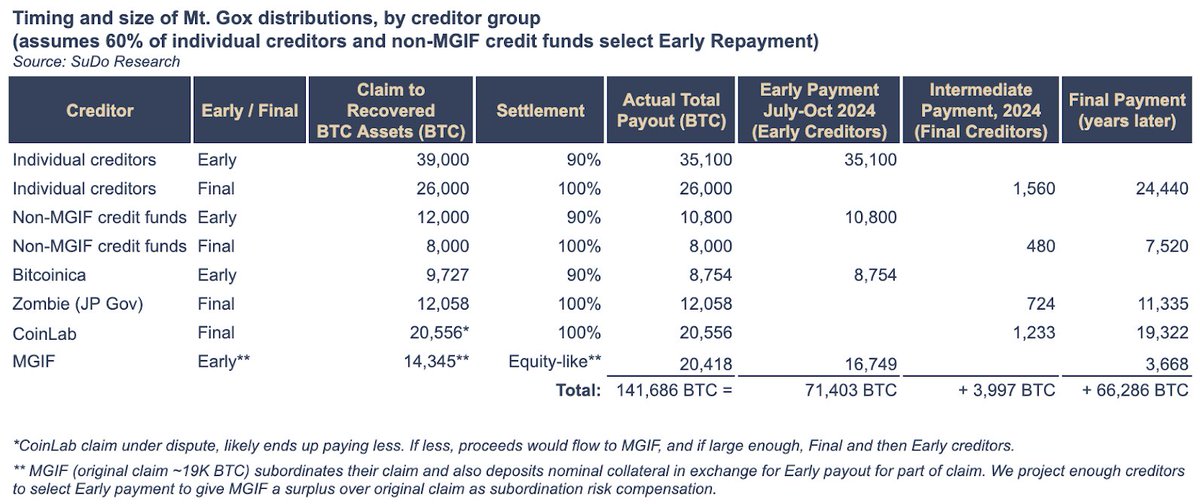
Of the 141,686 #BTC to be distributed, individual claims make up ~65K BTC, other credit funds ~20K, Bitcoinica ~10K BTC, Zombie claims ~12K, Coinlab ~21K, and MGIF’s pre-subordination claim ~19K (has potential downside and upside from subordination risk)
It was reported that Bitcoinica and MGIF both selected Early payouts, and we know zombie claims and CL are Final. As for individual claims and credit funds, we can only make an assumption of what percent chose Early vs Final.
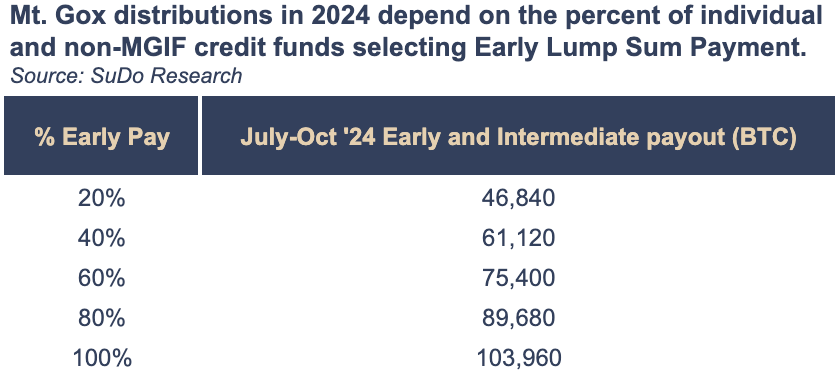
We note that the default selection is Final, and if we assume 20% of respondents did not select, and of those that selected, 75% chose Early, then 60% of individual and other credit funds would have chosen Early.
Final repayments will still have a small “Intermediate” portion paid out this year. A rough estimate of coins hitting the market this year is shown, heavily dependent on the % of individuals and credit funds choosing Early. 70-85K coins could be a rough range.
We also note the possibility that the supply could be distributed gradually from July till the last self-imposed deadline of Oct. 2024, to accommodate for logistical and administrative factors.
As for if each of these entities will #hodl or dump, we’ll leave that as an exercise for the reader.
Hit that bookmark button and follow us for more thoughts on the crypto market.
English
RT @SuDoResearch: / Navigating Liquid Restaking Tokens: An Overview of Leading Projects /
Following Ethereum's move to a PoS with "the Mer…
English
CryptoHao retweetledi
Here is our official website!
sudoresearch.com
On this website, you can see all our research articles as well as our VC portfolio. Contact us if you have any research collaboration or investment opportunities!
GIF
English
CryptoHao retweetledi

Introducing an surging Ethereum L2 - @modenetwork. Mode is under airdrop campaign (5.5% of total supply) via the point system. Currently, users can try out numerous DeFi protocols as well as leading restaking protocols to earn various points all at once.

English
CryptoHao retweetledi
Introduction of #zkWASM
In this thread, we detailed the mechanism & advantage of zkWASM as well as an introduction and high-level comparison among @delphinuslab @fluentxyz @thezkcross
English
CryptoHao retweetledi
Introducing @silentdao_ and how it develops a human-centric privacy solution.
@authentic_kobi_macaw_13/silent-protocol-is-encapsulating-ethereum-today-797c5c80fec0" target="_blank" rel="nofollow noopener">medium.com/@authentic_kob…
*Note: Silent Protocol is one of the investment portfolios of SuDo Research Lab.
English
CryptoHao retweetledi
1/n
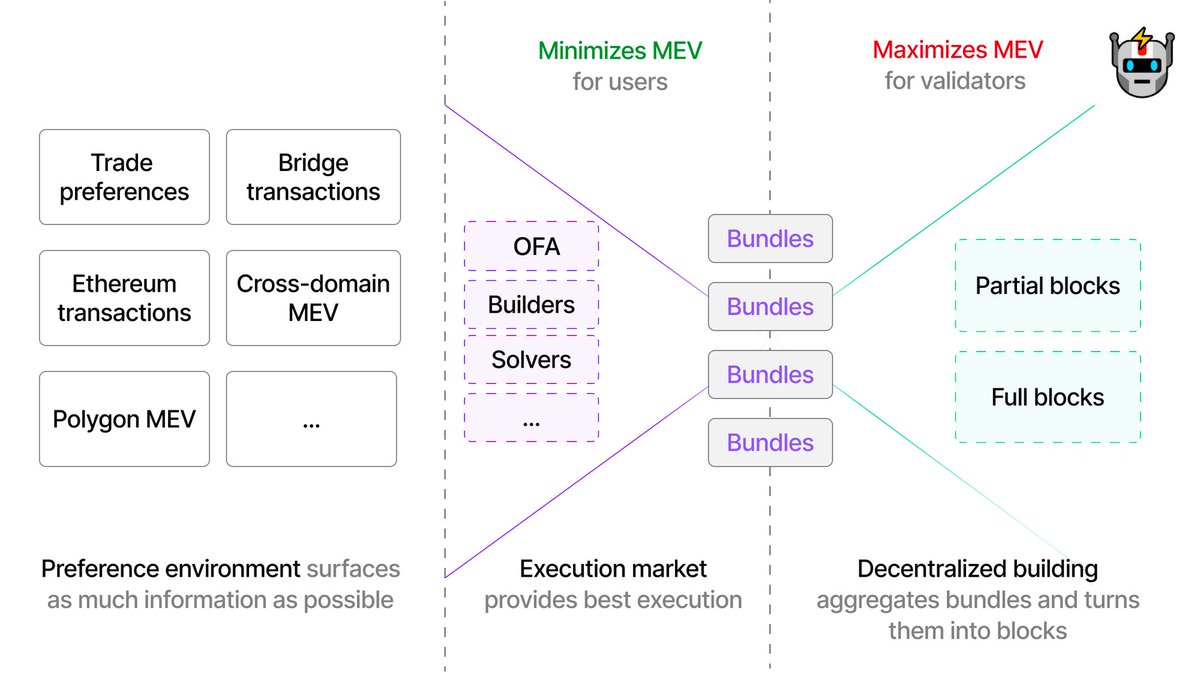
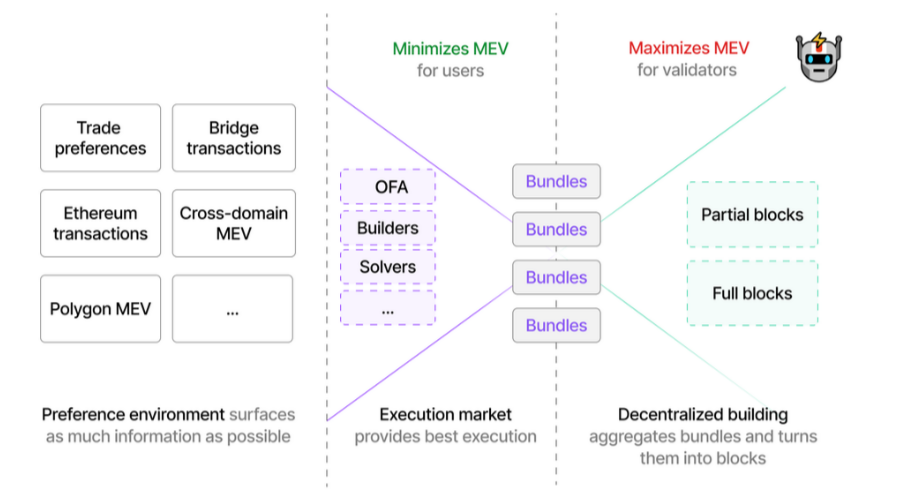
關於 #SUAVE(#Flashbots 團隊正在開發中),這是一個包含但不限於出塊、Order flow、跨鏈 MEV 提取、Intent Centric 相關、mempool 隱私,以及將 MEV 返還給用戶的去中心化終局方案。
中文
CryptoHao retweetledi
(1/n) A thread on #SUAVE (in development at #Flashbots), the decentralized endgame for block building, order flow, cross-chain #MEV extraction, intents, mempool privacy, and returning MEV to users:
English
CryptoHao retweetledi
1/n
What is a #modular #modularblockchain?
#Modularization in software engineering splits code into independent modules, reducing dependencies, enhancing reusability. It facilitates diverse program creation through "high cohesion, low coupling", integrating various modules.

English
CryptoHao retweetledi
1/n
Radiant @RDNTCapital,一個統治 Arbitrum Lending 的項目
長期 TVL 輾壓借貸協議元老 @AaveAave
究竟是什麼原因和設計機制讓他有今天的成績呢?
又是什麼特別的代幣排放措施讓 $RDNT 永不崩盤呢?
一篇讓你由淺入深對這個項目有一個通篇的認識!
$RDNT
🧵 👇
中文
CryptoHao retweetledi
(1/n)
A thread looking at @LayerZero_Labs and how it compares with @chainlink CCIP:
$ZRO $LINK

English
CryptoHao retweetledi
1/n
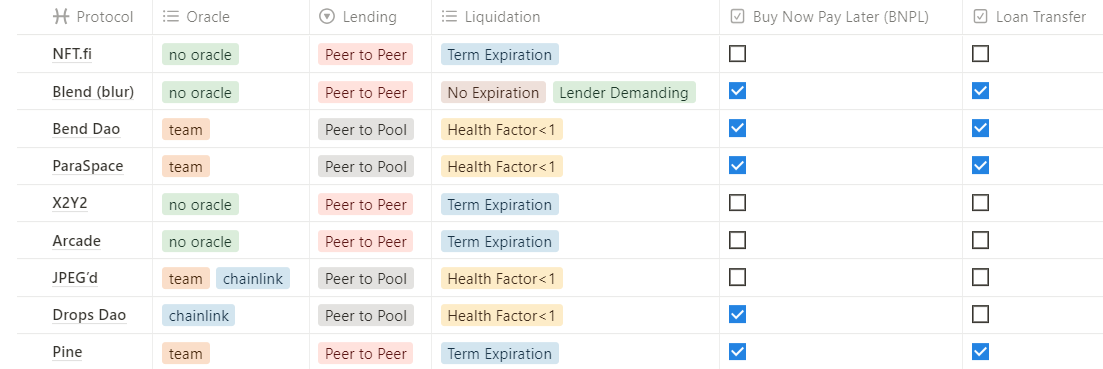
A thread to compare various NFT lending protocols
@blur_io @NFTfi @BendDAO @ParaSpace_NFT @the_x2y2 @JPEGd_69 @PineProtocol @Arcade_xyz @dropsnft
$blur $bend $x2y2 $JPEG $DROPS $PINE #Alts
English
CryptoHao retweetledi
1/n
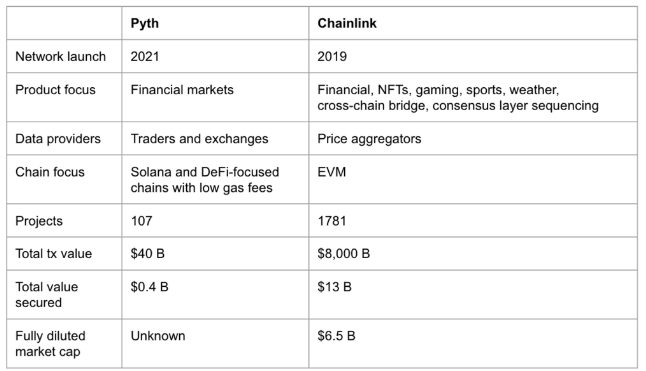
A thread looking at @PythNetwork and @chainlink and the key differences in their oracle network designs:
$LINK $PYTH #altcoins
English
CryptoHao retweetledi
(1/n)
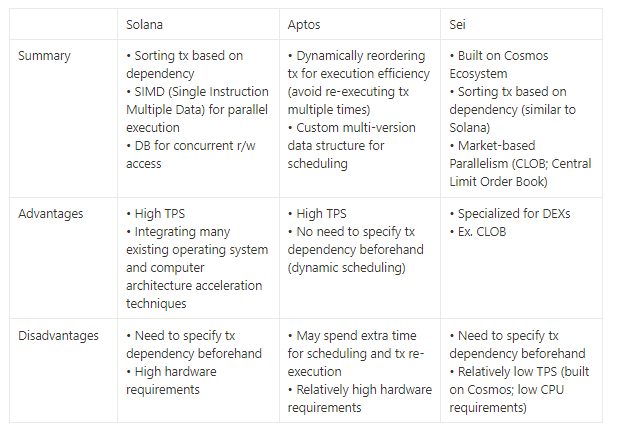
In our final part of comparing @solana, @Aptos_Network, @SeiNetwork, and @ethereum, we look at how those four blockchains perform parallel execution and their hardware requirements.
$ETH $SOL $APT $SEI
English
CryptoHao retweetledi
(1/n)
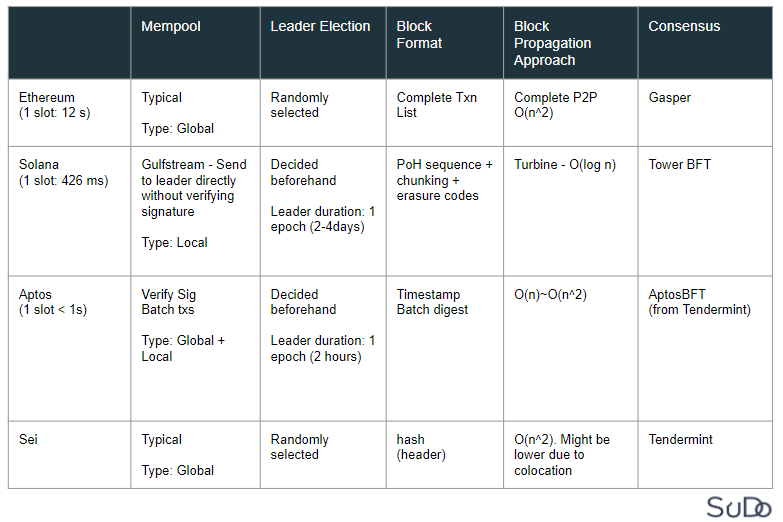
In our second part of comparing @solana, @Aptos_Network, @SeiNetwork and @ethereum, we look at consensus mechanisms and design tradeoffs among these four blockchains.
$ETH $SOL $APT $SEI
English

Dashboard 📋
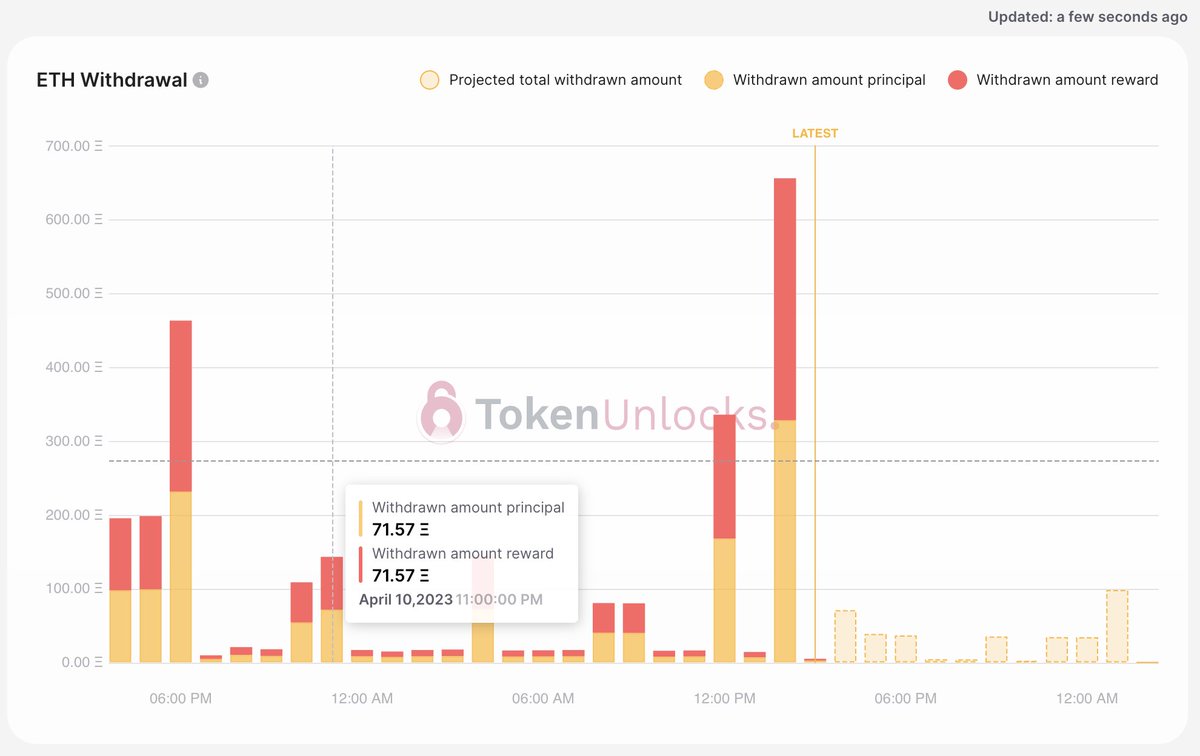
There will be a waiting period when stakers initiate the withdrawal of their staked $ETH, and this will provide us plenty of time to manage our portfolio
Our dashboard provides information on the amount of $ETH to be withdrawn and when it will become liquid
6/11
English
🔥The Shanghai hard fork is scheduled for tomorrow 🔥
More than 18 million $ETH will be uncaged 🕊️
It will be interesting to see what changes and impacts this Capella upgrade will bring 🤯
1/11
English