
Crypto gaucho ⭐️⭐️⭐️
5K posts

Crypto gaucho ⭐️⭐️⭐️
@Cryptogaucho1
Entusiasta Crypto de las llanuras / Crypto Enthusiast from the meadows. Not financial advice, just ideas to share!
Katılım Kasım 2020
1.6K Takip Edilen260 Takipçiler

Que lindo lo que se viene.
Gallo Financial Technology@GalloFintech
El inversor argentino ya cambió. Exige más. Decide más rápido. No distingue entre tradicional y cripto. En Expo EFI mostramos junto a @RipioApp cómo una ALyC puede integrar cripto en minutos, cumpliendo normativa. La discusión ya no es si hacerlo. Es quién llega primero.
Español


@SantinoCripto Comprar salas vacías y vender salas llenas ? Veremos
Español

DESASTRE. La conferencia de Bitcoin registró la menor asistencia de los últimos 5 años, con solo unas pocas docenas de asistentes.
Varios conferenciantes tampoco se presentaron, y el evento terminó 4 horas antes de lo previsto.
Español
¿Hay algún agente productor CNV interesado en activos tokenizados?
Esto es para ustedes 👇
docs.google.com/forms/d/e/1FAI…
Español
@paul_ironforce Sos tan fuerte como tu eslabón más débil lamentablemente
Español

Tema de comunicacion. Queda Aave en el ojo de la tormenta, todos hablan de Aave, cuando el/los culpables silvan bajito. A largo plazo asumiremos que hackearon a uno y no al otro.
Español
@cryptochica_arg No coincido. Van a haber modelos locales que vas a correr en infra local sin problemas para tu sustento. Comprar tierras y vacas si, pero como RWA pls, no perdamos el norte jaja
Español

Ayer una amiga en Madrid me dijo que, de ahora en más, tenemos que pensar nuestro poder adquisitivo individual en función de cuántos tokens/créditos de IA vamos a poder desbloquear para generar nuestro propio sustento.
Y que el otro camino es comprar tierras y vacas.
Todavía me sacude la confusión de pensar que dijo algo distópico desde su habitual nihilismo, pero a su vez, muy lúcido.
Pesado para digerir un jueves de fines de abril.
Español
Sueño con que podamos tener un mercado Argentino tokenizado de private equity
Naval@naval
Introducing USVC - a single basket of high-growth venture capital, for everyone. No accreditation required, SEC-registered, and a very low $500 minimum. Includes OpenAI, Anthropic, xAI, Sierra, Crusoe, Legora, and Vercel. As USVC adds more companies, investors will own a piece of that too. Liquidity typically comes when companies exit, but we’re aiming to let investors redeem up to 5% of the fund every quarter. This isn’t guaranteed, but if we can make it work, you won’t be locked up like in a traditional venture fund. It runs on AngelList, which already supports $125 billion of investor capital. And I’ve joined USVC as the Chairman of its Investment Committee. — Go back to the 1500s, you set sail for the new world to find tons of gold - that was adventure capital. Early-stage technology is the modern version. It says we are going to create something new, and it’s risky. It’s daring. But ordinary people can’t invest until it’s old, until it’s no longer interesting, until everybody has access to it. By the time a stock IPOs, most of the alpha is gone. The adventure is gone. Public market investors are literally last in line. This problem has become farcical in the last decade. Startups are reaching trillion dollar valuations in the private markets while ordinary investors have their noses up to the glass, wondering when they’ll be let in. Investing in private markets isn’t easy. You need feet on the ground. You need judgment built over years. Most people don’t have the patience to wait ten or twenty years for an investment to come to fruition. But there is no more productive, harder-working way to deploy a dollar than in true venture capital. USVC enables you to invest in venture capital in a broad, accessible, professionally-managed way, through a single basket of innovation, focused on high-growth startups, at all stages. It is how you bet on the future of tech: the smartest young people in the world, working insane hours, leveraged to the max, with code, hardware, capital, media, and community. Your dollar doesn’t work harder anywhere. There is an old line - in the future, either you are telling a computer what to do, or a computer is telling you what to do. You don’t want to be on the wrong side of that transaction. USVC lets you buy the future, but you buy it now. Then you wait, and if you are right, you get paid. Get access here: usvc.com
Español

Malvinas puede ser un gran lugar para crear Freedom City ;)
El Oráculo de Trenque Lauquen@laromadelsur
Peter Thiel leyo la Rebelion de Atlas y le dijo a Trump, conseguime una isla, cualquiera, y te levanto Freedom City. Un viejo anhelo de los libertarios norteamericanos, y de buena parte del mundo. Trump les ofreció Gaza, pero ahí hay aún musulmanes, así que quedo Greenland
Español
Crypto gaucho ⭐️⭐️⭐️ retweetledi

Mark Cuban just described the largest wealth transfer of the AI era.
Almost nobody understood what he said.
Cuban: “There are 33 million companies in this country. Aren’t going to have AI budgets. Aren’t going to have AI experts.”
Not tech startups.
The shoe store. The regional trucking outfit. The accounting firm with 12 employees.
The businesses that actually run the physical economy.
They know AI is coming. They have no idea what to do with it.
Cuban: “You’ve got the head of Microsoft saying software is dead because everything’s going to be customized to your unique utilization.”
Software is dead.
The SaaS era ran on one rule. Build a generic product. Force millions of companies to bend their workflows around it. Charge rent forever.
AI ends the contract.
The business stops bending to the software. The intelligence bends to the business.
But customized by whom.
The third-generation manufacturer cannot tell Claude from Gemini. The county hospital is staring at a reactor asking where the light switch is.
Cuban: “Who’s going to do it for them?”
That question is worth more than the frontier models themselves.
Hundreds of billions are being burned to build the foundation. The smartest engineers alive are locked in a bloodbath over who owns the base layer.
Let them fight.
Let them burn the capital. Let them drive the cost of raw intelligence toward zero.
Because the wealth does not collect where the brain is built.
It collects where the brain meets the business.
Every ambitious kid in college right now thinks survival means a seat at OpenAI or Anthropic.
Cuban is staring at the other 99 percent of the economy.
Learn the models. Then learn the messy, unglamorous reality of how a 50-person company actually operates.
Walk through the door. Understand their problems. Wire the intelligence directly into their revenue.
That is not a job title. That is an entire economic class being born.
You do not need to build the brain. You need to build the nervous system.
The biggest winners of the electricity era were not the engineers who built the generators. They were the ones who walked into dark factories and showed the owners where to plug in.
33 million companies are standing in the dark right now.
Silicon Valley is racing to build the god. The fortunes will belong to whoever teaches him a trade.
English
@laromadelsur Es que va a ser como la electricidad. No te cuestionas si algo está energizado, lo mismo con IA. Va a estar embebido en todo.
Español
Ya le meten IA a todo.
El problema de la IA es que no termine siendo un commoditie que termine aburriendo. Temo que en muchas cosas volveremos a lo tradicional, obviamente, con tecnología IA.
Crypto Rover@cryptorover
💥BREAKING: Allbirds $BIRD stock rises over 420% after announcing shift from shoes to AI. Absolutely insane.
Español
Crypto gaucho ⭐️⭐️⭐️ retweetledi
Elon Musk thinks the entire education system is built on a broken assumption.
That every student should learn the same thing. At the same speed. In the same order. At the same time.
Musk: “Everyone goes through from like 5th grade to 6th grade to 7th grade like it’s an assembly line. But people are not objects on an assembly line.”
The model was designed for a factory economy. Standardized inputs. Predictable outputs.
That economy is gone. The assembly line is gone.
But the education system still runs on its logic.
A student who masters algebra in two weeks sits through eight more weeks because the calendar says so. A student who struggles gets dragged forward because the schedule doesn’t wait.
Neither is being served. Both are being processed.
Musk: “Allow people to progress at the fastest pace that they can or are interested in, in each subject.”
AI doesn’t teach a classroom. It teaches a student.
One at a time. Every time.
It skips what a student already knows. It finds where they’re stuck and approaches it from a different angle.
It adjusts in real time. Not at the end of a semester when the damage is already done.
A student obsessed with basketball learns fractions through shooting percentages. A student who builds in Minecraft learns geometry through architecture.
The subject doesn’t change. The entry point does.
No teacher with thirty students can do this. Not because they lack skill.
Because the math doesn’t work.
AI doesn’t have that constraint.
Musk: “You do not need to tell your kid to play video games. They will play video games on autopilot all day. So if you can make it interactive and engaging, then you can make education far more compelling.”
The brain isn’t broken. The format is.
Kids learn complex systems and strategic thinking for hours voluntarily. Then walk into a classroom and can’t focus for twenty minutes.
That’s not a discipline problem. That’s a design problem.
Musk: “A university education is often unnecessary. You probably learn the vast majority of what you’re going to learn there in the first two years. And most of it is from your classmates.”
Four years. Six figures of debt.
And the real value comes from the people sitting next to you. Not the institution charging you.
The degree doesn’t certify knowledge. It certifies endurance.
Musk: “If the goal is to start a company, I would say no point in finishing college.”
The system was built to train employees. If you’re not trying to be one, it has nothing left to offer you.
Every lecture. Every textbook. Every curriculum. Now available instantly. Personalized to any learner. Adapted to any pace.
The question isn’t whether the old model survives.
It’s how long we keep forcing students through it while the replacement already exists.
English
Crypto gaucho ⭐️⭐️⭐️ retweetledi

Crypto gaucho ⭐️⭐️⭐️ retweetledi

Hay algo que me ronda la cabeza desde que Anthropic presentó Project Glasswing. No es lo que Mythos sabe hacer, que según los benchmarks supera a cualquier modelo hasta ahora. Lo que creo es que, además, no pueden permitirse encenderlo para todo el mundo.
Cincuenta partners con acceso. Cien millones en créditos. Un programa de verificación como aduana y cero disponibilidad general. Cuando el laboratorio más ambicioso del sector crea la máquina más potente que existe y su primera decisión es racionar quién puede usarla, eso no es estrategia de producto, es otra cosa.
Llevo meses con la misma tesis y cada semana me la confirman. Esto es el Proyecto Manhattan de nuestra generación, no por la grandilocuencia de la comparación sino por la naturaleza del cuello de botella.
En Los Álamos tenían todo lo que necesitaban menos lo único que importaba. La física estaba resuelta, Oppenheimer, Fermi… estaban ahi. Pero sin uranio enriquecido suficiente, la bomba era solo un paper interesante. Hoy el uranio se llama cómputo, y Mythos es la prueba de que ya nos hemos quedado cortos.
Los números cuentan la historia mejor que yo. Mythos cuesta, por millón de tokens, casi el doble que Opus 4.6, y ese multiplicador es el suelo del coste real porque el precio de API nunca refleja lo que cuesta servir el modelo de verdad. Imagina que mañana Anthropic abre la puerta a toda su base de usuarios. La mitad de la demanda migra hacia un modelo tres veces más caro por consulta y el consumo total de compute se dispara entre cinco y diez veces. Solo con los usuarios que ya tienen, sin contar las cargas de agentes autónomos de ciberseguridad que van a correr día y noche sobre cada kernel y cada repositorio del planeta, cargas que por diseño no pueden apagarse nunca.
O sea, que la unidad de cuenta de esta economía ha dejado de ser el dólar. Lo que manda ahora es el joule, el vatio-hora, el ancho de banda de memoria. Cada capacidad nueva consume tokens, y los tokens consumen silicio, memoria y electricidad, todo a la vez, todo el rato, sin pausa.
Y nos estamos quedando sin los tres.
Google firma un acuerdo de treinta mil millones por TPUs. AWS acelera Trainium como si le fuera la vida en ello, que le va. NVIDIA coloca inversiones estratégicas en toda la cadena. Los hyperscalers disparan el capex trimestre tras trimestre mientras la mitad del sell side repite “burbuja” como quien reza un rosario para calmarse. No es una burbuja. Entre 1942 y 1945 Estados Unidos levantó Oak Ridge, Hanford y Los Álamos en paralelo y gastó el equivalente a treinta mil millones actuales sin que el Congreso supiera exactamente en qué iban. Nadie llamó burbuja a aquello. Lo llamaron movilización industrial, y quien no la entendió a tiempo se quedó fuera del orden que vino después. La diferencia es que esta carrera cotiza en bolsa y aun así la mitad del mercado la confunde con una moda pasajera.
Lo que poca gente entiende es que la cadena de restricciones no termina en el chip. El chip necesita memoria de alto ancho de banda para funcionar, la memoria necesita energía para alimentarse, y la energía necesita infraestructura física que tarda años en construirse.
Cada eslabón tarda más en resolverse que el anterior y es más difícil de sustituir. En el último tramo de la cadena están la geopolítica del gas, el uranio real esta vez, las tierras raras y unos transformadores eléctricos con plazos de entrega de tres años.
Las fábricas de chips, las centrales y la infraestructura energética que se levanten ahora van a decidir quién manda en la próxima década.
Español
Crypto gaucho ⭐️⭐️⭐️ retweetledi

There's a physicist at Stanford named Safi Bahcall who modeled this exact principle and the math is wild.
He calls it "phase transitions in human networks." When you're stationary, your probability of a lucky event is limited to your existing surface area: the people you already know, the places you already go, the ideas you've already been exposed to. Your opportunity window is fixed.
When you move, your collision rate with new nodes in a network increases nonlinearly. Double your movement (new conversations, new cities, new projects) and your probability of a serendipitous encounter doesn't double. It roughly quadruples. Because each new node connects you to their entire network, not just to them.
Richard Wiseman ran a 10-year study at the University of Hertfordshire tracking self-described "lucky" and "unlucky" people. The single biggest differentiator wasn't IQ, education, or family money. Lucky people scored significantly higher on one trait: openness to experience. They talked to strangers more, varied their routines more, and said yes to invitations at nearly twice the rate.
The "unlucky" group followed the same routes, ate at the same restaurants, and talked to the same 5 people. Their networks were closed loops. No new inputs, no new collisions.
Luck isn't random. Luck is surface area. And surface area is a function of movement.
The lobster emoji is doing more work than most people realize. Lobsters grow by shedding their shell when it gets too tight. The growth requires a period of total vulnerability. No protection, no armor, soft body exposed to the ocean.
That's the cost of movement nobody posts about. You have to be uncomfortable first. The new shell only hardens after you've already moved.
ຸ@d9vidson
a moving man will meet his luck 🥀
English
Crypto gaucho ⭐️⭐️⭐️ retweetledi

Mythos Preview seems to be the best-aligned model out there on basically every measure we have. But it also likely poses more misalignment risk than any model we’ve used:
Its new capabilities significantly increase the risk from any bad behavior. 🧵

English

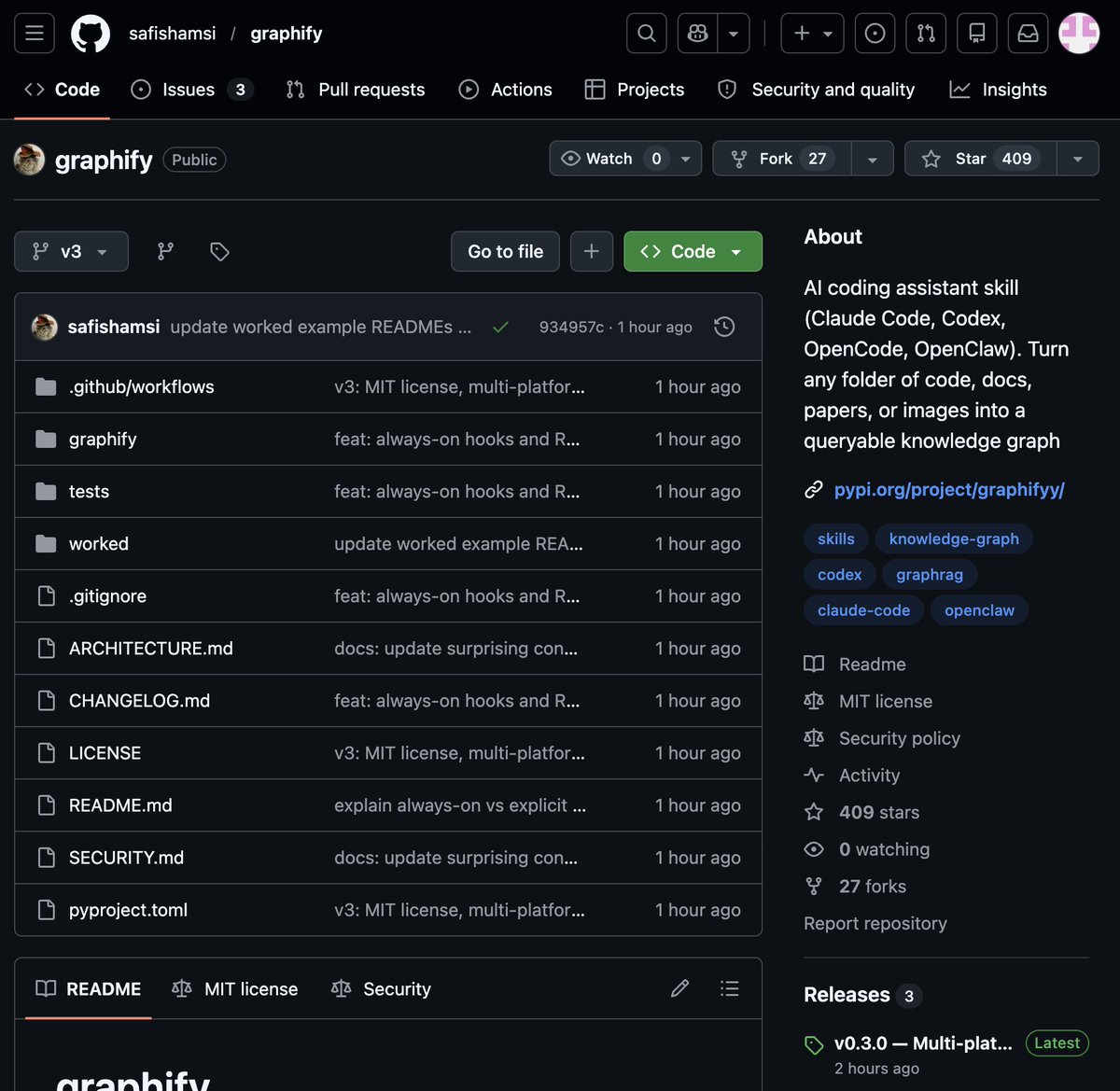
🚨 BREAKING: Someone just built the exact tool Andrej Karpathy said someone should build.
48 hours after Karpathy posted his LLM Knowledge Bases workflow, this showed up on GitHub.
It's called Graphify. One command. Any folder. Full knowledge graph.
Point it at any folder. Run /graphify inside Claude Code. Walk away.
Here is what comes out the other side:
-> A navigable knowledge graph of everything in that folder
-> An Obsidian vault with backlinked articles
-> A wiki that starts at index. md and maps every concept cluster
-> Plain English Q&A over your entire codebase or research folder
You can ask it things like:
"What calls this function?"
"What connects these two concepts?"
"What are the most important nodes in this project?"
No vector database. No setup. No config files.
The token efficiency number is what got me:
71.5x fewer tokens per query compared to reading raw files.
That is not a small improvement. That is a completely different paradigm for how AI agents reason over large codebases.
What it supports:
-> Code in 13 programming languages
-> PDFs
-> Images via Claude Vision
-> Markdown files
Install in one line:
pip install graphify && graphify install
Then type /graphify in Claude Code and point it at anything.
Karpathy asked. Someone delivered in 48 hours.
That is the pace of 2026.
Open Source. Free.
English
Crypto gaucho ⭐️⭐️⭐️ retweetledi

I am not going to motivate you because if you need motivation from a stranger on a plane the answer is stay
but I will give you the game theory
your corporate M&A gig is a repeated game with diminishing marginal returns. year 1 you learn everything. year 2 you refine it. year 3 you are executing pattern recognition. year 4+ you are being paid more to do the same thing with slightly larger numbers. the learning curve flattens but the golden handcuffs tighten because every year the comp goes up and the opportunity cost of leaving gets more painful on paper
this is a classic status quo bias trap. the payoff of staying is known and comfortable. the payoff of leaving is uncertain and scary. so you stay not because staying is optimal but because the asymmetry of regret is lopsided. you can imagine regretting the leap. you cannot as easily imagine regretting the years you stayed too long because that regret builds slowly and never hits you in one moment
here is where game theory actually helps:
in your M&A seat you are playing someone else's game. the firm sets the rules, the deal flow, the comp structure, the promotion timeline. you optimize within their framework. you are a very well-compensated player in a game you did not design. your upside is capped by whatever the partnership or MD economics look like. your downside is protected by a salary. that is the trade
owning a local business flips the entire payoff matrix. you design the game. you set the rules. the downside is real and unprotected but the upside is uncapped and compounds in ways a salary never does because you own the equity. a $2M EBITDA business bought at 4x and grown to $3M EBITDA over 3 years is worth $12-15M on exit. no M&A salary trajectory produces that kind of wealth creation in that timeframe unless you are a founding partner
the Nash equilibrium of your current situation: you and every other M&A professional are competing for the same promotions, same deal credit, same bonus pool. the competition is fierce because the players are identical. same schools, same skills, same hours. you are in a crowded equilibrium where everyone works 80 hours to stay in the same relative position
local business ownership is a different game with different players. the competition is a 62-year-old owner who stopped innovating in 2014 and a 35-year-old who inherited the business and does not want to be there. you walk in with financial sophistication, deal structuring experience, and the ability to read a balance sheet faster than anyone in the room. you are overqualified for the game which is exactly where you want to be. the best strategy in game theory is to play games where your existing skill set gives you an asymmetric advantage over the other players
the timing question is about optionality. every year you stay in M&A your financial optionality goes up slightly because you save more. but your operational optionality goes down because you get further from the reality of running anything. the M&A guy who leaves at 28 adapts to operations in 6 months. the one who leaves at 38 has a decade of habits built around delegating to analysts and reviewing decks, and managing a P&L feels foreign in a way it would not have 10 years earlier
but again. if you need me to motivate you, stay. the people who actually do this do not need motivation. they need a spreadsheet that shows the math works and then they cannot NOT do it. if you have the spreadsheet and you are still asking strangers for motivation the spreadsheet is not the problem
English
@MathiasChu Sip. Mythos se debe estar consumiendo todo y no queda nada para Opus
Español

@Mariandipietra YPF Luz lanzó enertoken, para tokenizar sus contratos de energía.
No lo sé Rick… misleading. Igual es un monton, está bueno que rompan el hielo.
Español

Crypto gaucho ⭐️⭐️⭐️ retweetledi

>war drags on
>maybe hikes
>with or without -> markets crash
>uneployment rises
>buy opportinity
>fed capitulates Q3/4
>markets recover
>bull run into 28/29
English