Christian Thomas

610 posts

Christian Thomas banner
Christian Thomas

Christian Thomas

@Cthomsix

Likes/Retweets ≠ Endorsements. Opinions my own and not investment advice.

Katılım Ağustos 2012
1.5K Takip Edilen108 Takipçiler
Christian Thomas
Christian Thomas@Cthomsix·
@kieranwgoodwin Well that’s a good source! Just weird they haven’t published it on their website yet…even still
English
0
0
0
36
Kieran Goodwin
Kieran Goodwin@kieranwgoodwin·
Feb Performance of Private BDCs and Cliffwater $CCLFX + 0.29% $BCRED - 0.40% $ADS -0.07% (Apollo) $HLEND -0.30% (Blackrock) $ASIF -0.68% (Ares) $OCIC -0.86% (Blue Owl) Wow, Cliffwater must just be the superior investor.
English
8
1
42
12.6K
Christian Thomas
Christian Thomas@Cthomsix·
@SpecialSitsNews IRRs account for uneven cash flows, your assumption is fully invested geometric return like owing the S&P 500. Geometric return and IRRs are apples and oranges. Not arguing with your point, it may still stand, impossible to say because IRR and geometric avg aren’t comparable.
English
1
0
12
2K
Special Situations 🌐 Research Newsletter (Jay)
Most of these PE long term IRRs are fake... If $KKR’s first $31 million fund from 1976 had compounded at 26% a year it would be worth $2.6 trillion today x.com/i/status/20335…
Trevor Noren@trevornoren

Apollo's John Zito on private equity: "I literally think all the marks are wrong...This next cycle is going to be a big moment in time for the private markets because people are way smarter than I think private-market participants, particularly people in the wealth channel. Like, I kind of sense an arrogance of the people who grew up in the private-markets business . . . If you don’t mark your book, I think you actually lose trust with the clients." As I dissected in my report on the "Retailization of Private Markets" (sageroadresearch.com/collections/re…), it's dumbfounding how much enthusiasm for PE over the past decade+ was predicated on nakedly absurd performance assumptions. In an article in May, the FT dissected IRR claims made by both KKR and Apollo in 10-K filings. First, they quoted KKR: “From our inception in 1976 through December 31, 2024, our Private Equity and Real Assets investment funds with at least 24 months of investment activity generated a cumulative gross IRR of 25.5%, compared to the 12.2% and 9.5% gross IRR achieved by the S&P 500 Index and MSCI World Index, respectively, over the same period.” As for Apollo, it claims a 39% gross IRR generated by its private equity funds from inception through year-end 2024. The FT contextualized these numbers: "Across almost all regulatory and marketing material filed by private equity, awe-inspiring IRRs are common. Apparently, these private equity firms have managed to defy the laws of mathematics, economics—and reality. Since most people typically don’t have a good grasp of compounding, it might be helpful to express these numbers in dollars to show how fantastical they really are. If KKR’s first $31 million fund from 1976 had compounded at 26% a year it would be worth $2.6 trillion today. Add in its second $350 million fund and you get $13 trillion—more than the global PE market. Apollo’s first funds would now be worth $74 trillion, just shy of global GDP." Private credit problems could easily spill over into PE and finally force a reckoning with the "laws of mathematics, economics—and reality." To again quote Zito: “There’s . . . unlimited demand for secondary private equity but they are worried about private credit which finances 80% of those portfolios . . . I can’t compute, but I’m the dumb guy. I don’t understand. I start saying this and I get these blank stares back at me like OK, I don’t know.” This is a particularly acute concern for the broader US economy given the PE creep into small businesses over the past decade (chart below). Learn more about Sage Road Research: sageroadresearch.com. Interested in subscribing? Message me. WSJ interview with Zito: wsj.com/finance/invest… Chart source: bloomberg.com/news/articles/…

English
21
8
171
139.1K
Sarcastic Hedgie
Sarcastic Hedgie@sarcastic_hedgi·
@MebFaber conferences are sponsored by the people charging 2 and 20 to do what VTI does with extra steps nobody's gonna write research notes about how their own business model just became obsolete lol
English
1
0
1
843
Meb Faber
Meb Faber@MebFaber·
I follow a fair amount of family office and endowment content (email newsletters, conferences, sell side research) and the two biggest stories of the past year have had zero coverage: 1. 351 ETF exchanges 2. Low cost endowment and family office style ETF launches. Theories?
English
17
13
100
23.5K
Christian Thomas
Christian Thomas@Cthomsix·
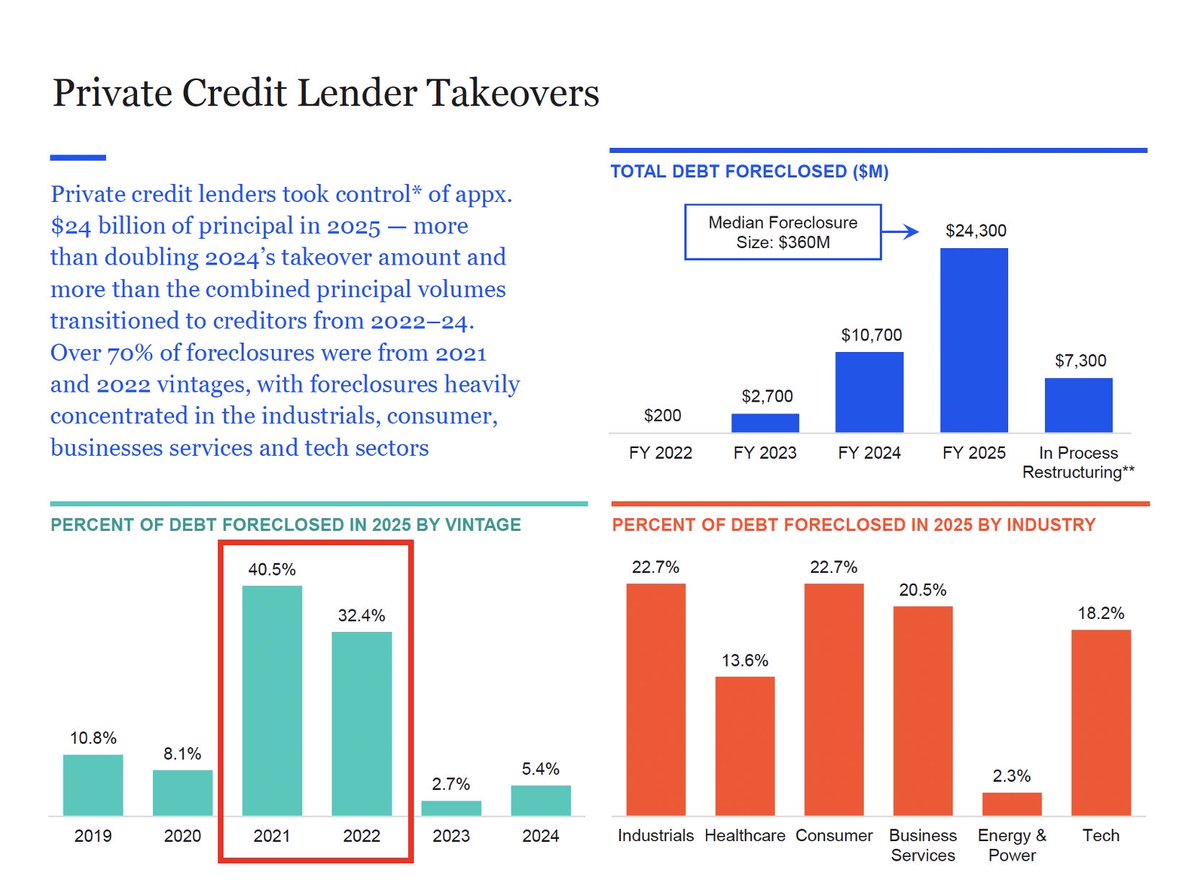
@Will_Schryver Can you segment this data by EBITDA? What percentage falls in lower middle market, vs. middle market, vs upper?
English
0
0
0
131
Will Schryver
Will Schryver@Will_Schryver·
Another 🚩 in Private Credit Private credit lenders took control of $24 billion of principal in 2025, double 2024 levels 70% of foreclosures were from 2021 and 2022 vintages when EV/EBITDA multiples peaked In other words, borrowers are defaulting on debt used 4 years ago to lever up on peak / frothy valuation levels Source: Kirkland & Ellis
Will Schryver tweet media
Will Schryver@Will_Schryver

🚩 Private Credit “shadow” defaults are up nearly 3x their 2021 levels 58% of private credit PIK borrowers continue to pay interest with MORE debt due to liquidity constraints This “bad” form of PIK (Payment-In-Kind) interest is a sign of distressed companies with liquidity needs seeking flexibility to avoid default In other words, the companies would begin missing payments and default had this PIK option not be been available, hence the “shadow” default Source: Kirkland & Ellis, Lincoln

English
12
21
163
25.9K
Phil Huber
Phil Huber@bpsandpieces·
Ok, I’ll bite. 1. Not sure why it's necessary to impugn those with “letters behind their name” – who actually bear the great responsibility of managing other people’s money – as if disagreement with your points below somehow violates their duty as charterholders. 2. Allocations to private credit in the wealth channel typically range between 5-10% of the overall portfolio. Not sure it’s the best and highest use of an advisor’s time attempting to arb BDC discounts for a relatively modest portion of their clients’ assets. 3. To that point, many will avoid the trade you describe now for the same reason they avoided listed BDCs in the first place (when discounts were narrower) – they have independently reached the conclusion they prefer other structures for obtaining their desired exposure to the asset class that can provide lower fees, less leverage, and more diversification. 4. I would argue the primary portfolio objective for private credit investors is high current income, not capital appreciation. For long-term strategic allocators, why introduce the brain damage of continuously rotating between listed BDC and evergreen vehicles based on sentiment-driven discount dynamics? Successful outcomes can be achieved w/o playing that game. 5. Lastly, “defaults existing” ≠ problems in private credit. Defaults have averaged ~2% over the last 20+ years. With ~10k middle market borrowers and another 1.4k BSL credits, one should expect more than 200 defaults a year. Not every failed borrower is a harbinger of the next GFC, no matter how much the anti-PC crowd desperately wants it to be.
Leyla@LeylaKuni

Anyone with “,CFA” or “,CAIA” behind the name, who’s twisting themselves into a pretzel arguing there are no problems in private credit should: 1. Disclose how much of their clients’ money is in PC evergreen vehicles 2. Exit them at NAV and buy shares of the public BDC No?

English
16
6
125
46K
Christian Thomas
Christian Thomas@Cthomsix·
@charles17187887 @JulianKlymochko Some non-accrual loans weren’t included, but that makes sense, who wants to buy those…but NA loans are <1% of book, so not a material impact to remaining book. There’s a lot the media gets wrong — it’s never as good or as bad as it sounds — truth is always in the middle
English
0
0
0
10
Christian Thomas
Christian Thomas@Cthomsix·
@charles17187887 @JulianKlymochko Blue owl sold their loans at 99.7 — to 4 different buyers (one being their insurance division) — at a profit to their origination price, but small discount to par — that validates their marks imho. They prorated most of their assets too, so didn’t cherry-pick the best loans.
English
1
0
0
17
Julian Klymochko
Julian Klymochko@JulianKlymochko·
The thing is, the current secondary market prices of liquid private credit vehicles (BDCs) are implying a default rate north of 20%, far in excess of anything experienced during the GFC and greater than UBS’s draconian “worst case” scenario
First Squawk@FirstSquawk

US private credit DEFAULT rates could reach levels not seen since the Financial Crisis In a worst-case scenario of rapid AI disruption, UBS projects US private credit defaults could hit 14–15%.

English
14
14
136
55.2K
Christian Thomas
Christian Thomas@Cthomsix·
@AyyouEm @Vuzhteetz PS - PluralSight? PC goes back before GFC, so there is decent history there and recovery rates have been 60-80 range. It’s the Evergreen/Interval vehicles that are newer and making headlines bc retail reads/watches News and institutions don’t.
English
0
0
0
11
JV
JV@AyyouEm·
@Cthomsix @Vuzhteetz yep... putting 100% in there insteading of like 'double that of liquid markets' is kinda clickbaity, but the point was 'PC recoveries sooooo much better than liquid markets' and thats just incredible rhetoric given nasency of asset class. PS recovery was <10.
English
1
0
0
42
JV
JV@AyyouEm·
As gates go up, remember the downside is actually the upside. "I suspect private credit, even when things go wrong, is at least 100% higher, if not more"
JV@AyyouEm

Golden Age - HPS edition

English
12
0
59
25.5K
Christian Thomas
Christian Thomas@Cthomsix·
@Vuzhteetz @AyyouEm Correct, a little misleading, but implying. That private credit recoveries are 60-80% with the “100%” number. Probably intentional to save face, but a little dirty. And I’m a private credit bull
English
1
0
0
35
Larry
Larry@Vuzhteetz·
@AyyouEm One thing I’ll never understand is how realistic it is for a company to default, give the lender the keys, and the recovery is in excess of 100%…if there was equity value you’d likely never be in that situation
English
4
0
3
494
Christian Thomas
Christian Thomas@Cthomsix·
@OperatorDen1 @UnicusResearch @BarackObama Sure thing! Not sure on the Cayman thing, interesting that they’re concerned about it. Was unaware about all the IG private credit that the insurers own, but makes sense. Then the diff b/t BSL and direct lending is what media gets wrong…that and low leverage
English
0
0
1
12
Kyle
Kyle@OperatorDen1·
@Cthomsix @UnicusResearch very illustrative deck, thanks for linking. some standout slides also interesting they included the sidebar on the cayman islands -- I thought @BarackObama nixxed most of the cayman island work arounds
Kyle tweet mediaKyle tweet mediaKyle tweet media
English
1
0
0
74
Unicus
Unicus@UnicusResearch·
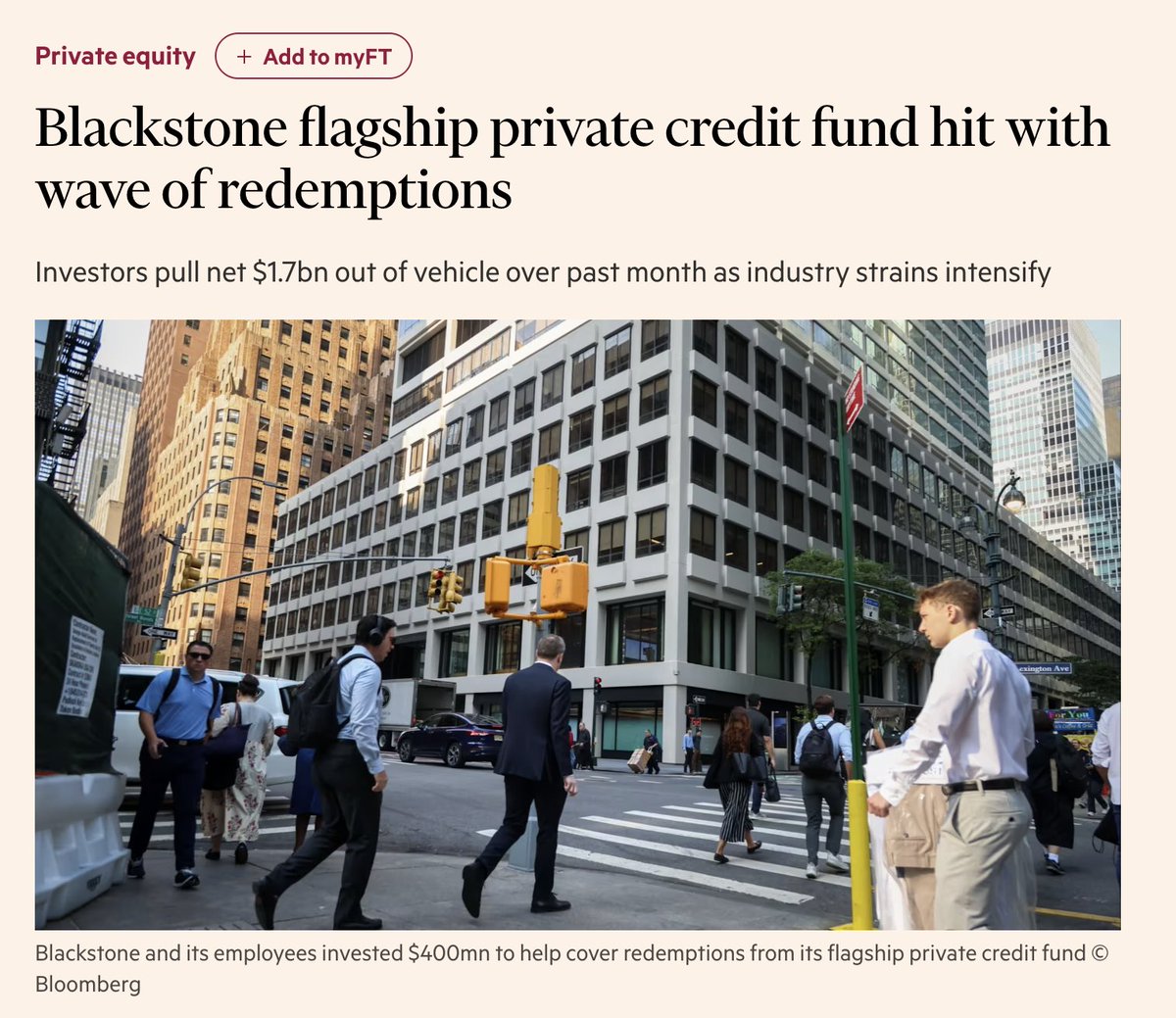
🚩To those who are in denial, like Blackstone's Jon Gray - here you go. 🧵 Blackstone is writing checks from its own pocket to cover the stampede out of BCRED. And Blackstone’s Jon Gray, as of this morning, is on CNBC calling all of this “a ton of noise.” The nerve.
Unicus tweet media
English
18
58
299
248.9K
Kyle
Kyle@OperatorDen1·
@UnicusResearch can someone explain the point of private credit? why not just get a loan from a bank? banks -> private credit -> loan sharks
English
2
0
0
1.3K
Leyla
Leyla@LeylaKuni·
The mass exodus of retail capital from private credit has begun. BCRED repurchase requests are up to 7.9% over the past month (the fund is fulfilling all of them) The fund paid out $3.7B (against $2B in new share sales)
Leyla tweet media
English
13
31
192
38.7K
Christian Thomas
Christian Thomas@Cthomsix·
@LeylaKuni @SemiTgtPrince Likely didnt sell anything they didn’t want to. They have low leverage in the fund <1x and their optimal leverage is 1.25x — they just haven’t been deploying capital as fast as flows have come in since they had tried to stay disciplined, thus the leverage dropped pretty low
English
1
0
0
118
Leyla
Leyla@LeylaKuni·
@SemiTgtPrince tbd - we have to wait for the quarterly report
English
2
0
3
504
Christian Thomas
Christian Thomas@Cthomsix·
@Roshan_Gudapati @lisaabramowicz1 Refreshing to hear some sense in this space finally. Lots of “private credit experts” on here and I don’t see a lot of rationality among them when they are critiquing the asset class as a whole
English
0
0
2
71
Roshan Gudapati
Roshan Gudapati@Roshan_Gudapati·
Private credit has taken massive share from the public bond market over the last several years, and public, liquid fixed income is DoubleLine’s core franchise. When institutions allocate to private credit, that capital often comes straight out of traditional bond strategies. That is competitive pressure, plain and simple. DoubleLine’s critique of illiquidity and “smooth” marks echoes arguments Gundlach has been making publicly for some time. Those points may have merit. But they also reinforce the core value proposition of DoubleLine’s own liquid, daily priced approach. Private credit is not a monolith. The large managers such as Apollo, Blackstone, and Ares have built long track records with relatively low realized default rates and strong cash-on-cash returns. You can only “smooth” marks for so long. Ultimately, funds have to deliver real cash returns to investors, and many of these firms have done exactly that. Manager selection and underwriting discipline matter enormously in this space. Are there risks in parts of the market? Of course. But framing private credit broadly as the next crisis feels convenient when competing for the same pool of capital. Two things can be true. There are risks in segments of private credit, and there are competitive dynamics shaping the narrative.
English
1
3
11
1.2K
Lisa Abramowicz
Lisa Abramowicz@lisaabramowicz1·
Private credit accounts for ~30% of the $4.1 trillion US leveraged finance mkt: DoubleLine. Many firms conflate illiquidity in private debt for price stability & “DoubleLine believes this is a form of volatility laundering & a misguided marketing campaign” doubleline.com/wp-content/upl…
English
33
91
467
47.2K
Christian Thomas
Christian Thomas@Cthomsix·
@DaglioDavid It doesn’t actually dilute. Blackstone pays it, not the BREIT fund. So more dollars are going in rather than more shares on same NAV.
English
0
0
1
47
David Daglio
David Daglio@DaglioDavid·
$BX is this for real, new shareholders get 1% back, very backward for existing shareholders as it dilutes them. This is not fair!
David Daglio tweet media
English
1
0
3
873
Christian Thomas
Christian Thomas@Cthomsix·
@cullenroche @dampedspring I truly think it’s bc of the cheating controversies. Deflstegate was kinda bullshit but Spygate sure seemed legitimate, and that would erode Shula, Landry, etc by having him in the same group. Not saying I agree with it, but the rationale is logical
English
0
0
1
26
Cullen Roche
Cullen Roche@cullenroche·
@dampedspring 6 Super Bowls as HC, 8 total, both most ever. 2nd winningest coach all time. I think it's bonkers that he's not first ballot.
English
2
0
11
2.4K
Andy Constan
Andy Constan@dampedspring·
As a patriots fan for 55 years i think Belichick was first ballot HOF. But the other first ballot coaches were pretty special having watched them all Shula, Landry, Noll. Not sure where Bill fits on the Mount Rushmore.
English
26
0
30
25.7K