Ch A.

58.9K posts

Ch A. banner
Ch A.

Ch A.

@Cubamula

Katılım Nisan 2022
80 Takip Edilen383 Takipçiler
Sabitlenmiş Tweet
Ch A.
Ch A.@Cubamula·
Le corps humain se renforce à mesure qu'il est soumis au stress et à l'effort, les mouvements populaires grandissent lorsqu'ils sont réprimés,le vivant en général se développe d'autant mieux qu’il est confronté à des facteurs de désordre et de volatilité. lesbelleslettres.com/livre/97822514…
Français
6
10
36
0
Ch A. retweetledi
Pierre-Marie Sève
Pierre-Marie Sève@pierremarieseve·
La régularisation de ces 840 000 clandestins mènera donc ensuite à l'obtention du "titre de séjour européen longue durée", qui permet une installation libre, partout en Europe. Sans parler de la naturalisation espagnole qui est parmi les plus laxistes d'Europe : possible dès 5 ans pour les réfugiés, voire 1 an en cas de mariage avec une Espagnole. Idéal pour les narcotrafiquants et terroristes.
Pierre-Marie Sève@pierremarieseve

Le premier ministre espagnol confirme qu'il va bien régulariser 500 000 migrants illégaux (jusqu'à 840 000 en réalité). Des dizaines de milliers d'entre eux arriveront en France dans les semaines qui viennent. C'est une catastrophe et il faut suspendre Schengen au plus vite.

Français
23
269
696
14.2K
Ch A. retweetledi
Le Canard enchaîné
Le Canard enchaîné@canardenchaine·
Après avoir chargé son ex-lieutenant Claude Guéant devant la cour d'appel, Nicolas Sarkozy vient de se prendre une sacrée torpille. Dans une lettre remise à la cour, Guéant met les points sur les « i » et démolit la défense de son ancien patron. lecanardenchaine.fr/police-justice…
Français
25
419
854
20.7K
Ch A. retweetledi
Pierre-Marie Sève
Pierre-Marie Sève@pierremarieseve·
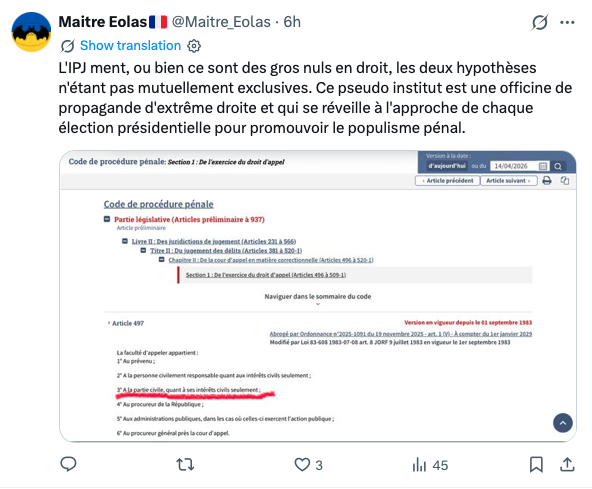
C'est un plaisir toujours renouvelé d'être insulté par Maître Eolas. Le problème, c'est que les arguments ont tendance à se répéter. Aujourd'hui, Eolas nous accuse d'être des "gros nuls en droit". Peu importe que, dans le collège d'experts de l'IPJ, on compte l'ancien premier président de la Cour d'appel de Paris, l'ancien procureur général de Paris, des conseillers d'Etat, des avocats, des commissaires divisionnaires. Pour ce gro-cervo avocat en droit des étrangers, ce sont tous des fachos, des menteurs et des idiots. Cette gauche est l'incarnation de l'intolérance, du mépris. C'est impossible de débattre.
Pierre-Marie Sève tweet media
Français
32
154
795
21.2K
Ch A. retweetledi
Jean-Charles Simon
Éric Lombard avait affirmé que "parmi les personnes les plus fortunées, des milliers ont un revenu fiscal de référence de zéro"... La DGFIP donne à présent des détails sur les quelque 13000 contribuables assujettis à l'IFI dont l'IR a été nul en 2024, et dont il a été beaucoup question. Comme nous étions nombreux à l'indiquer, un IR nul ne signifie absolument pas une absence de revenus imposables, et donc un RFR nul. C'est bien ce qui ressort de ces nouvelles données de la DGFIP, avec déjà les deux tiers des contribuables étudiés dont l'IR est positif avant réductions et crédits d'impôts. Encore 20% environ ont un IR nul du fait de charges déductibles ou de déficits imputés d'au moins 2000 euros. Seuls 1700 foyers (moins de 1% des redevables de l'IFI) ont un IR nul sans ces dispositifs, avec un RFR médian de 19300 euros. Les situations de RFR nul, si tant est qu'elles existent, ne peuvent être ainsi que marginales. Par ailleurs, comme cela était supposé, il s'agit majoritairement de personnes âgées. Eric Lombard a donc proféré un mensonge, aggravé par le fait qu'il laissait entendre que cela pouvait être le cas de milliardaires. Au passage, le fisc n'a aujourd'hui connaissance que du patrimoine immobilier des contribuables, infirmant là aussi l'idée selon laquelle Bercy cacherait des informations sur les plus hauts patrimoines.
Jean-Charles Simon tweet media
Français
5
134
399
63.1K
Ch A. retweetledi
FranceNews24
FranceNews24@FranceNews24·
🔴 INFO - #Allemagne : Un homme de Munich a placé un #AirTag dans une paire de chaussures déposée dans une borne de dons de la Croix-Rouge. Cinq jours plus tard, il a retrouvé l’objet à plus de 800 km, en Bosnie-Herzégovine, mis en vente dans un magasin pour 10 euros. Face à la polémique, la Croix-Rouge a expliqué qu’une partie des vêtements est donnée aux plus démunis, tandis que le reste est revendu pour financer des projets humanitaires.
Français
2
26
44
13.2K
Ch A. retweetledi
Le Parisien
Le Parisien@le_Parisien·
💬 «Vous ne semblez pas avoir pris la mesure de la chaîne de dysfonctionnements qui se sont produits ou vous continuez à les minimiser. Or, M. le maire, c'est votre responsabilité pénale et morale qui est engagée», charge le maire du VIe Jean-Pierre Lecoq à l'attention d'Emmanuel Grégoire au sujet du scandale du périscolaire parisien. Notre DIRECT ➡️ l.leparisien.fr/PgiY
Le Parisien tweet media
Français
8
125
279
24.3K
Ch A. retweetledi
Destination Ciné
Destination Ciné@destinationcine·
La colère de Xavier Giannoli face à la malhonnêteté intellectuelle des historiens de gauche (dont Laurent Joly) qui attaquent son film Le tort de #LesRayonsetlesOmbres ? Montrer que la gauche a aussi collaboré pendant la guerre 🤷🏻‍♂️ Courez le voir c’est un chef-d’œuvre !
Français
126
1.7K
5.7K
262.6K
Ch A. retweetledi
Minh Do
Minh Do@minhsmind·
Such a cool ad! Brilliant concept and execution.
English
324
7.2K
85.4K
4M
Ch A. retweetledi
sgp
sgp@stogolp·
Barron Trump trading against people that have no insider information:
sgp tweet media
English
215
7.3K
109.5K
1.5M
Ch A. retweetledi
VAN MUTOKA
VAN MUTOKA@vanmutoka1·
« La suranalyse est l’art de créer des problèmes qui n’existent pas » - Sénèque
VAN MUTOKA tweet media
Français
5
43
142
3K
Ch A. retweetledi
Police & Réalités
Police & Réalités@PoliceRealites·
Il vendait des arrêts maladie à 21€ pièce depuis son canapé, sans jamais avoir ouvert un livre de médecine. 44 000 faux documents. Un million d’euros. 25 ans. L’arnaque est colossale 👇 policeetrealites.com/2026/04/13/%f0…
Français
89
1.1K
1.5K
39.4K
Ch A.
Ch A.@Cubamula·
Ch A. tweet media
ZXX
0
0
0
7
Ch A. retweetledi
Shrimad Rajchandra Mission Dharampur
True intelligence comes from 3 core abilities: solving problems with clarity, adjusting with grace in any situation and making decisions that are thoughtful. When these qualities grow, so does your inner strength. Nurture them a little every day and watch the shift within you.
English
482
2.7K
20.3K
39.5M
Ch A. retweetledi
Le Figaro TV
Le Figaro TV@LeFigaroTV·
«Boualem Sansal est libre de changer d’éditeur s’il le souhaite. L’émoi, très parisien, provoqué par ce changement fait peu de cas de la liberté d’un homme qui s’est battu pour cela toute sa vie», défend @Benedetti65 dans Le Club Le Figaro Politique présenté par @yvesthreard.
Français
11
142
497
19.7K
Ch A. retweetledi
Ihtesham Ali
Ihtesham Ali@ihtesham2005·
A Soviet psychologist walked into a café in 1927 and watched a waiter do something impossible. He remembered every open order at every table. Perfectly. Without notes. Without effort. Then a table paid their bill. She asked him to repeat the order. He couldn't remember a single item. She spent the next two years figuring out why. What she found is now the operating system underneath every platform fighting for your attention. Her name was Bluma Zeigarnik, and she was a graduate student at the time, sitting with her professor Kurt Lewin, watching the waiters work the room. What caught her attention was something so ordinary that it had been happening in restaurants for centuries without anyone asking why. The waiters could remember every open order with perfect accuracy. Table four wanted the schnitzel with no sauce. Table seven had changed their wine twice. Table twelve owed for three coffees and a dessert. Every detail, held without effort, without notes, without any visible system at all. But the moment a table paid their bill, the information vanished. Completely. Lewin tested it on the spot. He called a waiter back minutes after a table had settled up and asked him to recite the order. The waiter could not do it. Not partially. Not approximately. The information was simply gone. Zeigarnik went back to her lab and spent the next two years turning that observation into one of the most replicated findings in the history of psychology. Here is what she proved, and why it changes how you think about attention, memory, and almost every piece of media you have ever consumed. She gave participants a series of tasks. Some tasks they were allowed to finish. Others were interrupted before completion. Then she tested recall across both groups. The unfinished tasks were remembered at nearly twice the rate of the completed ones. Not slightly better. Nearly twice. The brain was holding the incomplete work in a state of active tension, returning to it, keeping it warm, refusing to file it away. The finished tasks were closed, archived, released. The unfinished ones were still running. She called it the resumption goal. When the brain commits to a task and cannot complete it, it opens a file that stays open until resolution arrives. That open file consumes a portion of your cognitive bandwidth whether you are thinking about it consciously or not. It surfaces in idle moments. It pulls at the edge of your attention during other work. It is the thing you find yourself thinking about in the shower when you were not trying to think about anything at all. This is not a flaw in human cognition. It is a feature. The brain evolved to finish things. An open loop is a signal that something important is unresolved. Keeping that signal active increases the probability that you will return to it and complete it. In an environment where most tasks had real survival stakes, this was an extraordinarily useful mechanism. In the modern world, it is the most exploited vulnerability in human attention. Netflix did not invent the cliffhanger. But it industrialized it in a way no medium before it ever had. When a show ends on an unresolved question, it does not just create curiosity. It opens a file in your brain that stays active until the next episode closes it. The autoplay countdown that begins at 15 seconds is not a convenience feature. It is a precise calculation about how long the average person can tolerate an open loop before the discomfort of not knowing overrides every other intention they had for the evening. One more episode is not a choice. It is your brain doing exactly what it was designed to do: return to what is unfinished. The writers who built Lost, Breaking Bad, and Succession understood this intuitively without ever reading a psychology paper. Every episode ended on an open question. Every season finale answered three things and opened five more. The entire architecture of prestige television is a Zeigarnik machine running at industrial scale. But television is not where this gets dangerous. Every notification on your phone is an open loop. Every unread email is an open loop. Every task you wrote on a list and have not yet crossed off is an open loop. Each one is consuming a small but real portion of your available attention, pulling fractionally at your focus, degrading your capacity to be fully present in whatever you are actually doing right now. TikTok's algorithm does not just serve you content you like. It serves you content that ends one loop and immediately opens another, keeping the resumption system permanently activated so the cost of stopping always feels higher than the cost of continuing. The research on this accumulation effect is striking. Psychologists studying cognitive load have found that unfinished tasks do not sit passively in memory. They actively interrupt. They surface at the wrong moments. They are the reason you are reading something and suddenly remember an email you forgot to send. The brain is not malfunctioning. It is running its resumption system exactly as designed. It is just running it across forty open loops simultaneously, in an environment that generates new ones faster than any human nervous system was built to process. The most important practical implication Zeigarnik's research produced is one that most people use backwards. David Allen built his entire Getting Things Done system on the insight that the only way to close a cognitive open loop is to either complete the task or make a trusted commitment to complete it later. Writing something down in a system you actually trust has the same effect on the brain as finishing it. The file closes. The bandwidth is released. This is why writing a task down feels like relief even before you have done anything about it. You have not solved the problem. You have simply told your brain that the loop is registered and will be returned to, which is enough for the resumption system to stand down. The inverse is equally true and far more destructive. Every task that lives only in your head, unwritten and unscheduled, is an open loop burning cognitive resources around the clock. The mental cost is not proportional to the size of the task. A tiny nagging obligation consumes the same active tension as a major project. Your brain does not discriminate by importance. It discriminates by completion. Zeigarnik published her findings in 1927. The paper sat in academic literature for decades before anyone outside psychology paid attention to it. Then television got good. Then the smartphone arrived. Then the entire attention economy was engineered, largely by people who understood intuitively what she had proven scientifically: an open loop is the most powerful hook available to anyone who wants to hold human attention. Netflix knew it. Instagram knew it. Every designer who ever made a notification badge red instead of grey knew it. The café in Vienna is long gone. The mechanism she discovered there is now the operating system underneath every platform fighting for your time. Every "to be continued." Every unread notification. Every thread that ends with "part 2 tomorrow." All of it is the same waiter, the same unpaid bill, the same brain refusing to let go of what it has not yet finished. Zeigarnik noticed it over coffee in 1927. A century later, it is the most valuable insight in the history of media. And nobody taught it to you in school.
Ihtesham Ali tweet media
English
233
2.5K
8.7K
838.1K
Ch A. retweetledi
WTF
WTF@mrwtffacts·
In the UK, Millie Taplin was attending her first nightclub on her 18th birthday when she was handed a drink by a stranger. The stranger handed her a vodka lemonade “Try this” Millie took a sip. Seconds later, her face went numb, her fingers curled into claws and her entire body stiffened like she was possessed. She stayed fully conscious, trapped inside herself, writhing in agony and screaming in her head that she couldn’t move her body. Rushed to hospital, doctors said she was likely dosed with two unknown drugs: one to paralyse her, one to knock her out. Tests couldn’t identify the substance. Her mother later released footage as a warning: never accept a drink from stranger.
WTF tweet media
English
3.2K
18.6K
91.8K
20.2M
Ch A. retweetledi
Agence France-Presse
👨‍⚖️ France: l'ancien PDG de Lafarge, Bruno Lafont, a été condamné à six ans de prison avec incarcération immédiate pour financement du terrorisme, pour les paiements versés à des groupes jihadistes pour laisser tourner une usine lors de la guerre en Syrie en 2013 et 2014 ⤵️
Agence France-Presse tweet media
Français
168
1.5K
2.7K
268.7K
Ch A.
Ch A.@Cubamula·
ZXX
0
0
0
13
Ch A. retweetledi
Ramin Nasibov
Ramin Nasibov@RaminNasibov·
My dog after eating my philosophy book
Ramin Nasibov tweet media
English
1.6K
20.5K
144.9K
2.1M