DBS Think Tank

2.3K posts

DBS Think Tank banner
DBS Think Tank

DBS Think Tank

@DBSThinkTank

The DBS Think Tank addresses cutting edge research, technologies, and neuroethical issues in the field of neuromodulation.

Katılım Eylül 2020
1.5K Takip Edilen3.7K Takipçiler
DBS Think Tank retweetledi
Louisa Nicola
Louisa Nicola@louisanicola_·
New research in Nature just changed how I think about Parkinson’s disease. For years, we treated it as a problem in isolated motor areas that control the hand or foot. But brain imaging across 863 participants suggests something bigger. Parkinson’s may involve a whole body control system in the brain called the Somato-Cognitive Action Network (SCAN). Researchers found that deep brain regions like the substantia nigra become overconnected to this network. Treatments that work, like levodopa and deep-brain stimulation, seem to improve symptoms by normalizing this hyperconnectivity. In a small clinical trial, patients who received magnetic stimulation targeting the SCAN improved twice as much as those treated at traditional limb motor areas. This suggests Parkinson’s might not just be a movement disorder of isolated regions. It may be a network disorder of whole body control. Early results, but a fascinating shift in how we may treat the disease.
Louisa Nicola tweet media
English
15
96
372
22.8K
DBS Think Tank
DBS Think Tank@DBSThinkTank·
The deadline to submit to the DBS Think Tank Volume VI special collection has been extended to April 9. Don’t miss the chance to feature your neuromodulation and neurotechnology research in this @FrontiersIn collection. Submit here: frontiersin.org/research-topic…
English
0
1
3
297
DBS Think Tank
DBS Think Tank@DBSThinkTank·
Submit your latest research to the DBS Think Tank Special Collection: Updates in Neurotechnology and Neuromodulation Volume VI. The submission deadline has been officially extended to April 9, 2026. View the call for papers here: frontiersin.org/research-topic…
English
0
0
0
214
DBS Think Tank retweetledi
Michael Okun
Michael Okun@MichaelOkun·
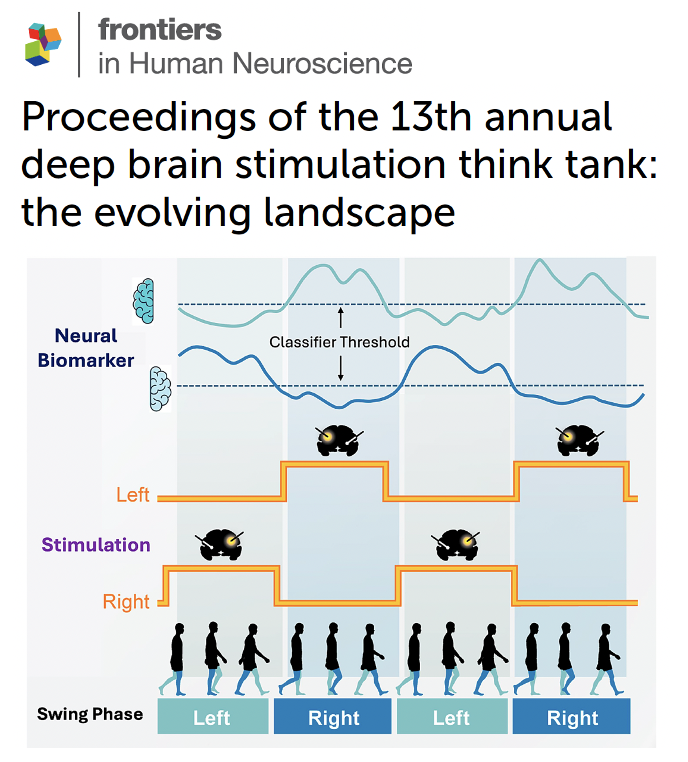
Adaptive DBS and the future of walking: Proceedings is out from the XIII annual DBS Think Tank. Adaptive DBS refers to a form of deep brain stimulation where the device senses brain signals and automatically adjusts stimulation in real time, instead of delivering constant stimulation. Chance Fleeting and colleagues just dropped a new paper in Frontiers in Human Neuroscience summarizing the 13th Annual DBS Think Tank held at the Fixel Institute for Neurological Diseases at the University of Florida. The meeting gathered engineers, neuroscientists, industry partners and health care providers to discuss the evolving landscape of DBS, including adaptive stimulation for walking and more broad brain network therapies. Key points on the 'walking work:' - Adaptive DBS synchronized to the walking cycle (Doris Wang lab at UCSF) can adjust stimulation during specific phases of gait and has shown improvements in symmetry, variability and fall reduction in Parkinson’s disease. - Neural signals from the subthalamic nucleus and other brain regions can decode mobility states such as sitting, standing and walking, allowing stimulation to switch automatically to gait optimized settings. - Modern DBS is shifting from targeting a single brain location to targeting distributed brain networks and to using biomarkers to determine where, when and in whom stimulation should occur. My take: The DBS field is rapidly moving toward smarter stimulation. Instead of delivering the same signal continuously, next generation systems can sense brain activity, recognize behavior and adjust therapy dynamically. This shift toward adaptive and network guided stimulation may one day help to address some of the most stubborn Parkinson’s symptoms such as gait freezing and falls. Please read and decide on your won as I am biased as a co-author and participant in the meeting. Here are 5 points that resonated w/ me: 1- Walking problems in Parkinson’s frequently persisted even when tremor and stiffness improved, making gait a critical target for next generation DBS strategies. 2- Adaptive DBS can synchronize stimulation to real world behaviors such as stepping, creating therapy that matches the brain’s natural timing. 3- Brain network mapping is revealing that DBS outcomes depend not only on where stimulation occurs, but also on who receives it and when stimulation is delivered. 4- Neural sensing technologies now allow implanted devices to record brain signals continuously, opening the door to automated and personalized therapy adjustments. 5- The future of DBS will likely blend sensing, AI driven decoding and adaptive stimulation so therapy responds dynamically to how folks move and function in daily life. frontiersin.org/journals/human… @DBSThinkTank @ParkinsonDotOrg #parkinson #depression
Michael Okun tweet media
English
0
13
28
2.2K
DBS Think Tank retweetledi
MDS
MDS@movedisorder·
Share a case for expert discussion! loom.ly/aixrunM
MDS tweet media
English
0
2
9
710
DBS Think Tank retweetledi
ASSFN
ASSFN@ASSFNeurosurg·
The Functional Neurosurgery Fellowship Match is now open! 🔔 Applications are live for PGY-5 or later residents pursuing a functional neurosurgery fellowship. If functional neurosurgery is your future, don’t wait. 👉Learn more and apply: bit.ly/FunctionalNeur… @JuliePilitsis
English
0
6
11
1.3K
DBS Think Tank
DBS Think Tank@DBSThinkTank·
Our goal for the next Annual DBS Think Tank is to tackle the subjects that matter most to you. We are open to all suggestions for keynote speakers and panel topics. Drop your recommendations in the link below and help us shape the conversation. fixel.ufhealth.org/dbs-think-tank…
English
0
1
0
179
DBS Think Tank
DBS Think Tank@DBSThinkTank·
As we build the schedule for the next DBS Think Tank, we are looking for a mix of established voices and new ideas. If you have heard a great talk recently or are following a trend that belongs in our next session, let us know your thoughts. fixel.ufhealth.org/dbs-think-tank…
English
0
0
0
157
DBS Think Tank
DBS Think Tank@DBSThinkTank·
The best insights at the DBS Think Tank come from our community. We are looking for speakers doing impactful work and topics that are currently driving the industry forward. Who would you like to see on the stage for our next event? fixel.ufhealth.org/dbs-think-tank…
English
0
0
0
171
DBS Think Tank
DBS Think Tank@DBSThinkTank·
Closely monitoring the debate on the methodological foundations of lesion network mapping. Given its transformative role in clinical neuroscience, determining the validity of these critiques is vital for the future of lesion-based connectomics.
Michael Fox@foxmdphd

Are connectome-based network mapping methods and the >200 papers that have used it invalid? New paper out in @NatureNeuro says YES. nature.com/articles/s4159… I have concerns about this new paper's methods and conclusions, but am biased. What do others think?

English
0
0
6
558
DBS Think Tank retweetledi
Michael Okun
Michael Okun@MichaelOkun·
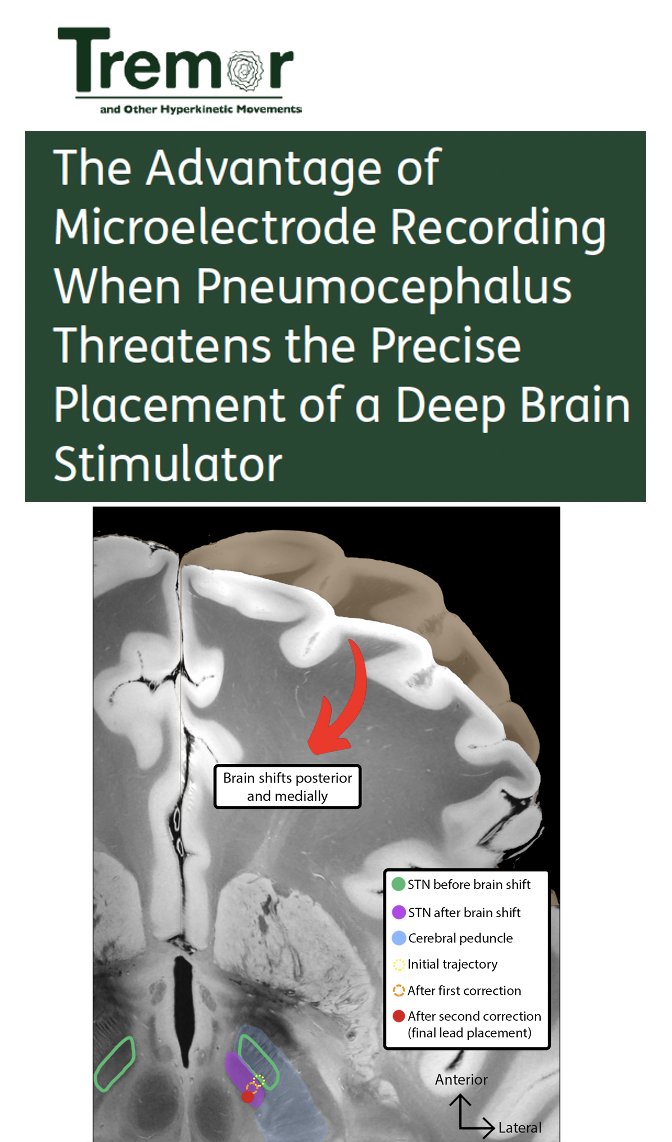
When air shifts the brain, physiology can save the day during DBS surgery. Microelectrode recording is a technique that listens to real time brain cell signals during surgery in an effort to confirm the location of a target. Walker-Pizarro and colleagues describe in a new paper in Tremor and Other Hyperkinetic Movements a real world DBS case where 'pneumocephalus' threatened accurate lead placement, and how physiology changed the outcome. Key Points: - Intraoperative pneumocephalus can shift deep brain targets by several millimeters and quietly undermine image based DBS accuracy. - Microelectrode recording exposed a mismatch between planned imaging and true subthalamic nucleus location. - The technique guided a major corrective adjustment. - Physiology guided repositioning and restored a wider therapeutic window and produced a strong motor benefit. My take: This case is a reminder that the brain is dynamic during surgery. Imaging offers us a map, however physiology tells us where we truly are when the terrain moves. Nur is a fellow at UF and I am an author on this study. I am biased, so please read for yourself and decide. Here are 5 points that resonated w/ me: 1- Brain shift is not rare, and even small shifts can matter when margins are measured in millimeters. 2- Microelectrode recording acts as a real time safeguard when anatomy is no longer static. 3- Low stimulation thresholds and changes in MER are warning signs that should not be ignored. 4- Correcting course during surgery can simplify programming and potentially improve long term outcomes . 5- Blending imaging precision w/ physiology can be powerful. tremorjournal.org/articles/10.53… @tremorjournal @FixelInstitute @ParkinsonDotOrg @DBSThinkTank
Michael Okun tweet media
English
2
4
26
2.4K
DBS Think Tank retweetledi
Movement Disorders Journal
Movement Disorders Journal@MDJ_Journal·
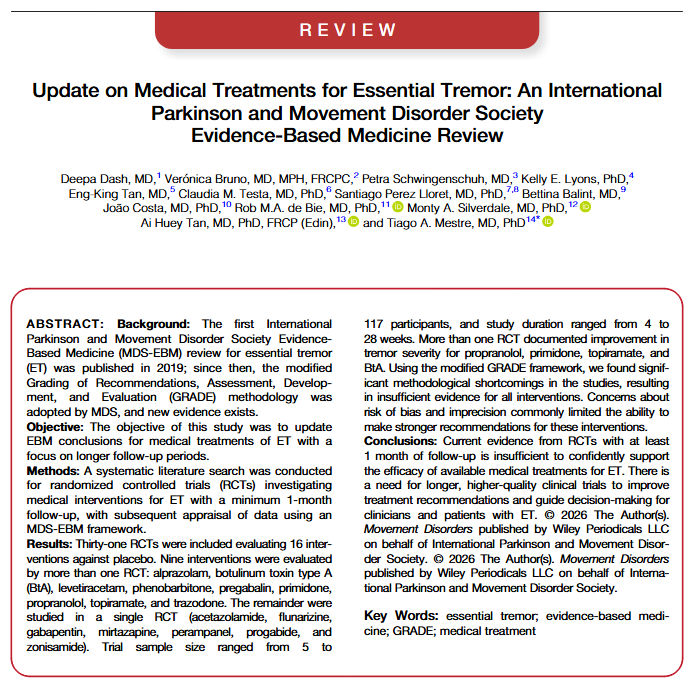
Here is an excellent review article on the medical treatment of essential tremor by Dash and colleagues. loom.ly/7b3mW9w
Movement Disorders Journal tweet mediaMovement Disorders Journal tweet media
English
1
30
62
3.9K
DBS Think Tank
DBS Think Tank@DBSThinkTank·
We are officially planning the next Annual DBS Think Tank. To ensure the agenda reflects the interests of our community, we want to hear from you! Which topics or speakers should be at the top of our list this year? Please share your suggestions below. fixel.ufhealth.org/dbs-think-tank…
English
0
0
1
171
DBS Think Tank retweetledi
Michael Okun
Michael Okun@MichaelOkun·
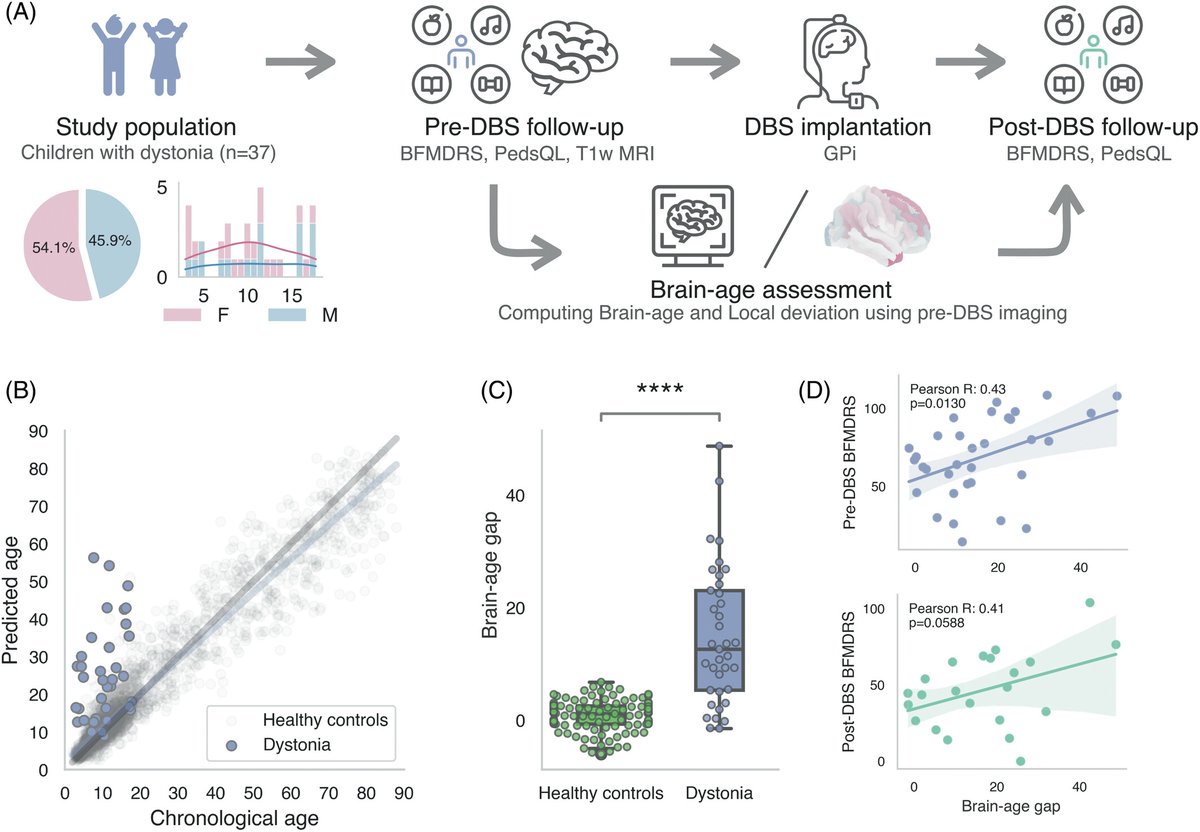
Do you know why some dystonia cases improve faster following GPi DBS? The cerebellum may hold the clue. Functional connectivity means how different brain regions communicate and work together, even when a person is at rest. Enrique Martinez Nunez and colleagues describe in a new paper that just dropped in Movement Disorders, how brain network connections help predict who improves 'earlier' following GPi DBS for dystonia. Key points: - Earlier improvement after GPi DBS was linked to stimulation sites connected to the cerebellum. - Connectivity to default mode and limbic networks predicted faster benefit beyond classic motor circuits. - A ventral GPi-GPe stimulation region emerged as a key network 'sweet spot.' My take: This study should move us past the simple idea that DBS works only by hitting a single motor target. It suggests timing matters and networks matter and that the cerebellum may be a silent partner in how dystonia improves following DBS. I am biased as an author so please read and make up your own mind. Here are 5 points that resonated w/ me: 1- Not all DBS benefit unfolds slowly, and some folks improve much earlier. 2- Brain networks including the cerebellum influence how fast symptoms respond. 3- Where stimulation connects may matter as much as where the DBS lead sits. 4- Network guided DBS could help health care providers better predict outcomes, 5- The future may include multi target and personalized DBS strategies in an effort to speed recovery. …mentdisorders.onlinelibrary.wiley.com/doi/10.1002/md… @DBSThinkTank @FixelInstitute @ParkinsonDotOrg @movedisorder @dmrf @TylersHope
Michael Okun tweet media
English
3
20
70
3.3K
DBS Think Tank retweetledi
Michael Okun
Michael Okun@MichaelOkun·
Could we use peripheral nerves to repair Parkinson's brain networks and do it during DBS surgery? MAYBE. van Horne and colleagues describe in a new paper in Neurosurgery Practice two cases where a person’s own peripheral nerve tissue was implanted into both the nucleus basalis of Meynert and the substantia nigra at the time of bilateral deep brain stimulation surgery. Autologous peripheral nerve tissue grafts means using a small piece of a person’s own nerve to deliver natural growth signals to injured brain cells. Nucleus Basalis of Meynert is a deep brain hub that supports attention and memory through the chemical acetylcholine. Substantia nigra is a dopamine producing region critical for movement in Parkinson disease. Key Points: - The surgical approach was feasible and it safely combined nerve graft delivery into two deep brain targets during DBS. - No serious adverse events were linked to the grafts and brain imaging showed no procedure related injury. - Motor outcomes were stable or improved and cognitive testing in one participant showed mixed changes, including improvements in some memory related tasks. My take: The idea of using the body’s own 'repair biology' to support vulnerable brain networks during DBS is quite interesting. It is not a cure and it is not ready for routine care, however could it provide an avenue to address non-motor Parkinson's features. Here are 5 points that resonated w/ me: 1- Using a person’s own nerve could avoid the need for immune suppression and tap into natural growth factors. 2- Targeting both movement and cognitive circuits more fully acknowledges the full lived experience of Parkinson's. 3- Safety has to come first, and this report showed that adding grafts at least in two individuals did not meaningfully increase risk. 4- Signals of possible network support were intriguing, however the number of subjects was very small. 5- The future will require more rigorous trials to learn who may benefit and when to intervene, and of course if the juice is worth the squeeze. journals.lww.com/neurosurgpraco… @ParkinsonDotOrg @neurosurgery @DBSThinkTank @SfNtweets @movedisorder #parkinson
Michael Okun tweet media
English
2
3
35
1.9K
DBS Think Tank retweetledi
International Neuromodulation Society
Examine the most recent advances in deep brain stimulation for Parkinson’s disease at our January Journal Club. 📖 Our expert panel will discuss quality of life, management of speech impairment, and changes in anticholinergic burden in Parkinson’s disease, with articles drawn from Neuromodulation: Technology at the Neural Interface. 📅 Thursday, January 15 🕦 16:30 EDT | 22:30 CEST 🔗 Register now to join this timely session: bit.ly/JC-Jan-2026 #Neuromodulation
International Neuromodulation Society tweet media
English
0
1
3
236
DBS Think Tank
DBS Think Tank@DBSThinkTank·
Exciting paper in @movedisorder . We need an objective biomarker to guide DBS programming in dystonia. Maybe ERNA can lead us in the right direction
Joshua Wong@JWongggMD

Wonderful study by @karaannjohnson that highlights the potential of ERNA to guide DBS programming in dystonia. Hopefully this can help navigate the challenging course patients and clinicians face when trying to optimize a new device …mentdisorders.onlinelibrary.wiley.com/doi/10.1002/md…

English
0
0
1
291